Most lockup complaints on a 45RFE arrive as something else. The customer says the truck "revs high on the highway," or the fuel mileage dropped four miles a gallon, or the check engine light came on with a P0740 and the parts store told them it was the converter. Sometimes it is. More often the converter is fine, and the problem sits in a valve bore in the pump or in the valve that decides whether one solenoid is working the low/reverse clutch or the converter clutch.
You cannot diagnose lockup on this family until you understand how the TCM applies it, because the RFE does it differently from almost every GM or Ford unit you work on. There is no dedicated TCC solenoid. One solenoid does two jobs, and a switch valve picks which job it is doing. This is the circuit, the codes it sets, and the order I check it in.
One Solenoid, Two Jobs
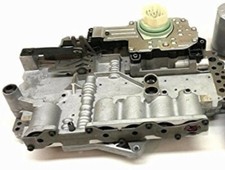
The 45RFE and 545RFE use a solenoid pack with an LR/CC solenoid. The name tells you the story: low/reverse and converter clutch. In park, neutral, reverse and first gear, that solenoid's output is routed to the low/reverse clutch. Once the transmission is out of first, the same solenoid output is routed to the converter clutch circuit instead. The part that does the routing is the solenoid switch valve in the valve body. Sonnax describes its main function plainly: it directs fluid between the L/R clutch and the TCC (Sonnax, "All in the Family").
Three things fall out of that design, and every one of them matters on the bench:
- The converter cannot lock in first gear. The solenoid is busy holding the low/reverse clutch.
- A sticking switch valve can show up as a shift problem or a lockup problem. Sonnax's symptom list for worn switch valve bores includes bind-up, failsafe, engine stall, no lockup, TCC apply and release concerns, and codes 841, 868, 871, 988, 1775 and 1776. P1775 and P1776 are the TCM telling you it believes the switch valve is latched in the wrong position, TCC side or L/R side.
- A bad LR/CC solenoid kills more than lockup. If it fails, you lose the low/reverse clutch control too, so a dead LR/CC usually brings a reverse or first gear complaint along with it.
Measure the switch valve before you buy repair parts. The 45RFE family originally used a .420 in. large spool and moved to a .453 in. spool around the 2010 model year, with both versions using .453 in. plugs. The oversized kits are bore-specific, and Sonnax warns that the wrong tooling can do irreparable damage to the valve body casting.
Partial Versus Full EMCC
Chrysler calls its strategy Electronically Modulated Converter Clutch, or EMCC, and it has two working states.
Partial EMCC. The TCM pulse-width modulates the LR/CC solenoid. That solenoid signal acts on two parts in the pump at the same moment: the TCC accumulator piston and the TCC regulator valve (TransGo, RFE-TCC-ACCUM). The regulator valve meters line pressure into the converter apply circuit, and the accumulator damps the constant oscillation of the solenoid so the regulator sees a smooth signal. The clutch is applied but allowed to slip a controlled amount, which soaks up driveline pulses.
Full EMCC. The TCM drives the clutch to full apply. Here the regulator stops regulating. Per Sonnax, the RFE TCC regulator valve only controls apply pressure during partial apply; at full apply, converter apply pressure equals line pressure, about 160 psi maximum in the forward ranges on a stock unit. That is why a tune or an aggressive shift kit that pushes line pressure past 220 psi drags converter apply pressure up with it, with ballooning and flex plate damage on the list of results (Sonnax, "Prevent RFE, RH/RE Converter Failure").
The TCM also uses controlled converter slip during gear changes. TransGo notes that with a worn accumulator bore, desired slip during shifts can exceed the target, and the driver feels it as an engine flare. If a customer describes a flare on the 2-3 or 3-4 with no slip once the gear is in, think converter control before you think clutch packs.
The Four Pump Valves Behind Most No-Lockup Jobs
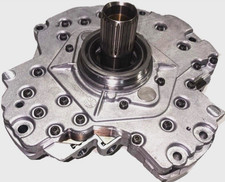
The switch valve sits in the valve body, but most of the converter control lives in the pump. Sonnax's RFE valve body layout lists the converter-related kits, and they break down like this:
| Valve | Job | What bore wear does |
|---|---|---|
| TCC regulator valve | Meters line pressure into the converter apply circuit during partial EMCC | Apply oil leaks past the spool to sump. Low vacuum at the TCC apply circuit is typical on cores (Sonnax 44912-11K). Spring-end wear gives erratic or harsh apply; signal-end wear gives low apply, slip and lockup codes (TransGo) |
| TCC accumulator | Damps LR/CC solenoid oscillation, sets initial regulation rate | Solenoid signal leaks to the spring side and vents to sump. Lockup slip, shudder, no apply, flare on shifts, codes P0740, P0741, P1740 (TransGo) |
| TCC switch valve | Routes converter apply and release oil | No lockup, TCC slip, overheating, TCC codes, engine stall if the clutch cannot release (Sonnax 44912-08K) |
| TC limit valve | Controls converter release pressure | Delayed engagement, engine stall, low release pressure, overheated converter |
The mechanism behind the wear is worth understanding because it tells you this is not a high-mileage-only problem. TransGo attributes TCC regulator bore wear to the constant PWM-induced oscillation of the LR/CC solenoid. Every minute the truck spends in partial EMCC, that spool is dithering in an aluminum bore. A pump that has seen a lot of highway time in partial lockup can wear these bores well before the clutches give up.
What the Codes Are Actually Telling You
P0740 on this family is a performance code, not a circuit code. The TCM commands lockup, watches engine speed against transmission input speed, and sets the code when it cannot close the gap. Chrysler's 45RFE/545RFE service information has it monitored during EMCC with input speed above 1750 rpm, and setting when the L/R solenoid reaches maximum duty cycle and still cannot pull engine speed within 60 rpm of input speed. It also sets in full lockup if the converter slips more than 100 rpm for 10 seconds, and it can take up to five minutes before the MIL comes on (Chrysler P0740 procedure). The logic is the point: the solenoid is giving it everything and the clutch is still slipping.
That logic is why P0740 so often gets blamed on the converter. The TCM has no way to know whether the clutch lining is worn or whether the apply oil is leaking out of a regulator bore before it ever reaches the converter. Both look identical from the computer's side. P0741 and P1740 show up on the same failures in TransGo's symptom lists. P1775 / P1776 point you to the switch valve in the valve body instead of the pump.
Chrysler's own P0740 cause list lines up with that: a related P0750, the L/R solenoid, a stuck TCC switch valve, a stuck TCC regulator valve, a cut input shaft seal ring, and the converter or internal transmission. If P1775 and P0841 are also present, the factory sends you to the solenoid/TRS assembly first. Only after the electrical and valve checks does it call for a converter, and even then it says to check every other cause too (Chrysler P0740 procedure).
If the code set right after a converter replacement on a 2006-up 5.7L Hemi, check the converter part number before anything else. The MDS engines need a specific TCC lining, and the wrong one is a known source of converter complaints. That trap is covered in detail in our 45RFE converter shudder guide.
Diagnosis Order
1. Confirm the complaint on the scan tool
Road test with engine speed, input speed, converter clutch status and LR/CC duty cycle on screen. Hot fluid, light throttle, steady cruise. With the TCM reporting full lockup, engine speed and input speed should sit essentially on top of each other. A gap of a hundred rpm or more with full lockup commanded is a clutch that is not holding. Tap the brake pedal and watch the status drop out; if the status never changes, you have an enable problem, not a hydraulic one.
2. Do not trust the slip number until you trust the sensor
Slip is calculated, not measured. If the input speed sensor is dropping out or reading erratically, the TCM will calculate slip that is not there, and it may refuse to apply or set a code. Look for a clean, steady input speed trace before you condemn anything hydraulic.
3. Fluid level and type
Low fluid starves the converter circuits first. These units take ATF+4 (Chrysler MS-9602). Per Chrysler's fluid capacity sheet, a service fill on the 45RFE and 545RFE is 5.20 L / 11.00 pints on 4x2 and 6.20 L / 13.00 pints on 4x4, and an overhaul fill runs 14.00 to 16.00 L / 29.00 to 33.00 pints, varying with the cooler setup. A pan service changes less than half the fluid, so dark, varnished fluid does not clean up with one drain.
4. Codes for the switch valve
If P1775 or P1776 is in memory, or there is an L/R pressure switch code alongside the lockup complaint, the switch valve moves to the top of the list. Pull the valve body, measure the valve, vacuum test the bore, and fit the matching oversized valve or plug kit.
5. Vacuum test the pump valves
With the pump on the bench, vacuum test the TCC regulator, accumulator, TCC switch valve and TC limit valve at the ports Sonnax specifies. Worn bores look like good bores; the vacuum gauge is the only honest answer. For the TCC switch valve, the balance port has to be tested with the valve moved and held roughly .060 in. to .100 in. against its spring, and a retainer clip from a neighboring valve train wedged into the port will hold it (Sonnax 44912-08K). Low readings justify the oversized kits. A pump whose bores are too far gone to ream gets replaced.
6. Then, and only then, the converter
If the circuit tests tight, the input speed signal is clean, and the clutch still slips under full apply, the converter lining is the part. Flush the cooler and lines before the new converter goes in and verify flow, or the debris from the old one ends up in the new one.
Quick Reference
| What you see | Look here first |
|---|---|
| P0740, slip under full lockup, no other codes | TCC regulator and accumulator bores in the pump, then converter |
| Flare on upshifts, no slip once in gear | TCC accumulator bore wear |
| Harsh lockup apply | Spring-end wear at the TCC regulator bore, accumulator spring |
| No lockup plus P1775 / P1776 or an L/R switch code | Solenoid switch valve and plugs in the valve body |
| No lockup plus a reverse or first gear complaint | LR/CC solenoid or solenoid pack |
| Stall coming to a stop | TCC switch valve or TC limit valve, clutch not releasing |
| Lockup status never changes on brake tap | Enable inputs: brake switch, TPS, temperature, input speed sensor |
45RFE Shift Solenoid Kit 1999-Up at CoreTransmissionParts
If your testing lands on the LR/CC solenoid circuit, this is the direct-fit 45RFE solenoid replacement. For pump and valve body hardware across the RFE family, browse the full collection.
View the solenoid kit → RFE family parts45RFE and 545RFE pumps, valve bodies, solenoid packs, speed sensors, filters and overhaul kits — shipped from the USA.
Shop 45RFE parts →FAQ
Does the 45RFE lock up the converter in first gear?
No. In park, neutral, reverse and first, the LR/CC solenoid output is routed to the low/reverse clutch, so it is not available for the converter. The solenoid switch valve moves that output over to the converter clutch circuit once the transmission is out of first, and the TCM then decides when to apply based on its enable conditions.
What is the difference between partial and full EMCC?
In partial EMCC the TCM pulse-width modulates the LR/CC solenoid and the TCC regulator valve meters apply pressure so the clutch slips a controlled amount. In full EMCC the regulator stops regulating and converter apply pressure equals line pressure, about 160 psi maximum in the forward ranges on a stock RFE unit according to Sonnax.
Will a new torque converter fix a 45RFE P0740?
Only if the converter lining is the actual fault. P0740 sets when the TCM cannot pull engine speed down to input speed with the solenoid at maximum effort, and leaking TCC regulator or accumulator bores in the pump produce exactly the same reading. Vacuum test the pump valves before you replace the converter.
Can a bad solenoid pack cause no lockup on a 45RFE?
Yes, because the LR/CC solenoid in the pack controls the converter clutch. A failed LR/CC solenoid usually also causes a low/reverse clutch complaint in reverse or first gear, which is a useful tell that separates it from pump valve wear.
What do codes P1775 and P1776 mean on a 45RFE?
They point to the solenoid switch valve in the valve body. The TCM believes the valve is latched in the TCC position or the L/R position. Sonnax lists 1775 and 1776 among the codes caused by switch valve and plug bore wear, along with no lockup and TCC apply and release concerns.
Sources
- Sonnax — "All in the Family: Identification & Repair of Chrysler Solenoid Switch Valve Problems." The switch valve's main function of directing fluid between the L/R clutch and the TCC; the symptom list of bind-up, codes 841, 868, 871, 988, 1775 and 1776, engine stall, failsafe, no lockup and TCC apply and release concerns; the .420 in. original and .453 in. revised large spool with .453 in. plugs, the change arriving around the 2010 model year in the 45RFE group; and the tooling warning. sonnax.com
- Sonnax — "Prevent RFE, RH/RE Converter Failure: Maintain Proper TCC Apply Pressure." The TCC regulator valve regulating only during partial apply; full-apply converter pressure equaling line pressure at about 160 psi maximum in forward ranges on stock RFE units; performance kits exceeding 220 psi; ballooning and flex plate damage; the 150 psi apply limit valves 44912-36K and 44912-41K. sonnax.com
- Sonnax — TCC Regulator Valve Kit 44912-11K. The OE valve's minimal valve-to-bore sealing at the line pressure to converter feed circuit, apply fluid leaking directly to exhaust, cores typically showing low vacuum at the TCC apply circuit, and the converter and lockup concerns that result. sonnax.com
- Sonnax — Oversized TCC Switch Valve Kit 44912-08K. The symptom set of no lockup, engine stall, TCC slip, overheating, TCC codes, loss of fuel economy and TCC lining failure; the TCC being unable to release; and the balance port test with the valve held about .060 in. to .100 in. against spring pressure. The TC limit valve symptom list comes from the Sonnax RFE valve body layout listing (kit 44912-03K: delayed engagement, engine stall, low TCC release pressure, overheated converter). sonnax.com (44912-08K) / sonnax.com (layout)
- TransGo — RFE-TCC-ACCUM TCC Accumulator Piston and Sleeve Kit. The TCM varying LR/CC solenoid PWM to control converter apply rate; the solenoid output acting on the TCC accumulator piston and TCC regulator valve simultaneously; accumulator bore wear venting signal oil to sump; lockup slip, shudder, no apply, flare during gear changes and codes P1740, P0740 and P0741. Also TransGo RFE-TCCREG-OS: regulator bore wear caused by constant LR/CC PWM oscillation, spring-end wear giving erratic or high apply and signal-end wear giving low apply, lockup slip and lockup performance codes. transgo.com (accumulator) / transgo.com (regulator)
- Chrysler / Ram Body Builder Guide — Fluid Capacities sheet. 45RFE and 545RFE service fill of 5.20 L / 11.00 pints on 4x2 and 6.20 L / 13.00 pints on 4x4, and overhaul fill of 14.00 to 16.00 L / 29.00 to 33.00 pints. rambodybuilder.com
- Chrysler 2007 Grand Cherokee (WK) service information — 45RFE/545RFE P0740 TCC Out of Range. The EMCC ramp to within 60 rpm and full lockup at 100 percent L/R duty cycle; the 1750 rpm input speed condition; the 100 rpm for 10 seconds full-lockup set condition; the five-minute MIL delay; the cause list (P0750, L/R solenoid, TCC switch valve, TCC regulator valve, input shaft seal ring, converter); and the P1775/P0841 solenoid assembly branch. jeep.automotive-manuals.com