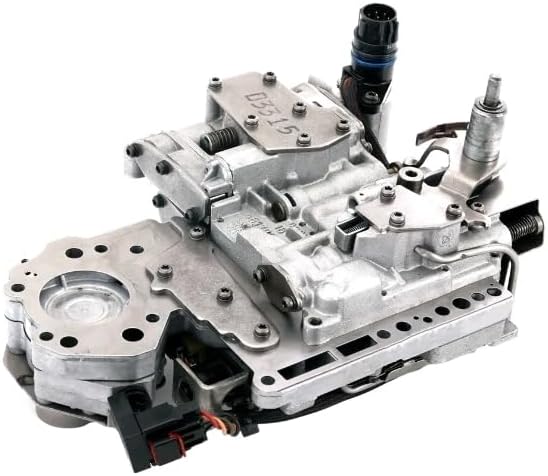
The 46RE and the 48RE are the same transmission family. Same four-speed layout, same two bands, same electronic governor, same TorqueFlite roots. Lay a 46RE valve body next to a 48RE body and most people cannot tell them apart. That is exactly the problem. The 46RE was built for gas V8s. The 48RE was built for the high-output Cummins and the V10. The differences are in the clutch packs, the fill volume and a few small passages in the valve body, and those few passages decide whether a rebuilt unit lives or comes back.
This guide covers what changed between the two, how to tell which one is on the bench, what interchanges and what does not, and what to check before you sign off on either one. Specs come from the Chrysler factory manual and Ram's own fluid charts; sources are listed at the bottom.

The Short Answer
The 46RE is the lighter-duty unit. It went behind gas V8s in Ram trucks and other Chrysler vehicles from 1996 on, with the 47RE as its heavy-duty sibling behind the V10 and the Cummins [1]. The 48RE replaced the 47RE in 2003. TransGo lists the 48RE for 2003-2008 behind the high-output diesel and the V10 [6]. So in practical terms, a 46RE is a gas-truck transmission and a 48RE is a heavy-duty truck transmission.
ATSG describes all three (46RE, 47RE and 48RE) as four-speed units with an electronic governor and a lockup converter. First through third come from the front and rear clutches, two bands, the low roller clutch and the planetary gearsets. Fourth comes from the overdrive unit at the back, which has an overdrive clutch, a direct clutch, an overrun roller clutch and its own planetary [4]. The 1998 Chrysler manual lists the 46/47RE ratios as 2.45 first, 1.45 second, 1.00 third, 0.69 fourth and 2.21 reverse [1]. The 48RE keeps that same gear spread. What it adds is holding capacity.
| 46RE | 48RE | |
|---|---|---|
| Typical use | Gas V8 trucks and SUVs | 2003-up HO Cummins and V10 [6] |
| Front clutch | 3 discs [1] | More discs (built off the 47RE layout) |
| Overdrive clutch | 4 discs [1] | Heavier pack (47RE had 5) [1] |
| Direct clutch | 8 discs [1] | Heavier pack (47RE had 10) [1] |
| Overhaul fill | 19-20 pints [2] | 29-33 pints [2] |
| Service fill | 8 pints [2] | 8 pints [2] |
| Line boost in lockup/4th | About 10-15 psi [3] | About 22-28 psi [3] |
| Throttle control | TV cable | TV cable; electric TTVA on 2005-up diesel [4] |
Clutch Packs: Where the Capacity Comes From
The 1998 Ram service manual spells out the clutch counts for the 46RE and the 47RE side by side in its specification table on page 21-323. The 46RE uses 3 front clutch discs, 4 overdrive clutch discs and 8 direct clutch discs. The 47RE uses 4 front discs, 5 overdrive discs and 10 direct discs [1]. The 48RE came from the 47RE side of the family, not the 46RE side, and grew from there. Sonnax notes that when the 48RE went into production in 2003 there were many changes to the clutch packs and gear train that set it apart from the 46/47RE [3].
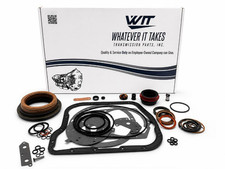
That matters for parts. A 46RE master kit and a 48RE master kit are not the same box with a different label. Frictions, steels, snap rings and in some cases pistons and drums change with the clutch count. When you tear one down, count the plates in each drum and write it on the tag before you order anything. If someone already swapped drums in a previous rebuild, the parts book will not match the unit in front of you.
The 1998 manual also gives clutch clearances that apply to the 46/47RE: front clutch 0.070-0.129 in. and rear clutch 0.025-0.045 in. [1]. Hit those numbers with selective snap rings. Loose clearance on a 46RE rear clutch shows up as a soft, late engagement and burned frictions long before the customer notices a slip.
Fluid Capacity: A Bigger Unit Underneath
Ram's 2004 fluid capacity chart is useful because it lists all three units in the same year. The 46RE overhaul fill is 19 to 20 pints. The 47RE and 48RE overhaul fills are both 29 to 33 pints. The service fill for a pan drop is 8 pints for all three [2]. That 10-pint difference in dry fill tells you how much more the 48RE carries in its converter, cooler circuit and case. The 1998 manual's dry fill table agrees on the 46RE: 19 to 23 pints, against 29 to 33 pints for the 47RE [1].
Practical point: never fill a rebuilt unit by the book number and walk away. Ram notes that dry fill varies with the internal cooler, the length and diameter of the cooler lines and any auxiliary cooler [2]. Put in the service fill, start it, run through the gears and bring it up to level hot.
The 1998 manual specifies ATF+3 (Type 7176) [1]. That fluid is superseded. Fluid makers formulate ATF+4 for Chrysler transmissions that call for ATF+4, ATF+3 or ATF+2 [7], so ATF+4 is the fluid for both units today.
The Valve Body: Same Look, Different Pressure
This is the difference that costs people money. Sonnax's technical article on 48RE hydraulics explains it plainly: many shops have tried putting a 46/47RE valve body on a 48RE because they look so similar. It seems to work at first. Then the truck comes back with a failed converter clutch or a failed overdrive clutch [3].
Here is why. On these units the pressure regulator valve has reduction points that push it toward lower line pressure. Throttle pressure works against them to raise pressure. Around 1996, Chrysler added a boost valve near the pressure regulator. In 3rd gear with lockup on, or in 4th, pressure from the converter clutch apply circuit and/or the overdrive apply circuit moves the boost valve and exhausts reduction points [3].
- 46/47RE: the boost valve exhausts one reduction point (D). Line pressure goes up about 10-15 psi in lockup and 4th [3].
- 48RE: the boost valve exhausts two reduction points (A and D). Line pressure goes up about 22-28 psi in lockup and 4th, and because point A is gone, the throttle pressure plug raises pressure faster too [3].
That extra 10 psi or so is the clamping force that keeps the converter clutch and the overdrive clutch from slipping behind a diesel. Take it away and you get a truck that drives fine on a test loop and cooks the OD clutch on the first heavy tow.
The converter clutch feed is different too. On the 46/47RE, the TCC solenoid feed comes from the 1-2 shift valve, and a passage from the manual valve in manual 2 or manual 1 goes to the spring side of the lockup valve and cancels lockup. On the 48RE, the TCC solenoid feed comes from the manual valve in any drive position, with no manual 2/1 cancel connection. That makes TCC apply possible in manual 2nd, and even manual 1st if an external controller commands it [3].
Can you convert a 46RE valve body to 48RE?
Yes, with the right kit and the right core. Good 48RE cores are hard to find, so TransGo makes the SK 48RE-CV kit to convert a 46RE or 47RE valve body into a shift-kitted 48RE body for 2003-2008 48RE units. The core must have a boost tube, a 4-land switch valve and a 3/16 in. checkball in the lower casting, and you must reuse the truck's original 48RE rooster comb [5]. If the core does not meet all three requirements, it is not a candidate. Do not try to convert a body by swapping a spring and calling it done.
How to Tell Which One You Have
Externally the cases look nearly identical, so do not trust the outside. Use these checks in order:
- The vehicle and engine. A 2003-up Ram 2500/3500 with the Cummins or the V10 should be a 48RE [6]. A gas V8 truck is the 46RE candidate. The 1998 Ram VIN decoding lists DGT as the 46RE and DGP as the 47RE in the transmission code digits [1].
- The separator plate. TransGo's plate guide says only 48RE separator plates have a balance hole in a specific area of the plate. They warn about hybrid valve bodies and tell you to always check the plate for the balance hole to confirm it is a 48RE [6].
- The lockup boost tube. TransGo's plate guide separates 1988-1997 big-case 46/47 RH and RE bodies without the lockup boost tube from 1993-2002 bodies with it [6]. It is a quick way to sort an unknown 46RE body, and it is one of the core requirements for the 48RE conversion [5].
- Count the plates at teardown. 3/4/8 (front, overdrive, direct) is a 46RE [1]. Bigger packs mean a 47RE or 48RE.
Throttle Control: The TTVA
Both units started out with a throttle valve cable. ATSG notes that from the start of the 2005 model year, Dodge trucks with the 5.9L diesel and 48RE got an electronically controlled Transmission Throttle Valve Actuator (TTVA) that replaced the throttle valve cable and all its linkage. A push-in transmission range sensor also replaced the screw-in park/neutral switch in model year 2002 [4]. A 46RE never had the TTVA. If you are swapping a 48RE into an older truck or a 46RE into a later one, the throttle control and the range sensor style have to match the vehicle.
Diagnosis: What to Check on Either One
1. Line pressure first
The 1998 manual's pressure test has line pressure at the accumulator in D, third gear, at 54-60 psi with the throttle lever forward, rising to 90-96 psi as the lever is moved rearward [1]. On a 48RE with lockup or overdrive complaints, the question is whether the boost is there. If line pressure does not rise in 3rd with lockup and in 4th the way the 48RE design calls for, suspect a 46/47RE body on a 48RE, or a worn boost valve or pressure regulator bore, before you blame the converter [3].
2. Governor pressure
Both units use the electronic governor: a governor pressure solenoid and a sensor [4]. Erratic shifts, no upshift or limp complaints on either one go through that circuit before any hard-part teardown. Watch governor pressure against vehicle speed on the scan tool. It should track speed smoothly from zero.
3. Band adjustment
Band adjustments are not the same between the families. The 1998 manual says to tighten both band screws to 72 in-lb, then back off: on the 46RE, front band 2-7/8 turns and rear band 2 turns; on the 47RE, front 1-7/8 turns and rear 3 turns [1]. Use the specification for the exact unit you have. A 46RE spec on a heavy-duty unit, or the reverse, gives you a flare or a bind on the 1-2 and 2-3 shifts.
4. Fluid condition
Check the fluid hot. Burnt fluid with clutch material in the pan on a 48RE that had a valve body replaced recently is the signature Sonnax describes: low clamping pressure, a slipping converter clutch or OD clutch [3]. Fixing the clutches without fixing the valve body puts the truck right back on the lift.
Which One Is Stronger?
The 48RE, and it is not close. More clutch area in the packs, more fluid in the system, and a valve body that adds roughly twice the line pressure boost in lockup and overdrive [2][3]. The 46RE is a good transmission behind the engine it was designed for. It is not a diesel transmission, and dropping one behind a tuned Cummins is asking for a short life. If you are building for towing or power, start with a 48RE core.
If you are rebuilding either one, the expensive mistakes are the same: the wrong valve body, the wrong master kit for the clutch counts, and the wrong band adjustment. Identify the unit before you order a single part.
Governor pressure solenoid and sensor kit at CoreTransmissionParts
The governor solenoid and pressure sensor are shared electronic-governor parts on these RE units and a common cause of erratic shifts and limp mode. Fix that circuit before you tear the unit down.
View the governor solenoid kit →Need parts for this job?
48RE master rebuild kits, valve bodies, pumps and shift kits, plus 46RE kits and valve bodies, all with secure checkout on our site.
Shop 48RE parts → Shop 46RE parts →FAQ
What is the difference between a 46RE and a 48RE?
The 46RE is the lighter-duty gas-engine unit and the 48RE is the heavy-duty unit used from 2003 behind the high-output Cummins and the V10. They share the same four-speed layout and gear ratios, but the 48RE has larger clutch packs, holds about 29 to 33 pints on an overhaul fill versus 19 to 20 for the 46RE, and its valve body raises line pressure about 22 to 28 psi in lockup and 4th versus about 10 to 15 psi on the 46RE.
Can I put a 46RE valve body on a 48RE?
Not as-is. Sonnax reports that a 46/47RE valve body on a 48RE seems to work at first, then the truck comes back with a failed converter clutch or overdrive clutch, because the 46/47RE body does not give the 48RE its extra line pressure in lockup and 4th. A 46RE or 47RE core can be converted with a kit such as TransGo SK 48RE-CV if it has a boost tube, a 4-land switch valve and a 3/16 in. checkball.
How can I tell a 46RE from a 48RE?
Start with the vehicle: a 2003-up Ram 2500 or 3500 with the Cummins or V10 should be a 48RE. On the bench, TransGo says only 48RE separator plates have a balance hole in a specific spot, and at teardown a 46RE has 3 front, 4 overdrive and 8 direct clutch discs per the factory manual.
Do the 46RE and 48RE use the same fluid?
Yes. Both take ATF+4 today. The 1998 factory manual called for ATF+3, which ATF+4 replaces, and a pan drop on either unit takes about 8 pints per Ram's fluid chart before you top off hot.
Is the 48RE stronger than the 46RE?
Yes. The 48RE has more clutch capacity, a larger fluid volume and a valve body that adds roughly twice the line pressure boost in lockup and overdrive. The 46RE is fine behind the gas engines it was built for, but it is not a diesel transmission.
Sources
- Chrysler, 1998 Dodge Ram Truck Service Manual (archive.org full text). Backs the 46/47RE gear ratios (pp. 21-211/212), the specification table with clutch disc counts and clutch clearances and the ATF+3 Type 7176 fluid (p. 21-323), the band adjustment procedures (pp. 21-308/309), the line pressure test values (pp. 21-217/218), the dry fill capacities (Group 0) and the DGT/DGP transmission codes. archive.org
- Ram Body Builder, 2004 Ram Fluid Capacities (PDF). Backs the 46RE service fill (8 pints) and overhaul fill (19-20 pints), the 47RE and 48RE overhaul fills (29-33 pints), and the note that dry fill varies with the cooler and cooler lines. rambodybuilder.com (PDF)
- Sonnax, Jim Dial, "Dodge 48RE Hydraulic Features Revealed" (2015). Backs the failed TCC and OD clutch result of putting a 46/47RE valve body on a 48RE, the 1996 boost valve, the 10-15 psi (46/47RE) versus 22-28 psi (48RE) line pressure increase in lockup and 4th, the reduction points exhausted on each, the TCC solenoid feed differences, and the 2003 clutch pack and gear train changes. sonnax.com
- ATSG, 46RE/47RE/48RE Technical Service Information, introduction (PDF preview, 2011). Backs the shared four-speed layout with electronic governor and lockup converter, the clutch, band and roller clutch arrangement, the 2005 TTVA on 5.9L diesel 48RE trucks, and the 2002 push-in transmission range sensor. atsg.biz (PDF)
- TransGo, SK 48RE-CV 48RE Valve Body Conversion Kit (PDF). Backs the conversion of a 46RE or 47RE valve body core into a 48RE body for 2003-2008 48RE units, the core requirements (boost tube, 4-land switch valve, 3/16 in. checkball) and reuse of the original 48RE rooster comb. TransGo (PDF)
- TransGo, TF-PLT-48RE separator plate guide (PDF). Backs the 48RE fit of 2003-2008 HO diesel and V10, the 48RE-only balance hole in the separator plate, the hybrid valve body warning, and the with/without lockup boost tube split for 46/47 RH and RE bodies. TransGo (PDF)
- Amalie Oil, Full Synthetic ATF+4 product data sheet (PDF). Backs ATF+4 being formulated for Chrysler transmissions that call for ATF+4, ATF+3 or ATF+2 (MS-9602 and MS-7176E/D). amalie.com (PDF)
Shop at CoreTransmissionParts →
Get the Spec Chart →