A Ram 2500 with a 5.9L Cummins and a 47RE that will not move is one of the most common tow-ins a Chrysler shop sees from the 1996-2002 trucks. The engine runs, the shifter goes into gear, and the truck either sits there, creeps, or moves a few feet and quits. The temptation is to quote a reman on the phone. Do not. On a diesel 47RE the list of causes is short, and a few of them are cheap, but the expensive ones are expensive for a reason that matters on reassembly: the Cummins breaks parts that a gas truck never touches.
This is the Cummins-specific version of the job. For the general 47RE no-movement procedure on any chassis, see our 47RE no-movement diagnosis guide. Here we focus on what the diesel does to the input path, the pump and the overdrive unit, and how to tell which one you have before the unit comes out.
What the 47RE Needs to Move
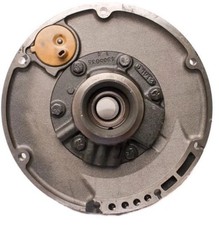
ATSG's 46RE/47RE/48RE manual lays the unit out plainly. The 47RE was the transmission behind the 5.9L diesel (and the 8.0L V10) in 1995-2002 Ram pickups. First through third come from the front section: the front clutch, rear clutch, kickdown (front) band, low/reverse (rear) band, the low roller clutch and the planetary sets. Fourth comes from the overdrive unit at the back, which holds an overdrive clutch, the OD/direct clutch, an overrun roller clutch and its own planetary. The pump bolts to the front of the case and is driven by the torque converter hub, and it supplies the pressure for every clutch and band apply plus lube.[1]
Put that together with the apply chart and the diagnosis gets simple:
- Drive (first): rear clutch plus the low roller clutch, with the overdrive unit locked in direct by the OD/direct clutch and the overrun roller clutch.
- Manual 1: same as Drive first, plus the rear band holding.
- Reverse: front clutch plus the rear band, with the overdrive unit in direct.
So the question that sorts the whole job is: which ranges are dead? Anything common to Drive and Reverse (converter drive, pump, input shaft, manual valve, filter, the overdrive unit and output) can stop both. Anything unique to one range only stops that range.
The electronics will not do this to you
Dave Skora's GEARS troubleshooting article on the 42-47RE makes the point that matters here: these are basically hydraulically controlled transmissions for the first three ranges, with an electronic governor pressure solenoid stroking the shift valves. When the computer sees a fault it goes to limp mode, de-energizes the governor solenoid and sends full mainline into the governor circuit, which gives you third-gear starts.[2] A third-gear start feels like a dog on launch, especially loaded, but the truck still moves. A dead 47RE that will not pull in Drive or Reverse is not a governor, transducer or wiring problem. Do not let anybody sell a solenoid pack for it.
Step 1: Rule Out Everything Outside the Case
Five minutes here saves a lot of embarrassment. On a 4x4 2500, confirm the transfer case is actually in a drive range and not sitting in Neutral, and that the parking brake is released. Look under the truck with a helper in gear at idle: is the front and rear driveshaft turning? A truck where the driveshaft turns and the wheels do not has an axle or U-joint problem, not a transmission problem.
Then check the shifter. 1996-2001 trucks use a screw-in Park/Neutral switch; 2002 got a push-in Transmission Range Sensor.[1] A quick linkage check on either one: the engine should crank only in Park and Neutral. If it cranks one detent off, or the shifter indicator does not line up with the detents, the manual valve may not be where the driver thinks it is. A loose or broken linkage grommet at the transmission lever can leave the valve body sitting in Neutral while the column says Drive.
Step 2: Fluid Level, Condition and the "Won't Move When Cold" Truck
Check the level hot, engine running, in Neutral, on level ground. The factory fluid is Mopar ATF+4 (Chrysler MS-9602). A 47RE that is several quarts low will often move cold and then quit as the fluid heats and expands into the converter, or move only after it sits and idles. Pull a sample onto a white towel. Clean red fluid and no smell says hydraulics or mechanical. Black, burnt fluid with friction material says something already let go, and a fluid change is not the fix.
A related complaint on high-mileage diesels is a truck that sits for 5-10 seconds after an overnight park before it engages. That is usually drainback and poor converter feed, not a dead transmission. Sonnax lists delayed engagement, converter drainback, lube failures and converter bushing failure as the symptoms its 22771A-02K lube-regulated pressure regulator valve addresses, and explains the root cause as poor converter feed pressure, with the regulator restricting oil to the converter and lube circuit under high pressure or temperature.[6] If the delay is getting longer every week, that is the same circuit headed toward a no-move.
Step 3: Line Pressure Splits Pump From Mechanical
Put a gauge on the line pressure tap and read it in each range at idle and at the rpm the service manual specifies for your year. You are looking for one of two pictures:
No or very low pressure in every range
The pump is not making pressure or the pressure is going somewhere it should not. Causes, in the order I find them on diesels: a plugged or unseated filter (a cracked filter neck or missing O-ring sucks air), a pump that is worn or not being driven, and a pressure regulator stuck open. Remember the pump is driven by the converter hub.[1] If the converter is not fully seated in the pump on a recent install, or the converter hub drive tangs are worn or broken, the engine turns the converter and the pump does nothing. Pull the dipstick at idle; a pump that is cavitating on air often foams the fluid.
Normal pressure, but no movement
If line pressure comes up normally in Drive and Reverse and the truck still sits, the hydraulics are doing their job and something mechanical is broken in the power path. On a Cummins truck that is overwhelmingly the input shaft or the rear clutch retainer, covered next.
Step 4: The Cummins Failures, Input Shaft and Rear Clutch Retainer
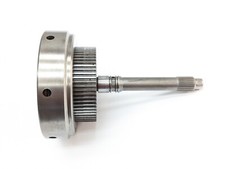
The OE 47RE input shaft is a two-piece design: the shaft and the forward clutch hub are separate pieces joined together. Sonnax calls out the weak connection between the two as the reason it makes its one-piece 22121B-01 heavy duty shaft, custom forged from 300M steel with a 23-tooth input spline and a 62-tooth clutch spline, for 1994-later units with the 1.245 in. sealing ring.[4] On the bench, a failed shaft shows up as twisted splines, a hub that has spun on the shaft, or a clean break. The whole drive path for Drive and Reverse runs through that joint, so when it lets go the engine revs and the truck sits in both ranges with normal line pressure. That is the classic Cummins 47RE tow-in, and it is far more common on trucks with added fuel.
The other part that fails the same way is the rear (forward) clutch retainer. Sonnax notes that the OE cast retainer (52854149AA) commonly fails from cracks and wear, especially with added power or towing loads, and sells a 4140 billet replacement, 22554-HD, that fits 46RH/RE, 47RH/RE and 48RE units and works with OE or aftermarket input shafts.[5] A cracked retainer can slip first in all forward gears, then lose the input entirely. If you find a broken shaft, inspect the retainer splines and the bore it rides in. If you find a cracked retainer, check the shaft splines. They tend to fail together.
A quick in-truck check before you pull it: drop the pan and cut open the filter. A sheared shaft or a failed hub usually leaves steel slivers and spline material in the pan. Bright steel in the filter on a diesel 47RE that will not move is almost never anything else.
Step 5: Drive Works but Reverse Does Not, or the Other Way Around
- No Drive, Reverse works: rear clutch pack or its piston seals, the rear clutch retainer, or the low roller clutch. If it will not move in Drive but moves in manual 1, the low roller clutch is freewheeling, because manual 1 adds the rear band and gives the gearset a second way to hold.
- No Reverse, Drive works: front clutch, rear band and servo, or the OD/direct clutch. If the truck also has no engine braking in manual 2 and 1, the OD/direct clutch is the suspect. See our 47RE no Reverse fix for that procedure.
- No movement in any range with normal pressure, input shaft and retainer intact: look at the overdrive unit. If the OD/direct clutch is burnt and the overrun roller clutch has failed, the overdrive unit has nothing holding it in direct and it will not pass torque to the output shaft.[1] Bench-check the overrun roller clutch freewheel direction against the ATSG manual on reassembly; installed backward, it is a guaranteed no-move.
Step 6: The Truck That Moves, Then Stalls the Engine
Some drivers call this "won't move" too: the truck pulls fine until it is warm, then drags the Cummins down and stalls it as it comes to a stop. That is a converter clutch that is applying when it should be released, and GEARS has the textbook case on a 1999 Dodge 2500 with the 5.9L Cummins and 47RE.[3] The procedure, least to most work:
- Cooler flow. Loop the cooler lines and blow through them with no more than 40 psi of air; it should pass with little resistance.
- Unplug the transmission connector and test for the stall. The article notes this test is valid on a 47RE because it uses a governor pressure solenoid rather than a line pressure solenoid, so unplugging it does not raise line pressure and mask the fault.
- Valve body. Inspect the TCC switch valve bore and check the body for warpage; flat-sand on glass with 220-grit wet/dry paper if needed.
- Air check. In that case, air applied to the front clutch came out of both converter passages. The cause was a warped pump stator support in the area of the feed holes, cross-leaking front clutch oil into the converter. Verify warpage with a flat file and confirm with compression film or Plastigauge.
The article puts the converter itself last on the list. Replacing a converter on this complaint before checking the stator support is the most common way this job gets done twice.
The Fix and What to Put Back In a Cummins 47RE
- Low fluid or a bad filter/O-ring, no debris: correct with ATF+4 and a new filter, then road test and recheck pressure.
- Linkage or Park/Neutral switch alignment: repair the grommet or adjust the linkage until the engine cranks only in Park and Neutral.
- Worn pump or converter hub drive: pump rebuild or replacement, new pump bushing and seal, and inspect the converter hub. Do not put a worn hub into a new pump.
- Broken input shaft or cracked rear clutch retainer: full teardown and rebuild. Replace the OE shaft with a one-piece heavy duty shaft and the cast retainer with a billet piece. Putting a stock two-piece shaft back into a Cummins that just broke one is selling the same job twice.[4][5]
- Overdrive unit failure: OD/direct clutch frictions and steels, overrun roller clutch, and check the overdrive planetary and output shaft bushings.
- Converter clutch stall: cooler flow, valve body, pump stator support flatness, then the converter.[3]
Prevention on these trucks is the same story every time: ATF+4 and a filter at the interval, a cooler that actually flows, a transmission temperature gauge for anybody who tows, and honest talk with the owner about what added fuel does to the input shaft. If the truck has a box or injectors on it, the shaft and retainer upgrade belongs in the quote from day one.
For fill and filter specs, see our 47RE fluid type and capacity guide, and keep the transmission fluid spec chart handy for the rest of the fleet.
47RE pumps, input drums, rebuild kits and valve bodies for the 1996-2002 Ram 2500 Cummins — shipped fast from the USA.
Shop 47RE parts →Shop the part for this fix
If the teardown shows a twisted or broken input shaft, the Sonnax 22121B-01 one-piece heavy duty shaft fits 1994-later RE units with the 1.245 in. sealing ring, including the Cummins 47RE.
Shop the HD input shaft → All RE-series partsFAQ
Why won't my Ram 2500 Cummins move in Drive or Reverse?
If the engine revs and the truck will not move in either range, start with fluid level and linkage, then put a gauge on line pressure. Low pressure in every range points to the filter, pump or converter hub drive. Normal pressure with no movement on a Cummins 47RE is usually a broken input shaft or a cracked rear clutch retainer.
Can a bad governor pressure solenoid stop a 47RE from moving?
No. The 47RE is hydraulically controlled through third gear and the governor system only times the shifts. When the electronics fail, the PCM goes to limp mode and the truck starts in third gear, which feels weak but still moves.
Why does my 47RE move in manual 1 but not in Drive?
Drive first relies on the low roller clutch to hold the gearset. Manual 1 adds the rear band as a second holding element. If the truck pulls in manual 1 but not in Drive, the low roller clutch is freewheeling and needs to be replaced.
What breaks in a 47RE behind a Cummins?
The OE two-piece input shaft and the cast rear clutch retainer are the classic failures, and both get worse with added fuel and towing. Sonnax sells a one-piece 300M input shaft (22121B-01) and a 4140 billet retainer (22554-HD) for that reason. Put both in when you rebuild a diesel 47RE.
Why does my 47RE stall the engine when I come to a stop?
That is the converter clutch staying applied. Check cooler flow first, then the valve body TCC switch valve bore, then air-check the pump. A GEARS case on a 1999 Ram 2500 Cummins traced it to a warped pump stator support cross-leaking front clutch oil into the converter.
Related 47RE guides
Sources
- ATSG (Automatic Transmission Service Group) — 46RE/47RE/48RE Technical Service Information manual (preview). Backs the 47RE application in 1995-2002 Ram 5.9L diesel trucks, the component layout (front/rear clutches, bands, low roller clutch; overdrive unit with OD clutch, OD/direct clutch, overrun roller clutch and planetary), the pump being driven by the converter hub, and the screw-in Park/Neutral switch versus 2002 push-in range sensor. atsg.biz (PDF)
- ATRA GEARS Magazine, October 2006 — "Troubleshooting the 42-47RE Transmissions," Dave Skora. Backs the 42-47RE being basically hydraulically controlled through third gear, and limp mode de-energizing the governor solenoid to send mainline to the governor circuit for third-gear starts. atracom.blob.core.windows.net (PDF)
- ATRA GEARS Magazine — "A Dead Stop: A Typical Dodge 47RE Problem with an Unexpected Solution." Backs the 1999 Dodge 2500 5.9L Cummins stall case, the 40 psi cooler air test, the unplugged-connector test being valid on the 47RE, the valve body flat-sanding with 220-grit, and the warped pump stator support cross-leak found by air testing. gearsmagazine.com
- Sonnax — Heavy Duty Input Shaft 22121B-01. Backs the OE two-piece shaft/hub design and its weak connection, the one-piece 300M forged replacement, the 23-tooth input and 62-tooth clutch splines, and 1994-later 1.245 in. sealing ring fitment. sonnax.com
- Sonnax — Heavy Duty Forward (Rear) Clutch Retainer 22554-HD. Backs OE cast retainer 52854149AA failing from cracks and wear with added power or towing, the 4140 billet replacement, and 46RH/RE, 47RH/RE and 48RE fitment. sonnax.com
- Sonnax — Lube Regulated Pressure Regulator Valve 22771A-02K. Backs delayed engagement, converter drainback, lube failures and converter bushing failure as symptoms of poor converter feed pressure, with the regulator restricting converter and lube oil under high pressure or temperature. sonnax.com
Fluid type (ATF+4, MS-9602) and the hot-in-Neutral level check are from the Chrysler 2001 Dodge Ram Truck (BR/BE) Service Manual, transmission section 21, as cited in our 47RE fluid guide.