A 47RE that will not move in Drive or Reverse is one of the easier calls on this transmission, provided you test in the right order. Most of what goes wrong with a 47RE leaves you with something: stuck in first, no overdrive, a flare on the 2-3, or a slip in reverse. Losing both directions at once narrows the list to the parts that every gear depends on. That means fluid supply, the pump, the drive from the converter into the geartrain, the shift linkage, and the driveline behind the transmission.
This guide covers the 47RE in 1996-2002 Ram 2500 and 3500 trucks, in the order we use on the bench: driveline, fluid, linkage, line pressure, teardown. Pressure numbers come from the factory test procedure; failure patterns from Chrysler's diagnostic chart, ATRA's GEARS magazine and Sonnax. Sources are at the end.

Why "No Movement" Points to a Short List
Look at the power flow before you look at the truck. In Drive first gear, the 47RE holds the rear (forward) clutch applied and lets the overrunning clutch hold the rear planetary. In Reverse it applies the front clutch and the low/reverse (rear) band. Those are different clutches and different holding devices. If the rear clutch burned up, you would still have Reverse. If the front clutch or rear band failed, you would still have Drive. Chrysler's diagnostic chart splits them the same way. It lists separate causes for "No Drive Range (Reverse OK)" and "No Reverse (D Ranges OK)."
When both are gone, look for something that sits upstream or downstream of both paths. The factory diagnosis chart for "No Drive or Reverse (Vehicle Will Not Move)" in the 1998 Ram service manual (p. 21-223) lists these causes:
- Gearshift linkage or cable loose or misadjusted
- Broken U-joint, axle or transfer case
- Plugged filter
- Damaged oil pump
- Valve body malfunction
- Damaged internal component
- Park sprag not releasing
- Torque converter damage
"Damaged internal component" covers a lot on a 47RE, so it gets its own section below.
The electronics cannot do this to you
This is the most useful fact to know before you plug in a scan tool. As Dave Skora put it in GEARS (October 2006), the 42-47RE family is basically a hydraulically controlled transmission, at least through third gear. The PCM duty-cycles a governor pressure solenoid, and governor pressure strokes the shift valves. Governor pressure should read zero at a stop and rise about 1 psi per mph up to roughly 40 mph. The PCM also runs the TCC and overdrive solenoids. None of those circuits applies the forward clutch or the reverse clutch. The worst an electrical fault can do is leave the truck in first gear with no upshift, and a truck in first gear still moves.
Mike Brown made the same point in GEARS (2022). On a 47RE you can unplug the transmission connector to kill the TCC solenoid without changing line pressure, because the unit uses a governor pressure solenoid rather than a line pressure control solenoid. So if the truck will not move, stored codes may be real, but they are not the reason. Do not spend money on solenoids or a sensor for a no-movement complaint.
Step 1: Make Sure the Transmission Is the Problem
Chrysler puts the driveline on the list for a reason. On a 4x4, confirm the transfer case is fully in 2H or 4H and has not jumped toward Neutral, then look for a dropped driveshaft, a sheared U-joint or a broken axle shaft. The fastest split: block the front wheels, raise the rear tires, and select Drive at idle. If the driveshaft turns, the problem is behind the transmission. If it does not, stay with the transmission.
Step 2: Fluid Level and Condition, Done the Chrysler Way
Low fluid is the cheapest no-movement fix, and it is commonly misread on this transmission. The 47RE is checked in Neutral, not Park, with the engine idling on level ground. Chrysler's fluid level procedure calls for fluid at normal operating temperature, 180 F (82 C), engine at curb idle, after shifting momentarily through every range and back to Neutral (1998 Ram service manual, fluid level check procedure). A 47RE that read full in Park can be low enough in Neutral that the pump sucks air at the filter on a turn, a hill or a hard stop. That is the classic "it moved, then it quit, then it came back" complaint.
Use ATF+4 (Chrysler MS-9602) only. Clean red fluid that is just low means top up and find the leak, usually the front pump seal or cooler lines. Dark, burnt-smelling fluid means cooked clutches. Glitter or chunks in the pan usually mean hard-part damage. A filter packed with friction material is on the factory list as its own no-drive cause, and it is also evidence that something upstream already failed, so do not just replace it and hand the truck back.
Step 3: Linkage, Manual Valve and Park
The shift cable or rod can let go at the transmission lever, at the column or at a worn bushing. The cab indicator says D while the manual valve sits in Neutral or Park. Get under the truck, disconnect the linkage at the transmission, and move the manual lever through every detent by hand. You should feel a clean detent at each position: P, R, N, D, 2 and 1. Then reconnect it and confirm the column puts the lever where the indicator says it is. A broken detent spring or a worn manual lever inside the pan gives the same symptom.
The factory chart also lists a park sprag that will not release. A truck parked hard on a grade, or one with a damaged park rod, can stay locked in Park even with the lever in Drive. It will usually lurch, clunk or refuse to roll in Neutral too. Chrysler's note is to check stall speed, because a stuck sprag loads the engine down hard. A broken input path does the opposite and lets the engine rev with almost no load.
Step 4: Line Pressure Tells You Pump or Mechanical
This is the test that decides the job. The factory procedure in the 1998 Ram service manual (Hydraulic Pressure Test, pp. 21-216 to 21-218) puts the truck on a hoist with the rear wheels free to turn, a 100 psi gauge on the accumulator port and a 300 psi gauge on the rear servo port, and has you disconnect the throttle and gearshift cables at the valve body levers so you can work them by hand. Then compare against the stock numbers:
- Drive, Manual 1 or Manual 2, 1,000 rpm: 54-60 psi at idle TV, rising to 90-96 psi with the TV lever at wide open. Rear servo pressure should be within 3 psi of the accumulator.
- Drive with overdrive off, 1,600 rpm: same 54-60 psi rising to 90-96 psi. Front servo pressure should be within 3 psi of the accumulator.
- Reverse, 1,600 rpm (rear servo port): 145-175 psi at idle TV, rising to 230-280 psi at full TV (Test Four, p. 21-217).
Those are factory figures for a stock unit. A built 47RE with a modified valve body will read differently. If you do not have a gauge handy, Mike Brown's cooler test in GEARS gives you a rough read. Put the cooler return line in a bucket, start the engine and select a gear. A healthy pump pushes a strong, steady stream. A trickle or nothing means the pump is not making flow.
Now sort the truck into one of two groups.
Zero or very low pressure in every range
The fluid is not getting pressurized. Work this list:
- Plugged filter or a cracked filter neck/O-ring sucking air. Cheapest, so check it first.
- Pump gears not being driven. Per ATSG's 46RE/47RE/48RE manual, the oil pump is driven by the torque converter hub and supplies the pressure for every clutch and band apply plus lube. The hub drives the inner pump gear on two flats. A converter that was not fully seated during installation can break the pump gear or the hub lugs on the first start. We see this on fresh installs more than anything else. If the truck quit right after a transmission or converter swap, this is the first suspect.
- Worn or scored pump. Gear clearance, a galled bushing, or a stator support that leaks. In the GEARS case, the stator support was warped at the feed holes and cross-leaked front clutch oil into the converter circuits. That truck stalled at a stop when warm rather than losing drive, but it shows how a pump can leak internally. Brown checks the stator support with a flat file and confirms warpage with Plastigauge or compression film.
- Stuck pressure regulator valve in the pump-side circuit, usually from debris.
Normal pressure, but no movement
Good pressure means the pump, filter and regulator are doing their job and the oil is reaching the clutches. The failure is in the parts that carry torque:
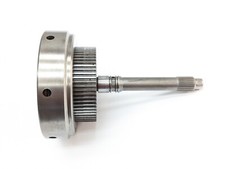
- Input shaft. The stock 46RE-48RE input is a two-piece shaft and hub. Sonnax calls the joint between the shaft and the forward clutch hub a weak connection, and its heavy-duty replacement (22121B-01) is a one-piece 300M shaft with a 23-tooth input spline and 62-tooth clutch spline. A sheared input shaft or stripped turbine spline is the textbook "engine revs, truck sits" failure. It is common on Cummins trucks with added power or heavy towing.
- Forward (rear) clutch retainer. Sonnax notes that the OE cast retainer (52854149AA) commonly fails from cracks and wear, especially with added power or towing. It sells a 4140 billet replacement (22554-HD) for that reason. A retainer that cracks at the shaft joint can take out the input path completely.
- Converter. A converter with a stripped turbine hub spline acts like a broken input shaft. The chart lists converter damage for this reason.
- Planetary, output or overdrive section damage. A shattered planetary or a broken shaft in the overdrive unit stops torque from reaching the output. The overdrive unit is also where Chrysler's "No Reverse (or Slips in Reverse)" chart places several reverse problems, including a collapsed or broken direct clutch spring and a failed overdrive thrust bearing.
A quick bench tell: with good line pressure, hold the brake and do a short stall check in Drive, no more than a few seconds. If engine speed shoots up with almost no load, something in the input path is broken. If it pulls down hard with the truck not even trying to creep against the brake, think park sprag or a dragging output.
Step 5: Teardown and the Fix
Once the pressure test says hard parts, the transmission comes out. Inspect the converter hub drive flats and turbine spline, then the pump gears, bushing and stator support flatness. Brown air-tests the front and rear clutches through the assembled pump to catch cross leaks. Then check the input shaft-to-hub joint, the rear clutch retainer for cracks, both clutch packs, the planetaries and sun shell, and the overdrive direct clutch spring, snap ring and thrust bearing. If the unit made metal, flush the cooler and blow air into the rear cooler fitting at no more than 40 psi to confirm it flows freely.
- Driveline, fluid or linkage: fix that and the transmission is fine. A unit that ran low long enough to lose drive should be watched for slipping.
- Pump not driven after an install: replace the pump gears, usually the converter too, and seat the converter fully into the pump drive before the bellhousing bolts are tightened.
- Sheared input shaft, cracked retainer or broken planetary: this is a rebuild. On a Cummins truck that tows or has added fuel, use heavy-duty shaft and retainer parts. The same OE parts under the same load usually fail the same way.
Prevention
Keep it on ATF+4, check it hot in Neutral, and keep the cooler flowing. If the engine has been turned up, build the input path to match. The shaft, retainer and converter are what break when a 47RE goes from "pulls fine" to "will not move" on one launch.
Shop the part for this fix: Sonnax Heavy Duty Input Shaft 22121B-01
One-piece 300M replacement for the stock two-piece input shaft. It fits 1994-and-later 46RE, 47RE and 48RE with the 1.245 in. sealing ring. This is the upgrade for a sheared input shaft on a Cummins truck.
View the input shaft →Need the retainer, pump or a full kit instead? Browse the 46RE/47RE/48RE parts collection at Core Transmission Parts.
FAQ
Why won't my 47RE move in Drive or Reverse?
When a 47RE loses both directions, the cause is something every gear depends on: low fluid, a plugged filter, a damaged or undriven pump, a disconnected shift linkage, a broken input shaft or rear clutch retainer, converter damage, a stuck park sprag, or a broken driveline part behind the transmission. Drive and Reverse use different clutches, so a single burnt clutch pack does not take out both.
Can a bad governor pressure solenoid cause a 47RE not to move?
No. The 47RE is basically hydraulically controlled through third gear, and the governor pressure solenoid only controls the pressure that strokes the shift valves. A failed governor solenoid or sensor typically leaves the truck stuck in first gear, but it still moves. Do not replace solenoids for a no-movement complaint.
How do I tell a bad pump from a broken input shaft on a 47RE?
Put a gauge on the accumulator port. A stock 47RE should show 54-60 psi in Drive at 1,000 rpm and 145-175 psi in Reverse at 1,600 rpm with the throttle valve at idle. Near-zero pressure points to the filter, pump or pump drive; normal pressure with no movement points to the input shaft, rear clutch retainer, converter spline or geartrain.
Will low fluid stop a 47RE from moving?
Yes. If the level drops far enough, the pump pulls air at the filter and line pressure collapses, often on a turn, hill or stop first. Check the 47RE hot, idling in Neutral on level ground, not in Park, and top up with ATF+4 only.
A truck that only takes 5-10 seconds to engage after sitting overnight is usually not this failure yet. Sonnax ties delayed engagement and converter drainback in these units to poor converter feed pressure from the pressure regulator circuit, and sells its 22771A-02K lube-regulated regulator valve for it. If the delay is getting longer, treat it as the early stage of a pump or regulator problem. For the diesel-specific version of this job, including the input shaft and the warm-stall case, see 47RE Ram 2500 Cummins won't move.
Sources
- Chrysler Corporation, 1998 Dodge Ram Truck Service Manual, Group 21, 46RE/47RE diagnosis charts (archived copy). Backs the nine causes for "No Drive or Reverse (Vehicle Will Not Move)" on p. 21-223, the park sprag stall-speed note, the separate no-drive and "No Reverse (or Slips in Reverse)" lists with the overdrive thrust bearing and direct clutch spring entries, and the 180 F (82 C) Neutral fluid level check. archive.org
- Chrysler Corporation, 1998 Dodge Ram Truck Service Manual, Group 21, 46RE/47RE Hydraulic Pressure Test, pp. 21-216 to 21-218 (archived copy). Backs the hoist and gauge setup (100 psi gauge at the accumulator, 300 psi gauge at the rear servo), the 54-60 rising to 90-96 psi forward specs, the 145-175 rising to 230-280 psi Reverse spec at 1,600 rpm and the 3 psi servo-match specs. archive.org (full text)
- ATRA GEARS Magazine — Dave Skora, "Troubleshooting the 42-47RE Transmissions" (October 2006). Backs the point that the 42-47RE is basically hydraulically controlled through third gear, and governor pressure at zero at a stop rising about 1 psi per mph to roughly 40 mph. atracom (GEARS PDF)
- ATRA GEARS Magazine — Mike Brown, "A Dead Stop! A Typical Dodge 47RE Problem With an Unexpected Solution" (2022). Backs the unplug test, the bucket cooler-flow test, the 40 psi cooler air test, the warped stator support cross-leak, and the pump air-test procedure. gearsmagazine.com
- Sonnax — Heavy Duty Input Shaft 22121B-01. Backs the two-piece OE shaft/hub "weak connection," the one-piece 300M design, and the 23-tooth/62-tooth splines and 1994-later fitment. sonnax.com
- Sonnax — Heavy Duty Forward (Rear) Clutch Retainer 22554-HD. Backs the OE 52854149AA cast retainer cracking and wear failures under added power or towing, and the 4140 billet replacement. sonnax.com
- ATSG (Automatic Transmission Service Group) — 46RE/47RE/48RE Technical Service Information manual (preview), 2011. Backs the oil pump being driven by the torque converter hub and supplying all clutch and band apply pressure and lube, the 47RE application in 1995-2002 Ram 5.9L diesel trucks, and the overdrive unit layout (OD clutch, OD/direct clutch, overrun roller clutch). atsg.biz (PDF)
- Sonnax — Lube Regulated Pressure Regulator Valve 22771A-02K. Backs delayed engagement, converter drainback, lube failures and converter bushing failure as symptoms of poor converter feed pressure in 42RE-48RE units. sonnax.com
Shop 47RE rebuild kits, input drums, valve body parts and filters — shipped fast from the USA.
Shop 47RE parts →