A 47RE that slips is telling you exactly which part is failing, if you know how to read it. This is the heavy-duty four-speed behind the 5.9L Cummins and 8.0L V10 in 1996-2002 Ram 2500 and 3500 trucks, and every gear it makes uses a different combination of two clutches, two bands, a roller clutch and a separate overdrive unit. Figure out which gears slip and which do not, and you have narrowed the problem to one or two parts before the pan comes off.
That is how Chrysler's own diagnosis works. The procedures and specs below come from Chrysler's Dodge Ram Truck factory service manual (Group 21, the 46RE/47RE section, which carries the same tests from the 1998 through 2001 books), the wear data from Sonnax and TransGo, and the cooler checks from Sonnax and ATRA's GEARS magazine. Sources are listed at the end.
First, Rule Out the Easy Stuff
Chrysler's road-test procedure starts before the truck leaves the lot: check the fluid level and the control cable adjustments, and clear any diagnostic trouble codes. The manual also warns that a poorly running engine will throw off the read.
The service manual's diagnosis chart for "slips in forward drive ranges" lists these causes, in this order:
- Fluid level low.
- Fluid foaming, from a high oil level, a bad pump gasket or seals, dirt between the pump halves, or loose pump bolts.
- Throttle linkage misadjusted.
- Gearshift linkage misadjusted.
- Rear clutch worn.
- Low hydraulic pressure from a worn pump, incorrect control pressure adjustment, a warped or sticking valve body, leaking seal rings, leaking clutch seals, servo leaks, or a clogged filter or cooler lines.
- Rear clutch leaking seals or worn plates.
- Overrunning clutch worn or not holding.
The first four cost nothing to check, and the throttle cable matters more than people think: on the 47RE it is what raises line pressure as you open the throttle. In the factory pressure test (Ram Truck service manual, p. 21-217), line pressure goes from 54-60 psi with the valve body throttle lever forward to 90-96 psi with it all the way back. If the cable is out of adjustment and the throttle valve does not get its full travel, the clutches never see that extra pressure under load, and the truck slips when it is working hardest. Our 47RE fluid guide covers the correct hot Neutral level check.
Read the Slip: The Clutch and Band Application Chart
The service manual calls the Clutch and Band Application Chart "the key" to finding a slipping unit. Here is which elements are applied in each range, from the 2001 manual:
| Range | Main transmission | Overdrive unit |
|---|---|---|
| Reverse | Front clutch, rear band | Direct clutch, overrunning clutch |
| D - First | Rear clutch, overrunning clutch | Direct clutch, overrunning clutch |
| D - Second | Rear clutch, front band | Direct clutch, overrunning clutch |
| D - Third | Front clutch, rear clutch | Direct clutch, overrunning clutch |
| D - Fourth | Front clutch, rear clutch | Overdrive clutch |
| Manual Second | Rear clutch, front band | Direct clutch, overrunning clutch |
| Manual First | Rear clutch, rear band, overrunning clutch | Direct clutch, overrunning clutch |
The manual spells out the logic in its Analyzing Road Test section (1998 Ram Truck service manual, Group 21). The rear clutch is on in every forward range. The transmission's overrunning (roller) clutch holds only in first. The rear band applies only in manual 1 and Reverse. The overdrive clutch applies only in fourth, and the overdrive direct clutch applies in every range except fourth. From there:
- Slips in first in D and 2, but not in manual 1: the transmission overrunning clutch is not holding. Manual 1 adds the rear band, which holds the same drum, so the slip goes away.
- Slips in any two forward gears: the rear clutch is slipping, since it is the one element they share.
- Slips in third: front clutch or rear clutch. Check Reverse. If it also slips in Reverse, it is the front clutch. If Reverse is fine, it is the rear clutch.
- Slips on the 3-4 shift or only in fourth: the overdrive clutch. The manual adds that if it will not shift into fourth at all, check the O/D switch, the overdrive solenoid and the wiring first.
- Loses Reverse and also loses engine braking in manual 2: the overdrive direct clutch. Those are the two places where only the direct clutch is carrying the load.
The chart also covers a slip in second only. Second uses the rear clutch and the front (kickdown) band. If the rear clutch holds in first and third, what's left is the front band: out of adjustment, worn, or a broken or bent kickdown strut, which is a known 47RE weak point covered in our 47RE common problems guide.
Slips in Reverse Only
The factory diagnosis chart for "slips in reverse only" (Group 21 diagnosis charts, pp. 21-220 to 21-232) lists low fluid, gearshift linkage, rear band misadjusted, rear band worn, overdrive direct clutch worn, low hydraulic pressure, a leaking rear servo, and binding band linkage. Reverse is the highest-pressure range in the unit, so a leak in that circuit shows up there first.
The overdrive direct clutch deserves special attention on a 47RE. It is applied by a large spring, not by oil pressure, and that spring fades with heat. TransGo, which makes a high-temp replacement (TFOD-SP, a direct replacement for OEM part 4461027), says a faded spring reduces clamping force. That causes a slip in Reverse, burnt direct clutch plates, and reduced or no coast braking in manual 2nd or 1st. If a truck slips in Reverse and freewheels on a closed-throttle downhill in manual 2, look at the direct clutch spring and plates before you blame the rear band.
The valve body can cause it too. Sonnax's vacuum test guide for the 46RE/47RE lists reverse slip, poor forward and reverse engagement, poor line pressure control and poor cooler charge at idle as symptoms of a worn line pressure plug and sleeve.
Slips in Fourth or on the 3-4 Shift
Fourth is the only gear that uses the overdrive clutch, so a slip that shows up only there points to the overdrive unit or its hydraulic feed. The manual's chart for no 3-4 upshift includes a failed overdrive clutch, low hydraulic pressure, a stuck 3-4 shift or 3-4 timing valve, an incorrect overdrive piston spacer, failed overdrive piston seals, and a failed overdrive check valve or orifice. Its correction for the seals is to replace both of them.
Sonnax ties two lower valve body valves to overdrive clutch damage. A worn 3-4 quick fill valve bore is listed with a burned OD clutch, no 4th and gear ratio codes. A worn 3-4 timing valve bore is listed with no 4th and gear ratio codes. Put a new OD clutch pack behind a leaking quick fill circuit and it burns up too.
To confirm it, run Chrysler's Test Six with a 300 psi gauge on the overdrive clutch port at the left rear of the case. With the O/D switch on, drive until the 3-4 shift happens. Pressure should read 68-72 psi at closed throttle and 90-120 psi at half to three-quarter throttle, and can reach about 130 psi at full throttle. Low pressure in fourth only, with the other tests normal, is what the manual's analysis chart ties to an overdrive clutch piston seal or check ball problem.
Pressure Test Before You Tear It Down
The manual says road testing finds the slipping unit, but the cause usually is not known until the hydraulic and air pressure tests are done, since nearly any condition can come from a leaking circuit or sticking valve. Unless the failure is obvious, do not tear it down first.
You need an accurate tachometer, a 100 psi gauge (C-3292) for the accumulator, governor and front servo ports, and a 300 psi gauge (C-3293-SP) for the rear servo and overdrive ports. Line pressure is read at the accumulator port on the right side of the case. With the rear wheels off the ground and the throttle and shift cables disconnected at the valve body:
- Test One, manual 1 at 1000 rpm: line pressure 54-60 psi, rising to 90-96 psi as the throttle lever moves rearward. Rear servo pressure should match line pressure within 3 psi.
- Test Two, 2 range at 1000 rpm: the same 54-60 rising to 90-96 psi.
- Test Three, D third at 1600 rpm, O/D off: line pressure 54-60 psi rising with throttle. Front servo pressure within 3 psi of line up to the kickdown point.
- Test Four, Reverse at 1600 rpm: rear servo 145-175 psi rising to 230-280 psi.
- Test Five, governor: no more than 3 psi at idle with the wheels stopped, rising about 1 psi per mph.
Then read the results against the manual's pressure test analysis chart:
| Result | What it points to |
|---|---|
| OK in R, low in D, 2 and 1 | Leak in the rear clutch area (seal rings, clutch seals) |
| OK in 1 and 2, low in D3 and R | Leak in the front clutch area |
| OK in 2, low in R and 1 | Leak in the rear servo |
| Front servo pressure low in 2 | Servo leak: broken servo ring or cracked servo piston |
| Low in D fourth only | Overdrive clutch piston seal or check ball |
| Low in all positions | Clogged filter, stuck regulator valve, worn pump, low fluid |
| Lube pressure low at all throttle positions | Clogged cooler or lines, leaking seal rings, worn pump bushings, clogged filter |
Air Checks Confirm What the Gauges Found
With the pan and valve body off, you can air-check each apply circuit in the truck. Apply air to the front and rear clutch apply passages with a finger or two on the clutch housing. You should feel the piston move and hear a soft thump as the clutch applies. For the front and rear servos, the servo rod should extend and tighten the band around its drum, then return on spring pressure when you release the air. A hiss with no thump means that circuit is leaking.
Valve Body Wear That Feels Like Clutch Slip
Plenty of "slipping" 47REs have good clutches and bad pressure control. Sonnax's vacuum test guide for this family lists the wear points and what each one causes:
- Line pressure plug and sleeve: reverse slip, poor engagement, poor line pressure control.
- Pressure regulator valve: delayed engagement, regulator buzz, lube failures, converter bushing failure.
- Lockup boost valve: TCC slip under load, no line rise during TCC apply in 4th, TCC cycling, overheated converter.
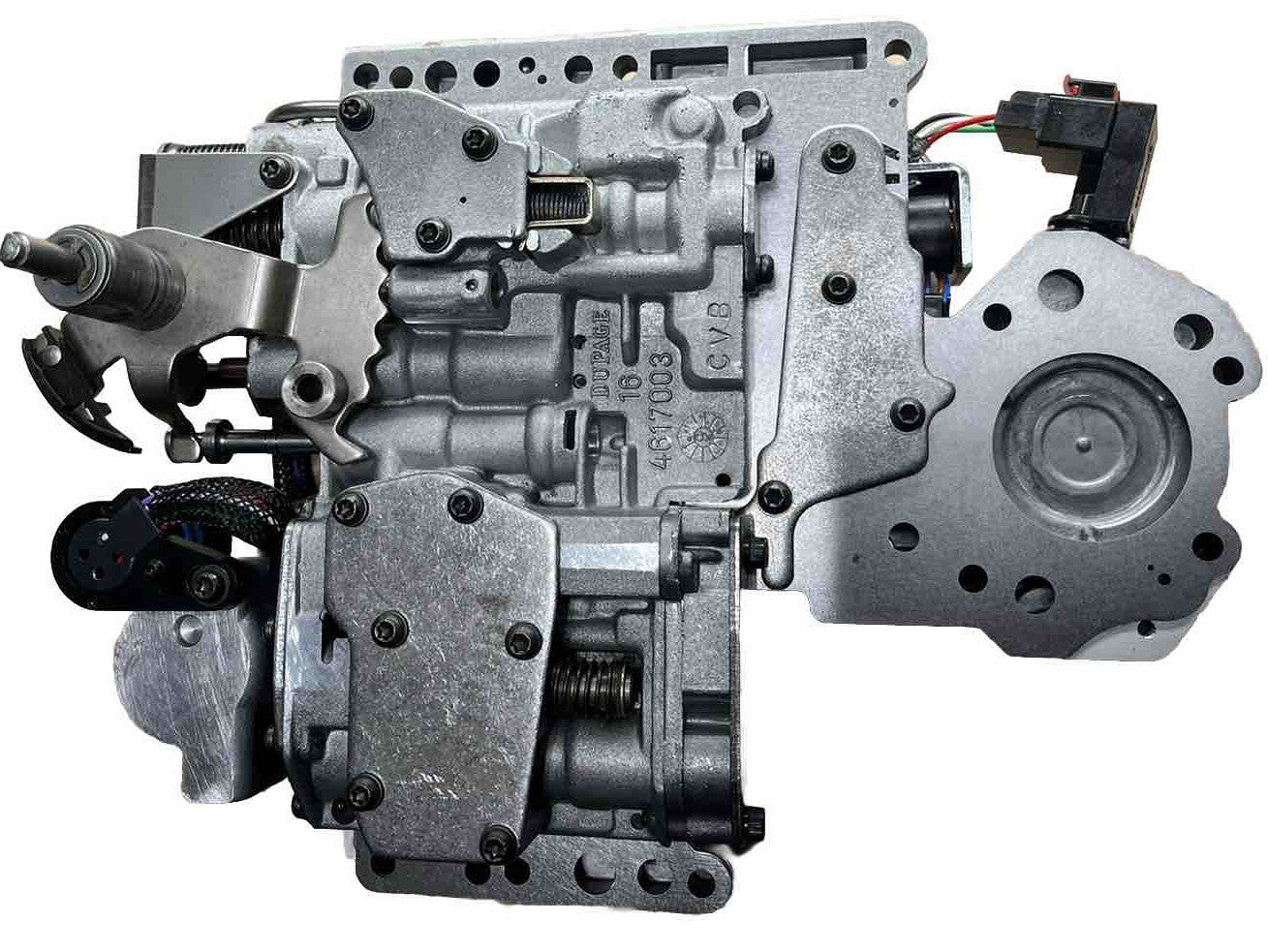
A low vacuum reading means the bore is worn. Our 47RE valve body testing guide covers the layout and the repair-or-replace call.
Converter Clutch Slip and the Cooler Circuit
If the flare happens at cruise after lockup, suspect the cooler circuit before the converter. Sonnax's write-up on 46-47RH/RE cooler and converter flow lists TCC slip under high torque, delayed engagement, slow converter fill, excessive stall speed and 740/1740 codes as symptoms of cooler restriction. Sonnax explains that a restricted cooler pushes the switch valve toward its spring, where it can stage mid-circuit and choke converter flow further as head pressure approaches 80 psi. Their first test is to bypass the cooler temporarily and retest. GEARS magazine adds a second check: blow no more than 40 psi of air into the rear cooler fitting. It should take air with little resistance. Our 47RE overheating guide covers cooler sizing.
The Fix, by What You Found
- Level, fluid or cable: correct it, adjust the bands to the 47RE specs, and retest.
- Band slip (second only, or Reverse only with good pressure): adjust the band. If it will not hold after adjustment, replace the band and strut.
- Pressure low in one circuit: find the leak with the air check. That means seal rings, piston seals, a servo ring or a cracked servo piston.
- Pressure low everywhere: filter, regulator valve or pump. Vacuum test the valve body.
- Burnt plates, debris in the pan, or burnt-smelling fluid: the manual calls that an overhaul. Rebuild it with a full master kit, replace the overdrive direct clutch spring, fix the valve body bores, and reverse-flush the cooler. We replace the converter on any unit that failed with debris, because flushing will not get it clean.
On a rebuild, check the overdrive piston spacer. The manual lists the wrong spacer as a cause of no 3-4 upshift.
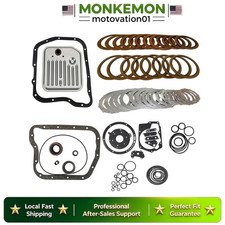
47RE/48RE Full Overhaul Rebuild Kit with Clutches, 1990-2002
Frictions, seals and gaskets for a 1996-2002 47RE that has burned its clutches, from CoreTransmissionParts. This is the kit for when the air check and the pan both say overhaul.
View the overhaul kit →Shop the RE overhaul kit →
Frequently Asked Questions
Why does my 47RE slip in reverse only?
Reverse uses the front clutch, the rear band and the overdrive direct clutch. Chrysler's chart lists low fluid, linkage, a misadjusted or worn rear band, a worn overdrive direct clutch, low pressure and a leaking rear servo. A weak overdrive direct clutch spring is a common cause, especially if coast braking in manual 2 is also gone.
What does it mean when a 47RE slips only in overdrive?
Fourth gear is the only gear that uses the overdrive clutch, so a slip in fourth or on the 3-4 shift points to the overdrive clutch, its piston seals, the check ball or the 3-4 quick fill circuit. Confirm it with a gauge on the overdrive clutch port: 68-72 psi at closed throttle and 90-120 psi at half to three-quarter throttle.
Can a band adjustment fix a slipping 47RE?
Sometimes. A slip in second only points to the front band, and a slip in Reverse can be the rear band. Adjusting the bands to the 47RE specs fixes it if the bands and struts are not worn. If it slips again soon after, the band, strut or servo is worn or leaking.
Will a fluid change fix 47RE slipping?
Only if the slip came from low, foamed or wrong fluid. Fresh ATF+4 at the correct hot level will not bring back worn clutches or seal a leaking circuit. If the pan has friction material in it or the fluid smells burnt, the unit needs an overhaul.
Sources
- Chrysler — 1998 Dodge Ram Truck (BR) Service Manual, Group 21, 46RE/47RE Road Test and Clutch and Band Application analysis (pp. 21-215 to 21-216). Backs the clutch-engagement logic used in this article: rear clutch in all forward ranges, overrunning clutch in first only, rear band in 1 and Reverse, overdrive clutch in fourth only, overdrive direct clutch in every range except fourth, and front clutch slip showing in both third and Reverse. archive.org — Chrysler 1998 Dodge Ram Truck service manual (full scan)
- Chrysler — 1998 Dodge Ram Truck (BR) Service Manual, Group 21, Hydraulic Pressure Tests (pp. 21-217 to 21-218). Backs 54-60 psi rising to 90-96 psi line pressure in Tests One through Three, servo pressure within 3 psi of line, and Test Four Reverse at 1600 rpm: 145-175 psi rising to 230-280 psi. archive.org — Chrysler 1998 Dodge Ram Truck service manual (full scan)
- Chrysler — 1998 Dodge Ram Truck (BR) Service Manual, Group 21, Diagnosis Charts (pp. 21-220 to 21-232). Backs the listed causes for forward-range slips (fluid foaming, linkage, worn rear or overrunning clutch, low pressure), slips in Reverse only (rear band misadjusted or worn, worn overdrive direct clutch, leaking rear servo) and no 3-4 upshift (overdrive solenoid, wiring, low pressure, overdrive clutch). archive.org — Chrysler 1998 Dodge Ram Truck service manual (full scan)
- Sonnax — Chrysler 46RE, 46RH, 47RE, 47RH Vacuum Test Guide. Backs the valve body wear points and symptoms: line pressure plug and sleeve (reverse slip), pressure regulator valve, lockup boost valve (TCC slip under load), 4-spool switch valve, 3-4 quick fill valve (OD clutch burned) and 3-4 timing valve. sonnax.com
- TransGo — TFOD-SP Overdrive Spring for TorqueFlite units. Backs the overdrive direct clutch spring fading and reducing clamping force, the resulting reverse slip, burnt direct clutch plates and lost coast braking in manual 2nd or 1st, and the OEM 4461027 interchange. transgo.com
- Sonnax — "46-47RH/RE Cooler and Converter Flow." Backs cooler restriction as a cause of TCC slip under high torque, delayed engagement, excessive stall speed and 740/1740 codes, the switch valve staging near 80 psi head pressure, and the cooler bypass test. sonnax.com
- ATRA GEARS Magazine — "A Dead Stop! A Typical Dodge 47RE Problem With an Unexpected Solution." Backs the check of blowing no more than 40 psi of air into the rear cooler fitting to find a restricted return. gearsmagazine.com
Shop 47RE rebuild kits, clutch packs, bands, valve bodies and coolers — shipped fast from the USA.
Shop 47RE parts →