P0700 sends more 48RE trucks to the wrong repair than any other code. It reads "transmission control system malfunction," which sounds like it names a failed part. It does not. It is a flag: something in the transmission control strategy has stored a fault and has asked for the malfunction indicator lamp to come on. The code that tells you what actually broke is a different code, and on a 2003-2007 Ram with a 48RE it is very often a Chrysler-specific P17xx that a basic code reader will never show you.
That is the whole problem in one sentence. A tech plugs in a cheap reader, sees P0700 and nothing else, and starts guessing. Meanwhile the truck has a P1751 or a P1763 sitting in the module pointing straight at the failed component.
What P0700 Actually Means on This Truck
Generic OBD-II gives every manufacturer a way to say "there is a transmission fault stored, go look." That is P0700. The lamp comes on because the transmission control strategy requested it. It is a pointer to another code, not a description of a failure.
Two things follow, and both matter on a 48RE:
- You need a scan tool that reads Chrysler enhanced codes. Generic mode shows you P0700 and stops. The 48RE's most common real faults live in the P1749-P1764 range, which is manufacturer-specific. If your tool only does global OBD-II, you have not finished pulling codes.
- Do not replace anything based on P0700 alone. Clearing it without finding the companion code means it returns on the next drive cycle, and you have thrown away the freeze frame that would have helped you.
Once you have the real code, the 48RE narrows down fast, because two subsystems generate the overwhelming majority of its stored faults: the throttle valve actuator and the governor pressure circuit.
Suspect 1: The Throttle Valve Actuator (2005-Up Diesel)
This is the one people miss, because it did not exist on the 47RE. Per Sonnax TASC Force member Jeff Parlee, writing in Transmission Digest, Dodge started using a transmission throttle valve actuator (TTVA) instead of a TV cable in 2005 on the 48RE diesel 2500 and 3500 Ram trucks. The actuator attaches to the case above the throttle valve shaft and contains two potentiometers that provide input to the ECM plus a DC motor that responds to ECM output. The bottom of the TTVA shaft has a D-shaped opening that fits onto the throttle shaft, letting the actuator mechanically stroke the TV valve and control transmission throttle pressure.
On a 2005-up diesel, in other words, the computer is physically operating your TV valve. When that loop is unhappy you get a stored code, P0700 lights the lamp, and the truck shifts badly or drops to failsafe.
The TTVA Code List
These are the codes to look for behind a P0700 on a 2005-up diesel:
- P1749 — Transmission throttle valve position sensor circuit low
- P1750 — Transmission throttle valve position sensor circuit high
- P1751 — Transmission throttle valve position minimum range performance
- P1752 — Transmission throttle valve span performance
- P1753 — Transmission throttle valve mechanical performance
- P1754 — Transmission throttle valve actuator stuck
- P1755 — Transmission throttle valve control circuit
The Calibration Detail That Causes Comebacks
Here is where rebuilders get bitten. There is no adjustment for the TTVA. It must be initialized when it is replaced, or removed and reinstalled. Every time the ignition is cycled on, the ECM performs an internal calibration to find the current zero position, and for that to complete, the ignition must be held in the on position for at least 30 seconds.
During calibration the ECM is looking for at least 48 degrees of movement from minimum to maximum span, and it needs to establish a minimum range value. Both parameters are affected by the throttle shaft adjustment bolt on the pressure regulator spring retaining bracket. Per Parlee, the distance between the bracket and the inside edge of the adjustment bolt head should be 0.905 inch. A shorter distance will not let the TV shaft travel far enough to satisfy the calibration parameters, and it sets P1751, P1752, or both.
Now the trap. Some brackets for cable-activated throttle valves have as little as 0.820 inch between the bracket and the inside of the adjustment bolt head. Use a cable-type bracket setup in a TTVA-equipped unit without changing the setting on the adjustment bolt and you set the same codes. If you build a 48RE out of a mixed parts pile and it comes back with P0700 and P1751 the day after delivery, measure that bracket before you order another actuator.
Suspect 2: The Governor Pressure Circuit
The 42RE through 48RE family replaced the old mechanical governor with an electronic one: a pulse-width-modulated governor pressure solenoid that regulates line pressure down into governor pressure, plus a governor pressure sensor, or transducer, that reports back what the circuit actually did.
Because there is a real transducer, the scan data here is measured pressure, not a command. Sonnax makes that distinction explicitly, noting that some Chrysler transmissions, including the 45RFE, 545RFE and the 42RE-48RE series, have pressure data from a transducer, while most other transmissions have no transducer input to the PCM at all and what you see is only a command. That is a gift diagnostically: you can compare desired governor pressure against actual governor pressure on the scan tool and know immediately whether the hydraulic side is obeying the electrical side.
P1763 and the Shared Ground Nobody Checks
Transmission Digest documents the set condition precisely: P1763 sets when the PCM sees 4.89 volts or higher on the governor pressure sensor circuit for eight seconds or more, and the PCM responds by placing the transmission into third gear failsafe. That is your limp-mode complaint.
There are two very different roads to that voltage, and they call for opposite repairs:
- A compromised ground. The governor pressure sensor shares a ground circuit with other sensors including the battery temperature sensor and the heated oxygen sensors. Of all the possibilities, malfunctioning heated oxygen sensors are the most common cause of a compromised shared ground path for the governor pressure sensor. Look for company codes: P1492 (battery temperature sensor volts too high) alongside P1763 is a strong hint you have a ground problem, not a transmission problem. P1762 (governor sensor offset volts or drift too low or too high) and P1757 (governor pressure above 3 psi at 0 mph) may also be present.
- Genuinely high line pressure. Line pressure feeds the governor solenoid, so when the computer turns that solenoid off, nearly all of the pressure feeding it enters the governor circuit. Should line pressure be above roughly 90 psi, so will pressure in the governor circuit, and after eight seconds the code sets. A P1763 caused by high line means governor pressure was 90-96 psi or higher in drive.
There is a clean test to separate them. Clear the codes, then drive the truck with the brake applied enough to activate the brake switch signal, which prevents converter clutch application. If P1763 does not return, release the brake and let the converter clutch engage. A code that appears immediately after converter clutch apply points at the pressure side, because on a 48RE line pressure — and therefore governor pressure — increases when the PCM commands fourth gear or TCC apply, since the boost valve is stroked.
The Aftermarket Governor Solenoid Trap
This one is worth the read. ATRA's Gears Magazine documents a recurring hotline complaint: 48RE transmissions behind diesel engines that will not upshift at wide open throttle, most of them after a basic overhaul with nothing out of the ordinary. The technicians had already overhauled the valve body and replaced the governor solenoid and transducer. The fix, over and over, was to install an OE governor solenoid.
On a scope the failure is obvious. With the aftermarket solenoid installed, governor pressure was unstable and never equal to line pressure when the PCM lowered the governor solenoid duty cycle signal to 1 percent. With an OE solenoid in place, governor pressure was more stable and rose to equal line pressure at that same 1 percent command.
The hydraulics explain the symptom exactly. Under wide open throttle, TV pressure is at maximum. When governor pressure reaches about 36 psi, the TV limit valve cuts off TV pressure to land H, leaving TV pressure only between lands F and G. Governor pressure has to overcome that TV pressure to stroke the 2-3 shift valve. If governor pressure is not high enough, the 2-3 shift valve will not stroke, which blocks mainline pressure from entering the direct clutch circuit, so it cannot release the intermediate band and apply the front clutch. Back off the throttle, TV pressure drops enough for governor pressure to stroke the valve, and the truck finally goes into third. That is the customer complaint word for word: it will not shift into third unless I let off.
You can see this on a scan tool without a scope. Compare the desired and actual governor pressure PIDs. When desired pressure is commanded to maximum, actual should equal line pressure. If it does not, and the solenoid is a recent aftermarket part, you have found it.
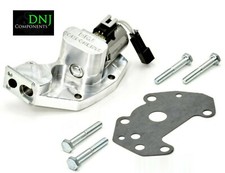
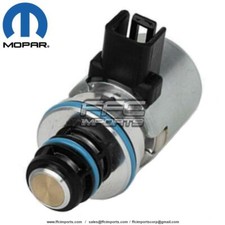
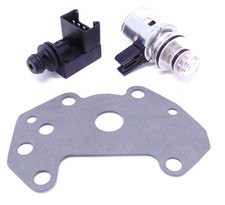
48RE Governor Pressure Solenoid Kit, 2001-2009, with Gaskets
The governor pressure solenoid is behind a large share of the codes hiding under a P0700 on these trucks, and it is a pan-off job you do not want to do twice. This kit ships with the gaskets so you are not making a second parts run mid-repair.
Get the 48RE governor solenoid kit →Need the transducer, a filter, a shift kit or a rebuild kit instead? Browse the full 48RE parts collection.
Suspect 3: The TCC Solenoid and the 48RE Stall Signature
If the truck stalls as well as storing codes, the 48RE gives you a shortcut that does not work on any other RE-series unit. Transmission Digest points out that the 48RE's converter clutch apply strategy is a significant departure from the 46RE and 47RE. The practical result: if it does not stall in reverse but stalls in drive, you know you have a defective TCC solenoid. A stall in reverse points at the pump instead.
This matters because the classic mistake is to see a stall, condemn the pump, replace it, cure the reverse stall, and still hand back a truck that dies in drive because the TCC solenoid was bad too. Which direction it stalls in tells you which part to buy.
If the complaint is converter clutch cycling in and out rather than a stall, do not jump straight to the solenoid either. ATRA Technical Bulletin #1390 for the 42RE through 48RE lists more than twenty hotline-proven causes, and most of them are outside the transmission: loose or dirty battery and engine ground cables, alternator noise getting into the PCM, a faulty or loose brake switch, a bad vehicle speed sensor signal, an engine running cold from a stuck thermostat or bad ECT sensor, and on the diesel, a faulty ECM connector or water in fuel. A genuinely bad TCC solenoid or circuit is on that list too, and ATRA notes it may set P0743, which is exactly the kind of companion code P0700 is pointing you toward.
Put a Gauge on It Before You Buy Parts
Scan data tells you what the computer thinks. A gauge tells you what the oil is doing. Sonnax's guidance on pressure gauge diagnosis applies directly here:
- Use a 0 to 100 psi gauge for governor pressure. Zero to 300 or 0 to 400 psi gauges are not sensitive enough to let you see the lower pressures in the governor oil circuit with any accuracy.
- Expect roughly 1 psi of governor pressure per mph. Most transmissions have about one pound of governor pressure for every mile per hour of speed, which turns a road test into a real measurement.
- Take pressures on a road test, not on a lift. Unloaded readings do not reproduce the conditions that set the code.
- Judge clutch circuits against line. A difference of more than 10 percent between a clutch circuit and line pressure means a leak in that circuit. Under 10 percent is normal sealing ring leakage.
- Watch line pressure leading up to a harsh shift. If pressure is normal until after the shift is commanded, there is a leak in the applying component, or non-OEM frictions or the wrong fluid were used. If pressure is already high before the shift is commanded, suspect the pressure control system or a bad input to the PCM.
Service and fill with ATF+4, Chrysler material standard MS-9602. These units are sensitive to friction modifier, and a fluid-caused shift complaint will chase you in circles while you are hunting an electrical fault.
The Repair Order That Actually Works
- Pull enhanced codes, not just generic. Record every stored code and the freeze frame before you clear anything.
- Chase the companion codes first. P1492 alongside P1763 means go fix the shared ground and the oxygen sensors, not the transmission.
- On a 2005-up diesel with P1751 or P1752, measure the bracket. You want 0.905 inch to the inside edge of the adjustment bolt head, not 0.820 inch. Then key on for a full 30 seconds and let the calibration run.
- Compare desired versus actual governor pressure. If actual will not rise to line pressure at a 1 percent duty cycle command, put an OE-quality governor solenoid in it.
- Gauge the truck on a road test with a 0-100 psi gauge on the governor tap before you condemn the valve body.
- Only then open it up. If line pressure is high, the boost valve, pressure regulator and TV circuit are where to look.
Done in that order, most of these trucks are a solenoid, a sensor, a ground, or a bracket dimension. Done backwards, they are a rebuild that comes back with the same code still stored.
FAQ
What does P0700 mean on a Dodge 48RE?
P0700 means the transmission control strategy has stored a fault and has requested that the malfunction indicator lamp be turned on. It is a pointer to another code, not a description of what failed. On a 2003-2007 Ram with a 48RE the code that actually names the failed part is usually a Chrysler-specific code in the P1749 to P1764 range. Until you pull that code, you have not finished diagnosing the truck.
Why does my scan tool only show P0700 and no other codes?
Because a basic reader only shows generic global OBD-II codes, and the 48RE stores most of its real faults as manufacturer-specific P17xx codes. Generic mode will display P0700 and stop there. You need a scan tool that reads Chrysler enhanced codes to see the throttle valve actuator and governor pressure codes hiding behind it. This is the single most common reason these trucks get misdiagnosed.
What is the TTVA on a 48RE and why does it set codes?
In 2005 Dodge replaced the TV cable on 48RE diesel 2500 and 3500 Ram trucks with a transmission throttle valve actuator. It mounts to the case above the throttle valve shaft and contains two potentiometers that feed the ECM plus a DC motor that responds to ECM output, so the computer physically strokes the TV valve. It sets codes P1749 through P1755 when the position signal, the span, or the mechanical movement falls outside what the ECM expects during its key-on calibration.
Why will my 48RE not shift into third at wide open throttle?
This is a documented ATRA hotline complaint on 48RE units behind diesel engines, and the cause is usually an aftermarket governor pressure solenoid. Governor pressure stays unstable and never rises to equal line pressure when the PCM lowers the duty cycle command to 1 percent. At wide open throttle, TV pressure holds the 2-3 shift valve closed, so if governor pressure cannot overcome it the valve never strokes and the truck stays in second until you lift off the throttle. Installing an OE governor solenoid has corrected virtually all of these.
Does P0700 mean my 48RE needs to be rebuilt?
Usually not. Most of these trucks turn out to be a governor pressure solenoid, a governor pressure sensor, a shared ground problem, a TCC solenoid, or a throttle valve bracket that is set to the wrong dimension. Chase the companion codes and put a pressure gauge on the truck during a road test before you pull the unit. A rebuild done without finding the actual stored code comes back with the same code.
Sources
- Transmission Digest — Jeff Parlee (Sonnax TASC Force), "Preventing 48RE Transmission Throttle-Valve-Actuator Codes." Backs the 2005 switch from TV cable to the transmission throttle valve actuator on 48RE diesel 2500 and 3500 Ram trucks, the two potentiometers and DC motor working with the ECM, the D-shaped shaft opening, the requirement to initialize the TTVA and hold the ignition on at least 30 seconds, the 48 degrees of minimum-to-maximum span the ECM looks for, the 0.905 in. bracket-to-adjustment-bolt-head dimension, the 0.820 in. cable-type bracket that sets P1751 and P1752, and the full P1749-P1755 code list. transmissiondigest.com
- Transmission Digest — "A Significant Departure — the 48RE Transmission." Backs the 48RE's departure in TCC-apply strategy from the 46RE and 47RE, and the diagnostic rule that a unit which does not stall in reverse but stalls in drive has a defective TCC solenoid, while a stall in reverse points at the pump. transmissiondigest.com
- Transmission Digest — March 2006 issue, governor-pressure-sensor diagnosis. Backs the P1763 set condition of 4.89 volts or higher on the governor pressure sensor circuit for eight seconds or more, the resulting third-gear failsafe, governor pressure of 90-96 psi or higher in drive when the cause is high line pressure, the shared ground path with the battery temperature sensor and heated oxygen sensors, heated oxygen sensors as the most common cause of that compromised ground, and the companion codes P1492, P1762 and P1757. transmissiondigest.com
- Gears Magazine (ATRA) — "It Can't Be the Solenoid...I Replaced It!" Backs the Valve Body Pro hotline pattern of 48RE units behind diesel engines that will not upshift at wide open throttle, the unstable governor pressure that never equals line pressure at a 1 percent duty cycle command with an aftermarket solenoid, the correction by installing an OE governor solenoid, the TV limit valve cutting off TV pressure to land H at about 36 psi of governor pressure, the resulting failure of the 2-3 shift valve to stroke, and the line and governor pressure rise when the boost valve is stroked in fourth or at TCC apply. gearsmagazine.com
- Sonnax — Jeff Parlee, "Transmission Diagnostics Using Pressure Gauges." Backs the statement that Chrysler 45RFE, 545RFE and 42RE-48RE series units have pressure data from a transducer while most transmissions show only a PCM command, the use of a 0-100 psi gauge for governor pressure because higher-range gauges are not sensitive enough, the roughly 1 psi of governor pressure per mph rule, taking pressures on a road test rather than on a lift, the 10 percent clutch-circuit-versus-line rule for finding a leak, and the interpretation of line pressure before versus after a commanded harsh shift. sonnax.com
- ATRA — Technical Bulletin #1390, "42RE/44RE/46RE/47RE/48RE TCC Cycling In and Out." Backs the list of TCC cycling causes on RE-series units, including battery and ground cable faults, alternator EMI into the PCM, brake switch faults, VSS signal problems, a cold-running engine or faulty ECT sensor, diesel ECM connector and water-in-fuel causes, and a faulty TCC solenoid or circuit that may set P0743. atracom.blob.core.windows.net (PDF)