Plug a generic reader into a 2005 Ram 2500 and P0868 comes back as a transmission fluid pressure sensor circuit fault. Go shopping on that definition and you will spend an afternoon looking for a line pressure sensor the 48RE does not have. Chrysler's definition for this code on a diesel truck is governor pressure sensor volts too high, and the part it names is the governor pressure transducer bolted into the valve body under the pan.
That mismatch is why these trucks get three transducers thrown at them before anyone finds the actual problem. Here is what the code is measuring, what the numbers should be, and the two tests that separate a bad sensor from a truck that is telling the truth about a hydraulic problem.
Why This Code Exists on a 48RE and Nowhere Else
The 42-48RE family is unusual, and the reason matters here. Per ATRA's Gears magazine, the 42-48RE that appears in 1996-up rear-drive Dodge trucks is basically a hydraulically controlled transmission, at least for the first three gears. It still uses governor pressure to move the shift valves, exactly like the Torqueflites that came before it. Only fourth gear is electronically controlled. What makes it different from an old 727 is that it has no mechanical governor. It uses a solenoid to make governor pressure instead.
That electronic governor system has four parts:
- Output speed sensor. Gives the computer road speed. No OSS signal means the computer never opens the governor solenoid, and governor pressure stays at zero.
- Governor pressure solenoid. A pulse-width-modulated solenoid fed from mainline oil. Higher duty cycle means lower governor pressure. Turn the solenoid off completely and governor pressure goes to maximum, equal to line pressure.
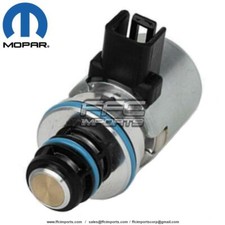
- Governor pressure transducer. The feedback sensor. This is the part P0868 is about.
- The computer, closing the loop between the two.
The transducer is the piece that makes this code possible. Sonnax makes the point directly: Chrysler 45RFE, 545RFE and 42RE-48RE series units have real pressure data coming from a transducer, while most transmissions have no transducer input to the PCM at all and what you see on a scan tool is only the command going out to the solenoid. On a 48RE your governor pressure PID is a measurement, not a model. That is worth something on a diagnosis, and it is also the reason the truck can catch its own sensor lying.
The Voltage Window, and Why Two Sources Give Different Numbers
The transducer is a three-wire potentiometer: 5 volt reference, ground, and signal. As governor pressure changes, the signal voltage tracks it. You will find two sets of numbers published for it, and both are correct once you know what each one describes.
- Transmission Digest gives the operating window: roughly 0.5 volts with zero psi inside the transducer, rising with pressure, and about 3.5 volts at maximum governor pressure. That is what a healthy truck actually shows you on a road test.
- ATRA gives the electrical span: about 0.60 volts at zero psi and 4.8 to 4.9 volts at the sensor's 100 psi ceiling. ATRA also notes that if governor pressure exceeds 100 psi, the signal rises above limits and sets a code saying the sensor is shorted.
The gap between 3.5 volts and 4.9 volts is your headroom. P0868 sets when the signal climbs into that headroom and stays there. On the gasoline side of the same family the PCM stores the identical fault as P1763, and Transmission Digest documents that code setting when the PCM sees 4.89 volts or higher on the governor pressure sensor circuit for eight seconds or more. Diesel trucks file it as P0868. Same circuit, same failure, different code number depending on what is bolted to the front of the bellhousing.
Either way the PCM shuts the governor solenoid off, which drives governor pressure to maximum, and the transmission starts and operates in third. If the customer says it takes off in third, you already know it is in failsafe before you plug anything in.
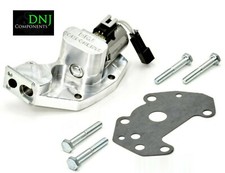
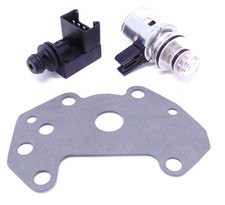
48RE Governor Pressure Solenoid Kit 4617210 with Sensor
The solenoid and the transducer sit side by side in the valve body, and the pan has to come off to reach either one. If the pan is coming down for a P0868, replacing both at once costs you one gasket and one fluid fill instead of two. This is the same 4617210 solenoid Chrysler bulletin 21-009-07 calls for on the 1-2 shift hunt complaint, bundled with the sensor.
Get the 48RE governor solenoid and sensor kit →Need only the transducer, or a filter, bands or a rebuild kit? Browse the full 48RE parts collection.
Read the Data Before the Pan Comes Down
You have three numbers available: desired governor pressure from the scan tool, actual governor pressure from the scan tool, and real pressure from a gauge on the governor tap. ATRA lays out the three combinations, and they sort this diagnosis in about ten minutes:
- Desired equals actual equals gauge. The governor pressure control system is working. If pressure is wrong for road speed anyway, look at the speed signal going to the computer, or the computer itself.
- Desired equals actual, but neither matches the gauge. The control system is fine and the transducer is out of spec. Check power and ground to the transducer first. If they are good, replace it. This is the classic P0868 truck.
- Actual and gauge agree with each other but not with desired. The control system is not working. Look for a fluid leak putting extra pressure into the governor circuit, a blockage in the governor circuit, or a bad solenoid.
For the gauge itself, follow Sonnax's rules or the readings will mislead you. Use a 0 to 100 psi gauge on the governor tap, because a 0-300 or 0-400 psi gauge is not sensitive enough to show the low pressures in the governor circuit with any accuracy. Expect roughly 1 psi of governor pressure per mph of road speed. Take the readings on a road test, not on a lift, since an unloaded transmission will not reproduce the conditions that set the code. Governor pressure should be near zero at a stop and rise almost in step with vehicle speed, and around 40 mph the computer shuts the solenoid off entirely so mainline holds the shift valves where they are.
The Three Causes Worth Chasing
1. The transducer is failing, including brand new ones
Transmission Digest documented a case that every 48RE builder should read before ordering parts. A 2005 Dodge 2500 4x4 with the 5.9L diesel came in for a rebuild. A new governor pressure transducer went in with the overhaul. The test drive was perfect for about five miles, then P0868 set. A second new transducer cleared it, and the truck went several more miles before setting P0868 again.
The cause was the new transducers themselves. Governor pressure enters the transducer, which converts it to a linear voltage signal. In the area where that conversion happens, pressure buildup was blowing a hole through the inside of the plastic unit. Transmission Digest notes this is more prevalent on performance transmissions running higher line pressures, which describes most of the modified Cummins trucks in the country. The fix is a metal-bodied transducer instead of the OE plastic one, and BD Diesel Performance builds a kit specifically for it.
The lesson: on a built truck, two failed transducers in a row is not bad luck. It is the sensor telling you the pressure behind it is above what the part can survive.
2. Line pressure is too high, and the sensor is honest
This follows straight from the last one, and there is a clean test for it. Per Transmission Digest, clear the codes, then drive the vehicle with the brake applied hard enough to activate the brake switch signal, which prevents the converter clutch from applying. If the code does not come back, release the brake and let the TCC engage. If the code sets immediately after converter clutch apply, line pressure above factory specification is your cause, and many times that traces to valve body modification done to firm up shifts and TCC apply.
That is a five-minute road test that saves a parts cannon. On the gasoline trucks, techs have handled the same problem by installing a 150-ohm quarter-watt resistor into the harness near the PCM connector as a voltage divider, which Transmission Digest reports works well. On a diesel truck the better answer is to bring line pressure back where it belongs rather than paper over the signal.
3. The ground, not the sensor
The governor pressure sensor does not have its own private ground. It shares a ground circuit with other sensors, and when that shared path is compromised the sensor signal floats high and stores the code even though the transducer is fine. Transmission Digest lists the companion codes that give it away: P1492 (battery temperature sensor volts too high), P1762 (governor sensor offset volts too low or too high) and P1757 (governor pressure above 3 psi at 0 mph). If any of those are stored alongside your governor pressure code, stop looking at the transmission and go find the ground.
On gasoline RE trucks the usual culprit is a heated oxygen sensor dragging the shared ground down, and the quick check is to unplug the upstream and downstream O2 sensors, clear the code and road test. A diesel truck does not have those sensors on that path, so that particular shortcut does not transfer. The principle does: pull the wiring schematic for the specific VIN, identify every sensor sharing the governor sensor's ground, and inspect each one. A malfunctioning alternator producing voltage spikes or high charging voltage belongs on the same list.
What Else Is Under That Pan
Once the pan is down, look at the rest of the governor circuit while you are in there, because a leak in it will keep actual pressure from ever matching desired no matter how good the sensor is.
The solenoid. TransGo reports that 1995 to 2007 Dodge, Ram and Jeep vehicles with the 40RE through 48RE frequently arrive with contaminated governor pressure solenoids, producing wrong gear starts along with governor solenoid and sensor performance codes. When the solenoid sticks or is restricted, the computer sees that measured pressure does not match commanded pressure, sets a code, and drops the unit into limp-in with a third gear start and no shift. Check resistance before you condemn it: ATRA gives the OE solenoid as a low-resistance unit at about 3.8 to 4.0 ohms at 70 degrees F, and TransGo states its repair kit only works on OE solenoids measuring 2.5 to 5.0 ohms. Outside that range the solenoid is scrap.
The governor bore plugs. Per Sonnax's 42-44-46-47RH/RE and 48RE valve body layout, governor oil leaving the solenoid acts on the 1-2 and 2-3 bore plugs, which sequentially stroke the shift valves. Wear in those bores shows up as 1-2 shuttle, oversensitive 2-3 and 3-2 shifts and early upshifts, and Sonnax addresses it with governor bore plug kit 22771-14K. Sonnax also lists Zip Kit 48RE-ZIP and Sure Cure kit SC-48RE for the rest of the 48RE valve body. If a truck has both a governor pressure code and shift quality complaints, the bores are where those two stories meet.
Fluid. Refill with ATF+4 to Chrysler material standard MS-9602. That standard exists because these units are sensitive to friction modifier. Shell's technical data sheet for Pennzoil Platinum ATF+4 states the fluid is approved against Chrysler MS-9602 and replaces ATF+3, ATF+2 and ATF+ (MS-7176) in Chrysler automatics, and it also warns the fluid is not for Chrysler 8-speed units, so do not treat ATF+4 as a universal Mopar fluid. A universal ATF in a 48RE will hand you a shift complaint that looks electrical and is not. Plan on roughly 7 to 8 quarts coming back on a pan drop, with the rest staying in the converter and cooler lines, plus a filter and pan gasket.
The Order That Actually Works
- Pull enhanced codes and the freeze frame. Note whether P1492, P1762 or P1757 are stored with it. Those change the whole diagnosis.
- Confirm failsafe. Third gear start means the PCM has already shut the governor solenoid off.
- Put a 0-100 psi gauge on the governor tap and road test it, watching desired and actual on the scan tool at the same time.
- Sort it with ATRA's three-condition table. Desired equals actual but not the gauge means the transducer. Actual and gauge together against desired means the hydraulics.
- Before replacing the transducer, verify its 5 volt reference and its ground at the connector. This is the step that gets skipped, and it is why some trucks eat three sensors.
- Run the brake-applied TCC test to rule high line pressure in or out.
- Then drop the pan and do the solenoid, the transducer, the filter and the gasket in one trip.
Worked in that order, most P0868 trucks are a transducer, a ground, or line pressure that somebody raised on purpose. Worked backwards, they are a rebuild that comes back with the code still stored.
FAQ
What does P0868 mean on a Dodge 48RE?
In a generic code book P0868 reads as a transmission fluid pressure sensor circuit fault, but that definition does not describe your truck. On a 2003-2007 Ram with a 48RE behind a diesel, Chrysler's own definition of P0868 is governor pressure sensor volts too high. The part it points at is the governor pressure transducer in the valve body under the pan, not a line pressure sensor. The 48RE does not have a line pressure sensor.
Why does my 48RE start in third gear with P0868?
That is failsafe, and it is normal behavior for this code. When the PCM stores a governor pressure fault it shuts the governor solenoid off, which sends governor pressure to maximum because the de-energized solenoid passes full mainline oil to the governor circuit. With the shift valves held that way the transmission starts and operates in third. If the truck launches in third, you can assume it is in failsafe before you even plug in a scan tool.
Is P0868 the same as P1763?
They are the same fault on the same circuit, split by which engine is in front of the transmission. Gasoline RE-series trucks store P1763, governor pressure sensor volts too high, and Transmission Digest documents that code setting at 4.89 volts or higher for eight seconds or more. Diesel trucks store the fault as P0868 instead. The diagnostic path, the wiring, the transducer and the third-gear failsafe are identical.
Can a shift kit or valve body work cause P0868?
Yes, and it is one of the most common causes on a modified Cummins truck. If line pressure has been raised to firm up shifts, governor pressure can be pushed past what the transducer is built to read, and the signal voltage goes over the limit. Transmission Digest gives a quick test: clear the code and drive with the brake applied hard enough to keep the converter clutch from applying. If the code stays away until you release the brake and the TCC engages, high line pressure is your cause, not the sensor.
What voltage should the 48RE governor pressure sensor read?
The transducer is a three-wire potentiometer running on a 5 volt reference. It sits at roughly 0.5 to 0.6 volts with zero psi in it, and the signal climbs with pressure. In normal driving you will see about 3.5 volts at maximum governor pressure. ATRA lists the sensor's full electrical span as about 4.8 to 4.9 volts at its 100 psi ceiling, which is the headroom above normal operation. The code sets when the signal climbs into that headroom and stays there.
Sources
- Transmission Digest — October 2018 issue, governor pressure transducer diagnosis. Backs the 2005 Dodge 2500 4x4 5.9L diesel 48RE case that set P0868 after roughly five miles on a new transducer and again on a second new transducer, the transducer providing a linear voltage signal of approximately 0.5 volts at zero psi rising to about 3.5 volts at maximum governor pressure, the failure mode of pressure blowing a hole inside the transducer where pressure is converted to voltage, the higher prevalence on performance transmissions running higher line pressures, and the metal transducer upgrade kit that replaces the plastic OE unit. transmissiondigest.com
- Transmission Digest — March 2006 issue, governor pressure sensor circuit diagnosis. Backs the P1763 set condition of 4.89 volts or higher on the governor pressure sensor circuit for eight seconds or more, the resulting third-gear failsafe, the shared ground path with the battery temperature sensor and heated oxygen sensors, the companion codes P1492, P1762 and P1757, the alternator voltage spike consideration, the brake-applied road test that proves whether high line pressure from valve body modification is generating the code, and the 150-ohm quarter-watt resistor used as a voltage divider in the harness. transmissiondigest.com
- ATRA / Gears magazine — Dave Skora, "Getting to Know the 42-48RE Series Transmissions, Part 1," July 2006. Backs the 42-48RE being hydraulically controlled for the first three gears with only fourth electronically controlled, the absence of a mechanical governor, the four-component governor system of output speed sensor, governor pressure solenoid, governor pressure transducer and computer, the solenoid resistance of about 3.8 to 4.0 ohms at 70 degrees F, the transducer signal of about 0.60 volts at zero psi and 4.8 to 4.9 volts near its 100 psi maximum, the code that sets when pressure exceeds 100 psi, the desired-versus-actual-versus-gauge diagnostic table, the solenoid shutting off around 40 mph, and the third-gear failsafe behavior. atracom.blob.core.windows.net (PDF)
- Sonnax — Jeff Parlee, "Transmission Diagnostics Using Pressure Gauges." Backs the statement that Chrysler 45RFE, 545RFE and 42RE-48RE series units have real pressure data from a transducer while most transmissions show only a PCM command to the EPC solenoid, the use of a 0-100 psi gauge for the governor circuit because higher-range gauges are not sensitive enough, the roughly 1 psi of governor pressure per mph rule, and taking pressure readings on a road test rather than on a lift. sonnax.com
- Sonnax — "Chrysler 42-44-46-47RH/RE, 48RE Valve Body Layout." Backs governor oil leaving the solenoid acting on the 1-2 and 2-3 bore plugs that sequentially stroke the shift valves, the governor bore plug kit 22771-14K and its symptom list of 1-2 shuttle, oversensitive 2-3 and 3-2 shifts and early upshifts, and the availability of Zip Kit 48RE-ZIP and Sure Cure kit SC-48RE for the 48RE valve body. sonnax.com
- TransGo — TF-GOV-SOL governor pressure solenoid repair kit technical page. Backs 1995 to 2007 Dodge, Ram and Jeep vehicles with the 40RE, 42RE, 44RE, 46RE, 47RE and 48RE frequently arriving with contaminated governor pressure solenoids, the resulting wrong gear starts and governor solenoid and sensor performance codes, the PCM setting a code and forcing limp-in with a third gear start and no shift when measured pressure does not match commanded pressure, and the OE solenoid resistance range of 2.5 to 5.0 ohms. transgo.com
- Shell / Pennzoil — Pennzoil Platinum ATF+4 Technical Data Sheet. Backs the approval against Chrysler specification MS-9602, its use where ATF+3, ATF+2 or ATF+ (MS-7176) is specified in Chrysler automatics, and the warning that it is not for Chrysler 8-speed transmissions. shell-livedocs.com (PDF)