A 2008 Silverado comes in with the light on, a bang on the 1-2, and a P0716 stored. The counter guy hears "speed sensor" and reaches for the one screwed into the tailhousing. That is the vehicle speed sensor. It is not the sensor this code is about, and on this transmission the one the code is about does not come out with the pan down.
P0716 is Input Speed Sensor Performance. Read the word performance the way the calibration engineer meant it: the circuit passed its electrical check, but the number coming back does not agree with the rest of the picture. That is a rationality fault, and it has a very different repair list than a dead wire.
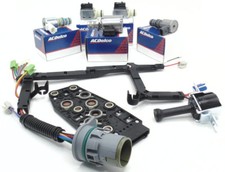
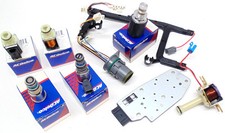
Which 4L60E Units Even Have an ISS
This matters before you diagnose anything, because a lot of 4L60Es cannot set P0716 at all. Per ATRA's 2005 technical update, the input speed sensor was fully implemented for the 2006 model year on the 4L60E and 4L65E, with some of the hardware pulled forward into mid-2005 builds, and the 4L70E arrived in 2006 using the same system. ATRA lists the two new codes by name: P0716 and P0717 were added for the ISS system.
Adding one sensor forced a surprising amount of hardware change. From the same ATRA update, the changes needed to make room for it and make it work were:
- The reverse boost / pressure regulator valve line-up was shortened. ATRA's note on that is worth taping to the bench: the PR valve train can no longer be serviced without removing the pump.
- Pump casting changes to relocate the S3 bore boss and to relocate the TCC release bore.
- Revised stator support sleeve passages.
- A new turbine shaft carrying 15 reluctor teeth, with the sealing rings moved to a different location.
- On applications that did not get an ISS, the sensor hole is filled with a plug.
Fifteen teeth is a number you can use. The sensor puts out one pulse per tooth, so signal frequency is turbine rpm divided by four. At a 2,000 rpm turbine speed you should see roughly 500 Hz on a scope, and around 150 Hz at idle in gear. If the frequency at the sensor is right but the scan tool reads zero, the problem is downstream of the sensor.
What the Controller Is Actually Comparing
The ISS is a hall switch, not a variable reluctance pickup. ATRA is explicit: the sensor must have a good power supply and ground to operate. That single sentence rules out about half of the parts-cannon repairs on this code. A two-wire magnetic sensor generates its own signal. A hall switch does nothing at all without feed and ground, and it reads a flat zero rather than a noisy signal when either one is missing.
Once it is running, the controller uses input speed for line pressure, shift scheduling, TCC slip calculation and gear ratio. GM's own OBD-II monitor table for the 4L60E states the ratio math plainly: ratio is measured NI/NO, input speed over output speed. Every ratio-based diagnostic in the transmission depends on the ISS being honest.
That dependency has a consequence most techs never notice. Look at the enable conditions in GM's table and you will see No ISS P0716, P0717 DTCs listed as a requirement for the transmission fluid temperature high-input monitor, both output speed sensor monitors, and the PRNDL ratio monitor. An active ISS code switches off a whole block of other transmission diagnostics. So when a truck shows up with only a P0716 stored, that is not proof nothing else is wrong. It is proof nothing else was allowed to look.
The Two Wiring Failures That Cause Most of These
1. The harness gets eaten by the reverse input drum
Transmission Digest published this one as a post-repair comeback, which is how most shops meet it. The complaint is a vehicle that returns after transmission work with P0716 or P0717. The cause: the input speed sensor wiring was not properly secured in its locating brackets on the back of the pump assembly, and the wires were damaged by the spinning reverse input drum, which sits very close to that harness. The correction is not a part. It is putting the wiring back in the brackets it was designed to sit in.
If you build these units, that is a checklist item, not a suggestion. The drum turns at turbine speed any time the engine runs in gear. A harness lying a quarter inch out of its bracket does not fail on the lift. It fails on the customer's second tank of fuel.
2. Casting flash cuts the unshielded section
ATRA documents the version that happens without anyone doing anything wrong. Part of the ISS wiring is not shielded in conduit, and casting flash on the pump can wear through it. If either the sensor signal circuit or the sensor voltage feed circuit shorts to ground, the sensor stops working entirely. ATRA's correction is specific, and it is the half people skip: replace the sensor and dress the sharp edges on the pump that caused the damage. Put a new sensor against the same flash and you have bought yourself another comeback.
The Test Sequence That Keeps You Out of Trouble
Work the connector, not the parts catalog. On the case connector, ATRA identifies pin E as power, pin V as ground, and pin K as signal. The signal circuit is circuit 1230, running from case connector pin K to PCM/TCM pin 3.
- Verify feed and ground at the case connector. Digital multimeter on pins E and V, key on. No power or no ground means you are chasing a harness or a module, not a sensor.
- Substitute a signal. ATRA's fastest check: unplug the case connector and feed the controller a 12 volt square wave from a signal generator on the signal circuit, then watch input speed on the scan tool. If a speed shows up, the wiring from the connector out to the module is fine and the problem is inside the transmission or intermittent.
- Ohm out circuit 1230. With both the module connector and the transmission connector unplugged, check circuit 1230 for a short to ground. This is the test that catches the casting-flash failure without pulling the unit.
- Run GM's ground test. Per bulletin PIP5084A, install the J 44152 harness (20 pins) on the engine side of the transmission inline 20-way connector, then go from terminal E to terminal V with a test light. If the light does not come on, the internal ground in the TCM is suspect.
- Split the TCM from the sensor. Still per PIP5084A: unplug the TCM connector and check continuity across pins 45 and 49. No continuity means replace the TCM and the ISS. Continuity present means replace the ISS only. That one measurement is the difference between a sensor and a programmed module, and it takes about thirty seconds.
Circuit 1984 is the ground leg the bulletin has you chase, running from ISS terminal V to TCM terminal 45. Transmission Digest adds the field fix for a TCM that has lost that ground internally: splice into circuit 1984/1231 and ground it externally rather than replacing the module. Know your customer and your warranty exposure before you go that route, but it is a documented repair and it works.
4L60E Input Speed Sensor, GM OEM 24244544
This is the exact ISS part number GM calls out in bulletin PIP5084A for the P0716 / P0717 repair on 4L60E trucks. If the pin 45-to-49 continuity check passed, this is the whole fix, and it is the part to have in hand before the pump comes off.
View the ISS, OEM 24244544 →Pump already apart? Browse the full 4L60E parts collection at Core Transmission Parts for seals, solenoids and pump components while you are in there.
The Rebuilder Trap: a Shaft With No Teeth
Here is the one that will cost you a second teardown, and no amount of wiring testing will find it. The ISS reads reluctor teeth on the turbine shaft. Mix cores from before and after the 2006 change and you can end up with a unit that is electrically flawless and has nothing to read.
Sonnax's TASC Force documents the exact mismatch: you may find a pump cover that does not have the ISS hole drilled, but has a reluctor-style stator with no reluctor on the input shaft. Their note is that this situation requires an ISS stator. Sonnax also warns what a wrong stator does in general on the 4L60-E, 4L65-E and 4L70-E: no movement, converter charge concerns, input shaft failure and converter damage. That is considerably worse than a code.
Their three checks before the pump goes back together are quick. Look at the sealing ring locations on the 300mm shaft, because there are several variations out there. Lay a straightedge through the center of the pump bolt holes and note whether the converter feed hole sits left or right of the line - early pumps put it just right of the line, late pumps just left. Then look at the stator: early stators have the converter feed and lube holes in line with each other, late stators put the feed hole to the right of the lube hole.
If you land on a mismatch, the Sonnax numbers are 77918S-08K for the reluctor-style stator support shaft assembly (298mm converter), 77733-12SB for a heavy duty input shaft in a 300mm reluctor-style application, and 77733-11SB for the non-reluctor version. Order by what the pump and the sensor need, not by what the old shaft looked like.
Fluid, and Why It Is Not the Answer Here
Every generic write-up on this code opens with "check the fluid." On a hall-effect sensor with a dedicated feed and ground, dirty fluid is not a plausible root cause, and chasing it wastes a bay. Fill the unit correctly because it is the right thing to do, not because it will clear a P0716. Every 4L60E family unit from the 2006 model year forward - the same line where the ISS appears - takes DEXRON-VI, which GM-approved fluid makers list as recommended for all 2006-and-beyond GM Hydra-Matic transmissions under spec GMN10060 (per the Pennzoil ATF Dexron-VI data sheet). It is fully back serviceable into DEXRON-III(H), III and IIE applications, so there is no reason to keep two fluids on the shelf for this family.
Shop 4L60E speed sensors, internal harnesses, pump and stator components, solenoids, overhaul kits and DEXRON VI — shipped fast from the USA.
Shop 4L60E parts →What It Costs to Get Wrong
GM prices this repair honestly in PIP5084A. The parts list is two lines: 24244544 input speed sensor and 24252114 transmission control module, with labor operations K6311 for the sensor and K5365 for the module. The bulletin also carries a tell about how stubborn this one can be. If the vehicle comes back with P0717 again, GM tells the dealer to stop and call the Technical Assistance Center rather than keep replacing parts.
The reason to get the diagnosis right up front is access. This is not a pan-drop sensor. It lives at the back of the pump, which means the transmission comes out and the pump comes off. Selling the wrong sensor on this code does not cost you a $45 part. It costs you the whole R&R twice.
FAQ
What does P0716 mean on a 4L60E?
P0716 is Input Speed Sensor Performance. It is a rationality code, not a circuit code. The controller is not saying the wire is open; it is saying the input speed number it is receiving does not make sense next to engine speed and output speed. On the 4L60E family the ISS only exists on 2006-and-later units and mid-2005 pull-ahead builds, because that is when GM added the 15 reluctor teeth to the turbine shaft and a hall-effect sensor to the pump.
Where is the input speed sensor on a 4L60E?
It is not on the outside of the case. The ISS mounts at the back of the pump assembly and reads the reluctor teeth on the turbine shaft, so the transmission has to come out and the pump has to come off to replace it. That is why the wiring damage matters so much: the harness runs right past the spinning reverse input drum, and getting to it is a teardown, not a pan drop.
Can a bad input speed sensor cause harsh shifts?
Yes, and GM says so directly. Bulletin PIP5084A lists the customer complaint on 2013 Express, Silverado, Savana and Sierra trucks with the 4L60E as a harsh shift or an illuminated MIL, with P0716 or P0717 sitting in the TCM as history. The controller uses input speed to set line pressure, shift timing and TCC slip, so when the number drops out the strategy defaults to something firm and ugly.
Do I have to replace the whole TCM for P0716?
Only if the TCM has lost its internal ground. PIP5084A gives the split: unplug the TCM connector and check continuity across pins 45 and 49. If there is no continuity, replace the TCM and the ISS. If there is continuity, replace the ISS only. Transmission Digest documents a field workaround for the lost internal ground - splice circuit 1984/1231 and ground it externally rather than buying a module.
Why did P0716 come back right after my rebuild?
Because the ISS harness was not put back in its locating brackets on the back of the pump. Transmission Digest documents exactly that comeback: unsecured wiring gets chewed by the spinning reverse input drum. ATRA documents the other version, where casting flash on the pump cuts through the section of ISS wiring that is not covered by conduit. Both look identical on a scan tool and both mean the unit comes back out.
Shop the part for this fix
The ISS, pump components, stator supports and the rest of the 4L60E catalog live at Core Transmission Parts. Same family, same part numbers, real inventory on the shelf.
Shop 4L60E parts at Core Transmission Parts →Related 4L60E guides
Sources
- ATRA (Automatic Transmission Rebuilders Association), 2005 GEARS technical update, General Motors section — Confirms the ISS was introduced for the 2006 model year on the 4L60E/4L65E with pull-ahead into mid-2005, that the 4L70E launched in 2006 using the same system, that the turbine shaft received 15 reluctor teeth with relocated seal rings, that non-ISS pumps get the sensor hole plugged, that the PR valve train can no longer be serviced without removing the pump, and that P0716 and P0717 were the two DTCs added. https://atracom.blob.core.windows.net/manuals/individual/2005/2005-63.pdf
- ATRA, 2010 GEARS technical bulletin: 4L60/65/70E Hard/Erratic Shifts, DTC P0716 and/or P0717 — Source for the ISS being a hall switch, case connector pin E power / pin V ground / pin K signal, signal circuit 1230 to PCM/TCM pin 3, the square-wave signal generator substitution test, and the pump casting flash that shorts the unshielded section of ISS wiring to ground. https://atracom.blob.core.windows.net/manuals/individual/2010/2010-39.pdf
- General Motors bulletin PIP5084A (January 2013), hosted by NHTSA — Source for the affected vehicles (2013 Express, Silverado, Savana and Sierra with the 4L60E / M30), the harsh shift and MIL complaint, the circuit 1984 check from ISS terminal V to TCM terminal 45, the J 44152 harness, the test-light ground check between terminals E and V, the TCM pin 45-to-49 continuity split, part numbers 24244544 and 24252114, and labor operations K6311 and K5365. https://static.nhtsa.gov/odi/tsbs/2013/MC-10112742-9999.pdf
- Transmission Digest, GM 4L70-E ISS DTC P0716 or P0717 (October 8, 2020) — Source for the post-rebuild comeback pattern: ISS wiring not secured in its locating brackets on the back of the pump and damaged by the spinning reverse input drum, plus the lost-internal-TCM-ground condition and the circuit 1984/1231 external ground repair between TCM terminal 45 and case connector terminal V. https://www.transmissiondigest.com/gm-4l70-e-iss-dtc-p0716-or-p0717/
- Sonnax, 4L60-E Series Input Shaft, Stator & Pump Cover Compatibility: Three Easy Checks (Caleb Perham, TASC Force, July 12, 2024) — Source for the reluctor / non-reluctor shaft mismatch that leaves a 2006-up core with no teeth for the ISS to read, the early-versus-late pump cover and stator identification checks, and Sonnax part numbers 77918S-08K, 77733-12SB and 77733-11SB. https://www.sonnax.com/tech_resources/1419-4l60-e-series-input-shaft-stator-pump-cover-compatibility-three-easy-checks
- General Motors GSI, 2005 Transmission Diagnostic Parameters, 4L60E (document 2005trans10) — GM's own OBD-II monitor table. Source for gear ratio being calculated as NI/NO, and for the fact that an active P0716 or P0717 is a disable condition on the transmission fluid temperature, output speed sensor and PRNDL ratio monitors. https://gsi.ext.gm.com/gmspo/mode6/pdf/2005/2005trans10.pdf
- Shell / Pennzoil, "ATF Dexron-VI" technical data sheet — Backs DEXRON-VI as the fluid recommended for all 2006-and-beyond GM vehicles with Hydra-Matic automatic transmissions, the same model-year line where the 4L60E gained the ISS, that it meets GM specification GMN10060, and that it is fully back serviceable for DEXRON-III(H), III and IIE applications. shop.sclubricants.com (PDF)