A truck rolls in with a P0756 and no third gear. The counter sells a shift solenoid, the tech installs it, and three days later the same truck is back with the same code and the same complaint. That sequence plays out in shops every week, and it happens because the code name is misleading.
P0756 is Shift Solenoid B Performance or Stuck Off. The operative word is performance. The PCM is not reporting that the solenoid failed. It is reporting that the transmission did not end up in the gear it asked for. Those are different statements, and only one of them points at a part you can buy over a counter.
Related reading: 4L60E P0751, shift solenoid A performance and the electrical codes P0753 and P0758.
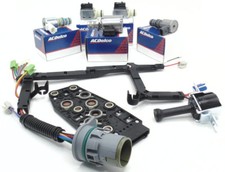
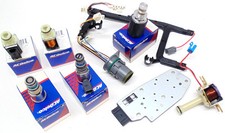
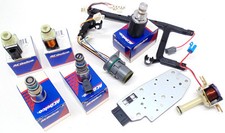
What Solenoid B Actually Controls
The 4L60E gets all four ratios out of two on-off shift solenoids. Solenoid A is the 1-2 solenoid; solenoid B is the 2-3 solenoid, GM part number 24230299. The pattern is fixed:
- 1st gear - A on, B on
- 2nd gear - A off, B on
- 3rd gear - A off, B off
- 4th gear - A on, B off
Solenoid B does not move a clutch. It holds or exhausts signal oil on the end of the 2-3 shift valve. When the PCM turns B off for the 2-3 upshift, that signal oil dumps, the valve strokes, and the valve body routes line pressure to apply the 3-4 clutch while releasing the 2-4 band. Sonnax documents a second job for the same valve on this family: it also governs overrun clutch apply, which is why the OE valve leaves the overrun clutch released in D3 first and second and only applies it in D3 third.
The PCM sees none of that hydraulics. It watches the input and output speed sensors, calculates actual ratio, and compares it to the commanded gear. Per ATRA's technical staff, that ratio comparison is the entire basis of a performance code. In a real Transmission Digest road test on a 4L60E-equipped S-10, the scan tool showed 1.6:1 while third was commanded, then 1.0:1 once the shift finally happened, and 0.69:1 in fourth. Command third, read back 1.6, and the module sets P0756 against a solenoid that may be doing exactly what it was told.
The Hydraulic Story Behind the Code
Solenoid B is a small electrical valve sitting on top of a hydraulic system that has to supply it. Sonnax, writing in Transmission Digest, puts a number on that supply: in the GM 4L60-E and 4L80-E, line pressure is regulated to approximately 115 psi by the actuator feed limit valve and fed to the shift solenoids, the pressure control solenoid, the TCC solenoid, the 3-2 control solenoid, and the 2-3 shift valve lineup. Every one of those consumers hangs off one valve.
That AFL valve is a known weak point. The OE design has a large reaction area on its spring end, so it side-loads in an aluminum bore, and the EPC solenoid's constant oscillation of the torque signal keeps the valve working. Sonnax states the consequence plainly on their AFL kit: as the bore wear increases, oil pressure is reduced to the shift solenoids, which causes solenoid and ratio codes. The published symptom list on that kit includes solenoid performance codes and wrong gear starts by name.
So the common P0756 is not an electrical failure at all. Solenoid B energizes and de-energizes correctly, but there is not enough clean feed oil behind it to stroke the 2-3 shift valve, the unit hangs in second, and the ratio monitor reports the discrepancy.
Second cause: the 2-3 shift and shuttle valves are worn in their own bores
Sonnax's 4L60-E vacuum test guide lists the 2-3 shift and 2-3 shuttle valves under exactly two symptoms: wrong gear starts and gear ratio codes. That is the textbook description of a P0756 complaint. Their repair for that location is oversized valve kit 77754-62K, which needs tooling F-77754-TL62 and VB-FIX. On the neighboring bore, the 3-4 shift valve wears at the spools and bore lands, worst at the signal A spool and land, and produces second gear starts, low AFL pressure and 3rd clutch failure; that one takes kit 77754-42K with tool F-77754-TL42.
Bore wear does not look like anything. You will not spot it with a flashlight. The whole point of vacuum testing is that the valve is checked in its rest position and a low vacuum reading indicates wear on a casting that photographs perfectly clean.
Third cause: the 2-3 flare that eats your 3-4 clutch
There is a version of this failure that destroys parts while you are still diagnosing it. When solenoid B does not turn off cleanly, its signal oil exhausts slowly instead of dumping, and the 2-3 shift valve creeps across its bore rather than snapping. The 2-4 band comes off before the 3-4 clutch has apply pressure behind it. You get a flare on the 2-3, engine speed runs up, and the 3-4 clutch pack absorbs the whole shift as heat. Repeat that a few hundred times and the code stops being the problem. That is why "it only does it sometimes, I will get to it" is expensive advice on this unit.
4L60E 2-3 Shift Solenoid, OEM 24230299 (1993-2008)
If the electrical testing below actually condemns solenoid B, this is the exact part for it - the 2-3 solenoid, not a guess kit. Most shops do A and B together, since the pan is already off and the labor is spent either way.
View the 2-3 shift solenoid →Doing both at once? The 1-2 and 2-3 solenoid set, 24230298-KIT covers A and B, or browse the full 4L60E parts collection.
How to Test It Instead of Guessing
ATRA's list for any solenoid performance code has three entries: a solenoid stuck open or closed, a blocked valve body or stuck shift valve, and a failed clutch, brake or gear. Two of the three are not a solenoid. ATRA calls the codes that set because a solenoid never received the pressure it needed ghost codes, and their recommended first move is a line pressure test rather than a parts order.
Here is the order that keeps you out of trouble on a 4L60E.
- Read all codes and note whether P0758 is also stored. P0758 is Shift Solenoid B Electrical: an open, a short, a circuit fault. If you have both, chase the electrical code first, because the ratio fault is downstream of a solenoid that never got current.
- Check fluid level and condition, driveline, and harness routing. Cheap, fast, and it disqualifies a surprising number of these before you have spent an hour.
- Road test watching commanded gear, SSA state, SSB state and calculated gear ratio together. Commanded third with the ratio parked at 1.6:1 confirms the unit is hanging in second. If the ratio eventually arrives on its own, time it - a delayed shift is a different fault than a no-shift.
- Command the solenoids on and off with the scan tool and listen. A healthy one gives you a distinct click going on and a clack coming off. A click with no clack means it is not releasing.
- Measure the circuit, do not eyeball it. GM's diagnosis charts spec shift solenoid resistance at 19 to 31 ohms. In the Transmission Digest case below, the tech put an ammeter inline to ground, read 0.49 amps on the 1-2 circuit and applied Ohm's Law for 26.5 ohms, then calculated 27 ohms on the 2-3 circuit - both in spec. Use a voltmeter, never a test light; a test light will glow at voltages a solenoid cannot work on.
- Scope the low-side driver if the mechanical and static electrical tests pass. Back-probe the control circuit with the PCM connected. Commanded off, the circuit should sit at source voltage; commanded on, it should pull to 0 V, with crisp transitions on both edges.
- Pull the valve body and vacuum test. Actuator feed limit valve, 2-3 shift and 2-3 shuttle valves, 3-4 shift valve, pressure regulator valve. Test in the rest position. Low vacuum means wear, and wear means ream and install an oversized valve - not another solenoid.
A case that shows why step six exists
Gordon Kehler documented a 2001 Chevrolet S-10 in Transmission Digest that came in revving high with no proper shift and a stored code for the 2-3 solenoid circuit. On the road test, third was commanded and the ratio stayed at 1.6:1, then the shift would suddenly arrive by itself. Starting out in manual third, the ratio change lagged the command by 20 to 25 seconds, cold or hot, every time.
Every static test passed. Twenty-seven ohms on the 2-3 circuit. A clean click-clack when he cycled the solenoid with a remote button at the PCM connector. Only when he scoped the low-side driver with the PCM plugged in did the fault appear: the 1-2 driver cycled 13 V to 0 V with a crisp edge, while the 2-3 driver took 15 to 27 seconds to turn off. The solenoid was fine. The computer's driver was lazy. A replacement PCM corrected it.
That is the diagnostic ceiling on this code. A solenoid, a worn valve bore, a plugged spacer plate orifice and a slow computer driver all produce the same DTC and the same customer complaint. The only thing that separates them is testing.
Working a 4L60E this week?
Shift solenoids, EPC and TCC solenoids, valve body and shift kits, internal harnesses, filters and DEXRON VI — the parts to fix P0756 right, shipped from the USA.
Shop 4L60E parts →The Fix, Matched to What You Proved
Repair what the testing found, not what the code was named after.
If the AFL bore tested low: ream it and install Sonnax kit 77754-09K, which uses a hardcoat anodized aluminum valve with annular grooves to resist side-loading and runs in a full-contact sleeve giving 54 percent more support than the OE valve had. It installs with tool kit 77754-TL, which also covers the 4L80-E. Fixing this valve raises solenoid feed and line pressure at the same time, so it frequently clears codes on more than one circuit.
If the 2-3 shift or shuttle valve bore tested low: that is 77754-62K with F-77754-TL62 and VB-FIX. If the 3-4 shift valve bore is also worn - and if you have any 3rd clutch distress it very likely is - do 77754-42K on the same pass rather than pulling the valve body twice.
If the electrical testing genuinely condemned the solenoid: replace B and A together. Same access, same gasket, same fluid. Know your unit before you order: 1995-and-later PWM units carry a 13-pin case connector, a PWM TCC solenoid and five solenoids total, while 1993-1994 non-PWM units use a 12-pin connector with four.
If you found a burnt 3-4 clutch: the code was a symptom of a unit the flare has already damaged. Fix the hydraulic cause in the same job or the new clutch pack goes the same way. If the vehicle sees load, this is also the moment to consider the heavy duty 2-3 shift valve 77754-41, which applies the overrun clutch in D3 first, second and third instead of third only, taking load off the input sprag and forward clutch.
Refill with DEXRON VI, the current GM specification for this family and backward compatible with the DEXRON III these units were filled with new. Budget roughly 5 to 6 quarts for a pan and filter service and about 11 to 12 quarts dry. Remember that 1998-and-later C/K trucks and vans got a deeper pan along with a longer dipstick, tube and stop bracket; mixing those parts across years is an easy way to end up a quart off with a level that reads correct. Set it hot, in gear, on level ground.
Then verify by duplicating the complaint, not by looking at the dash. Bring the unit to operating temperature, hold a steady light-throttle pull, and watch calculated ratio walk from 1.6 to 1.0 the moment third is commanded. No lag, no flare. That is the proof. An unlit warning light is not.
FAQ
What does P0756 mean on a 4L60E?
P0756 is Shift Solenoid B Performance or Stuck Off. It is a performance code, not an electrical one. The PCM uses input and output speed sensor data to calculate actual gear ratio and compares it to the gear it commanded. When it turns solenoid B off for third and the ratio comes back at 1.6:1 instead of 1.0:1, it sets P0756. A brand-new, electrically perfect solenoid can still set this code if the 2-3 shift valve never strokes.
Can I drive a 4L60E with a P0756?
Briefly and gently, but it is not a code to sit on. The failure mode that produces P0756 often includes a slow 2-3 shift valve, which lets the 2-4 band release before the 3-4 clutch applies. That flare dumps the entire shift energy into the 3-4 clutch pack as heat. A code that started as a valve body repair turns into a rebuild if you keep driving it.
Will a new shift solenoid B fix P0756?
Sometimes, but it is not the odds-on bet. Per ATRA, a solenoid performance code has three causes: a solenoid stuck open or closed, a blocked valve body or stuck shift valve, and a failed clutch, brake or gear. Sonnax lists solenoid performance codes and wrong gear starts as published symptoms of actuator feed limit bore wear, which starves the shift solenoids of feed oil. Run a line pressure test before ordering parts.
What is the difference between P0756 and P0758?
P0758 is Shift Solenoid B Electrical - the PCM sees an open, a short, or a circuit fault in the solenoid's power or ground path. P0756 says the circuit is electrically acceptable but the transmission did not reach the commanded gear. They are separate diagnostic trees. If both are stored, chase P0758 first, because a solenoid that never received current will also fail the ratio test.
What resistance should a 4L60E shift solenoid measure?
GM's diagnostic charts spec 19 to 31 ohms. In the Transmission Digest case study, the tech measured current instead - 0.49 amps on the 1-2 circuit worked out to 26.5 ohms by Ohm's Law, and the 2-3 circuit calculated to 27 ohms. Both were in spec, which is exactly why he kept testing and eventually scoped the PCM driver instead of selling a solenoid.
Shop 4L60E parts →
Sources
- Transmission Digest — "Hydraulic Fundamentals: AFL/Solenoid Modulator Valves," by Sonnax (April 28, 2020). Backs the figure that GM 4L60-E and 4L80-E line pressure is regulated to approximately 115 psi and fed to the shift solenoids, pressure control solenoid, TCC solenoid, 3-2 control solenoid and the 2-3 shift valve lineup; the large reaction area and resulting side-loading that makes the AFL bore susceptible to wear; and the statement that worn AFL bores in the 4L60E produce low actuator feed and line pressures, with leakage resulting in flooded or starved solenoid feed. transmissiondigest.com
- Transmission Digest — "Diagnosing an unusual problem: A slow-to-respond solenoid," Gordon Kehler (January 26, 2023). Backs the case study and the electrical specifications used in this article: the 2001 Chevrolet S-10 with a 4L60E, the observed gear ratios of 1.6:1 in second, 1.0:1 in third and 0.69:1 in fourth, the 20-to-25-second lag between commanded and actual ratio change, GM's shift solenoid resistance specification of 19-31 ohms, the 0.49-amp reading calculating to 26.5 ohms on the 1-2 circuit and 27 ohms on the 2-3 circuit, the click-clack solenoid command check, the lab scope capture showing the 2-3 low-side driver taking 15 to 27 seconds to turn off, and the PCM replacement that corrected it. transmissiondigest.com
- Sonnax — Actuator Feed Limit Valve Kit 77754-09K (GM 4L60-E, 4L65-E, 4L70-E). Backs the AFL valve's role as the solenoid feed regulator supplying the EPC and shift solenoids, the stated cause that actuator feed limit bore wear results in low pressure at the shift and EPC solenoids, the published symptom list including solenoid performance codes, wrong gear starts, erratic line pressure and 2nd gear starts, the explicit statement that increasing bore wear reduces oil pressure to the shift solenoids and causes solenoid and ratio codes, and the repair specification of a hardcoat anodized aluminum valve with annular grooves running in a full-contact sleeve for 54 percent more support, installed with tool kit 77754-TL. sonnax.com
- Sonnax — "GM 4L60-E, 4L65-E, 4L70-E Vacuum Test Guide" (January 21, 2013; revised June 2026). Backs the valve-by-valve symptom mapping and the part and tool numbers used in the diagnosis and repair sections: that OE valves are tested in their rest position and a low vacuum reading indicates wear; that the 2-3 shift and 2-3 shuttle valves are associated with wrong gear starts and gear ratio codes and are repaired with 77754-62K requiring F-77754-TL62 and VB-FIX; that the actuator feed limit valve is associated with wrong gear starts, solenoid performance codes, erratic line pressure, no 4th, harsh shifts and 2nd gear starts and is repaired with 77754-09K; and the pressure regulator valve replacement number 77917-07. sonnax.com
- Sonnax — Oversized 3-4 Shift Valve Kit 77754-42K (GM 4L60-E, 4L65-E, 4L70-E). Backs the adjacent-bore failure described in the hydraulic section: that wear at the shift valve spools and bore lands allows loss of critical hydraulic pressure, that wear is typically most severe at the signal A spool and land, and that the resulting symptoms are 2nd gear starts, low AFL pressure, 3rd clutch failure and 3-4 concerns, corrected by reconditioning the bore and installing 77754-42K with tooling F-77754-TL42 and VB-FIX. sonnax.com
- GEARS Magazine (ATRA) — "Performance Codes: Knowing Where to Start." Backs the definition of a performance code as distinct from an electrical code, the control module's use of input and output speed sensor signals to calculate actual gear ratio and compare it against the shift schedule, the three published causes of a solenoid performance code (a solenoid stuck open or closed, a blocked valve body or stuck shift valve, and a failed clutch, brake or gear), the ghost-code concept in which a performance code sets because the solenoid is not receiving the pressure it needs rather than because the solenoid failed, and the recommendation to run a line pressure test before replacing solenoids. gearsmagazine.com
Shop 4L60E shift solenoids, EPC and TCC solenoids, valve body and shift kits, internal harnesses, filters and DEXRON VI — shipped fast from the USA.
Shop 4L60E parts →