A Silverado 1500 with a 4L60E that "slips" usually shows up with a story: it was fine until the camper went on the hitch, or until the kid put 33s on it, or it started flaring after a long pull up a grade in July. The half-ton Chevy is the single most common home for this transmission, and it works the unit harder than a car or a light SUV ever will. Its weight, towing duty, and a couple of GM-documented failure patterns tell you where to look before you pull the pan.
The short version: Confirm the truck actually has a 4L60E (RPO M30 on the glovebox label) and not a 6L80. Check DEXRON-VI hot, between 160 and 200°F on the dash TRANS TEMP readout, per the GM owner manual. Then match the slip to the gear. Slip in 3rd and 4th on a Silverado is the 3-4 clutch the large majority of the time, and on 2012 trucks GM PIP5031 adds a specific cause: the turbine shaft walking in the input housing and bleeding off 3-4 pressure. A rebuild that does not fix the pressure loss will burn the new pack too.
First, Make Sure It Is a 4L60E
Half-ton Silverados from the GMT800 (1999-2006) and GMT900 (2007-2013) generations came with more than one automatic. The 2012 Silverado owner manual lists capacities for both the 4L60-E four-speed and the 6L80-E six-speed in the same truck line, which means two trucks of the same year can need completely different parts.
Open the glovebox. GM's Service Parts Identification label lists the production options for that VIN. You are looking for:
- M30 — 4L60-E (the RPO GM uses in PIP5031)
- M32 — 4L65-E, the heavier-duty version found behind some larger V8s
- M70 — 4L70-E
GM groups all three together in its service bulletins (the P0756 bulletin covers RPOs M30, M32, and M70), and the slip diagnosis below applies to each of them.
Why the Silverado Is Hard on a 4L60E
In a Silverado the 4L60E lives with a heavy vehicle, bigger tires, and towing. Each one raises the torque the 3-4 clutch and 2-4 band have to hold, and raises fluid temperature, which hardens seals and lets apply pressure bleed off.
GM's own owner information makes the point in plain terms. The 2012 manual warns that spinning the tires, or holding the truck on a hill with the accelerator alone, can damage the transmission and is not covered by warranty. It also tells owners to stop and idle if the TRANSMISSION HOT IDLE ENGINE message appears, because driving on overheated fluid can damage the unit. If the truck you are looking at has a hitch, a lift, or a history of that message, assume the clutches have seen heat.
Tow/Haul mode exists for a reason. GM describes it as adjusting the shift pattern to reduce shift cycling and help transmission cooling when towing, hauling, or descending grades. Trucks that tow without it hunt between 3rd and 4th, and every cycle is a 3-4 clutch apply under load.
Step 1: Check the Fluid the Way GM Wrote It
A Silverado 4L60E that is a quart low will slip in turns and on grades as the pump pulls air at the filter. Before anything else, check it correctly. On GMT900 trucks GM has you read the temperature right off the cluster:
- Engine running, truck level, parking brake set, in Park.
- Foot on the brake, move the lever through every range, pausing about three seconds in each, then back to Park.
- Idle 500-800 rpm for at least a minute.
- Scroll the Driver Information Center until TRANS TEMP displays.
- For the hot check, the reading needs to be between 71 and 93°C (160-200°F). The cold check (80-90°F) is only a reference.
- Pull the dipstick (rear of the engine bay, passenger side), wipe, reinsert, wait three seconds, and read the lower level on both sides. Do it twice and make sure the readings agree.
The fluid is DEXRON-VI. GM notes a low unit generally needs less than 0.5 L (1 pint) to get into the HOT band, so if it takes more than that, you have a leak to find. A pan-and-filter service on the 4L60-E takes about 4.7 L (5.0 qt) per GM. Do not confuse the transmission with the transfer case on a 4x4: GM fills the transfer case with DEXRON-VI too, but it is a separate 1.5 L (1.6 qt) unit with its own fill plug.
Read what is on the stick. Pink and clean with a slip means a pressure or electrical problem. Brown, burnt-smelling fluid with black friction material in the pan means the clutches are already damaged, and a fluid change will not bring them back.
Step 2: Match the Slip to the Gear
The 4L60E apply chart does most of the diagnosis for you. Drive it and note exactly where the engine flares. The ratios are 3.06, 1.63, 1.00, and 0.70, so with scan data you can also divide engine (or input) speed by output speed and see whether the unit is actually holding the gear it says it is in.
| What the Silverado does | Element involved | Look at |
|---|---|---|
| Flare on the 2-3 shift, slips in 3rd and 4th, fine in 1st and 2nd | 3-4 clutch | 3-4 pack, input housing, 3rd accumulator checkball, pump and stator |
| Flare on the 1-2 shift, slips in 2nd, weak 4th | 2-4 band and servo | Servo seals and pin bore, 4-3 sequence valve wear |
| Slips pulling away in Drive but Reverse is fine | Forward clutch and sprag | Forward clutch leak, low line pressure |
| Starts in 2nd or 3rd, feels like a soft slip from a stop | Shift valve hydraulics | AFL orifice, 2-3 shift valve (GM P0756 bulletin) |
| RPM creeps at steady highway speed, worse when hot or towing | Converter clutch | TCC circuit (see our P0894 guide) |
On Silverados, the first row is the one you will see most. The 3-4 clutch is applied in both 3rd and 4th and the truck spends most of its life in 4th at highway speed.
Step 3: The GM-Documented Silverado Causes
Turbine shaft moving in the input housing (PIP5031)
GM Preliminary Information PIP5031, dated June 2012, covers 2012 Silverado, Sierra, Colorado, Canyon, Express, and Savana with the 4L60E (RPO M30). The condition is slipping, late, or missed shifts in 3rd and 4th, sometimes with P0716 and P0717 (input speed sensor codes). Teardown shows a distressed 3-4 clutch. The cause: the turbine shaft is moving in the input housing, which lets fluid pressure escape from the 3-4 clutch. The input speed sensor teeth can move far enough out of position that the ISS signal drops out, which is why speed sensor codes can show up on what is really a mechanical failure.
GM's inspection is simple. If the 3-4 clutch feed hole is visible where the shaft meets the housing, the shaft has moved and the input housing needs to be replaced. GM's recommendation is a new input housing; if the shaft checks out, the PIP points technicians to PIP3136. On a Silverado with ISS codes and a 3rd/4th slip, look at the input housing before you replace the sensor.
3rd gear oil leaks and low line pressure
Sonnax's 4L60E 3-4 clutch article puts it bluntly: low line pressure and leaks of 3rd gear oil are the root cause of most 3-4 slipping. The 3-4 circuit connects to the D4, forward, 2nd, and 3rd accumulator circuits, so a handful of small leaks add up. The ones Sonnax calls out that matter most on a high-mileage truck:
- Input housing checkball: vacuum test it. Sonnax treats anything below 25 in-Hg as an impermissible leak.
- 3rd accumulator checkball (#7): it lives in the servo area and leaks both 3-4 apply pressure and band release pressure. Per Sonnax, a leak here can burn the 3-4 clutch and the 2-4 band at the same time. Test it with vacuum or solvent and reseat or replace it. Do not cup-plug it; Sonnax notes that blocks the vent and causes soft 2-3 shifts and 3-2 flares.
- Stator shaft and pump: worn stator sleeve where the input shaft sealing rings ride, a sleeve that has rotated and partly blocked a feed hole, a sticking pump slide, and worn boost valve bores.
- Backing plate flex: the OE 3-4 backing plate flexes under load. A heavy-duty plate (Sonnax 74140-01K) stops it, which matters on a truck that tows.
2nd/3rd/4th gear starts that feel like slipping (P0756)
Some Silverado owners say "slipping" when the truck actually launches in 2nd or 3rd and feels gutless from a stop. GM bulletin 01-07-30-036F covers this on 4L60-E, 4L65-E, and 4L70-E units through 2007. P0756 sets when the PCM sees a 4-3-3-4 shift pattern. GM ranks the causes: debris plugging AFL oil orifice #29 on top of the spacer plate is the most likely, then a stuck 2-3 shift valve or 2-3 shuttle valve, and last, a leaking 2-3 shift solenoid. GM is explicit that replacing the solenoid will not fix it unless the solenoid is cracked, broken, or leaking. Wiring faults set P0758, P0787, or P0788 instead.
Step 4: Scan Data and a Pressure Gauge
Before the transmission comes out, gather proof:
- Engine codes first. Sonnax notes that TP, MAP, and MAF faults change the line pressure the computer commands. A truck with a lazy MAF can slip a healthy transmission.
- Trans fluid temp (TFT): watch it under load. If it climbs past 200°F on a light tow, look at the cooler and lines before blaming the clutches.
- Commanded vs. actual gear and the ratio math: in 3rd, input speed should equal output speed (1.00 ratio). Input running ahead of output in 3rd or 4th is a slipping 3-4 clutch.
- TCC slip speed: on 1998-and-later units with EC3 controls the converter rarely runs at full lockup, and Sonnax puts normal TCC slip at 20-40 RPM under most conditions. If slip speed climbs well past that at cruise with lockup commanded, the converter clutch is slipping, not the 3-4 pack. Sonnax ties that to wear in the TCC regulator and isolator valve bore, which leaks apply pressure to exhaust and sets 894/1870 codes; the repair is a ream and the 77754-04K valve kit, plus the 77754-ISO sleeve if the isolator section is worn too.
- Line pressure: put a gauge on the line tap and compare idle and stall readings in each range to the factory spec. Low across all ranges points at the pump, pressure regulator, or EPC solenoid. Sonnax's indicator for a worn pump pressure regulator bore is a reading 50-100 psi below spec in Reverse during boost; the fix is reaming the bore for an oversized valve (77917-07) and checking the boost valves for leakage while you are there. Normal line pressure with a 3rd/4th slip points at a leak inside the 3-4 circuit.
The Fix, and Making It Last
If the fluid is clean and the slip goes away with the level corrected, find the leak and you are done. If the 3-4 clutch is burnt, the truck needs a rebuild, and on a Silverado the rebuild needs to cover the reason it burned:
- Replace the 3-4 pack with a higher-capacity setup. A 3-4 PowerPack adds friction surface area, and a heavy-duty backing plate stops flex.
- Inspect the input housing per PIP5031. If the feed hole is exposed or the bore is galled, it gets replaced.
- Vacuum test the input housing checkball, the 3rd accumulator checkball, the servo, and the valve body bores Sonnax lists (AFL, 2-3 shift, 3-4 shift, 4-3 sequence, TCC regulator).
- Replace the AFL screens on the separator plate and clean orifice #29.
- Flush the cooler and lines so the debris from the old pack does not land in the new one.
- Fill with DEXRON-VI and check hot at 160-200°F.
For prevention on a working half-ton: use Tow/Haul whenever there is a trailer behind it, stop and idle if the TRANSMISSION HOT message appears, keep the fluid level in the HOT band, and do not hold the truck on a hill with the throttle.
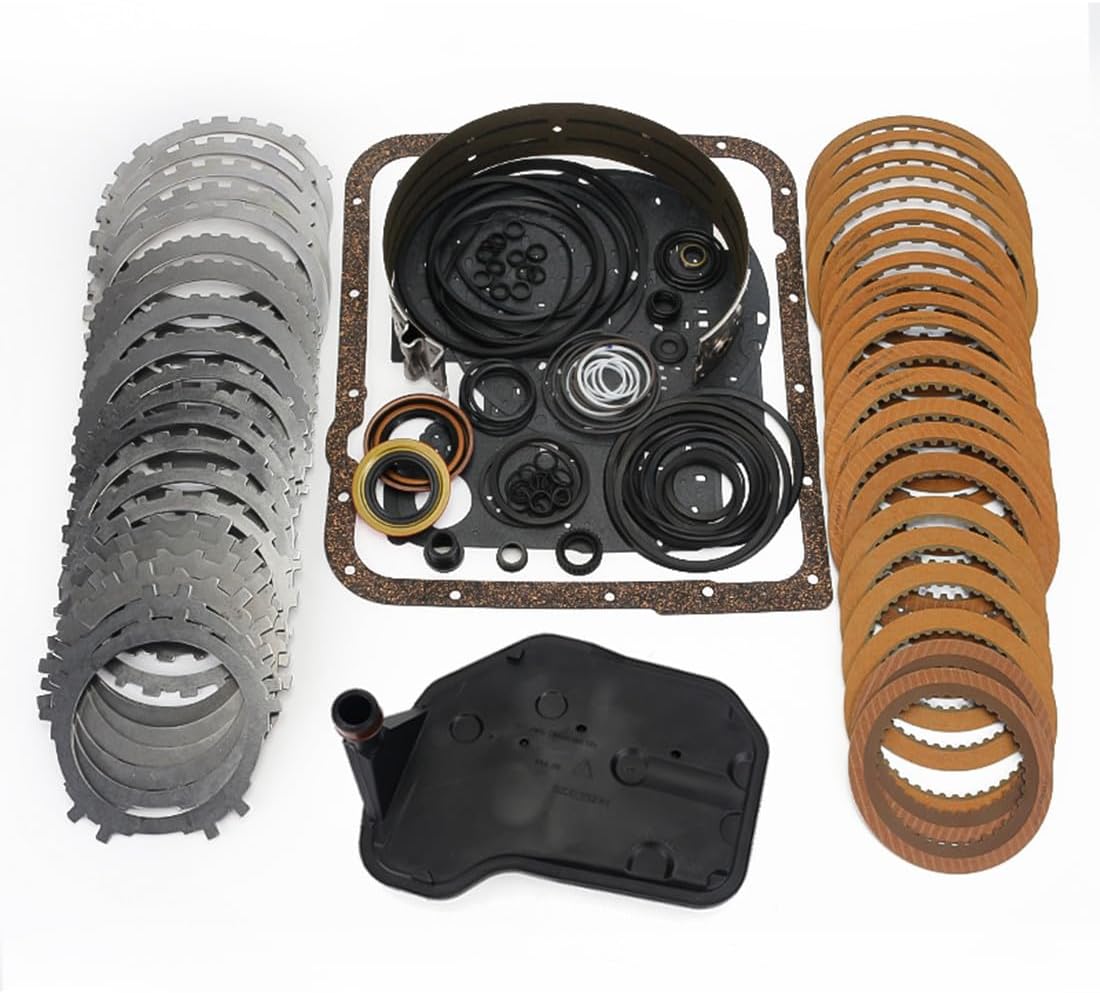
4L60E Master Rebuild Kit for Silverado (1997-2003)
Frictions, steels, seals, and gaskets matched to the GMT800-era Silverado 4L60E. If your truck is a different year, the full 4L60E lineup is here.
See the Silverado rebuild kit →FAQ
Why is my Silverado 4L60E slipping in overdrive?
Slip in 4th, usually with a flare on the 2-3 shift, points at the 3-4 clutch because it is applied in both 3rd and 4th. Sonnax identifies low line pressure and 3rd gear oil leaks as the root cause of most 3-4 slipping. On 2012 Silverados, GM PIP5031 also documents the turbine shaft moving in the input housing and bleeding off 3-4 pressure.
What transmission fluid does a Silverado 1500 4L60E take and how much?
GM specifies DEXRON-VI. A pan and filter service on the 4L60-E takes about 4.7 L (5.0 qt) per the 2012 Silverado owner manual. Check the level hot, with TRANS TEMP between 160 and 200 degrees F, and expect a low unit to need less than a pint.
Can P0716 or P0717 cause slipping on a Silverado?
The codes themselves do not cause slipping, but GM PIP5031 links them to a mechanical failure. When the turbine shaft moves in the input housing, the 3-4 clutch loses pressure and slips, and the input speed sensor teeth can move far enough to drop the signal. Inspect the input housing before replacing the sensor.
Will a fluid change stop a Silverado 4L60E from slipping?
Only if the slip came from low or degraded fluid and the clutches are not burnt yet. If the fluid is dark and smells burnt with friction material in the pan, the 3-4 pack is damaged and the transmission needs a rebuild that also fixes the pressure leak that burned it.
Keep the numbers at the bench. Our free transmission fluid spec chart lists the correct ATF type for the 4L60E and dozens of other units, so you never top off with the wrong fluid.
Sources
- General Motors Preliminary Information PIP5031 (via NHTSA). Backs: 2012 Silverado/Sierra 4L60E (RPO M30) slip in 3rd or 4th, the turbine shaft moving in the input housing, P0716/P0717 from ISS signal dropout, the visible 3-4 feed hole inspection, and the new input housing recommendation. static.nhtsa.gov/odi/tsbs/2012/SB-10045063-2502.pdf
- General Motors — 2012 Chevrolet Silverado Owner Manual. Backs: 4L60-E and 6L80-E both listed for the truck line, DEXRON-VI, the TRANS TEMP hot check at 71-93°C (160-200°F), the less-than-a-pint note, 4.7 L (5.0 qt) pan and filter capacity, 1.5 L transfer case fill, Tow/Haul description, and the tire-spinning and TRANSMISSION HOT warnings. GM Owner Center: 2012 Silverado owner manual (PDF)
- Sonnax — All Over the Map: Attacking 4L60/E Burnt 3-4 Clutches with Confidence. Backs: low line pressure and 3rd gear oil leaks as the root cause of most 3-4 slipping, the 25 in-Hg input housing checkball threshold, backing plate flex and 74140-01K, stator and pump checks, valve body bores to test, AFL screens, and engine sensor effects on line pressure. sonnax.com/tech_resources/659
- Sonnax — Guard Against 4L60/E Band & 3-4 Clutch Failure: Test the 3rd Accumulator Checkball Assembly for Leakage. Backs: #7 checkball leakage lowering 3-4 apply and band release pressure, and the vacuum and solvent tests. sonnax.com/tech_resources/323
- Vehicle Service Pros — summary of GM bulletin 01-07-30-036F, DTC P0756 2nd/3rd/4th gear start. Backs: RPOs M30/M32/M70, the 4-3-3-4 detection logic, AFL orifice #29 as the most likely cause, 2-3 shift and shuttle valve causes, and the electrical codes P0758/P0787/P0788. vehicleservicepros.com: GM shift DTC
- Sonnax — Understanding 4L60-E Series Isolator Bore Wear and How to Address It. Backs: EC3 controls on 1998-later units, 20-40 RPM normal TCC slip, the TCC regulator/isolator bore wear mechanism and 894/1870 codes, and the 77754-04K and 77754-ISO repairs. sonnax.com/tech_resources/1440
- Sonnax — Oversized Pressure Regulator Valve 77917-07 technical page. Backs: regulator bore wear symptoms (low line rise, 3-4 clutch failure, reverse chatter), the 50-100 psi low-in-Reverse indicator, and the boost valve leak check. sonnax.com/parts/2493