The 4L60E vs TH350 question comes up from two directions. Somebody with a TH350 in a C10, Nova or Camaro wants overdrive and has a 4L60E out of a junkyard Silverado. Or somebody running an LS swap with a 4L60E that keeps failing wants to know if a TH350 would just be simpler. Both are fair. The answer comes down to gear ratios, how each unit decides when to shift, what it takes to install, and where each one breaks on the bench.
Here is the builder's comparison. The 4L60E numbers come from GM's own Chevrolet Performance spec sheet. The TH350 service numbers come from GM's 1976 Chevrolet light truck service supplement. Swap dimensions come from Novak Conversions, and failure points come from Sonnax, Transmission Digest and GEARS (ATRA). All of them are listed under Sources.


The Short Version
| Item | GM 4L60E | GM Turbo Hydra-Matic 350 |
|---|---|---|
| Forward speeds | 4, with 0.70 overdrive | 3, no overdrive |
| 1st / 2nd / 3rd / 4th | 3.06 / 1.63 / 1.00 / 0.70 | 2.52 / 1.52 / 1.00 / none |
| Shift control | PCM or TCM, shift solenoids, pressure control solenoid | Hydraulic: governor, vacuum modulator, detent cable |
| Converter clutch | Yes, computer-controlled | None on TH350; electric lockup on 1979-84 TH350C |
| Case length | 21.9 in (Novak) | 21-3/4 in (Novak) |
| Dry weight | 146 lb (Novak); GM lists about 156 lb with a 298 mm converter | 120 lb (Novak) |
| Bellhousing | Removable on late units | Cast into the case |
| Factory fluid | Dexron VI on current GM sheets | Dexron-family ATF; GM approves Dexron VI for older units |
The 4L60E ratios are GM's: the Chevrolet Performance Supermatic sheet for the 4L65E/4L70E family lists 3.059, 1.625, 1.000 and 0.696 with a 2.294 reverse [1]. The TH350 ratios of 2.52, 1.52 and 1.00 are the commonly published GM figures. The case lengths and weights come from Novak's swap guides [3][4].
Gear Ratios: First Gear and Cruise RPM
First gear. The 4L60E starts at 3.06 against the TH350's 2.52, about 21 percent more multiplication. Behind a 3.73 axle that is an overall first of roughly 11.4:1 for the 4L60E and 9.4:1 for the TH350. A car swapped from a TH350 to a 4L60E feels like it got a steeper rear gear. Going the other way, from a 4L60E to a TH350, it feels lazy off the line unless you also change the axle ratio.
Highway rpm. This is why people want the 4L60E. The formula is rpm = mph x axle ratio x 336 / tire diameter. With a 28 in tire and a 3.73 axle at 65 mph, the TH350 turns about 2,900 rpm in third. The 4L60E turns about 2,030 rpm in fourth. And because the 4L60E locks its converter in fourth, that number is close to real. A non-lockup TH350 adds converter slip on top of its 2,900.
The 1-2 step. This is the trade-off. The 4L60E drops from 3.06 to 1.63, a step of about 1.88. The TH350 drops from 2.52 to 1.52, about 1.66. The wider 4L60E step pulls rpm down harder on the 1-2 shift, which a big-cam engine does not like, and it is part of why harsh 1-2 shifts hurt the 4L60E. Sonnax sells an input carrier kit (77284-K) that changes 4L60E first gear from 3.06 to 2.84 to close that gap [5].
How Each One Decides When to Shift
TH350: vacuum, governor and a cable
The TH350 is fully hydraulic. GM's 1976 truck supplement describes the vacuum modulator as a diaphragm and one spring. The spring raises modulator pressure, and engine vacuum works against it. Low vacuum (heavy throttle) gives high modulator pressure, and high vacuum gives low pressure [2]. A governor on the output supplies road speed, and a detent downshift cable to the carburetor handles forced downshifts. GM adjusts that cable with the throttle held wide open and the snap-lock pushed flush [2].
That makes the TH350 very forgiving. Give it vacuum, hook up the detent cable and it will shift. You need no wiring, no computer and no tuning. It is the reason the TH350 is still the default behind carbureted small-blocks.
4L60E: everything goes through a computer
The 4L60E has no governor and no throttle cable. Shift timing, line pressure and converter lockup are all commanded electrically. GM's own Supermatic sheet says it plainly: "TCM needed" [1]. Novak notes that the simplest path is to run the transmission with the engine and computer it came with. For other engines, GM sells a standalone controller (12497316), and a carbureted engine also needs a throttle position sensor [4].
Sonnax's valve body guide shows how the electrical side changed over the years. 1993-94 units have four solenoids and no separate TCC solenoid, and 1995-later units have five [6]. PWM solenoids should measure 10-15 ohms, and the plastic on/off 3-2 solenoid on 1996-later units should measure 20-31 ohms [6]. Those values are worth checking on a used core before you decide whether the problem is the transmission or the wiring.
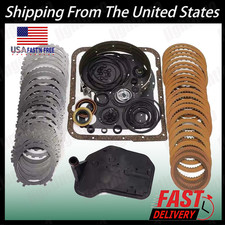
Shop the part for this fix: 4L60E heavy-duty rebuild kit with 3-4 Power Pack
Building a used 4L60E core for a swap? This kit covers the 1993-2008 unit and addresses the 3-4 clutch, its best-known weak spot. TH350 kits are in the CTP TH350 collection.
View the 4L60E heavy-duty rebuild kit →Browse all 4L60E transmission parts or TH350 transmission parts.
Physical Fit: Length, Weight and Bellhousing
The cases are closer in size than most people expect. Novak lists the TH350 at 21-3/4 in long and 120 lb [3], and the late 4L60E at 21.9 in long, 146 lb dry and 162 lb wet [4]. GM's sheet lists about 156 lb dry and 176 lb wet with a 298 mm converter, and a 2WD overall length of about 30.6 in with the tailhousing, or 22.5 in for a 4WD case [1]. The case is not usually the problem in a swap. The problems are the tailhousing, the crossmember mount location and the driveshaft length, so measure the driveshaft. Do not assume it will carry over.
The bellhousings differ. The TH350's bellhousing is cast into a one-piece case, and it came in Chevy, Buick-Olds-Pontiac and dual-pattern "unicase" versions [3]. The late 4L60E has a removable bellhousing, which Novak calls the key identifier for the late version [4]. That makes it easier to adapt, but it also means you need the correct bellhousing for the engine family and converter depth.
Two install specs from GM's 4L60E sheet are worth taping to the bench. Put 6-8 oz of Dexron VI in the converter before installing it. With the converter fully seated and the case against the block, the flexplate-to-converter pad gap must be at least 1/8 in and no more than 1/4 in [1]. Torque the converter to flexplate at 37 ft-lb, the transmission to the engine at 37 ft-lb, the pan at 18 ft-lb and the drain plug at 25 ft-lb [1]. On a TH350, GM specifies 35 ft-lb for the converter to flywheel and case to engine, 130 in-lb for the pan and valve body bolts, 18-1/2 ft-lb for the pump to the case, and 25 ft-lb for the extension housing [2].
Line Pressure and Fluid
The TH350 is easy to test with a gauge. GM's 1976 supplement gives line pressure for the 350 V8 at 1,200 rpm with the modulator vacuum line disconnected: 167 psi in Drive, 166 psi in L1 or L2, and 254 psi in Reverse. At 12 in Hg absolute manifold pressure with the modulator connected, it reads 85 psi in Drive, 105 psi in L1 or L2 and 129 psi in Reverse [2]. A low reading in every range points at the pump, the pressure regulator or a leaking circuit. A reading that will not rise with the modulator disconnected points at the modulator or its valve.
On the 4L60E, line pressure follows commanded pressure control solenoid current, so a gauge reading only makes sense next to the scan tool's commanded value. Sonnax traces many 4L60E pressure complaints to a worn pressure regulator bore and boost valve, which cause pump pressure pulsation and damage the pump vane ring [5].
For fluid, GM's current Supermatic sheet calls for Dexron VI and lists about 11.2 qt dry with a 300 mm converter [1]. Novak lists 8.4 qt with a 9.64 in converter and 11.4 qt with an 11.81 in converter [4]. For the TH350, GEARS quotes GM that units that originally used Dexron II/III can now be serviced with Dexron VI [8]. GEARS also notes Dexron VI is thinner at 100 C (5.8-6.4 cSt, against 6.8-8.0 cSt for older conventional fluid), so a worn, leaky old unit may show it [8]. GM's 1976 supplement calls for about 2-1/2 qt of fresh fluid after a TH350 pan drain. It sets the severe-service interval at 15,000 miles for heavy city traffic, regular 90 F heat, hills, towing or commercial use. The intervals for normal driving differ: the lubrication section says 60,000 miles, but the TH350 section says to drain the pan and clean the strainer every 30,000 miles [2]. On an old unit with unknown history, use the shorter number.
Where Each One Fails
4L60E:
- 3-4 clutch burnup. Sonnax blames a stock backing plate that flexes and a pack with too little room for steels to absorb heat [5]. This is the 4L60E failure most swap builds run into.
- 2-4 band and servo. Sonnax says to set servo apply travel between .075 in and .125 in with a dial indicator, never shim the servo, and never put a wider band on a used drum [5].
- Checkball leaks. Sonnax links a leaking 3rd accumulator checkball (#7) to band and 3-4 clutch failure, and recommends vacuum testing it [5].
- Tuning. Wrong pressure tables in a swap tune drop line pressure. Sonnax recommends confirming base pressure, pressure rise and max pressure with a gauge [5].
TH350:
- Intermediate overrun clutch outer race. Sonnax says racing a TH350 or TH350C puts huge stress on the stock race and sells a heavy-duty replacement (35723HD-02) [7]. Transmission Digest describes the same heavy-duty race for upgraded street units [7].
- Modulator. A leaking diaphragm pulls ATF into the intake. Look for low fluid and white exhaust smoke. A weak modulator shifts soft and late. GM's J-2466 comparison check measures a suspect modulator against a known-good one [2].
- Linkage and detent adjustment. GM warns that a shift linkage out of detent drops oil pressure and partially engages clutches, which fail "after only a few miles" [2].
Swapping One for the Other
TH350 to 4L60E needs more than the transmission:
- A controller. Use the factory PCM or a standalone TCM, plus a throttle position sensor on a carbureted engine [1][4].
- A crossmember for the 4L60E mount location, and a new driveshaft length.
- A vehicle speed sensor signal for the controller and speedometer.
- The correct bellhousing and a converter that matches the 30-spline input [4].
- Cooler lines. GM's sheet says the lower case fitting is cooler out and the upper is the return [1].
Going from a 4L60E to a TH350 means losing overdrive and computer-controlled lockup. In exchange, you get a three-speed that needs only vacuum and a detent cable.
So Which One Should You Run?
Pick the TH350 for a carbureted build that mostly sees short drives or the strip, where simplicity matters more than cruise rpm. It is lighter, it needs no electronics and it is easy to diagnose with a pressure gauge.
Pick the 4L60E for a car or truck that spends real time on the highway, or for any LS swap where the computer is already there. The 3.06 first and 0.70 overdrive let you run a steeper axle and still cruise near 2,000 rpm. Build it for the power, though. A stock 4L60E behind a built engine runs into the 3-4 clutch and band problems above. GM's own Supermatic ratings for the strengthened 4L65E and 4L70E are 430 and 495 lb-ft [1], and that tells you where the family sits.
Need parts for this job?
4L60E master rebuild kits, 3-4 clutch packs, shift kits and solenoids, plus TH350 master kits, modulators and valve bodies. Secure checkout on our site.
Shop 4L60E parts →Frequently Asked Questions
Is a 4L60E stronger than a TH350?
Not by default. Both are light-to-medium duty GM units, and a stock 4L60E behind a built engine tends to burn its 3-4 clutch or damage the 2-4 band. GM rates its strengthened 4L65E and 4L70E descendants at 430 and 495 lb-ft. Either transmission needs upgraded parts to live behind real power.
What are the 4L60E and TH350 gear ratios?
GM lists the 4L60E-family gearset at 3.059, 1.625, 1.000 and 0.696 with a 2.294 reverse. The TH350 is a three-speed with commonly published ratios of 2.52, 1.52 and 1.00. The 4L60E has about 21 percent more first-gear multiplication plus a 30 percent overdrive.
How much will a 4L60E lower my highway rpm compared to a TH350?
With a 28 in tire and a 3.73 axle at 65 mph, a TH350 in third turns about 2,900 rpm plus converter slip. A 4L60E in fourth turns about 2,030 rpm and locks its converter. The exact numbers change with tire size and axle ratio.
Does a 4L60E need a computer to run?
Yes. It has no governor or throttle cable, so shift timing, line pressure and lockup all come from a controller. GM's Supermatic sheet says a TCM is needed. Novak lists GM controller 12497316 for engines without a compatible PCM, plus a throttle position sensor on carbureted engines.
Can I put Dexron VI in a TH350?
GEARS quotes GM that transmissions that originally used Dexron II/III can now be serviced with Dexron VI. Dexron VI is thinner at operating temperature, so a worn old unit with marginal seals may show it. Check the level hot on the dipstick after any fluid service.
Sources
- Chevrolet Performance (GM) — Supermatic Transmission Specifications, PN 19260445. Backs the 3.059 / 1.625 / 1.000 / 0.696 / 2.294 ratios, the "TCM needed" control note, the 430 lb-ft (4L65E) and 495 lb-ft (4L70E) ratings, Dexron VI with 11.2 qt dry using a 300 mm converter, the 156 lb dry and 176 lb wet weight, the 30.6 in 2WD and 22.5 in 4WD lengths, the 1/8-1/4 in converter gap, the 6-8 oz converter pre-fill, cooler line direction, and the 37/37/18/25 ft-lb torques. chevrolet.com (GM PDF)
- General Motors — 1976 Chevrolet Light Truck Service Overhaul Supplement (ST-330-76), Section 7A Turbo Hydra-Matic 350 and Specifications. Backs the vacuum modulator description, the WOT detent cable adjustment, the 167/166/254 psi and 85/105/129 psi line pressure figures, the J-2466 modulator comparison, the out-of-detent warning, the 2-1/2 qt pan refill, the 15,000/30,000/60,000 mile service intervals (Sections 0 and 7A), and the TH350 torque specs. GM manual PDF (73-87chevytrucks.com archive)
- Novak Conversions — The Novak Guide to the GM TH350 Automatic Transmission. Backs the 1969 introduction, the 21-3/4 in length and 120 lb weight, the integral bellhousing with Chevy, BOP and unicase patterns, the modulator location, and the 1979-84 TH350C lockup. novak-adapt.com
- Novak Conversions — The Novak Guide to the GM 4L60E Automatic Transmission. Backs the 21.9 in length, 146 lb dry and 162 lb wet weight, the removable late bellhousing, the 30-spline input, controller 12497316 and the TPS requirement for carbureted engines, and the 8.4/11.4 qt capacities. novak-adapt.com
- Sonnax — Building the Killer 4L60E: Top Tips for Optimizing Your Transmission Upgrades. Backs the 3-4 clutch burnup cause, the .075-.125 in servo travel, the #7 checkball test, the PR and boost valve pump pulsation, gauge-verified tuning, and the 77284-K 2.84 first-gear carrier. sonnax.com
- Sonnax — GM 4L60-E Valve Body Identification Guide. Backs the four-solenoid 1993-94 units with no TCC solenoid, the five-solenoid 1995-later units, and the 10-15 ohm PWM and 20-31 ohm on/off resistance ranges. sonnax.com
- Sonnax — Stop TH350-C Intermediate Race Failure with a Sonnax Heavy Duty Race; and Transmission Digest — Heavy-Duty TH350/350C Intermediate Outer Race. Backs the stock intermediate overrun outer race as a known weak point under high power and the 35723HD-02 heavy-duty replacement. sonnax.com / transmissiondigest.com
- GEARS Magazine (ATRA) — Viscosity and ATF. Backs GM's statement that Dexron II/III transmissions can be serviced with Dexron VI, and the 5.8-6.4 cSt vs 6.8-8.0 cSt viscosity figures at 100 C. gearsmagazine.com