The Turbo Hydra-Matic 350 is a simple box on paper: three forward speeds, one reverse, a vacuum modulator, a cable kickdown and no electronics at all on the non-lockup version. But the numbers behind it decide almost everything about how a car or truck built around one will drive. Gear ratios set launch and highway rpm. Case length and output configuration decide whether it fits your tunnel and transfer case. Fluid capacity and line pressure specs are what you check it against when something goes wrong.
This page collects the TH350 specs a builder actually reaches for, with every number tied to a manufacturer or service source listed at the bottom. Where a spec varies by year or application, we say so instead of handing you one number that is only right half the time.
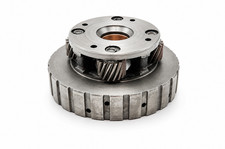

TH350 Gear Ratios
TCI's published gear ratio chart lists the factory TH350 at 2.52:1 first, 1.52:1 second and 1.00:1 third. Third is direct drive; there is no overdrive. Reverse is commonly published at 2.07:1. Those ratios come from a Simpson-style compound planetary gearset, the same basic layout GM used in the TH400 and later units, so the TH350 is a close cousin of the bigger box in how it makes its gears.
How it compares to its neighbors
The same TCI chart gives the factory ratios for the units most people are deciding between:
- Powerglide: 1.76 or 1.82 first, 1.00 second. Holley's GM transmission history notes the 1.82 version was the far more common one, with 1.76 reserved for high-performance cars and some trucks.
- TH350: 2.52 / 1.52 / 1.00.
- TH400: 2.48 / 1.48 / 1.00.
- 200-4R: 2.78 / 1.57 / 1.00 / 0.67.
- 700R4 / 4L60E: 3.06 / 1.63 / 1.00 / 0.70.
Two things jump out. First, the TH350 actually has a slightly deeper first gear than the TH400, so a TH350 car leaves the line a hair harder on the same axle. Holley's Jeff Smith makes the point that the 2.52 first gear was the reason the TH350 felt so much better than the Powerglide it replaced in 1969. Second, the 700R4's 3.06 first is a big jump over the TH350's 2.52. That is why a TH350-to-700R4 swap usually feels like an axle gear change at the same time as it drops your cruise rpm. See our TH350 vs 700R4 and TH350 vs TH400 guides for the full comparison.
What the steps mean on the road
The split between gears tells you where the engine lands after each upshift. Divide the next gear by the current one:
- 1-2 shift: 1.52 / 2.52 = 0.60. Shift at 5,000 rpm and the engine drops to about 3,020 rpm.
- 2-3 shift: 1.00 / 1.52 = 0.66. Shift at 5,000 rpm and you land near 3,290 rpm.
That is a well-spaced box for a small block with a mild cam. An engine with a narrow, high power band will fall off the cam on the 1-2 shift, which is one reason drag builders swap the low gear planetary (more on that below).
Overall ratio and cruise rpm
Multiply the transmission ratio by the axle ratio to get the overall ratio. On a 3.73 axle, a TH350 gives 9.40:1 in first. The same axle behind a TH400 gives 9.25:1, and behind a 700R4 it gives 11.41:1.
For highway rpm, use the standard formula: RPM = MPH x axle ratio x transmission ratio x 336 / tire diameter in inches. On a 27-inch tire at 65 mph, a TH350 in third (1.00) runs about 2,490 rpm on a 3.08 axle and about 3,020 rpm on a 3.73. Put the same 3.73 car behind a 700R4 in fourth (0.70) and it drops to about 2,110 rpm. That 900 rpm gap is the entire argument for overdrive. Torque converter slip adds a little on top of these numbers on a non-lockup TH350, so expect the tach to read slightly higher than the math.
The 2.75 low gear option
TCI lists a 2.75:1 first gear option for the TH350, with second staying at 1.52. It replaces the low gear planetary and changes only first. A 2.75 first on a 3.42 axle gives 9.41:1 in first, almost identical to a stock 2.52 on a 3.73, while cruising about 250 rpm lower at 65 mph on a 27-inch tire. The trade-off is a bigger 1-2 drop (1.52 / 2.75 = 0.55), so the engine falls further after the shift.
Case, Weight and Dimensions
Novak's TH350 guide gives the basics that matter for fitment:
- Case: one-piece aluminum alloy casting with an integral bellhousing.
- Length: 21-3/4 inches.
- Weight: 120 lb.
- Bellhousing patterns: Chevrolet and BOP (Buick, Oldsmobile, Pontiac), with some dual-pattern cases.
- Years: introduced for 1969, used in nearly all GM rear-wheel-drive cars and trucks through 1984, and phased out in favor of the 700R4 starting in 1982.
- RPO codes: M33, M38 and M39 for the conventional unit; MV4, MX2, MX3 and MX5 for the lockup TH350C.
The TH350C, per Novak, arrived in the late 1979 model year with an electrically applied lockup converter and is identified by the electrical plug on the left side of the case. Its gear ratios are the same as the standard TH350; the lockup only changes what happens in the converter.
Pan and identification
The TH350 pan is nearly square with one corner chamfered at the passenger-side rear, held by 13 bolts. The vacuum modulator sits at the right rear of the case. Holley's guide calls out the same two tells. Our TH350 identification guide covers tag locations and date codes.
Output Shaft and Tailhousing Configurations
The TH350 uses a 27-spline output on every version, the same count as the 700R4. What changes is how far the shaft sticks out and what bolts to the back. For 4WD units, Offroad Design documents two common versions:
- Output sticks out about 7/8 inch from the back of the case: the most common 4WD unit, originally paired with NP203 and NP205 transfer cases.
- Output sticks out about 2-1/2 inches: used with the NP208 in early-1980s trucks.
2WD units carry a tailhousing and a long output shaft in different lengths depending on the car or truck, and they are not useful for a 4WD build without changing the shaft. Measure the tailhousing before you order a driveshaft. Two TH350s that look identical from the side can need driveshafts several inches apart in length.
Internal Specs
Clutch packs
Raybestos Powertrain's OE replacement friction pack for 1969-1986 TH350s (RCP96-036) contains 9 frictions for the forward and direct clutches combined, 3 intermediate and 5 low/reverse. Raybestos's Stage-1 and Blue Plate Special performance packs list 10 forward/direct frictions instead of 9, which is the common route to more holding capacity in the forward and direct drums.
Endplay and valve body
GM's own numbers for the end clearances are in the 1975 Buick Service Manual, Section 7C (Turbo Hydra-Matic 350-375B). With the pump installed, push the input shaft rearward, zero a dial indicator on the end of it, then push the output shaft forward: the direct clutch to oil pump clearance should read between .030 and .079 inch. If it does not, the pump comes back out and the selective thrust washer is changed. The same section sets forward clutch pack clearance, pressure plate to faced plate with a feeler gauge, at no less than .011 and no more than .082 inch, corrected with one of three pressure plates of different thickness. Many builders tighten that end play toward the low end of the window on a performance unit; the factory range is the go/no-go. Take the reading before you pull the pump on teardown so you know which way to correct.
The same GM section has you pull the oil pump pressure screen and the governor screens from the case and clean them, and lift four check balls from the case face under the valve body spacer plate. GM's note is to record where each ball sits so they go back in the correct pockets; a missing No. 1 check ball is on GM's own diagnosis chart as a cause of no reverse or slipping in reverse. The governor assembly itself is also a point of failure worth checking on a high-mileage core: Sonnax's governor gear kit for the TH350 and TH350C exists specifically to address shift-point concerns caused by a lost or damaged governor gear component, which is an easy, cheap check before condemning a valve body over erratic shift speeds.
Line pressure
GM's 1976 light truck service supplement (ST-330-76) lists TH350 oil pressure for a 350 V-8 two ways. With the brakes on, the engine at 1,200 rpm and the vacuum modulator tube disconnected: 167 psi in Drive, 166 psi in L1 or L2, and 254 psi in Reverse. With the modulator connected and the engine held at 12 in. Hg absolute manifold pressure: 85 psi in Drive, 105 psi in L1 or L2, and 129 psi in Reverse. Other engine applications use different modulators, so treat these as the V-8 truck baseline. The hookup and how to read the results are in our TH350 pressure testing guide.
Fluid Spec and Capacity
GM specified DEXRON-type ATF for the TH350; any current licensed DEXRON fluid is a correct fill. Capacity depends on what you drained:
- Pan drop refill: GM's supplement calls for about 2-1/2 U.S. quarts after draining the sump, then top off to the mark on the dipstick.
- Transmission with stock pan: TCI lists 4 quarts.
- Converter: TCI lists 4 quarts for a new 12-inch converter, 3.5 for an 11-inch and 3 for a 10-inch.
So a fresh build with a new 12-inch converter takes roughly 8 quarts, and a deep pan adds more. Fill the converter before you install it, start with the pan amount, run the engine, and bring it up to the dipstick hot. GM's service interval was 60,000 miles for normal service and every 15,000 miles under severe conditions: heavy city traffic, regular 90 F heat, hilly terrain, trailer pulling or commercial use. The same GM supplement is not fully consistent: its Section 7A TH350 page says to drain the pan and clean the strainer every 30,000 miles, and to drain it immediately after operation while the fluid is hot. On a unit with unknown history, use 30,000 miles as the normal interval. Full detail is in our TH350 fluid type and capacity guide.
A Known High-Load Weak Point
The clutch pack counts above are the OE baseline, but one internal part in that same gear train is worth flagging for anyone building a TH350 or TH350C for racing or heavy load rather than a stock rebuild. Per Sonnax's technical writeup on the failure, "racing a GM TH350 and TH350C transmission puts huge stress on the OE intermediate overrun clutch outer race," and the OE race is the common failure point under that load. Sonnax's heavy-duty replacement race (part 35723HD-02) is "proven to deliver twice the torque capacity of any OE or other aftermarket race." If a built TH350 keeps coming back with intermediate-clutch damage despite a correct friction count and endplay, this race is the part to check before blaming anything else in the gear train.
Fasteners and Service Torques
B&M's TH350 deep pan instructions specify 12-13 ft-lb on the pan bolts and 20-25 ft-lb on a drain plug, and warn that overtightening causes leaks rather than stopping them. Cork gaskets crush, so bring the bolts up in a crisscross pattern in two passes and stop.
The factory numbers are lower than many aftermarket sheets. GM's 1976 Light Truck Service and Overhaul Supplement (ST-330-76, Section 7A specifications) lists the TH350 oil pan to case at 130 in-lb (about 11 ft-lb), valve body and support plate at 130 in-lb, oil suction screen at 40 in-lb, pump cover to pump body at 17 ft-lb, pump assembly to case at 18-1/2 ft-lb, extension to case at 25 ft-lb and converter to flywheel bolts at 35 ft-lb. Cooler pipe connectors to the case are 25 ft-lb for a straight fitting and 15 ft-lb for a tapered pipe fitting, with the pipe to connector at 10 ft-lb. On a stock stamped pan, use the GM figure; the B&M range is for its deep pan.
The same GM supplement gives the converter check you should run before reusing one: with tool J-21371-8 in the hub, converter end clearance must be less than .050 in., and a converter at .050 in. or more must be replaced. It also calls for air-checking the converter at 80 psi submerged in water for leaks.
TH350 Quick Spec Table
- Type: 3-speed automatic, Simpson-type planetary, vacuum modulator, cable kickdown
- Ratios: 2.52 / 1.52 / 1.00, reverse 2.07 (commonly published)
- Years: 1969-1984 (lockup TH350C late 1979-1984)
- Case length / weight: 21-3/4 in. / 120 lb
- Output: 27-spline
- Pan: 13 bolts, 130 in-lb factory (GM ST-330-76); 12-13 ft-lb on B&M deep pans
- Converter end clearance: under .050 in. (GM)
- Clutches (frictions): 9 forward/direct, 3 intermediate, 5 low/reverse
- Input endplay: .010-.044 in.
- Line pressure, 350 V-8, vacuum off at 1,200 rpm: 167 D / 254 R psi
- Fluid: DEXRON-type ATF, about 2-1/2 qt pan refill, about 4 qt plus converter dry
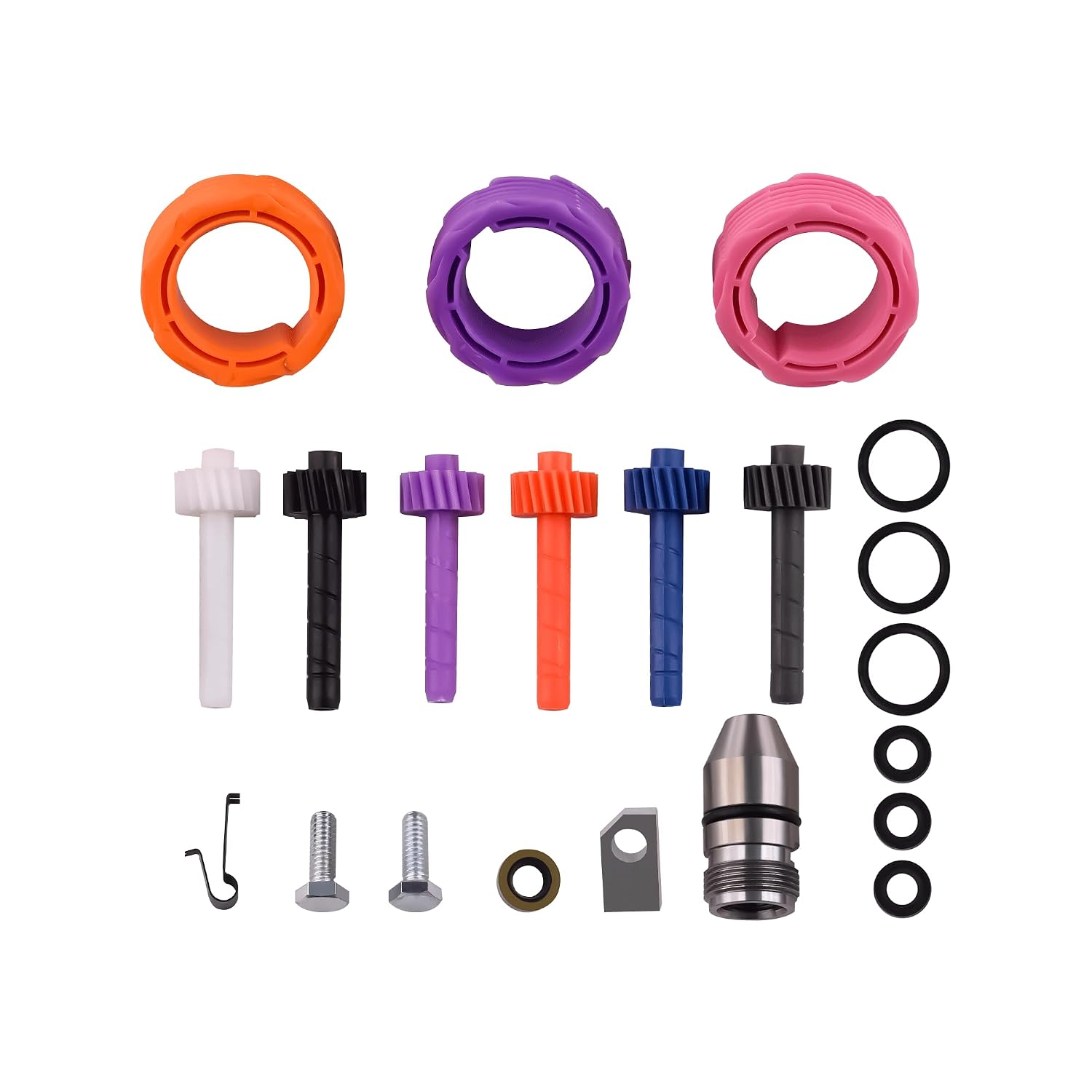
View the speedometer gear kit →
FAQ
What are the TH350 gear ratios?
The factory TH350 runs 2.52:1 in first, 1.52:1 in second and 1.00:1 in third, per TCI's gear ratio chart. Third is direct drive and there is no overdrive. Reverse is commonly published at 2.07:1.
Is a TH350 or TH400 lower geared?
The TH350 has the slightly deeper first gear: 2.52 versus 2.48 for the TH400, with second at 1.52 versus 1.48. On the same axle the TH350 launches a little harder, but the TH400 is the stronger unit for high-torque builds.
How much does a TH350 weigh and how long is it?
Novak lists the TH350 at 21-3/4 inches long and 120 lb, with a one-piece aluminum case and integral bellhousing. Tailhousing length varies by application, so measure before ordering a driveshaft.
How much fluid does a TH350 hold?
GM calls for about 2-1/2 quarts after a pan drain. TCI lists 4 quarts for the transmission with a stock pan, plus about 4 quarts for a new 12-inch converter, so a dry build takes roughly 8 quarts. Always finish by checking the dipstick hot.
Sources
- TCI Auto — Gear Ratios chart. Backs the factory TH350 ratios (2.52, 1.52, 1.00), the TCI 2.75/1.52 low gear option, and the factory Powerglide, TH400, 200-4R and 700R4/4L60E ratios used for comparison. tciauto.com
- TCI Auto — Fluid Capacity chart. Backs the 4-quart TH350 capacity with stock pan and the converter capacities by diameter (12 in. 4 qt, 11 in. 3.5 qt, 10 in. 3 qt). tciauto.com
- General Motors — 1976 Chevrolet Light Truck Service and Overhaul Supplement, ST-330-76, Section 0 and Section 7A. Backs the 2-1/2 U.S. quart TH350 refill, the 15,000/60,000-mile service intervals and severe-service conditions, the 350 V-8 oil pressure figures with the modulator connected and disconnected, the Section 7A factory torque specifications (pan 130 in-lb, valve body 130 in-lb, screen 40 in-lb, pump cover 17 ft-lb, pump to case 18-1/2 ft-lb, extension 25 ft-lb, converter bolts 35 ft-lb, cooler fittings 25/15/10 ft-lb), and the converter end clearance limit under .050 in. with the 80 psi leak check. 73-87chevytrucks.com (PDF)
- Holley Motor Life — "Everything You Need To Know About GM Automatic Transmissions," Jeff Smith. Backs the TH350 replacing the Powerglide in 1969, the 2.52 first gear versus the Powerglide's 1.76/1.82, and the pan shape and modulator location tells. holley.com
- Novak Conversions — The Novak Guide to the GM TH350 Automatic Transmission. Backs the 21-3/4 inch one-piece aluminum case with integral bellhousing, 120 lb weight, production years, Chevy and BOP patterns, the TH350C introduction and identification, and the RPO codes. novak-adapt.com
- Raybestos Powertrain — GM TH350 1969-1986 Friction Clutch Pack Module, RCP96-036. Backs the 9 forward/direct, 3 intermediate and 5 low/reverse friction count. raybestospowertrain.com
- General Motors — 1975 Buick Service Manual, Section 7C, "Turbo Hydra-Matic 350-375B Automatic Transmission." Backs the .030-.079 inch direct clutch to oil pump clearance measured at the input shaft, the .011-.082 inch forward clutch clearance and the three selective pressure plates, removal and cleaning of the oil pump pressure screen and governor screens, the four check balls in the case face and the note to record their positions, and the missing No. 1 check ball as a diagnosis-chart cause of no reverse or slipping in reverse. teambuick.com (PDF)
- Sonnax — TH350/TH350C Governor Gear Kit, part no. 352. Backs that a lost or damaged governor gear component causes shift-point concerns on these units, supporting the governor assembly as a high-mileage check point separate from the valve body. sonnax.com/parts/1589-governor-gear-kit
- B&M (Holley) — Installation Instructions, TH-350 Deep Pans, Part No. 30280 and 30289 (PDF). Backs the 12-13 ft-lb pan bolt torque, the 20-25 ft-lb drain plug and the overtightening warning. documents.holley.com (PDF)
- Offroad Design — TH350 Technical Information. Backs the 27-spline output on all versions, the 7/8 inch 4WD output for NP203/NP205, and the 2-1/2 inch output used with the NP208. offroaddesign.com
- Sonnax, "Stop TH350/C Intermediate Race Failure with a Sonnax Heavy Duty Race," Tech Resource 923. Backs the intermediate overrun clutch outer race as the common high-load failure point in racing applications, and the heavy-duty replacement race's 2x OE torque capacity rating. sonnax.com/tech_resources/923