The 4L65E (RPO M32) is the heavier-duty version of GM's 4L60E, built for the 6.0L trucks, Escalades, H2s and the like. It is a better transmission than the 4L60E, but it is not a different transmission. It shares the case, the valve body layout, the gear set design and most of the failure patterns. What changes is how hard it gets worked: these units live behind big V8s in heavy vehicles that tow. So the same weak spots show up, just sooner.
This is the list of what actually comes across the bench, roughly in order of how often we see it, with what causes each one and what fixes it for good.
The short version: Burnt 3-4 clutches are number one, and the cause is almost always low line pressure or 3rd gear oil leaking somewhere along a long circuit. Next is the reaction (sun) shell and rear planet bearing. After that come valve body bore wear (TCC regulator for P1870, the 4-3 sequence valve for no 4th), and self-inflicted problems from mixing early and late 2007 planetary parts. Fix the leaks and the stack-up, not just the burnt parts.
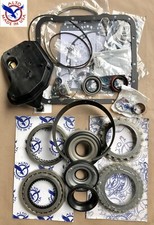
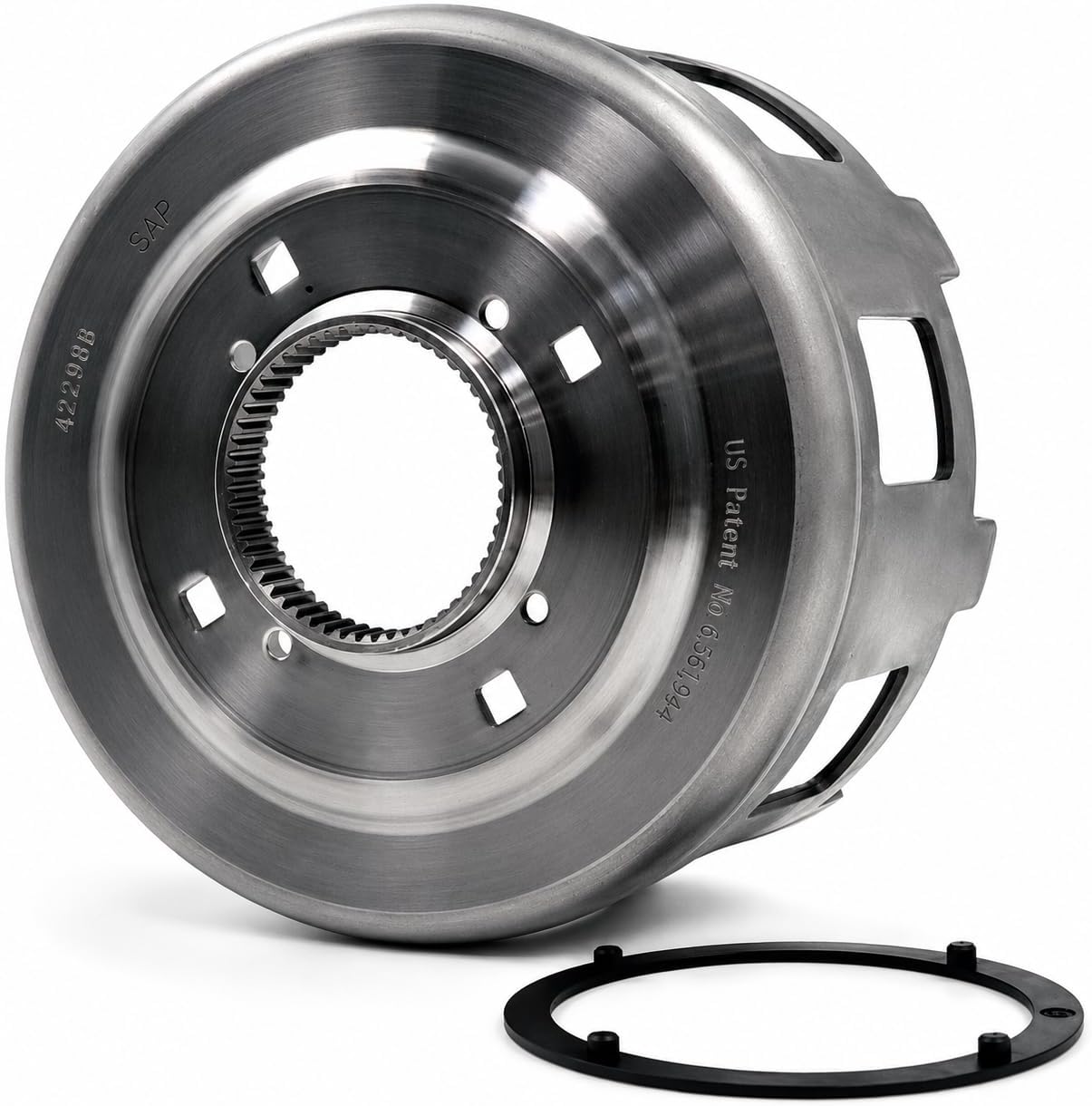
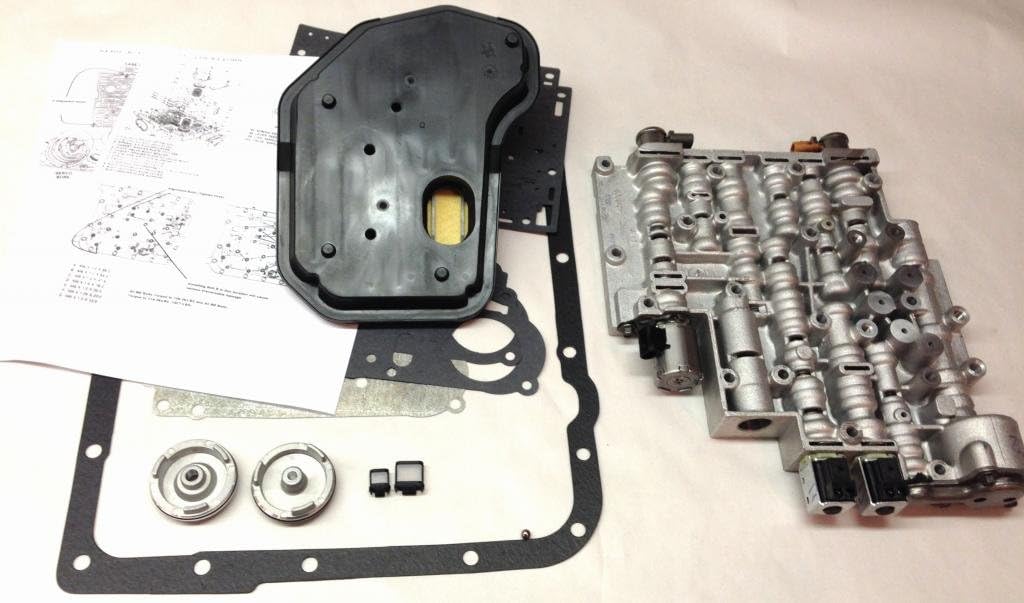
4L65E Specs You Need Before You Diagnose Anything
GM's own Chevrolet Performance Supermatic spec sheet (part number 19260445) covers the 4L65-E crate unit, 19260380, alongside the 4L70-E. The numbers worth knowing:
| Item | 4L65E spec (GM Supermatic sheet) |
|---|---|
| Maximum engine torque | 430 lb-ft (4L70E: 495 lb-ft) |
| Gear ratios | 1st 3.059, 2nd 1.625, 3rd 1.000, 4th 0.696, Reverse 2.294 |
| Fluid | DEXRON-VI |
| Dry fill capacity | 10.6 L (11.2 qt) with 300 mm converter |
| Converter pre-fill | 6-8 oz DEXRON-VI before installing it |
| Oil pan to case | 18 ft-lb (24 N-m) |
| Drain plug | 25 ft-lb (34 N-m) |
| Cooler pipe nut to case | 28 ft-lb (38 N-m) |
| Flexplate to converter / trans to engine | 37 ft-lb (50 N-m) |
Two install notes from the same sheet prevent comebacks. With the converter fully seated (you should feel two steps as it engages the pump, stator shaft and input shaft), the gap between the flexplate and the converter pads should be at least 1/8 in. and no more than 1/4 in. And always flush the cooler and lines when you install a transmission. GM's sheet notes the lower case fitting is cooler out and the upper fitting is cooler return. Swapped lines or a cooler full of old clutch material will kill a fresh unit fast.
1. Burnt 3-4 Clutch Pack
Symptoms: flare on the 2-3 shift, slipping in 3rd, then no 3rd or 4th at all. Often it sets P0894 or a ratio code on the way out. The fluid will be dark and smell burnt.
Cause: Sonnax says it plainly in its 3-4 burnup guide: low line pressure and leaks of 3rd gear oil are the root cause of most 3-4 slipping. The 3-4 circuit is long and ties into D4, forward clutch, 2nd, 2nd clutch and 3rd accumulator oil. A few small leaks along the way add up to enough pressure loss to slip the pack. The 4L65E lives in heavy trucks, so the pack has less margin to spare than it would in a light car.
Where to look (from Sonnax's checklist):
- Input drum and shaft. Air check the loaded drum so the 3-4 and forward clutches apply without leakage. Air check the housing bore-to-shaft fit. If the bore is galled, the housing is scrap. When you install an input shaft, dress the sharp leading edge and use Loctite above the feed hole, keeping it out of the hole itself.
- Input housing checkball. Vacuum test it. Sonnax treats anything below 25 in-Hg as an unacceptable leak for a checkball. A clogged ball causes partial apply from centrifugal force, which burns the pack just as well as a leak.
- Backing plate. The OE 3-4 backing plate flexes on apply, which builds heat unevenly in the pack. A heavy-duty plate stops that. Put new load release springs back in and never leave them out.
- Stator support. Replace both stator bushings and check the sleeve where the sealing rings ride. Worn bushings let the input shaft move, and the rings lose their seal.
- Pump. Vacuum test the boost valve and pressure regulator valve. Check that the slide moves freely: assemble the clean, dry pump halves with only the slide inside and shake it. A binding slide explains a lot of otherwise mystery low line pressure. Test for hairline cracks in the 3-4 and forward passages.
- Servo and 3rd accumulator checkball. Sonnax calls a leaking 3rd accumulator checkball capsule a leading cause of 3-4 failure, and says new ones can leak out of the box. Test them. Do not plug the circuit with a cup plug; the ball also vents, and plugging it causes soft 2-3 shifts and 3-2 flares.
The fix: new 3-4 frictions and steels, a heavy-duty backing plate, and the leak hunt above. A new clutch pack on top of the same leak is a 10,000-mile repair. Our 3-4 clutch pack diagnosis guide goes deeper on pack clearance.
4L65E 3-4 Power Pack Friction Clutch Kit
More 3-4 clutch capacity for a 4L65E that burned its pack. Pair it with the leak checks above so the new clutches actually live.
Shop the 3-4 Power Pack kit →Need a different part? Browse the full 4L65E parts collection.
2. Broken Reaction Shell and Rear Planet Bearing Failure
Symptoms: sudden loss of 1st and 2nd (it may still take off in manual 2 or 3rd), grinding or a whine that changes with road speed, and chunks of steel on the pan magnet.
Cause: Sonnax describes stripped or cracked shells in the 4L60, 4L60-E, 4L65-E and 4L70-E as a common problem, and notes that failure of the rear planetary captured bearing is just as common with both OE and thicker aftermarket shells. In the OE design, thrust load goes from the shell through the sun gear and overloads that small captured bearing. A heavier shell alone does not fix the bearing.
Run-out makes it worse. In an older Sonnax article, Gregg Nader describes stacking the reaction shaft, bearings, shell and rear planet on an output shaft in a vise to spin the shell. Most show about .010 in. of run-out, and he has seen as much as .050 in. That wobble contributes to shell breakage, spline wear, and even 2nd gear shudder. It takes a few minutes with spare parts, and it catches a bad shell before it goes in the case.
The fix: replace the shell with a heavy-duty one and replace the rear planet if the captured bearing is rough or the pinions are blued. Sonnax's SmartShell kit (77749-02K) adds a larger thrust bearing and a custom roller clutch race so the thrust load goes through the carrier and bypasses the captured bearing. Whatever shell you use, check run-out and inspect the sun gear tooth pattern.
3. Wrong Endplay After a Rebuild (2007 Parts Mix-Up)
Symptoms on the bench: the output shaft snap ring will not go in, or input shaft endplay is out of spec and no amount of re-assembly fixes it. On the road, a unit built this way can make noise or eat bearings.
Cause: Sonnax's Steve Garrett traces this to a GM design update in March 2007. The reaction carrier bearing went to a thicker design, and the reaction carrier and shaft were changed to fit it. The change covers both four- and five-pinion carriers. Matched as a set, everything works. Mix early and late pieces and the stack-up is wrong. With salvage-yard cores and mixed kits, this is one of the most common self-inflicted 4L65E problems.
The fix: keep the reaction carrier, reaction shaft and bearing as a matched early or late set. Input shaft endplay spec is .005 to .035 in. Before anything goes in the case, stack the planetary parts and bearings on the output shaft in order, install the snap ring inside the front planet, set it sun shell down, and measure bench endplay with a dial indicator or feeler gauge. About .020 to .030 in. means the stack-up is right. If it is off, swap one original part back in at a time until you find the one that is wrong.
4. Converter Clutch Slip: P1870 and P0894
Symptoms: rpm creeps or cycles at cruise with lockup commanded, the converter runs hot, and the PCM sets P1870 (older calibrations) or P0894. Left alone, it cooks the fluid and then the 3-4 pack.
Cause: Sonnax identifies severe TCC regulator valve bore wear, caused by the OE valve oscillating, as a primary cause of P1870 and overheated converters in the 4L60-E, 4L65-E and 4L70-E. Apply pressure exhausts through the worn bore, and it drags line pressure down with it, which is how a lockup problem turns into burnt clutches. Wear at the isolator valve bore also reduces TCC apply pressure.
Do not skip the bulletin check either. GM Preliminary Information PIP5340A covers a MIL, a harsh 1-2 upshift, and P0894 or P1870 setting after a torque converter or service replacement transmission is installed on listed trucks and vans with the 4L60E (M30) or 4L65E (M32). GM's instruction is to confirm the concern and contact technical assistance, so check for updated calibrations before you pull a fresh unit back out.
The fix: recondition the bore and install a TCC regulator and isolator valve kit (Sonnax 77754-04K), or replace the valve body with one already updated. Then clear adaptives and road test with lockup commanded, watching TCC slip speed. Our 4L65E P0894 guide covers the scan tool side.
5. No 4th or Drops Out of 4th
A 4L65E that will not take overdrive, or grabs it and falls back to 3rd, usually has 4th apply oil leaking in the valve body: a worn 4-3 sequence valve bore or worn aluminum end plugs at the 3-4 relay and 3-4 shift valves. Left alone, the 2-4 band slips in 4th and burns. It gets its own full write-up in 4L65E won't shift into overdrive, including the solenoid pattern and the ATRA resistance specs.
How to Keep a 4L65E Alive
- Use DEXRON-VI and check it hot. GM specifies DEXRON-VI for this unit. Low fluid aerates and drops line pressure, which is exactly what burns 3-4 clutches.
- Manage heat. These are heavy vehicles that tow. Use Tow/Haul when loaded, keep the cooler clean, and add an auxiliary cooler after the radiator (GM's sheet says to put it after fluid leaves the radiator and before it returns to the transmission). See our 4L65E overheating guide.
- Fix slip early. A P1870 or a mild flare is the cheap stage. The expensive stage is the one where the burnt clutch material has been through the cooler and valve body.
- On a rebuild, vacuum test the valve body and checkballs, check bench endplay, and match your planetary parts. Most repeat failures on these come from leaks and stack-up mistakes that were there on day one.
Keep the numbers at the bench. Our free transmission fluid spec chart lists the correct ATF for the 4L65E and dozens of other units, so you never top off with the wrong fluid.
FAQ
Is the 4L65E stronger than the 4L60E?
Yes, but it is the same family. GM rates the 4L65E Supermatic for 430 lb-ft of engine torque, and the 4L65E shares its case, valve body layout, and gear ratios (3.059, 1.625, 1.000, 0.696, reverse 2.294) with the 4L60E and 4L70E. That means it also shares their weak spots: the 3-4 clutch pack, the reaction shell, and valve body bore wear.
What is the most common 4L65E failure?
The burnt 3-4 clutch pack. Sonnax says low line pressure and leaks of 3rd gear oil are the root cause of most 3-4 slipping, and the circuit is long enough that several small leaks add up. Replacing the clutches without finding those leaks usually brings the truck back.
What causes code P1870 or P0894 on a 4L65E?
Both are slip codes. Sonnax identifies severe TCC regulator valve bore wear as a primary cause of P1870 and overheated converters on the 4L60-E, 4L65-E and 4L70-E. GM bulletin PIP5340A also documents harsh 1-2 shifts with P0894 or P1870 setting right after a converter or replacement transmission is installed on some M30 and M32 trucks.
Why won't the output shaft snap ring go on after I replaced 4L65E planetary parts?
You probably mixed early and late parts. Per Sonnax, GM moved to a thicker reaction carrier bearing in March 2007 and changed the reaction carrier and shaft to match, on both four- and five-pinion designs. Mixing them causes wrong endplay and a snap ring that will not seat. Check bench endplay before the parts go in the case: about .020 to .030 in. means the stack-up is right.
Sources
- General Motors / Chevrolet Performance — Supermatic Transmission Specifications, part number 19260445 (covers 4L65-E 19260380). Backs: 430 lb-ft max torque, gear ratios, DEXRON-VI, 11.2 qt dry capacity, converter pre-fill and 1/8-1/4 in. flexplate gap, cooler line orientation and flushing, auxiliary cooler placement, and torque specs. Chevrolet Performance Supermatic spec sheet (PDF)
- Sonnax — Brian Wing, "All Over the Map: Attacking 4L60/E Burnt 3-4 Clutches with Confidence." Backs: low line pressure and 3rd gear oil leaks as the root cause of most 3-4 slipping, the 25 in-Hg checkball limit, backing plate flex, load release springs, stator bushings, pump slide check, and the 3rd accumulator checkball capsule. sonnax.com/tech_resources/659
- Sonnax — SmartShell Heavy Duty Reaction Shell Kit 77749-02K. Backs: stripped and cracked shells and rear planetary captured bearing failure in 4L60-E/4L65-E/4L70-E units, and re-routing thrust load through the carrier. sonnax.com/parts/2454
- Sonnax — Steve Garrett, "Too Close For Comfort: Pinpointing 4L60-E Gear Train Assembly Problems." Backs: the March 2007 thicker reaction carrier bearing and matching carrier/shaft change on four- and five-pinion designs, .005-.035 in. input endplay, and the .020-.030 in. bench endplay check. sonnax.com/tech_resources/256
- Sonnax — TCC Regulator & Isolator Valve Kit 77754-04K. Backs: TCC regulator bore wear as a primary cause of P1870 and overheated converters, lost line pressure and burnt clutches, and isolator bore wear reducing TCC apply pressure. sonnax.com/parts/2458
- General Motors Preliminary Information PIP5340A (via NHTSA). Backs: MIL, harsh 1-2 shift, and P0894 or P1870 after torque converter or replacement transmission installation on listed 4L60E (M30) and 4L65E (M32) vehicles. GM PIP5340A (NHTSA PDF)