Every 4L65-E is a late unit. The family ran from 2001 to 2013 behind 6.0-liter GM trucks and SUVs, the Hummer H2, the SSR and the Trailblazer SS, and the whole reason it exists is mechanical: five-pinion planetaries, a stronger input shaft, better hard parts than a 4L60-E carries. The electronics did not change. It is still two on/off shift solenoids, A on the 1-2 and 3-4 shifts and B on the 2-3, each one switched to ground by a low-side driver in the PCM.
Those two solenoids are the cheapest parts in the circuit, which is exactly why they get replaced first and exactly why so many 4L65-E "solenoid jobs" come back. The state table tells you which circuit is at fault before you drop the pan. Everything after that is proving whether the fault is the solenoid, the wire, the computer, or the oil that feeds the solenoid.

What the two solenoids actually do
The 4L65-E runs the same two-solenoid pattern as every 4L60-E family unit:
| Gear | Solenoid A (1-2 / 3-4) | Solenoid B (2-3) |
|---|---|---|
| 1st | ON | ON |
| 2nd | OFF | ON |
| 3rd | OFF | OFF |
| 4th | ON | OFF |
Barry Bartlett, a diagnostician at Certified Transmission and an ASE Master technician with L1, wrote up the way to use that chart in Transmission Digest, and it is the fastest free diagnostic you have. Read it as a set of outcomes:
- Solenoid A never energizes. Second-gear starts. It will shift into third, but there is no fourth gear at all. Second and third end up being the only forward gears that work.
- Solenoid B never energizes. Fourth-gear starts, with manual second and manual third available at roughly 30 mph. Shift up out of manual second and you still get fourth when the computer commands it, because solenoid A is doing its job.
- No power to either solenoid. Third gear in Drive, no upshift, no downshift. Manual second still works because it is shifted hydraulically with no solenoid involved. That third-gear default is deliberate, and it is why a 4L65-E that loses its transmission fuse still drives home.
That last case matters more than the other two, because two solenoids do not die on the same afternoon. When you lose both, the fault is upstream: a fuse, a shared feed, a connector, an ignition switch, a computer. Bartlett's own advice is to check fuses first, then check for power at the transmission connector, and to suspect an ignition switch on Chevrolet applications when there is no power at the fuse itself.
Second-gear starts are not automatically a solenoid
This is the one that costs people money, and it is worth knowing before you open anything. Wayne Colonna laid out the mechanism in Transmission Digest in 2022. The valve body is in second gear by default with the engine off. Line pressure and actuator feed pressure have to build to 48 psi before the 1-2 shift valve spring is compressed and the valve strokes over into first gear.
Read that again in terms of what it means on a lift. Anything that lets pressure fall below 48 psi hands you a second-gear start with two perfectly healthy solenoids sitting in the pan. In Colonna's case the shop had already replaced both shift solenoids, then replaced the entire valve body assembly, then enlarged the shift solenoid feed orifices in the spacer plate to .035 in. None of it fixed anything, because none of it was the problem.
What did find it was a pressure gauge and a road test. Line pressure read a correct 62 psi in Drive, which ruled out the pump, the AFL valve and the forward accumulator piston in one measurement. On the road the unit would bind up in manual low. The 1-2 accumulator piston was missing its rubber seal, so accumulator pressure was feeding past the piston straight into the band apply circuit. One seal fixed it.
Put the gauge on it before you order parts. It is a five-minute test that either points at the hydraulics or clears them.
The valve that feeds both solenoids
Neither shift solenoid sees line pressure. They see actuator feed limit oil, and the AFL valve is the part that makes it. Per Sonnax, the AFL takes line pressure and regulates it down to a consistent solenoid feed typically in the 80-115 psi range, then hands that off to the shift solenoids, the pressure control solenoid, the TCC solenoid and the 3-2 control solenoid.
When the AFL bore wears, the feed goes wrong in one of two directions and neither one is obvious on a scan tool. Too much feed pressure and flow floods an on/off solenoid beyond its ability to exhaust, which strokes a shift valve when it should not be stroking. Too little and the shift valves never stroke fully. Sonnax lists the resulting complaints outright: solenoid performance codes, wrong gear starts, harsh or soft shifts, slips and flares, missing gears, and eventually burnt clutches.
That is a list of symptoms that reads exactly like a bad solenoid. The difference is that a new solenoid will not fix any of it. Vacuum test the AFL bore every time you have that valve body on the bench — Sonnax's position is that solenoid modulator and AFL locations should always be vacuum tested for wear, and on a high-mileage 4L65-E that is not an optional step.
Electrical testing: the numbers and the pins
ATRA's GEARS magazine publishes the specs you need for this circuit. Shift solenoid resistance is 20 to 30 ohms. With system voltage at about 12.6 volts engine off, Ohm's law says a healthy circuit should draw 0.42 to 0.63 amps. That current figure is the more useful of the two, because a coil that ohms fine at a few milliamps can still fail once it has to carry half an amp.
The circuit itself runs like this:
- Power. The ING 0 fuse feeds case connector pin E. That fuse is fed by the ignition switch, so start at the fuse box with the key on and check for system voltage on both sides of the fuse. Wiggle the key while you watch it. Bad ignition switch contacts cause intermittent solenoid codes, and on GM trucks they are common enough to check before anything else.
- Ground. The computer grounds the 2-3 solenoid through case connector pin B. To test the ground side, unplug the PCM, turn the key on, and check for voltage at pin 47 of the C2 connector. You should see system voltage there, because current travels from the ignition switch through each solenoid and out toward the computer looking for ground. No voltage on that pin means the circuit is open somewhere between the connector and the computer.
- Bypass the power side. Tap the wire feeding pin E and jump it to battery positive through a 10-amp fuse. If the problem disappears, the original power circuit has resistance or a break in it. Be aware of what you just did: that jumper hot-wires the vehicle, and it will not shut off until you disconnect it.
The single most common cause of a shift solenoid circuit code on a unit that was just installed is not the solenoid. It is the harness pinched between the bellhousing and the engine block on the way in, crimping the wires until they break or short to the block. GEARS documents exactly that on a P0758 job: the fix was loosening the transmission, sliding the wiring out of the bellhousing and repairing the broken wires.
If the current draw is correct and the circuit checks out, the computer becomes a suspect — but verify its power and grounds first. All PCM power inputs should read system voltage and all PCM grounds should read under 0.10 volts. Then run the bypass test: cut the control wire at the computer leaving an inch or two of pigtail, run it straight to one terminal of a known-good shift solenoid on the bench, and feed the other terminal from battery positive through a 10-amp fuse. If the code still sets against that clean test circuit, the computer is the fault.
When the scan tool lies to you
Rob Faucett published a case in GEARS that is worth carrying around in your head. A 4L60-E family unit came back from a rebuild with no second gear. It would skip second and go into third a little late. Held near 20 mph it would shift into second and hold it with no slippage even under more throttle. On the scan tool every command looked present and on time.
The builder had already vacuum tested the actuator feed limit valve, air tested the servo, and then replaced both solenoids. Still no second. So they put a meter on the solenoid command wires and drove it. Solenoid B was being commanded on and off cleanly. The solenoid A command signal rose very slowly, and the solenoid only turned off once its ground wire finally climbed all the way to battery voltage — which is exactly why holding it at 20 mph eventually produced the shift.
Powers to the computer were at battery voltage, grounds measured three millivolts during the event, and the harness passed a load test with no visual damage. That left an internal computer fault, and a reman PCM fixed it. The lesson Faucett draws is the one to keep: what you see on the scan tool is not always what is on the wire. Scan data gives you direction. It does not give you a verdict.
Which solenoid package your 4L65-E actually takes
Order by casting and connector, not by model year alone. Sonnax's valve body identification guide puts the 4L65-E on two castings: the GM049 for 2000-2002, which added the annular exhaust ports, and the GM051 for 2003-2008, which carries the annular design forward and introduces the late-style EPC solenoid.
That 2003 EPC break is the one that bites. An early 1992-2002 pressure control solenoid and a late 2003-up unit are not a straight swap; running the early style in a late unit takes a harness adapter. The shift solenoids themselves do not change — GM 24230298 covers the 1-2 and 3-4 solenoid and the 2-3 solenoid across the range — but if you are buying a full solenoid kit, the EPC inside it has to match the casting.
Two more identification points from the same guide, useful when you have a core on the bench and no paperwork:
| Feature | Non-PWM | PWM / EC3 |
|---|---|---|
| Case connector | 12-pin | 13-pin |
| Solenoid count | 4 | 5 |
| 3-2 control solenoid ('96-later) | ON/OFF, white plastic, 20-31 ohms | |
| TCC solenoid (PWM) | Gray plastic, 10-15 ohms | |
Replacing the shift solenoids
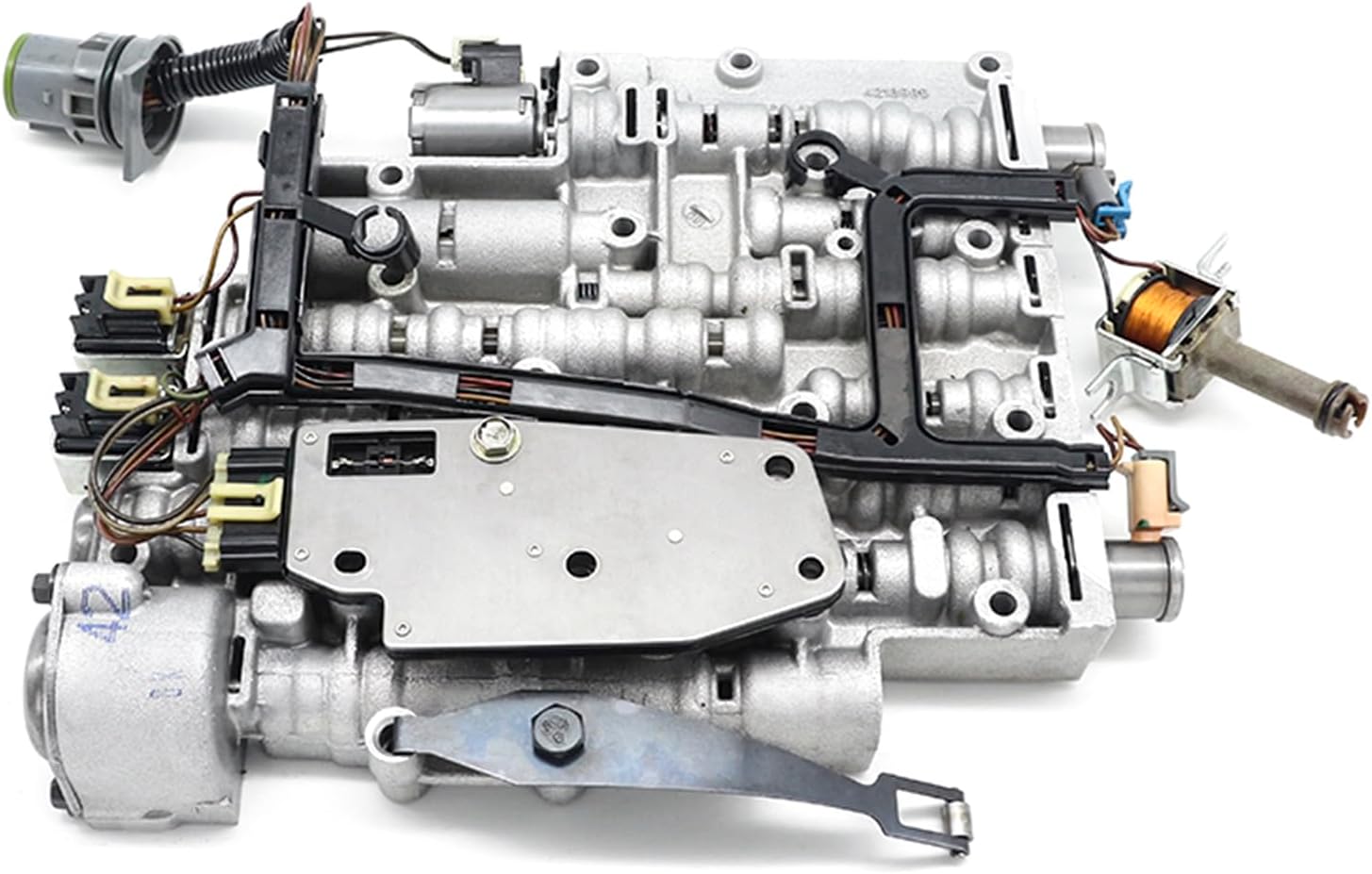
Both shift solenoids are pan-accessible. The transmission stays in the truck.
- Drain and drop the pan. Read the magnet before you go any further. Clutch material or bronze turns a solenoid job into a teardown conversation with the customer, and that conversation goes better before you have parts in it.
- Remove the filter and its seal. The seal often stays up in the pump bore. Get it out. A doubled seal is a guaranteed comeback with a low-pressure complaint.
- Unclip the internal harness from both shift solenoids. A and B are the same physical part with the same resistance, so mark which is which before removal. Reinstalled swapped, you get a unit that shifts first to fourth and back with no codes to explain it.
- Pull the retaining bracket and bolt and remove each solenoid straight out of its bore. Replace both O-rings — do not reuse them — and lube the new ones with ATF before install.
- Torque the bracket bolts with a click-type inch-pound wrench to the value published for your model year. These are small fasteners into an aluminum casting. No impact, ever.
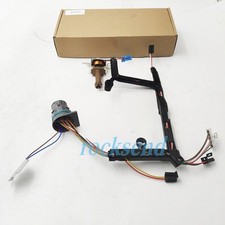
- While the pan is off, inspect the internal harness where it passes the case connector and where it runs near the valve body. Chafed insulation and pushed-back terminals there produce the same codes a failed solenoid does, for a fraction of the parts cost.
- New filter, new filter seal, new pan gasket. Run the pan bolts around the rail in a crossing pattern to spec rather than one after another down a side, or you will pull the rail out of flat and create a leak.
- Refill with DEXRON VI, which supersedes DEXRON III on this family. Confirm the exact capacity for your vehicle before you buy fluid rather than working from a number you remember.
Clear codes and drive it through a mix of light and moderate throttle upshifts across all four gears before judging the shift feel. Adaptive pressure learn happens on its own, and a firm 1-2 on the first few miles is normal.
Shift solenoids, EPC and TCC solenoids, internal wiring harnesses, filters, pan gaskets and complete valve bodies for the 4L65E — shipped fast from the USA.
Shop 4L65E parts →The short version
Let the state table name the circuit, then prove it. Ohm the solenoid for a hard open or short, load test it for the 0.42 to 0.63 amps a good circuit draws, and check the power feed at pin E and the ground path at pin B before you condemn anything in the pan. If the electrical side is clean, put a gauge on line pressure: under 48 psi and the 1-2 shift valve never leaves second, no matter how new the solenoids are. If both the electrical and the hydraulic sides check out and the shift still will not show up, scope the low-side driver. The solenoid is a thirty-dollar part. The diagnosis is what you are actually selling.
FAQ
What are the symptoms of a bad shift solenoid on a 4L65E?
The symptom depends on which solenoid quit and in which state it quit. If shift solenoid A never energizes you get second-gear starts, a shift into third, and no fourth gear at all. If shift solenoid B never energizes you get fourth-gear starts, with manual second and third available around 30 mph. If neither solenoid gets power the unit sits in third gear in Drive with no upshift or downshift, because third is the mechanical default when both solenoids are off.
Can you drive a 4L65E with a bad shift solenoid?
It will usually move, because the valve body defaults to a driveable gear rather than to neutral. That does not make it safe to leave alone. A unit stuck in one gear is either lugging the engine off the line or spinning the converter far past its intended slip range, and the heat that comes with it cooks the fluid and then the 3-4 clutches. Drive it to the shop, not through the winter.
Are 4L65E and 4L60E shift solenoids the same?
Yes. The 4L65E shares the 4L60E electronic control package, and the 1-2 and 2-3 shift solenoids are the same GM 24230298 part in both. Where the two units diverge is the pressure control solenoid: Sonnax's valve body identification guide puts the late-style EPC solenoid on 2003-and-later castings, so an early 1992-2002 EPC and a late 2003-up EPC are not interchangeable without an adapter.
What causes a 4L65E to start in second gear?
Not always a solenoid. The valve body sits in second gear by default with the engine off, and it takes 48 psi of line and actuator feed pressure to compress the 1-2 shift valve spring and stroke the valve into first. Anything that lets pressure fall below 48 psi gives you a second-gear start with two perfectly good solenoids in the pan. Put a pressure gauge on it before you order parts.
How do you test 4L65E shift solenoids with a multimeter?
Ohm each solenoid at the case connector and expect roughly 20 to 30 ohms. Then check it under load, because resistance alone only proves a solenoid is definitely bad, never that it is good. With about 12.6 volts of system voltage, a healthy circuit should draw somewhere between 0.42 and 0.63 amps. A reading outside that window means the problem is in the power feed, the ground, or the solenoid itself.
Sources
- Sonnax — "GM 4L60-E Valve Body Identification Guide." Backs the casting and year breaks that decide which solenoid package a 4L65-E takes: the GM049 '00-'02 annular-lockup casting and the GM051 '03-'08 casting with the late-style EPC solenoid, both listed as 4L65-E and 4L70-E applications; the 12-pin case connector with four solenoids on non-PWM units versus the 13-pin connector with five solenoids on PWM units; and the '96-and-later ON/OFF 3-2 control solenoid at 20-31 ohms alongside the gray plastic PWM TCC solenoid at 10-15 ohms. sonnax.com
- Sonnax — "Uncovering the Root Cause of Pressure Complaints: The Critical Role of Solenoid Modulator & AFL Valves," Maura Stafford, January 25, 2023. Backs the function and failure mode of the actuator feed limit valve: it takes line pressure and regulates it down to a consistent solenoid feed typically in the 80-115 psi range; bore wear at that valve sends feed pressure high or low; too much feed floods an on/off solenoid beyond its ability to exhaust and strokes a shift valve inappropriately, while too little leaves shift valves unable to stroke fully; and the resulting complaints include solenoid performance codes, wrong gear starts, harsh or soft shifts, slips and flares, missing gears and clutch failures. Also backs the recommendation that the AFL bore always be vacuum tested for wear. sonnax.com
- Transmission Digest — "Diagnosing Shifting Issues," Barry Bartlett, February 1, 2016. Backs the solenoid application chart logic used throughout this article and the specific 4L60-E family outcomes: both solenoids on in first and both off in third; if shift solenoid A is not turning on the unit gets second-gear starts and shifts into third but has no fourth, leaving second and third as the only forward gears; if shift solenoid B is not turning on the unit gets fourth-gear starts with manual second and third around 30 mph; and with no power to any solenoid the unit has third gear only with no upshift or downshift in Drive, while manual second still works because it is shifted hydraulically. Also backs the point that a total loss of solenoid power sets multiple solenoid codes and should send you to the fuses, the transmission connector and the ignition switch. transmissiondigest.com
- Transmission Digest — "Fixing 4L60-E 1-2 shift issues," Wayne Colonna, July 5, 2022. Backs the second-gear-start diagnosis: the valve body sits in second gear by default with the engine off; it takes 48 psi or more of line and AFL pressure to overcome the 1-2 shift valve spring and stroke the valve into first, so any deficiency that drops pressure below 48 psi creates second-gear starts; the correct 62 psi line pressure reading in Drive that ruled out the pump, the AFL valve and the forward accumulator piston; the shift-solenoid feed orifices in the spacer plate enlarged to .035 in. without effect; and the actual cause, a missing rubber seal on the 1-2 accumulator piston that let accumulator pressure feed past into the band apply circuit. transmissiondigest.com
- GEARS Magazine (ATRA) — "A Logical Approach to Solenoid Circuit Testing," Mike Brown, Street Smart. Backs the electrical specifications and the test sequence: solenoid resistance of 20 to 30 ohms with about 12.6 volts of system voltage engine off, giving an expected 0.63 to 0.42 amps of current flow; power reaching case connector pin E from the ING 0 fuse, which is fed by the ignition switch; the computer supplying ground to the 2-3 solenoid through case connector pin B; system voltage expected on pin 47 of the PCM C2 connector with the PCM unplugged and the key on; the 10-amp fused jumper used to bypass the power feed and the warning that doing so hot-wires the vehicle; all PCM power inputs reading system voltage and all PCM grounds reading under 0.10 volts; the wiring harness pinched between the bellhousing and the engine block as a real cause of P0758; and the bypass test at pin 47 that condemns the computer. gearsmagazine.com
- GEARS Magazine (ATRA) — "4L60E NO 2nd," Rob Faucett. Backs the real-world case of a freshly rebuilt unit with no second gear that would skip to third slightly late, yet would shift into second and hold without slipping if held near 20 mph; the scan tool showing all commands present and on time; the actuator feed limit valve vacuum tested and the servo air tested with no fault found; the solenoids replaced with no change; a meter on the solenoid command wires during a road test showing solenoid B commanding cleanly while the solenoid A command signal rose very slowly and only made the shift once the ground wire reached battery voltage; PCM power wires at battery voltage and grounds at three millivolts during the event; and the internal computer fault that was only cured by a reman PCM. gearsmagazine.com