A harsh 4L80E is often doing exactly what it was told. This unit has a published list of a dozen separate faults whose programmed default action is maximum line pressure, and maximum line pressure feels like the transmission is trying to snap the driveshaft. So the first job is not to pull the pan. It is to find out whether the controller is commanding the bang, or whether the hydraulics have stopped regulating on their own.
Those two answers send you to opposite ends of the truck. One is a $70 solenoid or a corroded ground. The other is a pump teardown.

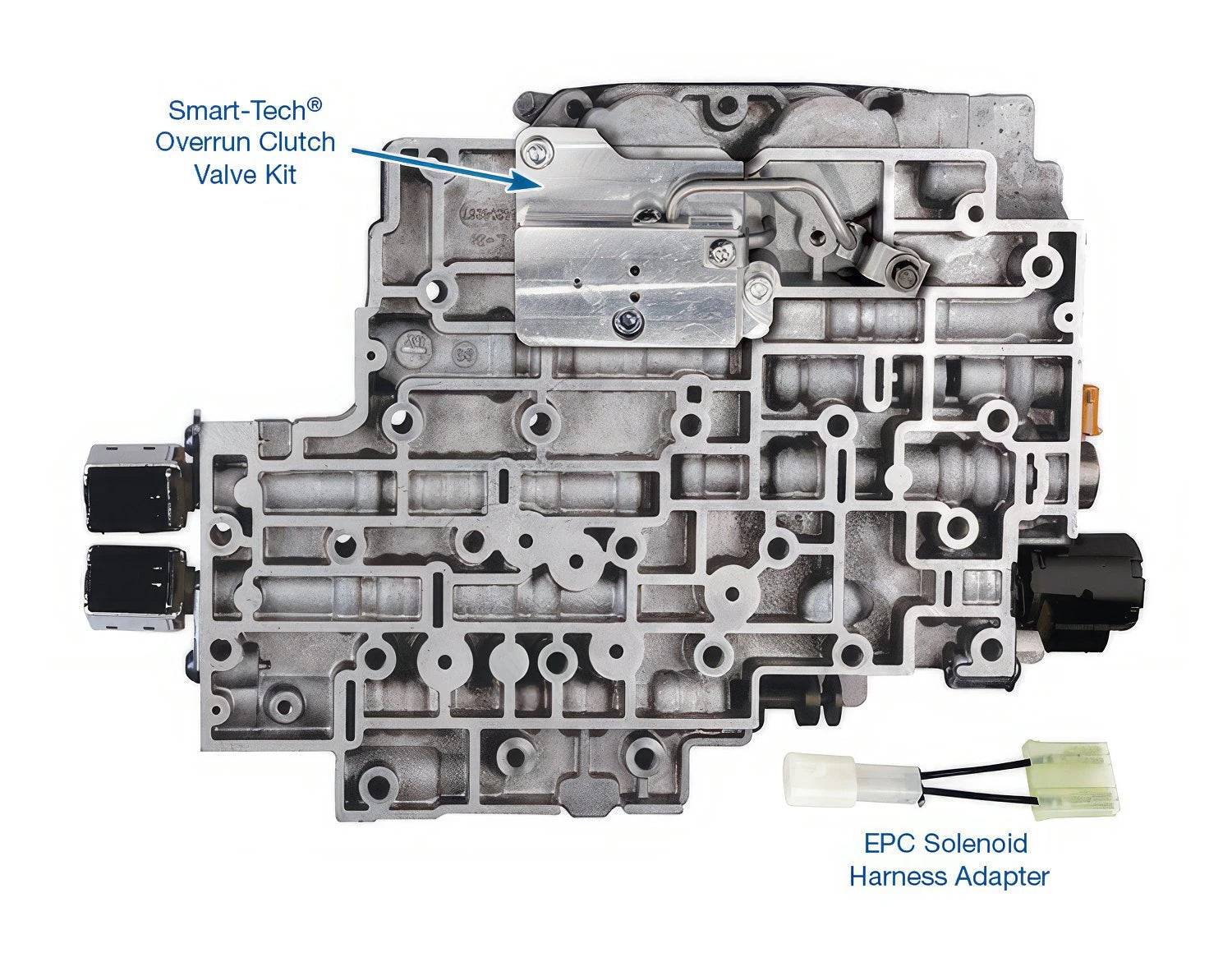
Firm is normal. Harsh is not.
Get the vocabulary right before you sell parts. The factory diagnosis manual draws the line precisely; the customer does not:
- Firm — "a noticeable quick application of a clutch or band that is considered normal with a medium to heavy throttle shift." A loaded 3500 that bangs the 1-2 at half throttle is behaving.
- Harsh (rough) — "a clutch or band application which is more noticeable than firm. This condition is considered undesirable at any throttle position."
- Initial feel — distinctly firmer at the start of the shift than at the end. End bump — firmer at the end than the start.
That distinction is diagnostic, not semantic. Harsh only at the start of one shift points at the accumulator cushioning that apply. Harsh at every throttle position in every range points at line pressure. Ask the customer which one, and whether it changed the day a lamp came on.
Step 1: pull the codes first, because most of them command a harsh shift on purpose
The 4L80-E malfunction code and defaults table is the most useful page in the book for this complaint. Look at how many unrelated faults land on the same default:
- DTC 21 / 22 — TP high or low. Signal above 4.9 V or below 0.2 V for one second. Default: maximum line pressure, substitute 35% TP, inhibit 4th.
- DTC 24 — VSS/TOSS low. Default: maximum line pressure, 2nd gear.
- DTC 52 / 53 — system voltage high. Over 16 V for 109 minutes, or over 19.5 V for 2 minutes. Default: maximum line pressure, 2nd gear, no TCC.
- DTC 73 — pressure control solenoid circuit. Return amperage more than 0.16 amp off the commanded value for one second. Default: maximum line pressure.
- DTC 75 — system voltage low. Ignition feed below 10.3 V at 90°C with engine over 1,000 rpm for four seconds. Default: maximum line pressure, 2nd gear, no TCC.
- DTC 81 / 82 — shift solenoid circuits. Default: maximum line pressure plus a limited gear set.
- DTC 85 / 86 / 87 — ratio errors. All three default to 2nd gear and maximum line pressure.
Twelve codes, one shared feel. A charging system putting out 16.5 volts gives you a truck that slams every shift with nothing wrong inside the transmission. So does a frayed TP signal wire. The factory TCM pin chart lists the expected failure symptom next to each pin, and "Harsh Shifts" appears next to three of them: pin D7 sensor ground (circuit 359B, tan), pin D8 TP signal (circuit 355A, dark blue, about 0.67 V at closed throttle) and pin D16 pressure control solenoid high (circuit 264A, red, roughly 0.11 V at rest and 4.43 V commanded). Check that tan ground splice before anything else — high resistance there skews the TP signal the TCM uses to schedule pressure, and it will not always set a code.
Step 2: put a gauge on it
Guessing at line pressure is how good clutch packs get thrown away. The published test:
- Check and correct the fluid level first, then raise the truck and connect a gauge to the transmission test port. The gauge must have 325 to 350 psi capacity — a 100 psi gauge will be destroyed in Reverse.
- Park, Neutral and both Drive ranges: minimum 35 psi at idle, rising to a maximum of about 171 psi at greater throttle openings.
- Reverse: minimum 67 psi at idle, rising to a maximum of about 324 psi as throttle opening increases.
Then read the result the way the manual reads it. Low in every range means the pump — worn or damaged gears, a blown-out cup plug, cross leakage, a worn bushing. High is the harsh-shift answer, and the published suspect list is short: the pressure control solenoid, the reverse/boost or pressure regulator valves, a bad TCM ground, or a bad solenoid connection. Note that "bad TCM ground" is on that list twice now.
Step 3: sweep the EPC solenoid and watch the pressure fall
The pressure control solenoid (EPC, force motor, PCS — same part) sets line pressure. The TCM compares TP voltage, engine rpm and other inputs, then applies a varying current from 0.1 to 1.1 amp. More current, lower pressure. That relationship is inverted on purpose: if the circuit dies, the unit defaults to full pressure and protects itself from burning clutches, at the cost of shift feel.
Test it with a sweep, not a guess. Gauge still connected, in Park with the brake set, use the scan tool's override PCS function and step the current up, letting the gauge settle three to five seconds at each step. Against the published table:
- 0.00–0.02 A → 157–177 psi
- 0.20 A → 140–172 psi
- 0.40 A → 121–147 psi
- 0.60 A → 88–113 psi
- 0.80 A → 43–73 psi
- 0.98–1.1 A → 35–55 psi
Pressure must fall as current rises. If it stays high across the whole sweep, the fault is in the TCM, the wiring or the solenoid. If it reads low everywhere, you have an oil pump or hydraulic circuit problem and the solenoid is innocent.
Resistance across the pressure control solenoid at the internal harness should be 3.5 to 5.2 ohms — not the 18 to 24 ohms you expect at each shift solenoid or the 10 to 14 at the TCC solenoid, so do not condemn a good part against the wrong spec. The failure mode maps straight to the complaint: per the manual, a PCS failed closed produces harsh shifts and high line pressure; failed open it gives soft shifts and possible slip.
4L80E EPC Pressure Control Solenoid, 1991-2013
If the sweep will not bring pressure down and the winding is out of the 3.5 to 5.2 ohm window, this is the part. It is the cheapest thing on the harsh-shift list and the most common single cause of a truck that slams every shift in every range.
See the EPC solenoid →Or browse the full 4L80E parts collection.
Step 4: when the solenoid is good and pressure is still high
Now you are into the pump, where two parts do almost all of the damage.
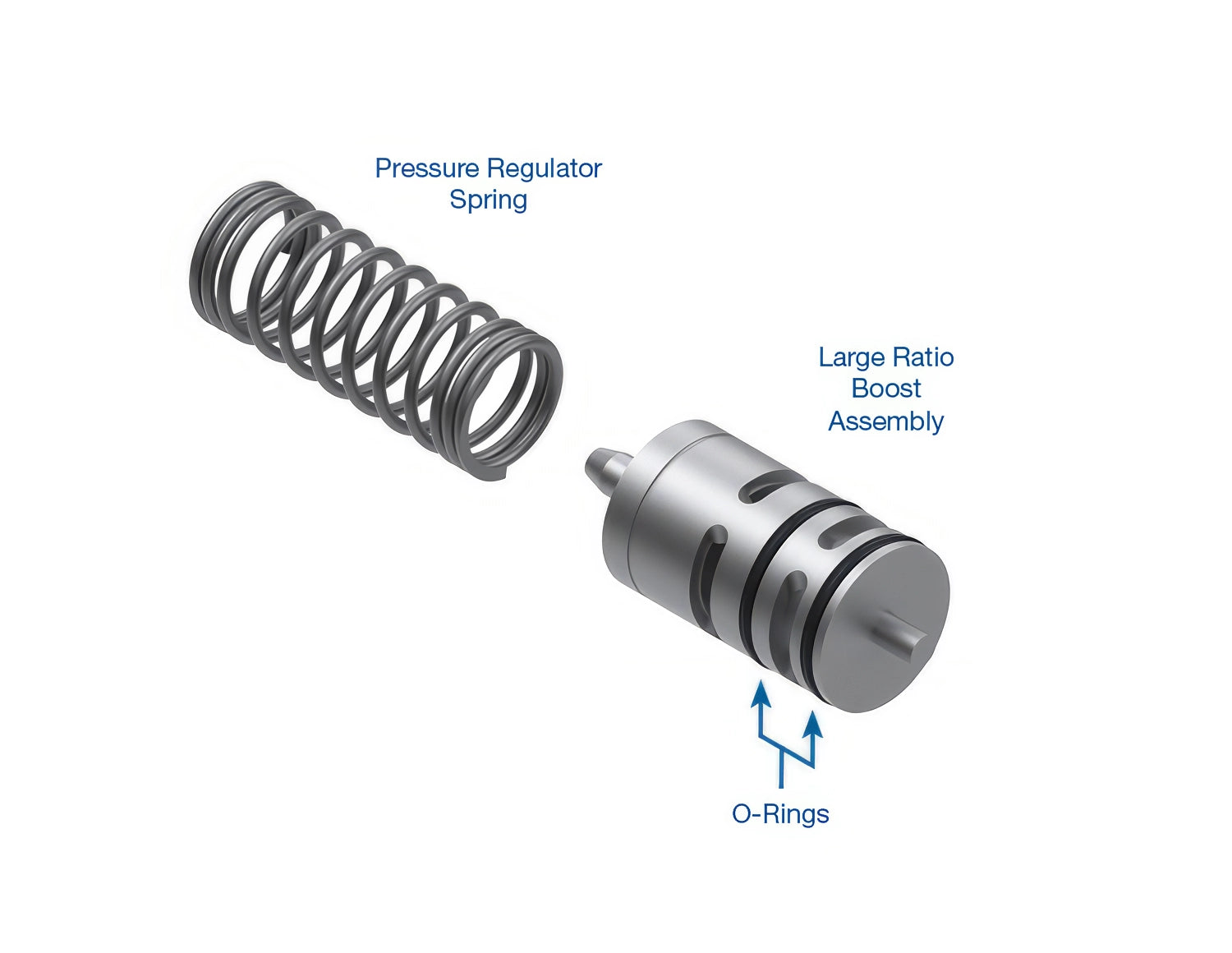
The boost valve assembly
Sonnax documents the 4L80-E and 4L85-E boost valve as a source of uncontrollable line rise upward of 500 to 600 psi, high line pressure in Reverse, a buzz, and broken direct clutch drums and cases. The mechanism is a wear-created cross leak at the sleeve that lets Reverse boost oil into the torque signal circuit, plus leakage past the aluminum balance plug. Read that number against the 324 psi Reverse maximum from Step 2 — this is a parts-breaker, not an annoyance.
The pressure regulator valve end plug
On the Sonnax 4L80-E critical wear chart, the pressure regulator valve end plug carries a symptom list that is easy to skim past: harsh/soft shifts and burnt clutches. Leakage there is what stops the regulator circuit controlling in either direction. The valve itself lists separately as engine surge at idle, low TCC release pressure and low cooler flow.
Both are vacuum-test findings, not visual ones — a worn bore rarely looks wrong. Sonnax's own benchmarks: an extremely good circuit might approach 22 to 23 inches of mercury, a severely worn bore as low as 8 inches. Vacuum loss is directly proportional to clearance, so the reading tells you how much wear you have, not just whether wear exists. Test the pressure regulator valve, its end plug, the boost valve and the accumulator control valve on the same pass.
Step 5: the accumulators, where shift feel actually lives
If pressure checks out and only one or two shifts are harsh, stop chasing pressure and look at cushioning. Sonnax describes an accumulator as "essentially acting as a shock absorber for the fluid pressure that is applying a clutch, brake or band," letting the component engage gradually instead of slamming on. Take that away and the clutch applies at whatever line pressure is present.
The factory mechanical diagnosis guide lists the causes for harsh shifts in all drive ranges in order of probability:
- Pressure control solenoid stuck in the off (de-energized) position — replace the solenoid.
- Accumulator fault — broken piston spring, missing piston spring, damaged piston seal, loose cover bolts, damaged gasket. Overhaul the accumulator.
- Valve body check ball missing or mispositioned — reposition them; if any check ball is actually missing, that unit needs to come apart.
- Incorrect TCM calibration.
Item two is worth a pan-drop on any unit that has been apart before: loose cover bolts and a damaged gasket are assembly errors, not wear items. Item three is the classic reassembly mistake — a check ball in the wrong seat produces one specific harsh shift rather than a general one. Test the accumulator control valve bore while you are in there; Sonnax lists its wear as soft shifts, low accumulator pressure, high line pressure in Drive and low line rise in Reverse, meaning that one bore can raise pressure and remove cushioning at the same time.
Harsh engagement into Drive or Reverse is a different list
A clunk when the lever comes into gear is not a harsh 1-2, and the factory guide treats it separately. Its causes, in order: high idle speed, then line pressure too high from a failed pressure control solenoid, a stuck reverse/boost or pressure regulator valve, an accumulator spring or seal failure, a shift sensor failure, or a missing check ball. Check idle speed first — a diesel idling 200 rpm high will bang into Reverse with a perfectly healthy gearbox.
What this costs if you drive it
Harsh shifting is not a comfort problem on a 4L80E. Sonnax lists sustained excess line pressure as the cause of broken parts, broken clutch pistons, broken direct clutch drums and cracked cases, and the pressure regulator end plug leak shows up alongside burnt clutches. The manual's fluid note applies too: overfilling aerates the fluid, and aerated fluid causes the exact shift quality problems you are chasing. Check the level hot, not cold on the rack. And for the performance crowd — a blanket line pressure boost on a truck that already shifts harsh hides the diagnosis and speeds up the damage. Firm a shift with the right accumulator spring and calibration, not with pressure everywhere.
FAQ
Why does my 4L80E slam into gear only after the check engine light comes on?
Because that is the designed behavior. A dozen separate 4L80-E fault codes list maximum line pressure as the controller's default action, including TP sensor faults, pressure control solenoid faults, high or low system voltage, shift solenoid circuit faults and all three ratio errors. The transmission runs full pressure to keep the clutches from slipping while it is operating blind, so fix the code before you touch the transmission.
Can a bad alternator cause harsh shifts on a 4L80E?
Yes, at both ends. DTC 52 sets over 16 V for 109 minutes and DTC 53 over 19.5 V for two minutes, and both default to maximum line pressure, 2nd gear and no TCC. DTC 75 does the same for low voltage, below about 10.3 V at operating temperature with the engine over 1,000 rpm. Check charging output before you pull a pan.
How do I know if the EPC solenoid is causing my harsh shift?
Run the pressure control solenoid override sweep with a gauge connected. Line pressure should fall steadily from roughly 157-177 psi at zero current to 35-55 psi at about 1.0 amp. If it stays high through the whole sweep, the fault is the solenoid, its wiring or the TCM. Confirm with a resistance check, which should read 3.5 to 5.2 ohms.
Is a harsh 1-2 shift on a 4L80E the accumulator or the valve body?
If line pressure tests normal and only one shift is harsh, look at that shift's accumulator first: a broken or missing piston spring, a damaged piston seal, loose cover bolts or a damaged gasket. If several shifts are harsh and pressure is high everywhere, it is a pressure problem and the accumulator is a symptom, not the cause.
How much line pressure is too much on a 4L80E?
The published maximum is about 171 psi in the forward ranges and about 324 psi in Reverse. Sonnax documents 4L80-E boost valve wear producing uncontrollable line rise upward of 500 to 600 psi, with broken parts, broken clutch pistons, broken direct clutch drums and broken cases as the result. Treat anything well above the factory maximums as a parts-breaking condition.