P0748 comes off the scan tool as Pressure Control Solenoid "A" Electrical. GM's own service information for the 4L80-E calls the part the PC Sol. Valve, and the code means one specific thing: the control module drove the pressure control solenoid circuit, measured the current that came back, and the two numbers disagreed by more than the module is willing to tolerate.
That is worth saying plainly, because P0748 is not a slipping code, a clutch code, or a pump code. It is a report about electricity. The good news, if you have spent any time under a 6L80, is that the 4L80E still gives you a solenoid you can put a meter on and a connector you can break into. This one is genuinely diagnosable in a bay.
Related reading: our 4L80E low line pressure diagnosis writeup, and the 4L60E version of P0748, which shares most of this circuit.
Exactly what has to happen for the code to set
Vague code descriptions are why this job takes three trips. GM's diagnostic table is specific, and every number in it is something you can go test:
- System voltage between 10 and 16 volts (10 to 16.5 on the 6.5L diesel calibration).
- Engine running above 475 RPM for at least 7 seconds.
- The difference between commanded amperage and measured return amperage greater than 0.16 amp.
- All of the above true for 200 milliseconds.
Read that list again with a diagnostic hat on. The module is not measuring pressure. It is measuring its own current feedback. A 0.16 amp error is a narrow window, which means corrosion, a spread terminal or a chafed wire will set this code long before the solenoid itself gives up. Wiring first is not shop folklore here, it is what the enable criteria are pointing at.
The part everybody gets backwards: current versus pressure
The 4L80E pressure control solenoid is a variable-force device. The PCM or VCM varies current through it from about 0.1 to 1.1 amps, and the relationship to line pressure is inverted. GM spells it out: 0.1 amp corresponds to high line pressure, and 1.1 amps corresponds to low line pressure.
Mechanically that makes sense once you see what the solenoid is doing. It is not pushing pressure up. It is bleeding torque signal oil off to exhaust, and that torque signal is what loads the boost valve behind the pressure regulator. More current opens the bleed further, less signal reaches the boost valve, and line pressure falls. Less current closes the bleed, signal pressure climbs, the boost valve loads the regulator harder, and pressure rises.
Two things follow from that. First, when you are staring at live data, a rising amperage number is a falling pressure command, not a rising one. Get that backwards and you will condemn a healthy solenoid. Second, a solenoid that has gone electrically dead sits at zero current, which is the maximum pressure end of the scale. That is the behavior the failsafe is built around.
Why the truck bangs instead of slips
When P0748 sets, GM disables the pressure control solenoid and the transmission defaults to maximum line pressure. The shift adapts freeze at the same moment, so the module stops learning from data it no longer trusts.
The customer complaint that walks in the door with this code is therefore usually a truck that slams. Harsh garage engagements into Drive and Reverse, a 1-2 that bangs, no modulation at light throttle. Techs who expect an electrical transmission code to mean slipping go looking for the wrong thing. Maximum line pressure with frozen adapts feels like a shift kit installed by someone in a bad mood.
It is also why this one should not sit. Sonnax documents where unregulated EPC pressure ends up on these units: the pressure regulator is driven into a high line position, line rise can go upward of 500 psi, and the resulting carnage is broken direct clutch drums and cracked cases. A customer who drives a banging truck for two months to avoid paying for a solenoid can end up buying a case.
Once the fault is repaired, the code clears with a scan tool, or on its own after 40 consecutive warm-up cycles without a repeat failure.
Symptoms worth writing on the ticket
- Harsh, slammed engagements into Drive and Reverse; firm-to-violent upshifts at all throttle positions.
- No pressure modulation: line pressure does not fall off at light throttle the way it should.
- MIL on with P0748, sometimes alongside shift solenoid or ratio codes (that combination has its own cause, below).
- Shift quality that does not improve with driving, because the adapts are frozen.
- On an intermittent, a truck that is normal cold and harsh after a heat soak, or harsh only over rough pavement.
Diagnosing it in order
1. Charging system and grounds, before you touch the transmission
The 10 to 16 volt window is part of the enable criteria. A weak battery, a failing alternator, or a corroded powertrain ground puts the module in a position where its own current measurement is unreliable, and a 0.16 amp threshold does not need much noise to trip. Load test the battery, check charging output, then clean and tighten the engine-to-body and case grounds. This costs nothing, and it is the most common reason a replaced solenoid does not fix the truck.
2. Capture the freeze frame before you clear anything
Note voltage, RPM, coolant and transmission temperature, and vehicle speed at the moment of the fail. Whether the code set cold in a driveway or hot on the highway narrows the search enormously. Clearing codes first to see whether they come back throws that away.
3. Ohm the solenoid at the case connector
This is the test a 6L80 will not let you run, and it is why a 4L80E P0748 is a much better day. GM's spec is 3 to 7 ohms across the pressure control solenoid coil. Unplug the 20-way case connector and measure across terminals C and D, which carry circuits 1228 and 1229, with the unit at or near room temperature.
- Open, or well above 7 ohms: the solenoid or the internal harness. The pan comes down.
- Near zero: shorted coil, or the two circuits shorted together inside. The pan comes down.
- Inside 3 to 7 ohms: the solenoid side is good. The fault is outboard, in the external harness or at the module connector.
Check each circuit to the transmission case for a short to ground while you are in there. A solenoid that ohms perfectly but has one leg grounded will still set the code.
4. Work the external harness back to the module
If the coil checked good, the wiring between the case connector and the module is the suspect. On the 6.5L diesel calibration the circuit lands at the 32-way brown C1 PCM connector, terminal C1-C7. On the gas trucks it is the grey C3 VCM connector, terminal C3-6. Check both circuits for continuity end to end, for a short to ground, and for a short to voltage. GM's diagnostic aids for this code call for inspecting terminals that are bent, backed out, damaged or have poor tension, and for massaging the harness while watching the data to catch an intermittent. Do that with the engine running and solenoid amperage on the screen.
5. Watch commanded versus actual amperage in live data
With the truck running, watch the pressure control solenoid command and the actual current feedback together. They should track. A gap that opens up under vibration, at temperature, or at a particular throttle position is your fault, and the condition it appears under tells you where to look. Keep the inversion in mind while you read it.
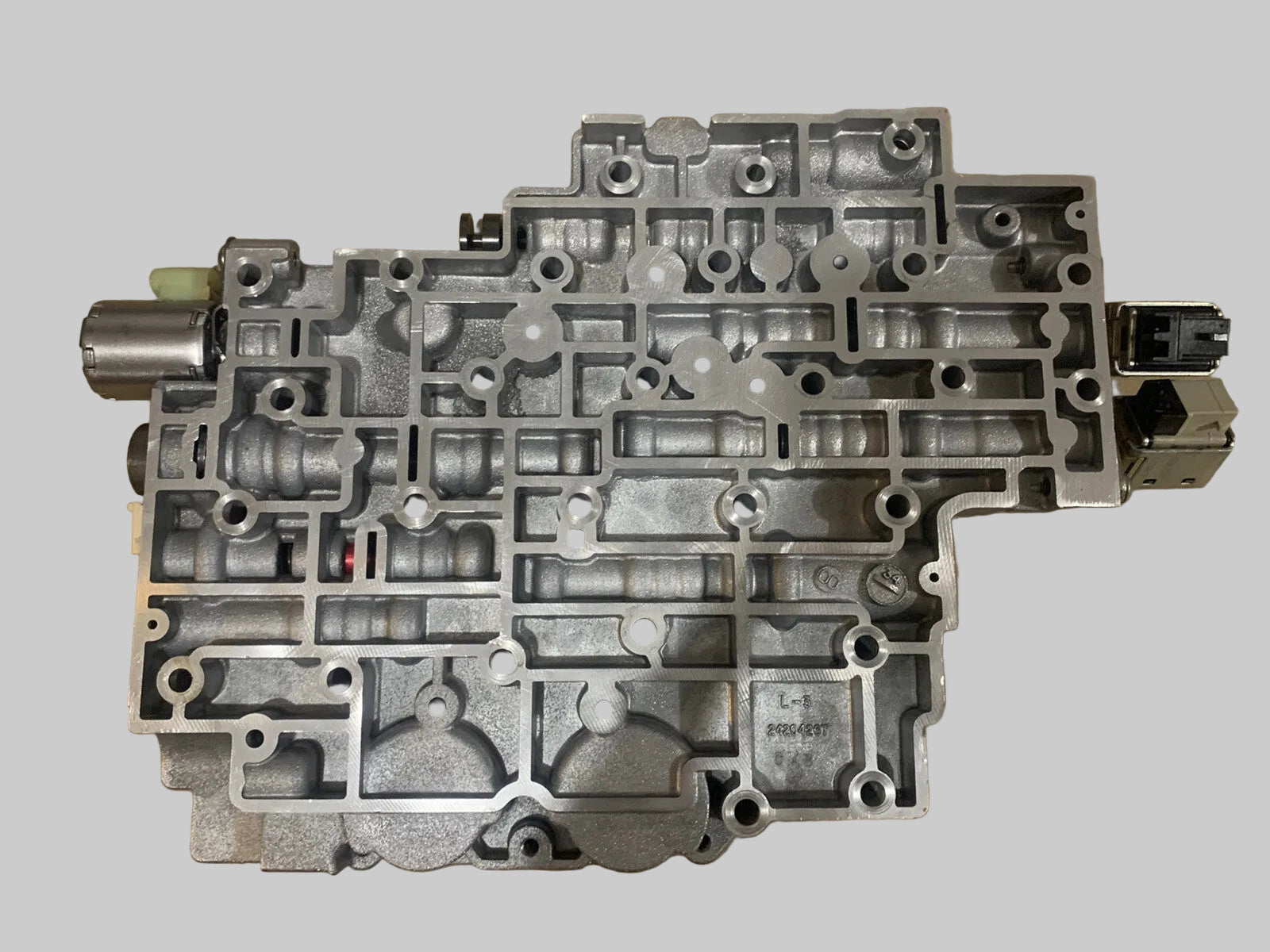
6. Inside the pan
If the resistance test sent you here, pull the pan and inspect the internal harness and the back side of the case connector. Look for chafe where the harness routes over the valve body, terminals pushed back in the connector body, and fluid that has wicked up into the external harness. Note the fluid condition and what is on the magnet while the pan is down, because that feeds directly into the next section.
When the circuit checks perfect: the AFL valve
Here is the failure that sends good techs in circles, and it is specific to this transmission family.
The actuator feed limit valve takes line pressure and regulates it down to a lower, steady feed for the solenoids. In GM 4L60-E and 4L80-E units that regulated feed sits at approximately 115 psi, and it supplies the shift solenoids, the pressure control solenoid, the TCC solenoid, the 3-2 control solenoid and the 2-3 shift valve lineup off one circuit. Sonnax puts the normal AFL range across transmissions at 80 to 115 psi.
The 4L80E AFL valve has a large reaction area, which side-loads it hard against the bore. Worse, per Sonnax, the EPC solenoid itself oscillates the torque signal and AFL oil, which increases valve movement and accelerates the wear. The valve wears out its own bore, and the thing driving that wear is the very solenoid you are diagnosing.
What that wear produces: oil pressure to the shift solenoids drops, which throws solenoid and ratio codes, and the same AFL oil loss shows up as low line pressure. So if P0748 arrived with a handful of shift solenoid or ratio codes for company, stop chasing individual solenoids and go vacuum test the AFL bore. One worn bore explains all of them at once. The repair is a sleeve and valve kit rather than a whole valve body: Sonnax 34200-16K uses a hard-anodized valve with annular grooves running in a full-contact sleeve that adds 54 percent more valve support.
The 6.5L diesel look-alike that sets no code at all
Worth knowing before you condemn a 4L80E behind a 1994-and-later 6.5L. Those trucks went drive-by-wire, and the accelerator pedal position sensor became the main input not just for fueling but for how much line pressure the transmission gets.
Gregg Nader of the Sonnax TASC Force laid the failure out in Transmission Digest: an injection pump with an internal leak feeds the engine more fuel than the computer asked for, so the truck pulls away from a stop on 2 to 10 percent throttle instead of the normal 50 to 100 percent. The computer, seeing almost no pedal, never commands the EPC rise the load actually requires. The result is soft sliding shifts and burned forward, intermediate and direct clutches, on a transmission that is doing precisely what it was told.
This one does not set P0748, which is exactly what makes it dangerous. The circuit is healthy. If you see burned clutches and soft shifts on a 1994-98 6.5L, check the injection pump before you quote a rebuild. GM extended coverage on those pumps from 5 years/100,000 miles to 11 years/120,000 miles under special policy bulletin #00064A.
The fix, and what to put back in it
If the coil failed its resistance check, the pressure control solenoid is a serviceable part on this unit. The common GM service part number covering the 4L60E and 4L80E pressure control solenoid is 24248893. Replace the filter and pan gasket while you are in there, and inspect the internal harness rather than reusing one that has been living in the same fluid that killed the solenoid.
Fluid is DEXRON VI. The 4L80E left the factory on DEXRON III, and GM superseded that spec: the current GM transmission capacities and fluids chart lists DEXRON VI, DEXRON HP and DEXRON ULV, and carries an explicit Not DEXRON III note. Use a licensed DEXRON VI, not a bottle that merely claims to be suitable for it.
One last thing, aimed squarely at the temptation. Do not install a line pressure booster kit to paper over a pressure complaint you have not diagnosed. Sonnax kits like the 4L80E-LB1 raise pressure deliberately, with regulator springs about 10 percent stronger than OE and larger ratio boost valves that make the increase progressive rather than linear. That is a build decision for a truck that tows or makes power. Stacked on top of an unresolved P0748 that is already defaulting to maximum pressure, it is how cases crack.
Need the part for this one
If the coil failed the 3 to 7 ohm check, the pressure control solenoid is the repair, and it is a serviceable part on this unit. Grab a filter and pan gasket at the same time so the pan only comes down once. Both are at CoreTransmissionParts, along with the full 4L80E catalog.
4L80E EPC Pressure Control Solenoid →FAQ
Why does my 4L80E shift harder after P0748 sets, instead of slipping?
Because that is the failsafe GM designed. When the module detects the pressure control solenoid circuit fault it disables the solenoid outright, and a disabled pressure control solenoid defaults the transmission to maximum line pressure. GM's service information also notes the shift adapts freeze at the same time. High pressure plus frozen adapts is exactly what a banging 1-2 and a slammed Reverse engagement feel like, so a harsh truck with P0748 is behaving normally for the code.
What resistance should the 4L80E pressure control solenoid read?
GM's diagnostic table for this code calls for 3 to 7 ohms across the pressure control solenoid coil. Measure it at the case pass-through connector across terminals C and D, which are circuits 1228 and 1229, with the fluid at or near room temperature. An open reading points at the solenoid or the internal harness, and a reading near zero ohms means a shorted coil. A reading inside 3 to 7 ohms tells you the solenoid side is fine and the fault is outboard of the case.
Can I keep driving a 4L80E with P0748 set?
To get it home or to the shop, yes. For weeks, no. The transmission is running at default maximum line pressure with no modulation, and Sonnax documents what unregulated pressure does to these units: the pressure regulator is forced into a high line position, line rise can climb upward of 500 psi, and the failures that follow are broken direct clutch drums and cracked cases. That is a far more expensive repair than the solenoid being put off.
Why did P0748 show up along with shift solenoid and ratio codes?
They share a feed. The actuator feed limit valve regulates line pressure down to roughly 115 psi and supplies the shift solenoids, the pressure control solenoid, the TCC solenoid and the 3-2 control solenoid from that one circuit. Sonnax notes that the 4L80E AFL bore wears badly because the valve has a large reaction area and the EPC solenoid constantly oscillates the torque signal and AFL oil. When that bore leaks, every solenoid on the circuit gets starved at once, so you get a fistful of codes rather than one.
Does DEXRON VI go in a 4L80E?
Yes. The 4L80E was factory filled with DEXRON III, and GM superseded that spec years ago. GM's current published transmission capacities and fluids chart does not list DEXRON III as a service fill at all and carries an explicit Not DEXRON III note, so DEXRON VI is what goes back into a 4L80E today. Use a licensed DEXRON VI fluid rather than a generic multi-vehicle ATF that only claims to be suitable for it.