A red puddle under a 4R70W truck gets treated like a one-part problem more often than it should. Somebody sees fluid on the driveway, assumes it's the pan gasket because that's the cheap, easy guess, drops the pan, puts in a new gasket and filter, and two weeks later the puddle is back. The pan gasket is a real leak point, but it isn't the only one, and on a specific run of Ford trucks it isn't even the most likely one. Before you buy a single part, it's worth knowing where this transmission actually leaks and which of those spots has a documented Ford bulletin behind it.


The five places this transmission actually leaks
In order of how often I actually find them on the lift:
- Pan gasket. The most common and the cheapest to fix. The 14-bolt pan uses a reusable gasket on most years; a warped pan rail, an overtightened bolt that crushed the gasket, or just age will let it seep. This is the right first guess, but confirm it before you pull the pan.
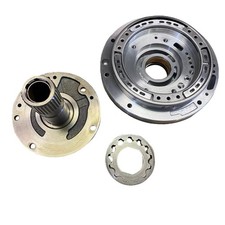
- Front pump seal and O-ring. Where the transmission bolts to the bell housing, sealed by a large O-ring and a thin paper gasket under the pump. It takes constant heat and rotation from the torque converter hub, and when it goes, fluid tracks down the front of the case and drips off the bottom of the bell housing, not the pan.
- Extension housing bushing and seal. The rear output shaft seal, which is really a large O-ring riding on the shaft just ahead of the splines. This is the spot with a documented Ford bulletin behind it, covered in detail below.
- Cooler line fittings. The crimped or threaded fittings where the steel cooler lines meet the case or the radiator. These weep slowly, usually only visible as a stain rather than a drip, and get missed because everyone's looking at the pan and the rear seal instead.
- Torque converter. Less common, but it happens at the weld where the stud pads attach to the cover, or from a worn converter hub chewing up the front pump bushing and seal it rides in. If you already replaced the front pump seal once and it's leaking again, check the hub for wear before blaming the seal a second time.
The bulletin behind the most common rear leak
If you're working on a 1997-2000 F-150 or F-250 light-duty truck, 4x2, with a 139-inch wheelbase, the rear extension housing deserves a look before anything else. Transmission Digest's October 2001 TECH/TALK column covered a Ford bulletin for exactly this truck and wheelbase combination: a driveline vibration and a transmission-fluid leak from the rear seal in the extension housing. Ford's stated cause is the extension-housing bushing or seal spinning or walking out because of excessive driveshaft flexing during extended high-speed operation. In plain terms, running that wheelbase at highway speed for long stretches flexes the driveshaft enough that the bushing inside the housing starts to spin in its bore instead of staying put, and once it spins, the seal riding against it loses its seal and starts walking too.
The listed fix is to check the extension-housing bushing and seal first. If either one has spun or walked out, Ford's repair is to replace the extension housing and gasket, and on some of these trucks, install a revised driveshaft at 127mm (5 inches) in diameter instead of the original 114mm (4.5 inches), along with aligning the balance marks on the output shaft, driveshaft and rear-axle universal-joint flange. That's a bigger job than a seal swap alone, and it's the reason a "quick" rear seal replacement on one of these trucks sometimes comes back leaking: if the bushing bore is worn from the spinning bushing, a new seal dropped into a housing with no interference left to hold it just repeats the failure. If you're seeing both a leak and a vibration on one of these trucks at the same time, that combination is the tell. Treat it as the bushing issue, not two unrelated problems.
Confirm the source before you buy anything
Fluid on the ground or fluid on the case doesn't tell you where it started. It runs downhill along whatever it touches first, so a front pump seal leak can end up looking like it's coming from the pan, and a cooler line weep can end up pooling near the crossmember where it looks like a rear seal. Ford's own workshop procedure for pinpointing an automatic transmission leak is the same basic method regardless of which Ford automatic you're on (the current Ford Leakage Inspection procedure, as published in the 2019 Ranger workshop manual, lays it out step by step): clean the transmission case and the surrounding area thoroughly, add fluorescent dye to the ATF, run the vehicle through drive and reverse on a lift to build hydraulic pressure, then inspect with a UV (black) light, checking the top of the torque converter housing and working outward from there. The procedure is explicit that the leak source has to be positively identified before a part gets replaced, specifically because fluid thrown off a spinning converter or driveshaft can travel well away from the actual failure point and mislead a quick visual check.
On the 4R70W specifically, that means: clean everything, drive it, then look with the light before you order a gasket kit. Fifteen minutes of dye-and-light work saves you from doing the pan job twice when the real leak was the front pump seal the whole time.
Refill it with the right fluid, not a stop-leak
Once the actual leak is fixed, don't undercut the repair on the refill. The 4R70W runs MERCON V (Ford's 2003 Crown Victoria Owner Guide lists MERCON V and an approximate 13.2 L / 13.9 qt dry fill for this unit), and the final fill level is always set by checking the dipstick hot, not by pouring in a dry-fill number and calling it done -- a stock-pan pan drop only returns 5 to 6 quarts, so a leak repair that required dropping the pan needs roughly that much fluid back in before you even get to the hot-check step. Chevron's technical data sheet for its MERCON V-licensed ATF (Ford approval MV130910) is a useful reference if you're sourcing fluid from a brand you don't recognize on the shelf: the approval number on the bottle is what tells you it actually meets Ford's spec, not just the "Mercon-compatible" wording some bargain fluids use loosely.
Skip the stop-leak bottle. A stop-leak product works by swelling old, hardened seal material, which is a temporary patch on a part that's already failed, not a repair. It can also make the next real seal replacement harder, since it leaves swollen rubber behind in the bore.
Don't chase a leak that isn't there
Low-feeling fluid level and a soft or buzzy shift don't automatically mean something is leaking. Sonnax has documented a specific wear pattern on the 4R70W: scoring at the EPC end of the pressure regulator valve, which is typically easy to spot by eye, plus wear in the surrounding valve body casting bore that usually accompanies a badly scored valve and will not seal properly even with a new valve installed. The combination drops line pressure and produces soft shifts and an erratic buzz under load. That's a mechanical wear issue inside the valve body, with no fluid actually leaving the case. Sonnax's fix is to vacuum test the bore, then ream and install an oversized valve where the casting itself is worn rather than just swapping in a standard replacement valve. If the dipstick reads full hot and you're still getting soft or buzzy shifts, stop looking under the truck for a leak and start looking at the valve body instead. Chasing a leak that isn't there wastes time and, if someone talks you into a stop-leak additive for a symptom that was never a leak, can make the real problem worse.
Need parts for this job?
Our 4R70W parts page has the FT105 filter and gasket kit, front pump assemblies, Motorcraft MERCON V by the case, and full rebuild kits if the inspection turns up more than a seal, all with on-site checkout.
4R70W rear housing gasket, bushing and seal kit (the extension-housing fix)
Matches the extension-housing bushing/seal repair covered above, sold by our sister store, CoreTransmissionParts.
Shop the part for this fix →Need something else? The 4R70W parts collection has pans, pump seal kits, gaskets and full rebuild kits.
FAQ
Where do 4R70W transmissions leak most often?
The pan gasket, the front pump seal and O-ring at the bell housing, the extension housing bushing and seal at the rear, the cooler line fittings, and the torque converter are the five real leak points. On 1997-2000 F-150 and F-250 4x2 trucks with a 139-inch wheelbase, Ford's own bulletin points at the extension housing more than any other spot, so start your inspection there on those trucks before assuming it's the pan.
What is the Ford bulletin about the 4R70W extension housing leak?
Transmission Digest's October 2001 TECH/TALK covered a Ford bulletin for 1997-2000 F-150 and F-250 4x2 trucks with 139-inch wheelbases: driveline vibration and a transmission fluid leak from the rear extension housing seal, caused by the bushing or seal spinning or walking out from excessive driveshaft flex at sustained high speed. The fix is to check the bushing and seal, replace the extension housing and gasket if they've spun out, and in some cases install a larger 127mm driveshaft and realign the balance marks.
How do I find where a transmission is actually leaking from before I buy parts?
Clean the case and the area underneath, add fluorescent dye to the ATF, run the truck through drive and reverse to build pressure, and check with a UV light under the torque converter housing and along the extension housing afterward. Ford's own workshop manual describes this exact dye-and-black-light procedure for its automatic transmissions, and it says plainly that the leak source has to be positively identified before any part gets replaced, because a leak can travel along the driveline and show up well away from where it started.
What fluid should I refill a 4R70W with after fixing a leak?
MERCON V, per Ford's owner's guide for the 4R70W, with a total dry-fill capacity of about 13.2 liters (13.9 quarts) and the final level always set by checking the dipstick hot, not by the dry-fill number. Don't add a stop-leak or conditioner on top of it; Ford's maintenance guide specifically warns against supplemental transmission additives, and a stop-leak product that swells an old seal is not a substitute for replacing it.
Can a worn valve body make a 4R70W look like it's leaking when it isn't?
Not a true fluid leak, but it can produce symptoms that get blamed on low fluid. Sonnax has documented scoring at the EPC end of the 4R70W's pressure regulator valve and wear in the valve body's casting bore, which drops line pressure and produces soft shifts and a buzz under load. That's an internal wear issue, not fluid escaping the case, so if the dipstick reads full and you still have soft or buzzy shifts, don't keep chasing a leak that isn't there.
Related guides
- 4R70W Filter and Pan Service Guide
- 4R70W Flush vs Drain-and-Fill
- 4R70W Torque Converter Shudder
- 4R70W Valve Body Wear and Fix
- 4R70W Overheating Prevention
Sources
- Transmission Digest, "Transmission TECH/TALK," October 2001 issue. Backs the 1997-2000 F-150/F-250 4x2, 139-inch-wheelbase driveline vibration and extension-housing rear-seal leak, its cause (bushing/seal spin or walk-out from driveshaft flex), and the repair (extension housing and gasket replacement, possible 127mm driveshaft and balance-mark alignment). transmissiondigest.com
- Ford Motor Company, Automatic Transmission Diagnosis and Testing, Leakage Inspection procedure (2019 Ranger workshop manual, section 307-01; Ford uses the same dye-and-UV leakage inspection method across its automatics). Backs the fluorescent-dye-and-black-light leak diagnosis method and the requirement to positively identify the leak source before repair. servicemanuals-backend.fly.storage.tigris.dev (PDF)
- Chevron, Havoline ATF MERCON V Technical Data Sheet (TTF-95). Backs the MERCON V specification approval number (Ford MV130910) used to identify a correctly licensed replacement fluid. shop.sclubricants.com (PDF)
- Sonnax, "Watch Out for 4R70W Pressure Regulator Valve & Casting Wear." Backs the EPC-end pressure regulator valve scoring and valve body casting bore wear pattern that produces soft shifts and buzz without an actual fluid leak. sonnax.com
- Ford Motor Company, 2003 Crown Victoria Owner Guide, Maintenance and Specifications. Backs the MERCON V fluid specification and the approximate 13.2 L (13.9 qt) dry-fill capacity for the 4R70W. Ford's fordservicecontent.com host blocks direct PDF access, so this links the Internet Archive's copy of the same Ford document. web.archive.org (Ford PDF)
- Ford Motor Company, 2003 Scheduled Maintenance Guide. Backs the warning against supplemental transmission additives and cleaning agents, which is why a stop-leak is not a substitute for replacing a leaking seal. Internet Archive copy of the Ford document. web.archive.org (Ford PDF)