A 4R70W that runs hot doesn't fail all at once. It gets a little softer on the 2-3, a little slower into Reverse, the converter starts to shudder on a light-throttle cruise, and one day the fluid comes out of the pan dark brown with that burnt-toast smell. By then the forward clutches and the overdrive band have usually been cooked for a while. The question on the bench is always the same: was the heat the cause or the symptom?
This post is the non-towing side of the heat story. If the truck pulls a trailer, read our 4R70W towing upgrades guide for Ford's cooler requirements and the overdrive servo fixes. Here I'm covering the everyday reasons an F-150, Expedition, Crown Vic or Mustang 4R70W runs hot, how to prove where the heat is coming from, and what actually prevents it.
The short version: Keep the fluid near 200°F; every 20 degrees above that halves the transmission's expected life [1]. Most 4R70W heat problems come down to four things: low cooler flow (a plugged cooler, a failed thermal bypass [2], or debris left from a prior failure [3]), a converter clutch that won't lock or slips because the converter limit valve is worn [4], low line pressure from a worn pressure regulator bore that gets worse as the oil thins [5], and the wrong or tired fluid [6]. Measure before you replace anything.
Why Heat Matters More Than Mileage
Automatic transmission heat comes from slip. The torque converter slips whenever it's unlocked, and clutches and bands slip during every apply and any time pressure is too low to hold them. All of that slip turns engine power into fluid temperature. The cooler's job is to carry it away faster than it's made.
The damage curve is steep. Mike Brown's overheating article in Gears Magazine (ATRA) puts the ideal maximum transmission temperature at 200°F and says every 20 degrees above that cuts expected life in half: 220°F gives half the life, 240°F a quarter, 260°F an eighth [1]. Heat also breaks down the fluid itself, so the friction modifiers and oxidation inhibitors wear out faster, which makes the clutches slip more, which makes more heat. That loop is how a 4R70W goes from "a little soft" to burned in a few thousand miles.
Cause 1: Not Enough Cooler Flow
The 4R70W sends converter charge oil out through the cooler and back into the case as lube oil. If flow through that circuit drops, the converter runs hot and the geartrain gets less lube at the same time. There are three usual reasons.
A plugged or undersized cooler
The radiator tank cooler is only as good as the engine's cooling system. Gears Magazine points out that when the cooler sits in the radiator tank and the engine is running hot, the transmission can't be cooled either [1]. A radiator that's half plugged, a lazy fan clutch or a stuck thermostat will push transmission temperature up with it. Check engine temperature under load before blaming the transmission.
A failed thermal bypass
Some 4R70W and 4R75E applications route the cooler lines through a bypass block with a thermal valve. When the fluid is cold, the valve lets oil skip the cooler so the unit warms up faster. When it fails, it can keep bypassing the cooler after the fluid is hot. ATRA Technical Bulletin #1488 addresses this directly: transmission overheating on the 4R70W/75E (and Chrysler 62TE) can be caused by a failed cooler bypass, and the fix it describes is to disable the bypass for full cooler flow [2]. The procedure is to remove the snap ring and bypass valve, drill with a 21/64 bit, tap 1/8 NPT about eight threads deep, install a 1/8 in. Allen plug until snug, then reinstall the end plug, snap ring and bypass block [2]. The trade-off is a slower warm-up in cold weather, which is a much smaller problem than a cooler that never sees oil.
Debris from the last failure
This is the one that kills rebuilt units. When a 4R70W burns a band or clutch pack, the friction material goes straight into the cooler. A fresh unit installed on that cooler gets the debris back, or runs with a restriction from day one. The thermal bypass makes flushing harder too. Transmission Digest's Mike Steen explains that if a thermal bypass valve isn't heated during flushing so it fully stops bypassing, you'll get little if any flushing of the cooler, and that a higher-than-normal pressure reading on the flusher points to a restriction [3]. His advice is to flush around the bypass where you can, or plug it temporarily so all the flow goes through the cooler [3]. Our cooler flush guide walks through the procedure.
How to check flow
Don't guess. With the engine idling in Park and the fluid at operating temperature, disconnect the cooler return line, route it into a container, and time the output. Gears Magazine gives a minimum of about one gallon per minute of cooler flow [1]. If you get less, test the external cooler and lines first by flowing them off the truck. If the external circuit flows freely and the output from the case is still weak, the restriction is inside the transmission: pump, pressure regulator, converter limit valve or the converter itself.
Cause 2: The Converter Clutch Isn't Doing Its Job
On the highway, a locked converter makes almost no heat. An unlocked converter at 60 mph makes a lot. So a 4R70W that has quietly stopped locking up, or that slips the converter clutch, will run hot on the same drive that used to be cool. Watch for engine RPM that stays a few hundred higher than normal at a steady cruise, a shudder on light throttle, or converter slip codes like P0741.
The electrical side is the TCC solenoid and its PWM command, covered in our 4R70W P0741 guide. The hydraulic side is where a lot of heat problems hide. Sonnax lists converter shudder, TCC slip, low converter pressure and an overheated converter as complaints tied to the converter limit valve in the 4R70E, 4R70W, 4R75E, 4R75W and AODE [4]. Wear at the inboard spool lets converter pressure leak away, and debris damage at the outboard spool can bind the valve so it sticks in either a high or low converter pressure position [4]. Stuck low, the converter clutch can't hold and the converter overheats. Stuck high, pressure into the converter isn't limited and the converter can be damaged or ballooned [4]. Sonnax's repair criteria is a failed vacuum test at the listed ports or visible wear, and the fix is the drop-in 76948-56K valve kit [4].
If the converter itself has been glazed from slipping, the valve body repair won't bring it back. A converter that has been running hot needs to be replaced or rebuilt along with the valve work. Our 4R70W converter shudder guide covers how to tell a converter problem from a fluid problem.
Cause 3: Low Line Pressure That Gets Worse When Hot
Line pressure feeds everything, including the converter and cooler circuits. On the 4R70W the pressure regulator valve is a known wear point. Sonnax lists low line pressure resulting in band and clutch failure, a throttle-sensitive buzz especially when hot, soft shifts, delayed Reverse and uncontrolled Reverse pressure as common AODE and 4R70W complaints [5]. The cause is severe wear at the pressure regulator valve spool and bore, which lets EPC oil leak to exhaust and cuts line rise. As the fluid heats up and thins, the leak gets worse [5].
That's a textbook heat loop. The unit gets warm, pressure drops, the clutches slip, and the slip adds more heat. The early-unit repair is the Sonnax 76948-16K oversized pressure regulator and boost valve kit, which uses reaming tools to restore valve-to-bore clearance [5]. Later units have their own Sonnax regulator and boost valve kits. Either way, a line pressure test done cold and again hot is the only way to see this. A reading that's fine cold and falls off as the unit warms points straight at valve body wear. Our 4R70W slipping guide has the pressure test procedure.
Cause 4: Wrong, Low or Worn-Out Fluid
The 4R70W takes MERCON V. Ford's Motorcraft ATF quick reference chart lists MERCON V for the 4R70W/4R70E and the 4R75W/E, and the same chart says not to use supplemental transmission fluid additives, treatments or cleaning agents [6]. A "cooling" additive doesn't change how much heat the converter makes. Running the wrong fluid can change friction characteristics enough to cause converter shudder, which leads to more heat.
Level matters as much as type. Low fluid lets the pump draw air, and aerated fluid doesn't carry heat or hold pressure well. Overfilled fluid gets whipped into foam by the rotating parts and does the same thing. Check the level hot, on level ground, using the procedure in our 4R70W fluid type and capacity guide.
Ford's own level-check instructions tie heat and level together. The 2006 F-150 owner guide (4R70E and 4R75E) puts normal operating fluid temperature at 150-170°F, says to shut the truck off for about 30 minutes to let the fluid cool before checking if it has been towing, run at high speed or sat in hot city traffic, and notes that a high fluid level can itself be caused by an overheating condition [7]. So a stick that reads high right after a tow is not automatically an overfill. Let it cool, recheck, and if it still reads high on a unit nobody has topped off, look at the cooler and converter.
Old fluid is its own problem. Once it has been cooked, it has less friction modifier and less oxidation resistance left, so the next heat cycle does more damage [1]. A pan drop only swaps part of the fluid, since a lot stays in the converter and cooler. On a unit that has been hot, I do a full exchange and a new filter, and I look at what's in the pan before deciding whether fluid is enough.
How to Diagnose a Hot-Running 4R70W
- Confirm it's really hot. Read the TFT (transmission fluid temperature) PID on a scan tool and check it against an infrared thermometer on the pan. The TFT sensor is a thermistor on the solenoid body whose resistance drops as temperature rises. A bad sensor or internal harness can report heat that isn't there. Ford's P1783 transmission over-temperature code should agree with what you measure.
- Check the engine cooling system. Coolant temperature, fan clutch, radiator condition. The tank cooler can't do better than the radiator it sits in [1].
- Check fluid level, color and smell. Dark and burnt means damage has already happened; pull the pan and look for friction material.
- Measure cooler flow. About a gallon per minute minimum [1]. If the truck has a thermal bypass block, suspect it when flow is low with a hot unit [2].
- Watch converter lockup on a drive. Compare engine RPM to turbine speed at steady cruise. If they don't match when lockup is commanded, the converter is slipping.
- Run a line pressure test cold and hot. Pressure that falls off as the fluid warms points to pressure regulator or valve body wear [5].
Prevention That Actually Works
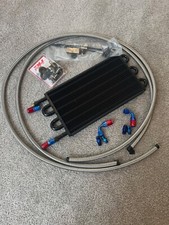
- Add cooling if the truck works. An auxiliary cooler plumbed in series after the radiator tank cooler, mounted where it gets clean air. See our cooler types and sizing guide.
- Flush or replace the cooler after any internal failure, and get the thermal bypass out of the way while you do it [3].
- Fix the converter limit valve and pressure regulator on every rebuild. They're cheap next to a converter and a clutch pack [4] [5].
- Use MERCON V, no additives, at the right level [6].
- Change fluid more often on a hard-working truck. Hot fluid wears out faster [1]. Ford's 2006 Scheduled Maintenance Guide moves the automatic transmission fluid change to every 30,000 miles for towing, extended idling or low-speed fleet use, dusty roads and off-road driving, versus 150,000 miles on the normal truck schedule [8]. For a 2004-2008 F-150 four-speed, see our 4R75W F-150 fluid change guide.
- Watch the TFT reading with a gauge or scan tool. Readings that settle around 180-200°F on the highway are healthy. If it climbs past 220°F, find out why before it costs you half the unit's life [1].
Sonnax Converter Limit Valve Kit 76948-56K for the 4R70W
The drop-in fix for the worn or sticking converter limit valve that causes TCC slip and overheated converters.
View the converter limit valve kit →Need something else? Browse all 4R70W parts at Core Transmission Parts.
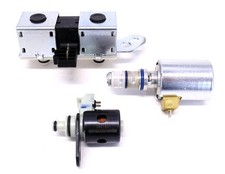
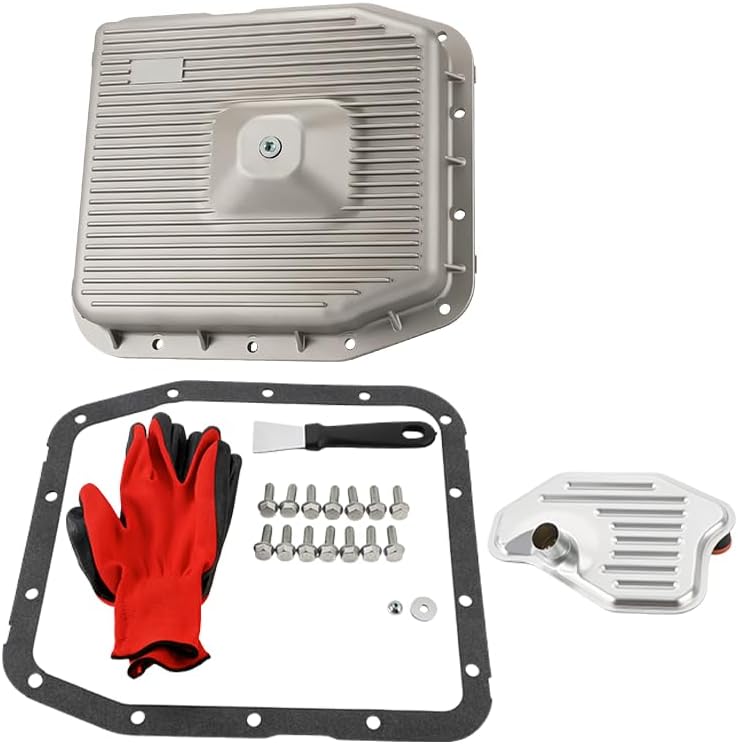
Coolers, deep aluminum pans, TCC solenoids, valve bodies and master rebuild kits for the 4R70W, with checkout on our site.
Shop 4R70W parts →FAQ
What is the normal operating temperature for a 4R70W?
Readings that settle around 180 to 200 degrees F on the highway are healthy. Gears Magazine puts the ideal maximum at 200 degrees F and notes that every 20 degrees above that cuts expected transmission life in half, so a unit living at 240 degrees F has about a quarter of its normal life left.
Why does my 4R70W overheat without towing?
The usual causes are low cooler flow from a plugged cooler, a failed thermal bypass or debris from a prior failure; a converter clutch that won't lock or slips; low line pressure from a worn pressure regulator bore; and wrong, low or burned fluid. Measure cooler flow, lockup and line pressure before replacing parts.
Can a bad cooler bypass valve cause a 4R70W to overheat?
Yes. ATRA Technical Bulletin 1488 lists a failed cooler bypass as a cause of 4R70W/75E overheating. The bulletin's fix is to remove the bypass valve, drill and tap the bore 1/8 NPT, and install a 1/8 in. Allen plug so all fluid goes through the cooler.
How much cooler flow should a 4R70W have?
Gears Magazine gives a minimum of about one gallon per minute of cooler flow. Check it at idle in Park with the fluid hot by timing the output of the disconnected return line. If flow is low and the external cooler and lines flow freely off the truck, the restriction is inside the transmission.
Does a worn converter limit valve cause overheating?
It can. Sonnax lists converter shudder, TCC slip, low converter pressure and overheated converters from converter limit valve wear in the 4R70W. A valve stuck low lets the converter clutch slip and make heat; the drop-in fix is the Sonnax 76948-56K kit.
Sources
- Gears Magazine (ATRA) — "48RE/68RFE/AS68RC Transmission Overheating" (Mike Brown), on the 200°F ideal maximum and life halving every 20°F above it, radiator tank cooler dependence on engine cooling, and minimum cooler flow of about a gallon per minute. gearsmagazine.com
- ATRA — Technical Bulletin #1488, "4R70W/75E & 62TE Transmission Over Heating" (November 2012), on overheating caused by a failed cooler bypass and the drill, tap and plug procedure for full cooler flow. ATRA bulletin 1488 (PDF)
- Transmission Digest — "Cooler Bypass" (Mike Steen, July 2011), on thermal bypass valves blocking cooler flushing unless heated or plugged, and high flusher pressure as a sign of restriction. transmissiondigest.com
- Sonnax — Converter Limit Valve Kit 76948-56K, on converter shudder, TCC slip, low converter pressure and overheated converters in 4R70E/4R70W/4R75E/4R75W/AODE units from inboard spool wear and outboard spool binding, and the vacuum test criteria. sonnax.com/parts/5077
- Sonnax — Oversized Pressure Regulator & Boost Valve Kit 76948-16K, on low line pressure, throttle-sensitive buzz when hot and band/clutch failure from pressure regulator spool and bore wear that worsens as oil thins. sonnax.com/parts/2400
- Ford / Motorcraft — Automatic Transmission Fluid Quick Reference Chart (US), listing MERCON V for the 4R70W/4R70E and 4R75W/E and cautioning against supplemental fluid additives, treatments and cleaning agents. fcsdchemicalsandlubricants.com (ATF quick reference PDF)
- Ford Motor Company — 2006 F-150 Owner Guide, Maintenance and Specifications (4R70E/4R75E), on the 150-170°F normal operating fluid temperature, the 30-minute cool-down before checking after towing or hard use, and high fluid level caused by overheating. fordservicecontent.com via archive.org (PDF)
- Ford Motor Company — 2006 Model Year Scheduled Maintenance Guide, Special Operating Conditions, on the 30,000-mile automatic transmission fluid change for towing, extended idling/low-speed, dusty and off-road use, and the 150,000-mile fluid and filter change on the normal truck schedule. fordservicecontent.com via archive.org (PDF)