On a 2004-2008 F-150 with the four-speed automatic, a transmission fluid change is a pan-and-filter job with MERCON V, and the honest answer to "how much fluid" is: about 5 to 6 quarts on a pan drop, with the final level set hot on the dipstick. Ford's 2006 F-150 owner guide lists 13.9 quarts (13.2 L) for the 4R70E and 4R75E, but that is a dry-fill figure for an empty case, converter, cooler and lines. You will never pour that much into a truck that is just getting serviced.
This is the service the way I do it on these trucks: confirming which four-speed is under it, the fluid Ford specifies, the interval that actually applies to an F-150 that tows, the pan drop itself, what to look for in the pan, Ford's hot-check procedure, and the two complaints that show up after a fluid change and get blamed on it. Every Ford spec below is tied to a source at the bottom.


First, confirm it is a 4R75 and not a 4R70
Ford put two versions of this four-speed in the 2004-2008 F-150. The owner guide calls them the 4R70E and the 4R75E; the trade calls them 4R70W and 4R75W. They take the same fluid and the same service, but parts like the pump, drums and planetary differ, so know which one you have before you order anything beyond fluid and a filter.
The quick way is the Safety Compliance Certification Label on the driver's door jamb. Per the 2006 F-150 owner guide's transmission code table, code Q is the four-speed automatic 4R75E and code A is the 4R70E. In my experience most 5.4L trucks carry the Q code, but read the label instead of guessing from the engine badge.
If the truck is a 2009 or 2010, check the door label before you buy fluid. Ford kept the four-speed in those years behind the 4.6L two-valve, but the 2009 F-150 owner guide changes the spec: it lists the 4R75E (transmission code Q) at the same 13.9 qt with Motorcraft MERCON LV, XT-10-QLV, not MERCON V. Trucks with code 6 have the six-speed 6R80, which also takes MERCON LV and has no dipstick (how to tell the 4R75E and 6R80 apart). Everything below is written for the 2004-2008 MERCON V trucks.
The fluid: MERCON V, nothing else
The 2006 F-150 owner guide lists Motorcraft MERCON V ATF, part XT-5-QM, for the 4R70E and 4R75E automatics. That part number has since been superseded. Ford's Customer Service Division fluid page lists the same MERCON V as XT-5-QMC (quart, case of 12), XT-5-5Q3M (5-quart jug) and XT-5-DMC (55-gallon drum).
Two things trip people up at the parts counter:
- MERCON LV is not a substitute. Motorcraft says not to use MERCON V where MERCON LV, SP or ULV is called for, because those are different fluids for different transmissions. It works the other way too: LV is a lower-viscosity fluid built for the six-speed and ten-speed units, and it does not belong in a 2004-2008 4R75. The exception is the 2009-2010 4R75E, which Ford specifies with MERCON LV in the 2009 owner guide. Follow the guide for the exact year.
- Dual-label jugs are fine here. Ford's footnote says fluids labeled for both MERCON and MERCON V must not go in a transmission that requires plain MERCON, but they may be used in one that requires MERCON V. The 4R75 is a MERCON V unit.
Ford also says the fluid requirement is printed on the dipstick or dipstick handle. On a truck with a swapped or rebuilt transmission and no paperwork, read the stick before you open a jug.
Skip the bottle of additive. The owner guide says not to use supplemental transmission fluid additives, treatments or cleaning agents because they can damage internal parts. If a truck only shifts right with a bottle of something in it, it has a hydraulic or mechanical problem the bottle is covering up.
How often: the F-150 that tows is on the 30,000-mile schedule
Ford's 2006 Scheduled Maintenance Guide has two answers. On the normal schedule for trucks, full-size vans and SUVs, the fluid level is inspected at regular service visits and the automatic transmission fluid and filter are changed at 150,000 miles.
Under Ford's Special Operating Conditions, the automatic transmission fluid is changed every 30,000 miles. Those conditions include towing a trailer or using a camper or car-top carrier, extensive idling or low-speed driving over long distances, driving on dusty or unpaved roads, and off-road operation.
Be realistic about which list your truck is on. A half-ton F-150 that pulls a camper, a boat or a work trailer is on the 30,000-mile schedule by Ford's own definition. In my shop I treat every 4R75 F-150 as severe service unless the owner can show me it never towed.
What the job costs in parts
A pan service needs a filter and pan gasket kit and roughly 6 quarts of MERCON V, plus a spare quart or two to finish the level. Using our own prices: a 12-quart case of Motorcraft XT-5-QMC is $173.99, which works out to about $14.50 a quart, so 6 quarts is roughly $87 of fluid and the case covers two services. The FT105-style filter and gasket kit is $26.99. Call it about $115 in parts for one pan drop with genuine Motorcraft fluid, less per service if you use the rest of the case on the second drain.
Labor varies by shop and region. The job is about an hour on a lift, most of it waiting for the pan to drip.
The pan drop, step by step
- Warm it up, then let it cool enough to handle. Warm fluid carries more debris out with it. Hot fluid also burns hands, so give it time.
- Drop the pan from one corner. On the stock stamped pans I've serviced there's no drain plug, so loosen all the bolts, remove the ones on one end, and let the pan tip and drain into a wide catch pan before you take out the rest.
- Pull the filter. Make sure the old filter's seal came out with it and is not still sitting in the bore. A doubled-up seal causes a cavitation complaint you will chase for a week.
- Read the pan (next section) before you clean it.
- Clean the pan and magnet, install the new filter, and hang the pan with a new gasket. Tighten the bolts in a crisscross to the value in the shop manual for your year. These are low, inch-pound values. Overtightening a stamped pan bends the bolt holes and squeezes the gasket out, which makes the leak you were trying to prevent.
- Refill through the dipstick tube. Put back a little less than you drained, start it, and finish the level using Ford's procedure below.
Read the pan before you throw it away
The pan is the cheapest diagnostic tool you will get on this job. A light gray paste on the magnet is normal wear. Here's what isn't:
- Friction material or a lot of black sludge: clutches are wearing. Fresh fluid won't bring them back, and on a slipping unit the new fluid can make it worse by washing out what was holding it together.
- Needle bearing pieces, rollers or broken cage material: look hard at this one on a 2004-2008 truck. Transmission Digest's write-up on the 4R70W notes the main ravigneaux pinion carrier has a reputation for failure, particularly in 2004 to 2008 vehicles. The heavy carrier wears its rear bushing, which loads the captured needle bearing until the bearing retainer splits or the race cracks, and those pieces then get into the pinion gears. Ford deepened the bearing pocket for a thicker 0.215 in. bearing in 2009. If you find bearing parts in the pan, stop and plan a teardown rather than buttoning it up with new fluid.
Setting the level: Ford's hot check
Most "it's low" and "it's overfilled" complaints on these trucks are checking mistakes. This is the procedure from the 2006 F-150 owner guide:
- Drive about 20 miles (30 km) until the fluid reaches normal operating temperature, which Ford gives as 150-170°F (66-77°C). If the truck has been towing, run at high speed or sat in hot city traffic, shut it off for about 30 minutes to let the fluid cool first.
- Park on a level surface and set the parking brake.
- With your foot on the brake, start the engine and move the shifter through every range, giving each one time to engage.
- Latch the shifter in Park and leave the engine running.
- Pull the dipstick, wipe it with a clean, lint-free rag, reseat it fully, then pull it and read it.
The stick has two zones: the upper range for fluid at 150-170°F, and the lower range for fluid at ambient temperature, 50-95°F (10-35°C). Ford allows a cold check when it's above 50°F outside, but warns that fluid added at that point can overfill the unit once it gets hot. If it needs fluid, add it in 1/2 pint (250 ml) steps through the filler tube.
If you have a scan tool on it, go by the transmission fluid temperature PID instead of the 20-mile rule.
Low versus high
Ford says not to drive the truck if the level is at the bottom of the dipstick with the ambient temperature above 50°F. A low unit draws air at the pump and you get slipping, delayed engagement and heat.
Overfill is a bigger deal than people think. The owner guide warns that fluid above the safe range may cause transmission failure, and that an overfill can cause shift or engagement concerns and possible damage. It also notes that a high level can be caused by overheating. If an F-150 that tows reads high before you've touched it, look at the cooler and the converter before you just pull fluid out.
Pan drop, double pan drop, or cooler-line exchange?
A single pan drop only replaces part of the fluid, because most of it stays in the converter, the cooler and the lines. On a truck with dark fluid, these are the options in the order I use them:
- Double pan drop: service it, drive it a few hundred miles, and drop the pan again. Cheap and low-risk.
- Cooler-line exchange: after the pan service, disconnect the cooler return line, idle the engine with the return directed into a container, and add fresh MERCON V at the fill tube as fast as old fluid comes out. Stop the moment the color changes and never let it run low. This replaces most of the fluid with no machine involved. It takes two people.
- Machine flush: not on a high-mileage unit with unknown history. If the fluid is burnt and the pan shows friction material, the unit needs diagnosis, not a flush.
Two complaints that get blamed on the fluid change
A cold-weather upshift delay
The 2006 F-150 owner guide describes a cold-weather shift strategy: when it's 23°F (-5°C) or colder and engine coolant is below 100°F (38°C), light-throttle upshifts may be slightly delayed, and normal shifting comes back once coolant reaches 160°F (71°C). Ford calls that normal operation. If it does not return to normal once the engine is warm, it needs a look.
A bump on the 1-2 upshift or the coast downshift
Wayne Colonna of ATSG wrote up a 2005 F-150 4x2 with a 4R75W in Transmission Digest. The truck had 48,000 miles and towed a 27-foot boat. It had a bump on the coast downshift and the no-load 1-2 upshift, and the dealer wanted to sell a transmission. The fluid looked and smelled good, there were no codes, and line pressure was right where it should be. The fix was Ford TSB 05-26-11, which calls for 7 to 13 grams of Motorcraft PTFE lubricant on the driveshaft slip yoke. Greasing the yoke cured the bump. So if a four-speed F-150 develops a shift "clunk" after any driveline service, check the slip yoke before you blame the fresh fluid.
Reverse is soft or late with the correct fluid at the correct level
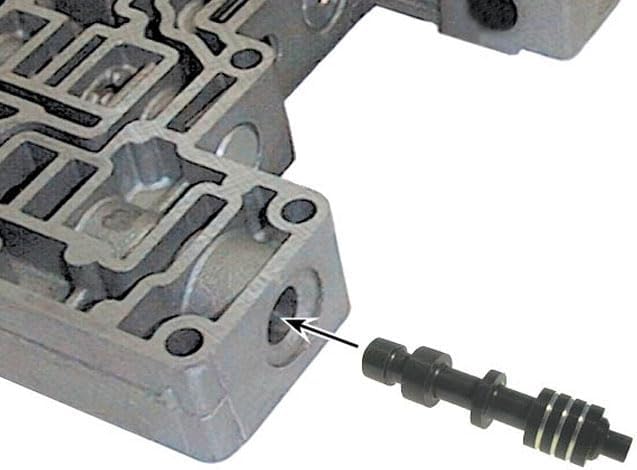
That's a valve body problem, not a fluid problem. Sonnax documents boost valve and sleeve wear on the 4R70E, 4R70W, 4R75E, 4R75W and AODE: the OE boost valve oscillates in its sleeve until it wears an exhaust path, which gives you insufficient line rise in Reverse, delayed or slipping Reverse, and a burnt Reverse clutch. Their fix is the 76948-02K kit. Put a gauge on line pressure in Reverse before you order parts, and see our 4R75W valve body testing guide for the rest of that diagnosis.
Quick reference
| Item | Spec |
|---|---|
| Trucks covered | 2004-2008 F-150 four-speed automatic (cert label code Q = 4R75E, A = 4R70E) |
| Fluid | MERCON V (Motorcraft XT-5-QM, now XT-5-QMC / XT-5-5Q3M) |
| Dry fill | 13.9 qt (13.2 L), set by dipstick |
| Pan and filter service | About 5-6 qt in practice (shop figure), finish on the stick |
| Hot check | 150-170°F (66-77°C), engine running, Park, level ground |
| Ambient check band | 50-95°F (10-35°C) |
| Top-off increment | 1/2 pint (250 ml) |
| Interval | 30,000 mi under towing/special conditions; fluid and filter at 150,000 mi normal |
| Additives | Ford says do not use |
4R75W filter and pan gasket kit (FT105 style)
If the pan is coming down on a four-speed F-150, put in a new filter and gasket. This is the FT105-style kit for the 4R70W/4R75W pan, sold by our sister store, CoreTransmissionParts.
Shop the part for this fix →Need something else? The 4R75W parts collection has pans, solenoid kits, Sonnax valve body parts and rebuild kits.
Need parts for this job?
Our 4R75W parts page has filter kits, Motorcraft MERCON V, solenoid kits, valve bodies and complete rebuild kits for the F-150, Expedition, Crown Victoria and Town Car four-speeds. Checkout is on site.
FAQ
What transmission fluid does a 2004-2008 F-150 take?
The four-speed 4R70E and 4R75E automatics in the 2004-2008 F-150 take MERCON V. Ford's 2006 F-150 owner guide lists Motorcraft MERCON V part XT-5-QM, now sold as XT-5-QMC (quart) and XT-5-5Q3M (5-quart). Do not use MERCON LV in these years. The exception is the 2009-2010 4R75E, which Ford switched to MERCON LV.
How many quarts does a 4R75W F-150 fluid change take?
A pan and filter service usually takes about 5 to 6 quarts, because most of the fluid stays in the converter, cooler and lines. Ford's 13.9 quart (13.2 L) figure is a dry fill for an empty transmission. Put back a little less than you drained and set the final level hot on the dipstick.
How often should I change the transmission fluid in a 4R75W F-150?
Ford's 2006 Scheduled Maintenance Guide calls for changing the fluid and filter at 150,000 miles on the normal truck schedule, and the fluid every 30,000 miles under special operating conditions such as towing, extended idling, dusty roads or off-road use. An F-150 that tows belongs on the 30,000-mile schedule.
Should I flush a high-mileage 4R75W?
On a high-mileage unit with unknown history, a double pan drop or a cooler-line exchange is the safer way to get fresh fluid in. If the fluid is burnt or the pan shows friction material or bearing pieces, the transmission needs diagnosis rather than a flush, because new fluid will not repair worn parts.
Related guides
- 4R75W Fluid Type and Capacity
- 4R75W F-150 Common Problems
- 4R75W F-150 Slipping: Causes and Fix
- 4R75W F-150 Shift Problems
- 4R75W High-Mileage Service Checklist
Sources
- Ford Motor Company, 2006 F-150 Owner Guide, Maintenance and Specifications. Backs MERCON V part XT-5-QM and the 13.9 qt (13.2 L) dry-fill capacity for the 4R70E/4R75E, the dipstick and dual-usage fluid footnotes, the 20-mile / 150-170°F check procedure, the 50-95°F ambient band, 1/2-pint top-off steps, the low-level, overfill and no-additive warnings, the cold-weather shift strategy, and the transmission code table (Q = 4R75E, A = 4R70E). fordservicecontent.com via archive.org (PDF)
- Ford Motor Company, 2006 Model Year Scheduled Maintenance Guide. Backs the 150,000-mile fluid and filter change on the normal truck/SUV schedule and the 30,000-mile automatic transmission fluid change under Special Operating Conditions (towing, extended idling/low speed, dusty roads, off-road). fordservicecontent.com via archive.org (PDF)
- Ford Motor Company, 2009 F-150 Owner's Guide, Maintenance and Specifications. Backs the 2009 change to Motorcraft MERCON LV (XT-10-QLV) at 13.9 qt (13.2 L) for the four-speed 4R75E, the transmission codes (Q = 4R75E, 6 = 6R80), and the six-speed having no dipstick. fordservicecontent.com via archive.org (PDF)
- Ford Customer Service Division, Motorcraft MERCON V Automatic Transmission and Power Steering Fluid product details. Backs current part numbers XT-5-QMC, XT-5-5Q3M and XT-5-DMC and the do-not-use list (MERCON SP, LV, ULV, Type F, CVT chain fluid). fcsdchemicalsandlubricants.com
- Wayne Colonna (ATSG), "Getting Greased," Transmission Digest, November 2012. Backs the 2005 F-150 4x2 4R75W shift-bump case and Ford TSB 05-26-11 (7 to 13 grams of Motorcraft PTFE lubricant on the slip yoke). transmissiondigest.com
- Beau Hansen (ETE Reman), "An Inexpensive Fix for the 4R70W," Transmission Digest, December 2019. Backs the pinion carrier failure pattern in 2004-2008 vehicles, the split needle bearing retainer and cracked race, and the 2009 change to a 0.215 in. bearing. transmissiondigest.com
- Sonnax, Boost Valve Kit 76948-02K (AODE, 4R70E, 4R70W, 4R75E, 4R75W). Backs the boost valve and sleeve wear mechanism and the low Reverse line rise, delayed or slipping Reverse and burnt Reverse clutch symptoms. sonnax.com