The 2004-2008 F-150 with the 4.6L or 5.4L three-valve got the 4R75W, Ford's heavier-duty version of the 4R70W. It is a good, simple four-speed, but by now most of these trucks are past 150,000 miles, a lot of them pulled a trailer for a living, and "it slips" is the complaint that brings them in. The good news is that this unit's slip complaints are well mapped. The gear it slips in, and whether it only does it hot or under throttle, tells you which circuit to look at before the pan ever comes off.
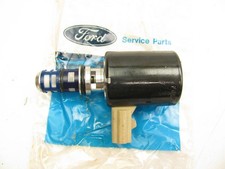
This guide is organized that way: confirm it's really slipping, figure out which gear and which apply component, then test the specific hydraulic failure that matches. Every cause below has a known test and a known fix.
The short version: If it slips in every forward gear and gets worse hot and under throttle, suspect lost EPC from a worn pressure regulator valve bore before you buy an EPC solenoid [1][2]. Slip or flare into 3rd with burnt forward or direct clutches on a 2001-later unit points to a forward/direct cross leak under the separator plate [3]. Slip or neutral in 4th with a burnt overdrive band means the overdrive servo regulator [4]. A neutral feel on a forced 4-2 downshift that then "catches" is flooding shift solenoids hammering the intermediate one-way clutch [5]. Start every one of these with the correct fluid: MERCON V, about 13.9 quarts total [6].
Step 1: Prove It's Slipping, and Where
"Slipping" gets used for flares, delayed engagements, converter shudder and even a lazy engine. Get a scan tool on it and pull five PIDs while you drive it into the complaint: turbine shaft speed (TSS), output shaft speed (OSS), commanded gear, desired EPC pressure, and transmission fluid temperature (TFT). Divide TSS by OSS and compare it to the gear the PCM is commanding. The 4R75W ratios are 2.84 first, 1.55 second, 1.00 third and 0.70 fourth, the same gear set as the 4R70W. If the measured ratio is drifting above the commanded one, something is slipping. If it matches and the truck still feels soft, look at the converter or the engine instead.
If it set codes, read them as a pointer, not a verdict. Ford's ratio-error codes (P0731 through P0734 and their cousins) fire whenever calculated ratio doesn't match commanded gear. ATRA's Ford technical manual lists the causes as poor line pressure, slipping clutches, bad solenoids, wrong fluid, bad input from an engine sensor, and ignition or alternator noise getting into the speed sensor signal [5]. Half of that list isn't a hard-part failure at all, so check the fluid and the sensor signals before you condemn anything.
Know what's applied in each gear
| Gear (OD on) | Main apply components | Slip here usually means |
|---|---|---|
| 1st (2.84) | Forward clutch, low one-way clutch | Forward clutch or low line pressure |
| 2nd (1.55) | Forward clutch, intermediate clutch and intermediate one-way clutch | Intermediate clutch or one-way clutch damage |
| 3rd (1.00) | Forward, intermediate and direct clutches | Direct clutch, or forward/direct cross leak |
| 4th (0.70) | Direct clutch, overdrive band | Overdrive band or overdrive servo circuit |
The forward clutch is applied in first through third, which is why a forward clutch or line pressure problem shows up as slip "in every gear" until fourth, when the band and direct clutch take over. Keep that in mind when a customer says it slips everywhere except on the highway.
Step 2: Fluid First, Every Time
The 2006 F-150 owner guide specifies Motorcraft MERCON V for the 4R75W and lists 13.9 quarts (13.2 L) total capacity [6]. Most of that lives in the converter, cooler and lines, so a pan drop recovers only a fraction of it. Pull the dipstick and smell it. Dark, burnt fluid with friction material in the pan tells you a clutch or band has already been slipping long enough to cook; changing fluid on that unit won't save it, but it may buy enough time to find the hydraulic cause. The one I see constantly in a two-truck household is a 4R75W topped off with MERCON LV from the newer six-speed in the driveway. LV is lower viscosity, and in a unit with worn bores it makes leakage and slip worse. Drain it and refill with MERCON V.
If the fluid is correct and reasonably clean and it still slips, the cause is hydraulic or mechanical. Put a pressure gauge on it and keep going.
Cause 1: Lost EPC from Pressure Regulator Bore Wear (Slips in All Gears, Worse Hot)
This is the big one on high-mileage F-150s, and it's the one that eats EPC solenoids. Transmission Digest's Wayne Colonna documented it on the AODE/4R70W family: wear in the pressure regulator valve bore can reduce or completely kill EPC pressure when the unit is hot, which means little or no line rise, and that shows up as medium- to full-throttle slipping in gear and sliding shifts [1].
Here's the mechanism. EPC oil is routed to the pressure regulator valve right alongside a circuit Ford calls boost, and that boost circuit actually runs back to the inlet side of the pump. When the bore wears between those two circuits, the pump literally sucks the EPC signal away, so line pressure can't rise with throttle [1]. The tell on a gauge is EPC that stays near zero at any throttle opening, even with the transmission electrically unplugged. That's the moment most techs replace the EPC solenoid, and the problem stays exactly where it was [1].
The air test that finds it
With the pan and filter off, blow compressed air into the TV pressure port. Air and fluid escaping around the EPC solenoid area is normal. Air and fluid blowing out of the filter pickup area means the bore is worn and the EPC signal is being lost to the pump inlet [1]. Colonna also notes that minor bore wear may not produce an obvious pressure complaint at all, but can still show up as premature forward clutch wear [1], which is exactly the burnt forward clutch you find in a lot of these trucks at teardown.
The fix
Sonnax warns that severe wear on the PR valve, usually scoring at the EPC end, almost always means the bore is worn too, and a worn casting won't seal even with a new valve [2]. Vacuum test the bore before you buy anything. On '96-and-later units, including every F-150 4R75W, the repair options are the 76948-09 replacement PR valve where the bore is still good, the 76948-12K elevated PR valve kit Sonnax lists for soft shifts, low base line pressure, delayed forward and forward clutch failure, or the 76948-17K oversized PR and boost valve kit after reaming a worn bore [2]. If the bore is too far gone or you don't have reamers, a replacement valve body is the fix, and it's the one Transmission Digest recommended before aftermarket oversized valves existed [1].
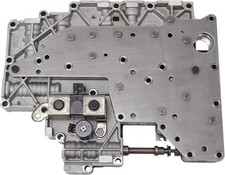
4R75W Valve Body with Solenoids, 2004-2010
A complete replacement valve body with solenoids for F-150 4R75W units where the PR valve bore is worn past saving.
View the 4R75W valve body →Need something else? Browse all 4R75W parts at Core Transmission Parts.
Cause 2: Forward/Direct Cross Leak (Slip or Flare into 3rd, Burnt Clutches)
Every F-150 4R75W is a 2001-or-later design, and that matters. Sonnax traced a pattern of cracked separator plates, forward and direct clutch failures, and dragging clutches on 2001-later 4R70W and 4R75W units to a change Ford made that year: the two-bolt stiffener plate under the 2-3 accumulator was deleted [3]. That plate clamped the separator plate and lower gasket to the valve body. Without it, pressurized forward clutch oil pushes the separator plate upward. Sonnax measured up to 0.011 in. of bow at normal forward clutch pressure, enough to let forward oil cross into the direct clutch circuit, because the two circuits meet in a casting right under that spot [3].
From the driver's seat this looks like a soft or flaring 2-3 shift, slip in third, or a burnt forward or direct pack after a rebuild that seemed fine. The cracked separator plate you find at teardown is the evidence, but Sonnax is clear that the cracks are a symptom of the bigger circuit problem, not the problem itself [3]. Replacing the plate alone puts you back where you started.
The fix is to put the clamping back: Sonnax's 76507F-01K valve body retainer plate kit for '01-later units, which requires drilling and tapping the valve body and drilling the separator plate, using the lower gasket to locate the holes [3]. On any F-150 4R75W that's apart for clutches, I treat this as mandatory, not optional.
Cause 3: Overdrive Servo Regulator Wear (Slips in 4th, 4-3-Neutral)
If the truck is fine around town but slips or flares into fourth, drops into a neutral feel on the 4-3 downshift, or loses fourth altogether, look at the overdrive band circuit. Sonnax lists burnt overdrive band, no fourth, and a 4-3-neutral pattern as the symptoms of wear in the overdrive servo regulator boost valve sleeve on '01-later 4R70W/4R75W units [4]. The valve oscillates constantly in service, the sleeve ID wears, and overdrive oil leaks past it so the servo can't be regulated properly [4].
Towing makes it worse. An F-150 pulling a camper in fourth at highway speed is asking that band to hold the most torque it will ever see, and a weak servo apply lets it slip and glaze. If the band is already burnt, replace it along with the regulator repair, and inspect the servo pin and its case bore while you're in there. Confirm the regulator with a vacuum test at the port Sonnax specifies; the kit is needed if the port won't hold the recommended minimum or the wear is visible [4]. The repair is the 76948-29K drop-in regulator kit, with the 76948-59K oversized version for worn bores [4].
Cause 4: Flooding Shift Solenoids (Neutral on a 4-2 Kickdown, Then a Bang)
This one gets misdiagnosed as a slipping intermediate clutch. ATRA's Ford technical manual explains it on the 4R70W: during a forced 4-2 downshift the PCM turns shift solenoids SS1 and SS2 off. If those solenoids are worn and don't exhaust properly, they flood and hold the 3-4 shift valve in its fourth-gear position while the 2-3 valve strokes to second [5]. The result is a neutral feel with the overdrive band and direct clutch applied but no intermediate and no forward. When the driver lifts, line pressure drops, the intermediate clutches catch, and the intermediate one-way clutch gets hammered until it wears or breaks [5].
So if you're replacing an intermediate one-way clutch on a truck with a kickdown complaint, replace the shift solenoids too, or you'll be doing it again. Check the internal harness and case connector at the same time; ATRA also notes that intermittent solenoid codes and erratic shifting on this family can come from a distorted or poorly seated internal hard-shell harness [5].
When It's Time for the Rebuild
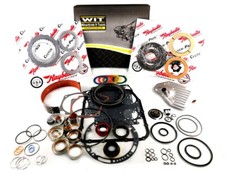
If the pan is full of friction material, the slip is in more than one range, or the fluid is black and burnt, the hydraulic fix alone won't save the clutches that already cooked. Rebuild it, and do it right for this truck: fix the PR bore (Cause 1), install the retainer plate kit (Cause 2), and address the overdrive servo regulator (Cause 3) while the valve body is on the bench. A fresh set of clutches on a unit with a worn PR bore or a bowing separator plate will burn up just as fast as the old set did. Flush or replace the cooler on reassembly, refill with MERCON V, and confirm ratios on the scan tool before the truck goes back out.
Check the hard parts while it is apart. Sonnax lists ratio codes, slipping gears and no forward among the symptoms of a failed OE forward drum in the 4R70W and 4R75 family, and describes direct drums that strip their splines and break the intermediate stub shaft. Order any replacement direct drum kit for the 2.84/1.55 gearset these units use (Sonnax 76656-01K), not the AODE 2.40/1.46 version.7 On a 4R75E with a turbine speed sensor, keep the sun shell non-magnetic: ATRA says a magnetic shell blocks the sensor and causes harsh or no shifting with possible ratio and input speed sensor codes, and the 2004-up sun shell, bearing and forward sun gear go in as a set (Ford kit 4L3Z-7D234-AA).8 More on reading those codes in our 4R75W P0730 guide.
Quick Triage Order
- 1. Scan tool ratio check — TSS divided by OSS against commanded gear tells you if and where it slips.
- 2. Fluid check — MERCON V, correct level, no LV top-off.
- 3. Line pressure and EPC test — no line rise hot means PR bore wear, not the EPC solenoid.
- 4. Match the slip to the circuit — 3rd/2-3 to the cross leak, 4th to the OD servo regulator, 4-2 neutral to the shift solenoids.
- 5. Rebuild with the valve body fixes — only after the hydraulic cause is identified.
Valve bodies, EPC solenoids, pumps and master rebuild kits for the F-150 4R75W, with checkout on our site.
Shop 4R75W parts →FAQ
Why is my F-150 4R75W slipping in every gear?
If it slips in first through third and gets worse when hot or under throttle, the most common cause on a high-mileage F-150 is lost EPC pressure from a worn pressure regulator valve bore, not the EPC solenoid. Transmission Digest documented that this bore wear lets the pump pull the EPC signal away, so line pressure cannot rise with throttle. Confirm with a pressure gauge and the compressed-air test at the TV port before buying parts.
Will replacing the EPC solenoid fix 4R75W slipping?
Only if the solenoid itself has failed. When EPC pressure stays near zero at any throttle opening, even with the transmission unplugged, the usual cause is pressure regulator bore wear, and a new EPC solenoid leaves the problem exactly where it was. Vacuum test the PR valve bore first.
What causes a 4R75W to slip into 4th or go to neutral on the 4-3 downshift?
Sonnax lists burnt overdrive band, no 4th and a 4-3-neutral pattern as symptoms of wear in the overdrive servo regulator boost valve sleeve on 2001-later 4R70W and 4R75W units. Overdrive oil leaks past the worn sleeve, so the servo cannot hold the band properly. The repair is the 76948-29K regulator kit, plus a new band if the old one is burnt.
What fluid and how much does a 2004-2008 F-150 4R75W take?
Ford's 2006 F-150 owner guide specifies Motorcraft MERCON V and lists a total capacity of 13.9 quarts (13.2 L). A pan and filter service takes much less because most of the fluid stays in the converter and cooler. Never top off a 4R75W with MERCON LV.
Can I just rebuild a slipping 4R75W without touching the valve body?
You can, but it often fails again. Fresh clutches on a unit with a worn pressure regulator bore or a bowing separator plate burn up just as fast as the old ones. On F-150 units, fix the PR bore, install the Sonnax 76507F-01K retainer plate kit, and address the overdrive servo regulator while the valve body is on the bench.
Sources
- Transmission Digest — Wayne Colonna, "I Lost My EPC!," on AODE/4R70W pressure regulator valve bore wear causing reduced or zero EPC when hot, medium- to full-throttle slip and sliding shifts, the boost-circuit leak path to the pump inlet, the compressed-air test at the TV port, and the link to premature forward clutch wear. transmissiondigest.com
- Sonnax — "Watch Out for 4R70W Pressure Regulator Valve Casting Wear," on PR valve scoring at the EPC end, worn castings that won't seal with a new valve, the vacuum test method, and the 76948-09, 76948-12K and 76948-17K repair options for '96-later units. sonnax.com/tech_resources/1152
- Sonnax — "4R70W/4R75W 2001-Later Forward and Direct Clutch Problems: The Easy Valve Body Fix," on the deleted stiffener plate, separator plate bow of up to 0.011 in., forward-to-direct cross leaks, cracked separator plates, and the 76507F-01K retainer plate kit. sonnax.com/tech_resources/135
- Sonnax — Overdrive Servo Regulator Kit 76948-29K, listing 4-3-neutral, no 4th and burnt overdrive band symptoms from boost valve sleeve wear on '01-later 4R70W/4R75W units, the vacuum test requirement, and the 76948-59K oversized option. sonnax.com/parts/2402
- ATRA — 2003 Ford Technical Seminar Manual, on 4R70W repeat intermediate one-way clutch (diode) failure from flooding SS1/SS2 solenoids on 4-2 downshifts, internal harness seating causing solenoid codes, and the causes of Ford ratio-error codes. atracom.blob.core.windows.net (PDF)
- Ford Motor Company — 2006 F-150 Owner Guide, Maintenance and Specifications section, listing Motorcraft MERCON V ATF for the automatic transmission and a 13.9 qt (13.2 L) capacity. Ford owner guide (archived PDF)
- Sonnax — "Stop 4R70W Forward Drum Failure with a Sonnax Smart-Tech Drum" and "Stop Chasing AODE, 4R70W Direct Clutch Drum Problems," listing ratio codes, slipping gears, no forward and broken drums as forward drum symptoms (76654-01K), the stripped direct drum splines and broken stub shaft, and the 2.84/1.55 (76656-01K) versus AODE 2.40/1.46 (76656-02K) gearset split. forward drum • direct drum
- ATRA — "Ford 4R70W/4R70/75E" technical manual interchange section, 2009, on the non-magnetic 4R70E/75E sun shell required by the turbine speed sensor, the harsh or no shift and ratio/ISS codes from a magnetic shell, and service kit 4L3Z-7D234-AA. atracom.blob.core.windows.net (PDF)