A 4R70W pan and filter service is one of the cheapest jobs you can do on a Ford rear-wheel-drive four-speed, and one of the most useful for diagnosis. You get fresh MERCON V in the unit, a new filter on the pump suction side, and a clear view of what the transmission has been shedding. Done carelessly, it also causes problems: a leaking pan from over-torqued bolts, the wrong filter under an aftermarket deep pan, or an overfill that foams the fluid.
This guide walks through the job the way I do it on the bench and in the bay. The specs come from Ford's owner and maintenance guides and from the pan manufacturers' own instructions, all listed at the bottom. Where a number is my shop experience rather than a published spec, I say so.


What a pan and filter service does, and what it doesn't
The 4R70W has no factory drain plug. You drain it by dropping the pan, and that only gets out the fluid sitting in the pan. Everything in the torque converter, the cooler and the lines stays put. Ford's own capacity footnote makes the point: the listed 13.2 L (13.9 qt) for the Crown Victoria's 4R70W is only an approximate dry-fill figure, and the final amount has to be set by the dipstick. In my bay, a stock-pan 4R70W usually takes back around 5 to 6 quarts after a pan drop. That's a shop number, not a Ford spec.
So a single service replaces roughly 40 percent of the fluid. On a unit with badly oxidized fluid, plan on a second pan drop a few hundred miles later. What the service won't do is fix a mechanical fault. Fresh fluid on a burnt clutch pack or a worn valve body just buys a few weeks. The inspection you do with the pan off is often worth more than the fluid you put back in.
Parts and supplies
| Item | Notes |
|---|---|
| Fluid | MERCON V, per Ford's owner guides for the 4R70W. Have 6 quarts on hand for a stock pan, more for a deep pan. |
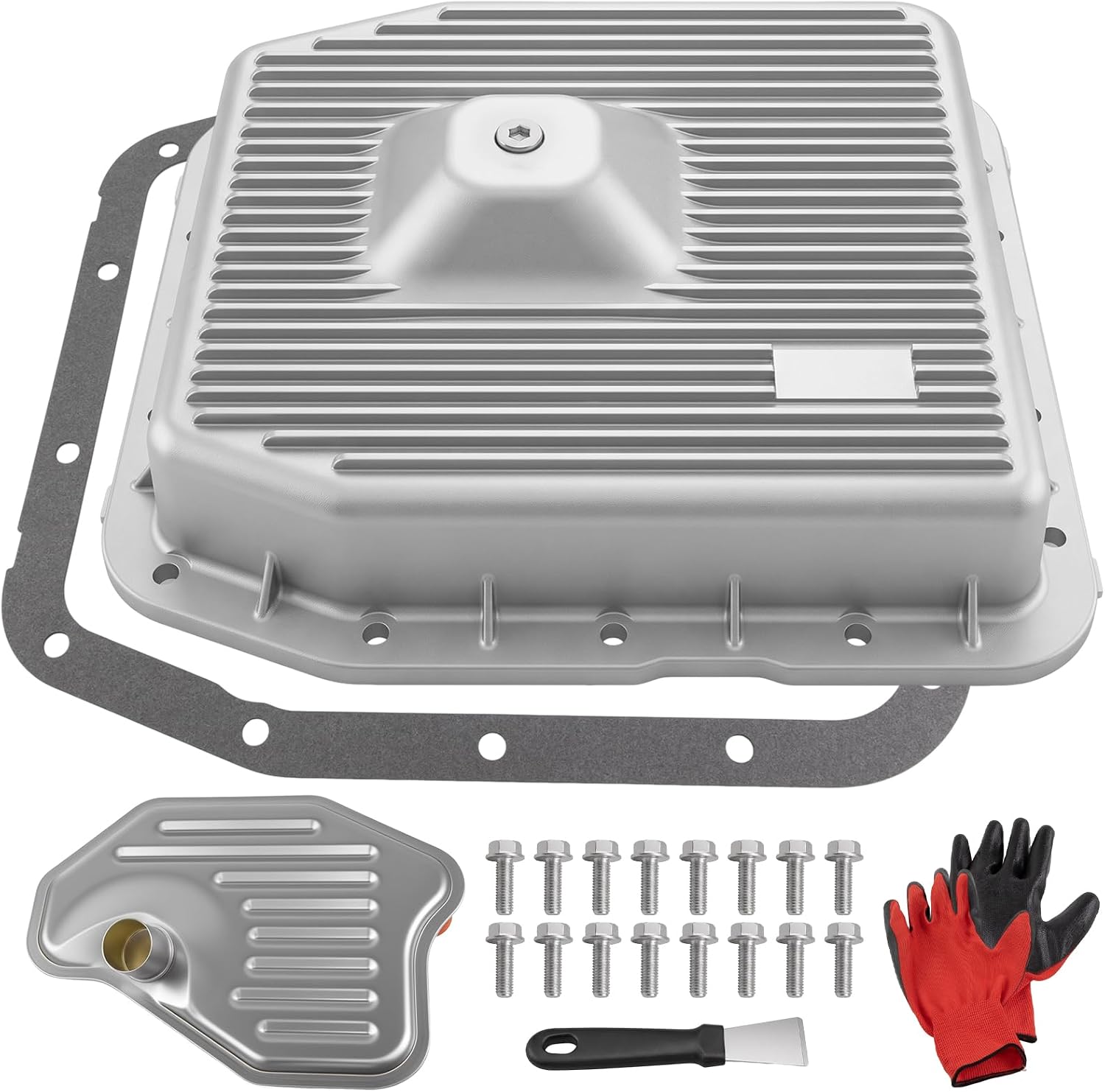
| Filter and pan gasket | FT105-style kit for the 14-bolt pan. If the truck has an aftermarket deep pan, use the filter the pan maker specifies (see below). |
| Pan bolts | 14 bolts, M8-1.25 x 20 mm (per the B&M parts list for its replacement pan). Replace any with stretched or damaged threads. |
| Drain container | At least 8 quart capacity (Mag-Hytec's tool list) |
| Also needed | Torque wrench that reads accurately at low values, plastic scraper, lint-free rags, brake cleaner, a clean funnel for the filler tube |
Before the pan comes off
Check the fluid first, hot and on level ground, so you know what you started with. Ford's procedure is to drive about 30 km (20 miles) to reach normal operating temperature, park level with the parking brake set, run the shifter through every range with your foot on the brake, then latch it in Park with the engine running and read the stick. Ford's dipstick has a hot band for fluid at 150-170°F (66-77°C) and a lower band for ambient fluid at 50-95°F.
Write down the level, the color and the smell. A unit that was already a quart low has a leak you need to find before you send it out the door. A unit that reads high on a vehicle nobody has touched deserves a second look, because Ford's guide notes a high reading can be caused by overheating. If you have a scan tool, record transmission fluid temperature and any stored codes now. A P0741 or P0750-series code is a solenoid or converter clutch issue that a fluid change won't clear, and it changes what you'll be looking for in the pan.
Let the fluid cool before you start. B&M's instructions note that automatic transmissions run between 150°F and 250°F, and hot ATF down your sleeve is a bad start to the job.
Dropping the pan
- Support the vehicle properly on stands or a lift, never on a jack alone.
- Set the drain container under the pan. Remove the bolts along the rear and sides first, working toward the front, so the pan tips rearward as it comes loose. B&M's procedure is to take the last two bolts out slowly and let the pan tilt down to drain.
- If the gasket has stuck, break it free with care. Mag-Hytec's instructions warn against prying with anything that will damage the case gasket surface, and that's good advice for the factory pan too. A gouged aluminum case rail is a leak you'll chase forever.
- Lower the pan level so the fluid and debris in the bottom stay put for inspection.
Reading the pan and the old filter
This is the part of the job worth slowing down for. Mag-Hytec's maintenance notes put it plainly: a "fuzzy" coat of fine metallic particles on the magnet is normal wear, while larger chips of metal on the magnet call for further inspection by a transmission specialist.
Here's how I read a 4R70W pan, from my own experience rather than a published chart:
- Fine gray paste on the magnet, light brown film in the pan: normal for the mileage. Clean it and move on.
- Black, gritty friction material that you can feel between your fingers: clutches are wearing. Check the history for slips and flares and road test it again after the service.
- Bronze or brass-colored flakes: bushing or thrust washer wear. On a 4R70W that often travels with a converter or pump complaint.
- Steel chunks, needle bearings, or pieces of snap ring: stop. That unit is coming apart, and a filter won't save it.
Pull the old filter straight down and make sure its seal came out with it. A filter seal left in the bore means the new filter won't seat, and that's an air leak on the suction side. That shows up as whine, delayed engagement and low line pressure under load.
Look at the new filter before it goes in, too. GEARS Magazine (Keith Clark, July 2022) covers how to check replacement filters for defects. Pay close attention to the seam where the media is secured on metal-and-plastic filters. Two checks work. The first is a vacuum test on the pickup with the inlet plugged: the reading should hold steady, and a sudden drop means a crack. The second is a low-pressure air test at no more than 40 psi, with fluid sprayed on the seams to look for bubbling. You won't do that on every pan drop. But if a unit came back with a suction complaint after a previous service, the filter is a suspect.
Deep pans: match the filter to the pan
Lots of 4R70W trucks now have an aluminum deep pan. The filter has to reach the right depth in that pan, and the pan makers don't all specify the same one:
- B&M cast aluminum deep pan (40291): for AODE/4R70W, designed to be used with the 4WD filter, Ford F6AZ-7A098-A or equivalent. B&M notes the 2WD filter may still be used but isn't recommended if the vehicle goes off-road. The pan uses 14 M8-1.25 x 20 mm bolts with washers, and B&M calls for about 7 quarts at initial refill before setting the level.
- Mag-Hytec 4R70W-D pan: Mag-Hytec specifies the 2x4 filter, Ford F2VY-7A098-A, at every change with its pan. It holds 6 quarts, 1.25 quarts more than a stock 2x4 pan, for a total of about 10 quarts with the converter and cooler drained. The pan seals with an O-ring instead of a flat gasket and has a magnetic drain plug.
The lesson isn't that one filter is right. Whoever made the pan decided how deep the pickup should sit, so find out which pan is on the truck and use that maker's filter. A pickup sitting too high can suck air on hard stops and steep grades. One that's too low can starve against the pan floor.
Cleaning and reinstalling
- Clean the pan and magnet with brake cleaner and a lint-free rag. Don't use shop towels that shed fibers into the pan.
- Clean the case sealing rail. Mag-Hytec says the surface must be clean and flat to seal. Check it for dents or gouges, and dress any high spots with a smooth flat file without rounding off the flat surface.
- Install the new filter and seal, pushing it fully home.
- Fit the new gasket, set the pan in place and start all 14 bolts finger tight.
- Torque in a cross pattern. For aftermarket pans, use the pan maker's figure: B&M calls for 10 ft-lb with its supplied bolts and warns that overtightening can cause leaks. Mag-Hytec specifies 12-16 ft-lb on its allen cap screws, in a cross-tight pattern. On the factory steel pan, use the value in your Ford service information for that year. Low torque is correct here. The flange on a stamped pan bows between bolts if you lean on it, and that's where the weep starts.
Refill and set the level
Start with less than you drained. On a stock pan I put in about 4 quarts through the filler tube, start the engine, and add from there. Then follow Ford's procedure: bring it to operating temperature, cycle through the ranges with your foot on the brake, leave it running in Park, and read the stick. Ford says to add fluid in 250 ml (1/2 pint) steps through the filler tube and recheck each time.
Don't overfill it. Ford warns that fluid above the safe range can cause shift and engagement concerns and possible damage, and says excess fluid should be removed. B&M adds that overfill causes foaming and overheating. Foamed fluid can't hold pressure, so an overfilled 4R70W can slip in exactly the way a low one does. After the road test, recheck the level hot and look around the pan rail for weeps.
How often to do it
Ford's 2003 scheduled maintenance guide only calls for checking the fluid level on the 4R70W at each 15,000-mile visit on the normal schedule, and lists a transmission fluid and filter change at 150,000 miles. The 30,000-mile ATF change on that normal schedule is reserved for the AX4S, 4F50N, 4F27E and 4R100. Ford had not always been that relaxed: its 1998 Expedition maintenance guide put a 4R70W fluid change on the normal schedule every 30,000 miles and moved it to every 21,000 miles under severe duty. Under special operating conditions, Ford calls for changing the automatic transmission fluid every 30,000 miles. Those conditions are towing or using a camper or car-top carrier, long idling or low-speed driving such as delivery, taxi, patrol or livery use, dusty or unpaved roads, and off-road driving.
Most 4R70W vehicles still on the road are F-150s that have towed something, or Panther-platform cars that spent their first life in a police or livery fleet. That's severe service by Ford's own definition, so I treat 30,000 miles as the real interval. Ford's owner guides also say not to use supplemental transmission additives or cleaning agents. If the shift only feels right with a bottle of additive in it, there's a mechanical problem underneath.
When the service doesn't fix it
The classic comeback is a 4R70W with soft shifts or low line rise that gets a pan and filter service and feels no better a week later. Sonnax documents a pattern on this unit: severe scoring on the EPC end of the pressure regulator valve and wear in the valve body casting bore. The symptoms are reduced line pressure or low line rise, soft shifts, an erratic buzz, and premature clutch and band failure. Sonnax's point is that a new valve alone won't seal against a worn bore. They recommend a vacuum test to find the wear, then reaming the bore for an oversized valve (their 76948-16K and 76948-17K kits).
If the fluid is correct, the level is right hot, the filter is the right one for the pan, and line pressure is still low, the valve body is next. Another fluid change won't help. Our 4R70W valve body wear guide covers that side of the unit.
Quick reference
| Item | Spec or guidance |
|---|---|
| Fluid | MERCON V (Ford owner guides) |
| Dry fill, for reference | 13.2 L (13.9 qt); 12.1 L (12.8 qt) Crown Victoria Police/Handling Package. Set the final level by the dipstick. |
| Typical pan-drop refill | About 5-6 qt on a stock pan (shop experience); B&M deep pan: about 7 qt to start |
| Pan bolts | 14, M8-1.25 x 20 mm, cross pattern; B&M pan 10 ft-lb, Mag-Hytec pan 12-16 ft-lb |
| Deep pan filter | Use the pan maker's spec: B&M F6AZ-7A098-A (4WD); Mag-Hytec F2VY-7A098-A (2x4) |
| Hot check | 150-170°F, engine running, in Park, level ground; top off in 1/2 pint steps |
| Interval | Every 30,000 miles under Ford's special operating conditions |
4R70W filter kit with pan gasket (FT105, 14-bolt pan)
The filter and gasket for a stock-pan 4R70W service, 1994-2010. Sold by our sister store, CoreTransmissionParts.
Shop the part for this fix →Need something else? The 4R70W parts collection has pans, gaskets, solenoid kits and rebuild kits.
Need parts for this job?
Our 4R70W parts page has the FT105 filter and gasket kit, Motorcraft MERCON V by the case, aluminum deep pans with a magnetic drain plug, coolers, solenoid kits and full rebuild kits, all with on-site checkout.
FAQ
Does a 4R70W have a drain plug?
No, the factory 4R70W pan has no drain plug, so the fluid is drained by removing the pan. Some aftermarket aluminum deep pans, such as the B&M and Mag-Hytec pans, add a drain plug with a magnet. Even with a plug, you still need to drop the pan to change the filter.
How much fluid does a 4R70W take after a filter change?
Much less than the 13.9 quart dry-fill figure Ford lists, because the converter, cooler and lines stay full. A stock pan usually takes back about 5 to 6 quarts in my experience, and B&M calls for about 7 quarts to start with its deep pan. Always set the final level with Ford's hot dipstick check at 150-170°F.
What is the torque spec for 4R70W pan bolts?
The pan uses 14 M8-1.25 bolts, and the job calls for low torque in a cross pattern. B&M specifies 10 ft-lb for its deep pan and warns that overtightening causes leaks, and Mag-Hytec specifies 12-16 ft-lb for its cap screws. On a factory steel pan, use the value in the Ford service information for that year, because an over-torqued stamped flange bows and weeps.
Which filter goes with a 4R70W deep pan?
Use the filter the pan maker specifies, because the pickup has to sit at the right depth. B&M designed its AODE/4R70W deep pan around the 4WD filter, Ford F6AZ-7A098-A, while Mag-Hytec requires the 2x4 filter, Ford F2VY-7A098-A, with its pan. The FT105-style kit is the standard filter for the stock 14-bolt pan.
How often should a 4R70W filter be changed?
Ford's 2003 normal schedule for the 4R70W calls for checking the fluid level and a fluid and filter change at 150,000 miles. Under special operating conditions such as towing, long idling, fleet use, dusty roads or off-roading, Ford calls for a fluid change every 30,000 miles. Most surviving 4R70W trucks and Panther cars qualify, so change the fluid and filter every 30,000 miles.
Related guides
- 4R70W Fluid Type and Capacity
- Ford 4R70W and 4R75W Transmission Problems
- 4R70W Valve Body Wear and Fix
- 4R70W P0741 Fix
- 4R70W vs 4R75W Differences
Sources
- Ford Motor Company, 2003 Crown Victoria Owner Guide, Maintenance and Specifications. Backs MERCON V for the 4R70W, the 13.2 L (13.9 qt) approximate dry-fill figure and 12.1 L Police/Handling Package capacity, the dipstick-sets-the-level footnote, the 20-mile / 150-170°F check procedure, the 1/2-pint top-off steps, the overfill and overheating warnings, and the no-additives warning. Ford's own fordservicecontent.com host now blocks direct PDF access (Akamai 403), so this links the Internet Archive's cached copy of the same document. web.archive.org (PDF)
- Ford Motor Company, 2003 Scheduled Maintenance Guide. Backs the inspect-level normal schedule for the 4R70W with a fluid and filter change at 150,000 miles, the normal-schedule 30,000-mile change for the AX4S, 4F50N, 4F27E and 4R100 only, and the 30,000-mile fluid change under towing, extended idling, fleet, dusty and off-road conditions. Ford's own fordservicecontent.com host now blocks direct PDF access (Akamai 403), so this links the Internet Archive's cached copy of the same document. web.archive.org (PDF)
- GEARS Magazine (ATRA), Keith Clark, "Spotting Imitation Filtration! Checking Filters for Flaws" (July 2022). Backs the media-seam inspection on metal-and-plastic filters, the plugged-inlet vacuum test and the 40 psi maximum air test. gearsmagazine.com
- Sonnax, "Watch Out for 4R70W Pressure Regulator Valve and Casting Wear." Backs the EPC-end PR valve scoring and bore wear pattern, its low line rise and soft shift symptoms, the vacuum test, and the 76948-16K/17K oversized kits. sonnax.com
- B&M Racing and Performance Products, Installation Instructions, AOD/AODE/4R70W Cast Aluminum Deep Oil Pan, part 40291. Backs the rear-to-front bolt removal, the F6AZ-7A098-A 4WD filter recommendation, 10 ft-lb pan bolt torque and the overtightening warning, 14 M8-1.25 x 20 mm bolts, the 7-quart initial refill, the overfill foaming warning, and the 150-250°F operating range. B&M instructions (PDF)
- Mag-Hytec, Installation Recommendations, Ford 4R70W-D Transmission Pan (05/08/17). Backs the 8 qt drain container, the no-prying and flat-sealing-surface guidance, the F2VY-7A098-A filter requirement, the 12-16 ft-lb cross-tight torque, the 6 qt pan and roughly 10 qt total capacity, and the normal-fuzz versus large-chip magnet guidance. mag-hytec.com (PDF)
- Ford Motor Company, 1998 Ford Expedition Scheduled Maintenance Guide. Backs the earlier 30,000-mile normal-schedule automatic transmission fluid change and the 21,000-mile severe duty interval, with towing and heavy loads, sustained high speed in heat, short trips in humidity or freezing weather, dusty roads and police, taxi or delivery use defined as severe duty. Linked through the Internet Archive's cached copy. web.archive.org (PDF)