"It shifts funny" covers a lot of ground on a 2004-2008 F-150. I have seen that complaint turn out to be a dry driveshaft slip yoke, a pinched wire under the pan, a solenoid that drifted out of spec, a worn bore in the valve body, and once in a while a transmission that really did need to come out. The 4R75W in these trucks (Ford's owner guides call it the 4R75E) is a simple four-speed with two on/off shift solenoids, a TCC solenoid and an EPC solenoid, which means you can narrow most shift complaints down in the bay before anything gets pulled.
This guide covers shift quality and shift timing: harsh or bumpy shifts, flares, missing gears, erratic shifting, and the codes that go with them. If your truck has metal on the magnet, grinding, or a loss of reverse, start with our 4R75W F150 common problems guide instead, because that is usually the planetary carrier and not a shift problem. Every bulletin and spec below is linked in the Sources section at the bottom.
How a 4R75W picks a gear
You cannot diagnose a shift problem if you do not know what is supposed to happen, so start here. The PCM selects the gear with two on/off shift solenoids, SS1 (also called A) and SS2 (B). Sonnax's ZIP kit booklet for the AODE, 4R70W and 4R75W family lays out the solenoid states:
| Range / gear | SS1 (A) | SS2 (B) | Holding members (Sonnax application chart) |
|---|---|---|---|
| Park / Reverse | ON | OFF | Reverse: reverse clutch + low/reverse band |
| OD 1st | ON | OFF | Forward clutch + low roller clutch |
| OD 2nd | OFF | OFF | Forward clutch + overdrive band |
| OD 3rd | OFF | ON | Forward + intermediate + direct clutches |
| OD 4th | ON | ON | Overdrive band + intermediate + direct clutches |
TCC apply is a separate solenoid that the PCM commands based on load and speed. Line pressure is controlled by the EPC (electronic pressure control) solenoid, which on these units is mounted in the case, not on the valve body. All of the shift solenoids are fed from a solenoid regulator valve in the valve body. Keep that last point in mind, because a weak supply feed makes good solenoids act like bad ones.
Two things fall out of this table that save a lot of time. First, both solenoids are OFF in 2nd. If you lose all solenoid power (blown fuse, open harness), the truck defaults to 2nd gear from a stop and feels like it "won't shift." Second, the 3-4 shift releases the forward clutch and applies the overdrive band. Any 4th gear complaint is an overdrive band or band-apply problem until you prove otherwise.
Step 1: Rule out the driveline bump
The single most common misdiagnosis on these trucks is a "harsh 1-2 and 2-1 bump" that is not in the transmission at all. Wayne Colonna of ATSG documented it in Transmission Digest: a 2005 F-150 4x2 with the 4R75W, 48,000 miles, used to tow a 27-foot boat. It had a bump on the light-throttle 1-2 upshift and the 2-1 coast downshift. The dealer quoted a new transmission.
The fluid was full and healthy, there were no codes, and line pressure was textbook. ATSG found Ford TSB 05-26-11, which calls for 7 to 13 grams of Motorcraft PTFE lubricant on the driveshaft slip yoke. The yoke looked fine and slid freely. They greased it anyway, and the bump was gone. The same shop then got a second truck with the identical complaint.
So the rule is simple. If the complaint is a bump right at the 1-2 or 2-1 shift, no codes, good fluid and correct line pressure, index-mark the driveshaft, pull it, lube the slip yoke per TSB 05-26-11, and road test before you touch the transmission.
Step 2: Pull codes and check the electrical side
Electrical faults cause a lot of 4R75E shift complaints, and Ford wrote a bulletin about one of them. Per a Ford service bulletin summarized by Vehicle Service Pros, 2009 F-150 and E-150 trucks (plus Crown Victoria, Grand Marquis and Town Car) with a 4R75E built before 12-1-2008 can show improper gear selection, wrong converter clutch operation or bad shift feel. Likely codes include P0750, P0753, P0755, P0758, P0740, P0743, P0748, P0962, P0963 and P0712.
The cause is an intermittent open or short and/or a blown fuse in the battery junction box (fuse F79 on F-Series and E-Series). The most likely root cause is a mis-routed internal wiring harness that gets pinched between the pan and the main control. The fix starts by checking the build date on the transmission tag and pulling the pan to inspect the harness routing. If the tag date is 12-1-2008 or later, the bulletin does not apply and you go to normal diagnostics in workshop manual section 307-01.
That bulletin is written for the 2009 build, but I check harness routing on every 4R75W pan drop, especially on a unit that has already been serviced or rebuilt. A harness someone else routed wrong will chafe through eventually, no matter the year.
Solenoid resistance checks
With the connector unplugged, ohm the solenoids through the case connector. Sonnax publishes these values for this family:
| Solenoid | Sonnax ZIP kit booklet | Sonnax F095/F098 valve body sheet |
|---|---|---|
| SS1 (A) | 20-30 ohms | 20-40 ohms |
| SS2 (B) | 20-30 ohms | 20-40 ohms |
| TCC | 10-16 ohms | 10-16 ohms |
| EPC | 2-5 ohms | 3-6 ohms |
The connector pinout changed over the years (Sonnax shows separate case connectors for '97-earlier, 1998-2008 and '09-later units), so confirm which pins you are on before you condemn anything. A reading that is open, shorted, or way off the range points to the solenoid or the internal harness. A reading in range does not clear the solenoid. A solenoid can ohm out fine and still stick mechanically or leak, so take it to the road test next.
Step 3: Road test with data, not just feel
Warm the fluid first. Sonnax's own road-test procedure for its valve bodies says to bring the fluid to about 185 degrees F and run 10 to 15 upshift and downshift cycles through all four gears. I log these with the scan tool:
- Commanded gear against the actual ratio (input speed divided by output speed). These units run 2.84, 1.55, 1.00 and 0.70. If the PCM commands 3rd and the ratio sits at 1.55, the shift solenoid side or the direct clutch circuit is the problem, not the computer.
- SS1 and SS2 state against the table above. If the scan tool shows the PCM commanding the right solenoid states and the transmission does not follow, the fault is downstream of the PCM: wiring, solenoid, valve body or a clutch.
- EPC pressure command alongside a line pressure gauge on the case tap. EPC should command a rise as you load the engine, and the gauge should follow it.
- TFT, so you know what temperature the problem shows up at. A lot of valve body wear only shows up hot.
- TCC slip, to separate a converter shudder from a shift problem.
Step 4: Match the symptom to the valve body cause
If the electrical side checks good and the solenoids are being commanded correctly, the shift complaint usually lives in the valve body. These are the patterns I see most on 2004-2008 F-150 units:
Soft shifts, slipping under load, flare on the shift
Sonnax's Brian Wing points to wear on the main pressure regulator valve in the AODE, 4R70W, 4R75W and their E versions, with severe scoring on the EPC end of the valve. The result is low line pressure or poor line rise. If the gauge does not follow the EPC command, that is your answer. A worn valve almost always means a worn bore, so a new stock valve alone will not seal. The bore gets vacuum tested and, if it leaks, reamed for an oversize valve (Sonnax lists 76948-17K, an oversize PR and boost valve kit, for '96-and-later units).
Erratic shifts, no 2nd, neutral after 4th, 2-3 neutral
This pattern points to the solenoid regulator valve. Sonnax's oversized solenoid regulator valve kit, 76948-47K, lists erratic shifts, loss of forward under hard acceleration from a stop, 2-3 neutral, neutral after 4th, no 2nd, and 3rd and reverse only. Bore wear lets oil escape and lowers the supply pressure to the shift solenoids. Severe wear can make the valve hang. Low solenoid feed is why a truck can get two sets of new solenoids and still shift erratically: the solenoids were never the problem.
4-3-neutral, no 4th, burned overdrive band
Remember that 4th is held by the overdrive band. Sonnax's overdrive servo regulator kit, 76948-29K, for 2001-and-later units, lists a 4-3-neutral shift, loss of 4th and a burned overdrive band. The boost valve oscillates, wears its sleeve, and overdrive servo oil leaks away. Sonnax's ZIP kit booklet adds that the inboard overdrive servo regulator valve is commonly stuck, because the overdrive servo retaining ring breaks and the pieces lodge in that bore. Check it whenever the valve body is off.
Bind-up feel, burned direct clutch after a rebuild
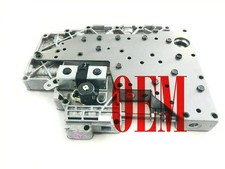
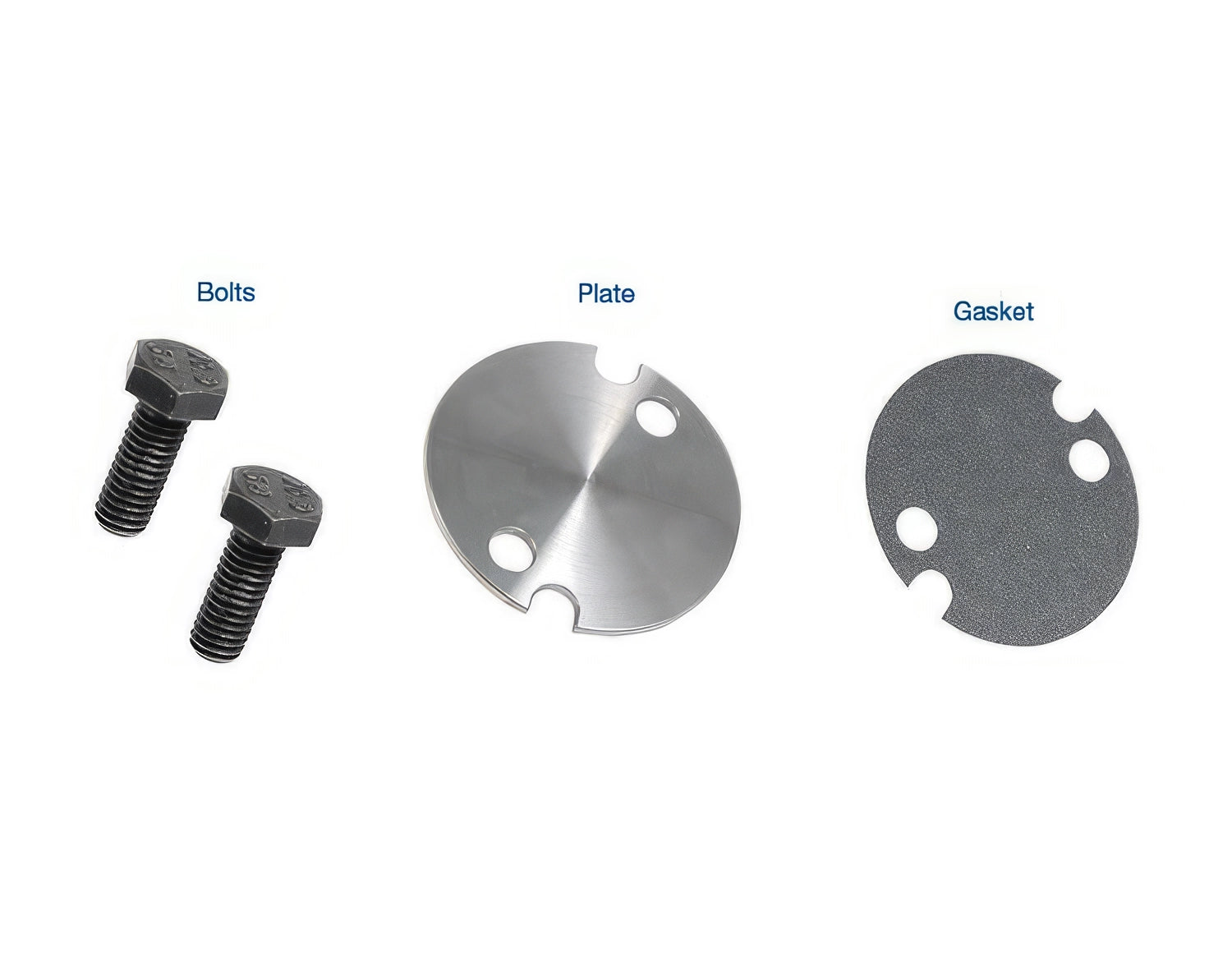
Every 2004-2008 unit has the 2001-and-later valve body without the stiffener plate under the 2-3 accumulator. Without that clamp, forward clutch oil can bow the separator plate and leak into the direct circuit, so the direct clutch drags in 1st and 2nd. The fix is a retainer plate to clamp the separator plate again, such as the Sonnax 76507F-01K kit. Our 4R75W valve body testing guide covers this in more detail.
Step 5: Fix it once
When the valve body comes off, do the whole job:
- Pull the pan, check the magnet, and inspect the internal harness routing.
- Vacuum test the pressure regulator and solenoid regulator bores. Repair worn bores with oversize valves rather than stock replacements.
- Inspect the overdrive servo regulator valve and sleeve, and look for retaining ring pieces in the bore.
- Install a valve body retainer plate kit to stop the forward-to-direct leak.
- Replace the shift, TCC and EPC solenoids as a set if they are original. They are cheap compared to doing the job twice.
- Torque the valve body to case bolts to spec. Sonnax lists 100 in-lb on its remanufactured valve body sheet and 106 in-lb in the ZIP kit booklet, and recommends re-checking torque after a 10 to 15 minute set.
- Refill with MERCON V only. Ford's 2006 F-150 owner guide lists MERCON V (XT-5-QM) at 13.2 L (13.9 qt) total for the 4R70E and 4R75E. A pan drop takes far less, so check level hot on the dipstick.
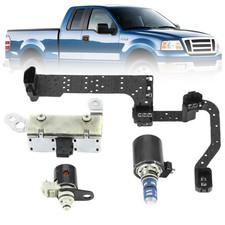
4R75W shift, EPC and TCC solenoid kit with harness (2005-2008)
When the ohm test or the road-test data points at the solenoids or a chafed internal harness, this kit replaces the shift, EPC and TCC solenoids along with the wire harness in one job. Sold by our sister store, CoreTransmissionParts.
Shop the part for this fix →Need Sonnax valve kits, a valve body or a rebuild kit instead? The 4R75W parts collection has the full range.
Need parts for this job?
4R75W solenoid kits, valve bodies, the Sonnax retainer plate kit, and master rebuild kits for the 2004-2008 F-150 are on our 4R75W parts page, with checkout on site.
FAQ
Why does my 2004-2008 F-150 bump on the 1-2 shift with no codes?
Check the driveshaft slip yoke before the transmission. ATSG documented a 2005 F-150 4R75W with a 1-2 and 2-1 bump, good fluid, no codes and correct line pressure that was fixed by Ford TSB 05-26-11, which calls for 7 to 13 grams of Motorcraft PTFE lubricant on the slip yoke. The dealer had quoted a new transmission.
Why is my F-150 stuck in 2nd gear?
On the 4R75W both shift solenoids are off in 2nd, so a loss of solenoid power makes the truck start and stay in 2nd. Check the battery junction box fuse (F79 on F-Series) and the internal harness under the pan. Ford has a bulletin on 2009 4R75E units built before 12-1-2008 where a mis-routed harness gets pinched between the pan and the main control.
What should 4R75W shift solenoids read in ohms?
Sonnax lists SS1 and SS2 at 20-30 ohms in its ZIP kit booklet and 20-40 ohms on its remanufactured valve body sheet, the TCC solenoid at 10-16 ohms, and the EPC solenoid at 2-5 or 3-6 ohms depending on the document. A reading in range does not clear a solenoid, because it can still stick or leak, so confirm with road-test data.
I replaced the solenoids and it still shifts erratically. What now?
Look at the solenoid regulator valve. Sonnax ties erratic shifts, no 2nd, 2-3 neutral and neutral after 4th to wear in the solenoid regulator bore, which lowers the supply pressure feeding the shift solenoids. The bore needs to be vacuum tested and repaired with an oversize valve such as Sonnax 76948-47K.
What fluid does a 2004-2008 F-150 4R75W take?
MERCON V. Ford's 2006 F-150 owner guide lists MERCON V (XT-5-QM) at 13.2 L (13.9 qt) total for the 4R70E and 4R75E. A pan drop takes far less, so check the level hot on the dipstick.
Related guides
- 4R75W F150 Common Problems and Fixes
- 4R75W F150 Slipping: Causes and Fix
- 4R75W Valve Body Problems and Testing
- 4R75W Limp Mode Causes
- 4R75W TCC Lockup Explained
Sources
- Transmission Digest — Wayne Colonna (ATSG), "Getting Greased," Technically Speaking. Backs the 2005 F-150 4x2 4R75W shift-bump case at 48,000 miles (no codes, good fluid, correct line pressure), Ford TSB 05-26-11, and the 7 to 13 grams of Motorcraft PTFE lubricant on the slip yoke that fixed it. transmissiondigest.com
- Ford service bulletin for 2009 F-150, E-150, Crown Victoria, Grand Marquis and Town Car with the 4R75E built before 12-1-2008, via Vehicle Service Pros, "Confused Ford Transmission." Backs the improper gear selection, TCC and shift-feel symptoms, the DTC list (P0750, P0753, P0755, P0758, P0740, P0743, P0748, P0962, P0963, P0712), the pinched internal harness, BJB fuse F79 and workshop manual section 307-01. vehicleservicepros.com
- Sonnax — Ford 4R70E, 4R70W, 4R75E, 4R75W, AODE ZIP Kit (AODE-4R75E-ZIP) Quick Guide and Installation & Testing Booklet. Backs the solenoid and component application charts, the SS1/SS2/TCC/EPC resistance values, the in-case EPC location, the 106 in-lb valve body bolt torque, the solenoid regulator bore check, and the stuck inboard overdrive servo regulator valve from broken retaining ring pieces. Sonnax ZIP kit booklet (PDF) · sonnax.com part page
- Sonnax — 4R70E/4R70W/4R75E/4R75W Remanufactured Valve Body F095/F098 Tech & Install Tips. Backs the alternate solenoid resistance values (SS1/SS2 20-40, TCC 10-16, EPC 3-6 ohms), the 100 in-lb bolt torque with re-check after a 10 to 15 minute set, and the 185 degree F, 10 to 15 cycle road test. Sonnax F095/F098 sheet (PDF)
- Sonnax — Oversized Solenoid Regulator Valve Kit 76948-47K and Overdrive Servo Regulator Kit 76948-29K technical pages. Back the erratic shift, no 2nd, 2-3 neutral and neutral-after-4th symptoms from solenoid regulator bore wear, and the 4-3-neutral, no 4th and burned overdrive band symptoms from servo regulator sleeve wear. 76948-47K · 76948-29K
- Sonnax — Brian Wing, "Watch Out for 4R70W Pressure Regulator Valve & Casting Wear." Backs the PR valve scoring on the EPC end, low line rise, the vacuum test for bore wear, and oversize kit 76948-17K. sonnax.com
- Ford Motor Company — 2006 F-150 Owner Guide, Maintenance and Specifications (archived copy). Backs the 4R75E designation and MERCON V (XT-5-QM) at 13.2 L (13.9 qt). 2006 F-150 owner guide (PDF)