I get asked some version of this question almost every week: "the quick-lube wants to flush my transmission, should I let them, or just do a pan drop myself?" On a 4R70W the answer isn't the same for every truck, because the two services don't do the same job, and the unit's own plumbing changes the math. A pan drop on a stock 4R70W pan only ever touches part of the fluid. A flush touches nearly all of it, including fluid a pan drop can't reach. That sounds like flush wins by default, but it isn't that simple once mileage and history are in the picture.
This isn't a repair guide. It's the decision I actually walk customers through, with the real numbers behind it and the sources I pulled them from, listed at the bottom.


What each method actually replaces
ATRA's own description of the two services is the cleanest I've found, and it matches what I see on the lift. A standard fluid service, what most people mean by "drain and fill," replaces about one-third to one-half of the transmission fluid. A full flush, done with dedicated equipment, replaces nearly all of the transmission fluid by pushing new fluid through the unit and the cooler lines while pulling old fluid out. ATRA also flags something worth asking about before you book either one: many flush machines do not replace the transmission filter, so a flush and a filter change are two separate line items unless you confirm otherwise.
On the 4R70W specifically, that one-third-to-one-half figure for a drain-and-fill is generous unless the truck already has a deep aftermarket pan. The factory 14-bolt pan has no drain plug, so the only way to get fluid out is to drop the pan, and that only empties what's sitting in the pan itself.
The 4R70W's own math
Ford's figure for total dry-fill capacity on the 4R70W is 13.2 L (13.9 qt), with the final level always set by the hot dipstick check rather than a fixed number. In my bay, a stock-pan pan drop on a 4R70W typically returns around 5 to 6 quarts. Do the division and a single pan drop is replacing somewhere around 35 to 45 percent of the total fluid in the unit, which lines up with ATRA's one-third-to-one-half figure almost exactly.
The rest, somewhere around 8 quarts, is sitting in the torque converter, the cooler, and the lines running to and from it. A pan drop never touches that fluid. It just sits there, mixing down slightly each time you top off, but never getting fully replaced unless something pushes it through.
That's the whole argument for a flush: it's the only single-visit method that reaches the converter's fluid. It's also the whole argument for caution, because reaching the converter means reaching whatever is suspended in that fluid.
Where a flush gets risky on this unit
The 4R70W has a known wear pattern that makes this more than theoretical. Sonnax has documented severe scoring at the EPC end of the pressure regulator valve and wear in the valve body's casting bore on these units, producing reduced line pressure, soft shifts, and an erratic buzz under load. That's a mechanical wear issue, not a fluid issue, but it tells you something important: the 4R70W's valve body bores are not immune to wear, and a valve body with marginal bore wear is more sensitive to whatever is circulating in the fluid than a tight one is.
Picture a 4R70W that has gone 150,000 miles on its original fluid, in a truck that's towed for most of its life. The fluid in the pan looks dark but isn't gritty. The fluid trapped in the converter and cooler lines has been sitting there even longer, and it's carrying fine clutch and band material in suspension, some of which may be doing nothing because it's not moving. Push that fluid hard through the unit with a flush machine, and you're moving material that was previously static through valve bores, orifices, and a converter that has its own clearances. On a unit with healthy bores that's rarely a problem. On a unit with wear already started at the pressure regulator valve or the converter limit valve, it's a plausible way to turn a slow fluid-breakdown shudder into a sudden slip or buzz that shows up a few days after the service, right when the shop and the customer are both convinced the transmission is now "fixed."
The industry's own trade press says the same thing. Writing in GEARS Magazine, ATRA's technical publication, Pat Burrow explains that fresh fluid's detergency can loosen deposits that then affect solenoids and valves, and that a full flush on a high-mileage unit with unknown history makes that more likely. His recommended alternative is the partial service: drop and clean the pan, replace the filter, refill with the correct fluid, and leave the converter alone, which removes about half the old fluid with far less disturbance.
None of this means flushing is wrong. It means flushing is a different risk profile than a drain-and-fill, and the deciding factor is what you actually know about the unit's history and condition, not just its mileage.
What Ford's own maintenance guidance leaves out
It's worth noting what Ford's own documentation does and doesn't say. Ford's scheduled maintenance guide for the 4R70W doesn't call for a routine fluid change on the normal schedule at all, only a level check. Under what Ford calls special operating conditions, towing, extended idling, dusty roads, off-road use, the guide calls for an automatic transmission fluid change every 30,000 miles. It describes that as a fluid change, not a flush, and the same guide explicitly warns against adding supplemental transmission additives or cleaning agents on top of the specified MERCON V fluid. Ford isn't silent on flush machines because flushing is approved; Ford is silent because the factory procedure it documents is a pan-drop fluid change, and a chemical "flush and fill" additive is squarely inside the no-additives warning.
That doesn't make a mechanical flush machine the same thing as a chemical additive. But it does mean you're choosing a method Ford's own literature doesn't describe, using judgment the manual doesn't give you. That's exactly the situation where fluid condition and service history should decide the call, which is what ATRA's guidance points toward too.
A simple way to decide
- Known history, fluid changed on schedule, no symptoms: a flush is a reasonable way to get the converter's fluid refreshed in one visit. Confirm the filter is included or plan a separate pan drop for that.
- Unknown history, original fluid, high mileage, no symptoms yet: favor a drain-and-fill, or at most a flush at a shop willing to inspect the pan and pull a sample first. You're trying to avoid moving a lot of suspended material through tight clearances all at once. Burrow's GEARS checklist is a good one to borrow: compare a fluid sample against new fluid, look at the pan and magnet, and confirm reverse works on a short test drive before the service, not after. If the truck's radiator is old, also strip-test the fluid for coolant and water. GEARS columnist Mike Brown notes that contamination can damage clutches without ever turning the fluid milky, and no fluid service saves clutches that have absorbed moisture.
- Already slipping, shuddering, or showing a pressure-related code: don't reach for either fluid service as the fix. Diagnose the cause first. A fluid change on a mechanical fault buys weeks at best, and a flush on a unit that's already shedding material is the worst time to push fluid hard through it.
The staged drain-and-fill protocol
When I'm not confident about a 4R70W's history, I default to three pan drops spaced a few hundred miles apart instead of one flush. Each pan drop replaces roughly the same 35 to 45 percent of total fluid, but because you're diluting what's left each time rather than fully replacing it in one pass, three services in sequence gets the mix to somewhere north of 90 percent fresh fluid without ever running fluid through the unit under machine pressure. It costs more in labor and a little more in total fluid than a single flush, and it takes longer. It also gives you three chances to look at the pan and the magnet instead of one, which matters more than people think. A magnet with fine gray paste after the first service and the same fine paste after the third is a healthy unit. A magnet that's clean the first time and loaded with metal the second time just told you something a flush machine never would.
Need parts for this job?
Our 4R70W parts page has the FT105 filter and gasket kit, Motorcraft MERCON V by the case, aluminum deep pans with a magnetic drain plug for easier repeat services, and full rebuild kits if the inspection turns up more than a fluid issue, all with on-site checkout.
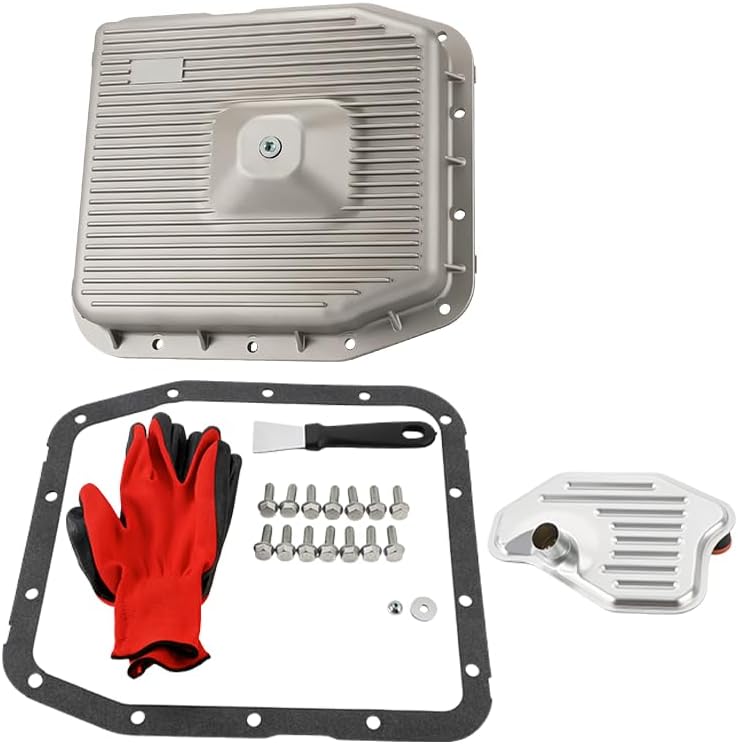
4R70W aluminum pan with gasket (makes repeat drain-and-fills faster)
An aluminum replacement pan and gasket for the stock 14-bolt 4R70W, sold by our sister store, CoreTransmissionParts.
Shop the part for this fix →Need something else? The 4R70W parts collection has pans, gaskets, filters and full rebuild kits.
FAQ
Is a transmission flush bad for a 4R70W?
Not inherently, but it carries more risk on a high-mileage unit with unknown history. A flush pushes nearly all the fluid through the transmission and cooler lines at once, and on a unit with worn clutches or a scored valve body, that can dislodge debris that was otherwise doing no harm. On a transmission with regular fluid changes and no symptoms, a flush is generally fine. On one that has never been serviced or already shows soft shifts, a staged drain-and-fill is the lower-risk choice.
How much fluid does a drain-and-fill actually replace on a 4R70W?
On a stock pan, dropping it typically drains 5 to 6 quarts out of a roughly 13.9 quart dry-fill total, so a single pan drop replaces well under half the fluid in the unit. The torque converter, cooler and lines hold the rest and stay full. A flush machine is the only method that reaches that remaining fluid in one pass.
Does a flush replace the filter on a 4R70W?
Not by itself. ATRA notes that many flush machines do not replace the transmission filter, so if you want a new filter with a flush, the pan still has to come off separately. Ask the shop directly whether the filter is included, because a flush alone leaves the old filter in place.
How many drain-and-fills does it take to get most of the old fluid out?
A single pan drop on a stock 4R70W pan only replaces roughly 40 percent of the total fluid. Three pan drops spaced a few hundred miles apart, each refilling with fresh MERCON V, gets the mix well above 90 percent fresh fluid without ever pushing fluid through the unit under machine pressure.
What fluid does a 4R70W need for either service?
MERCON V, per Ford's owner and maintenance guides for the 4R70W. Use a fluid carrying Ford's current MERCON V license approval rather than a generic multi-vehicle ATF, and don't add a friction modifier or a flush-and-clean chemical on top of it; Ford's guides warn against supplemental transmission additives.
Related guides
- 4R70W Filter and Pan Service Guide
- 4R70W Fluid Type and Capacity
- 4R70W Valve Body Wear and Fix
- 4R70W Torque Converter Shudder
- 4R70W vs 4R75W Differences
Sources
- ATRA, "Transmission Service." Backs the one-third-to-one-half fluid replacement figure for a standard service, the nearly-all-fluid definition of a flush, the caution that many flush machines don't replace the filter, the 24,000-mile/two-year interval, and that the choice between methods depends on fluid condition. members.atra.com
- Ford Motor Company, 2003 Crown Victoria Owner Guide, Maintenance and Specifications. Backs the MERCON V fluid specification, the 13.2 L (13.9 qt) approximate dry-fill figure for the 4R70W, and the hot-dipstick level-setting procedure. Ford's own fordservicecontent.com host now blocks direct PDF access (Akamai 403), so this links the Internet Archive's cached copy of the same document. web.archive.org (PDF)
- Ford Motor Company, 2003 Scheduled Maintenance Guide. Backs the inspect-only normal schedule for the 4R70W, the 30,000-mile fluid change under towing/extended-idle/dusty/off-road conditions, and the warning against supplemental transmission additives and cleaning agents. Ford's own fordservicecontent.com host now blocks direct PDF access (Akamai 403), so this links the Internet Archive's cached copy of the same document. web.archive.org (PDF)
- Sonnax, "Watch Out for 4R70W Pressure Regulator Valve & Casting Wear." Backs the EPC-end pressure regulator valve scoring, the valve body casting bore wear pattern, and the resulting low line rise, soft shift and buzz symptoms used here to explain why a worn 4R70W is more sensitive to a hard fluid exchange. sonnax.com
- Chevron, Havoline ATF MERCON V Technical Data Sheet (TTF-95). Backs the MERCON V specification approval number (Ford MV130910) and typical fluid properties referenced for the correct fill fluid. shop.sclubricants.com (PDF)
- GEARS Magazine (ATRA), Pat Burrow, "Is It Safe to Change Transmission Fluid in High-Mileage Vehicles?" Backs the risk of loosened deposits reaching solenoids and valves after a full flush, the partial pan-and-filter service that replaces about half the fluid, and the pre-service sample, pan inspection and reverse check. gearsmagazine.com
- GEARS Magazine (ATRA), Mike Brown, "Identifying ATF Contamination." Backs coolant and water contamination that does not turn the fluid milky, the antifreeze and water test strips, and clutches that cannot be saved once they absorb moisture. gearsmagazine.com