"No movement in any gear" on a 4R70W is a specific complaint, and it's worth separating from the symptoms that already have their own write-ups on this site. A transmission that's slipping (it engages, but engine rpm climbs faster than road speed) or one that only loses Reverse points at a single clutch, band, or servo. A 4R70W that sits still in both Drive and Reverse, with the engine revving cleanly and no clunk or shudder as the lever moves through the gates, almost always means something common to every range has failed -- not one clutch pack, but something upstream of all of them: the fluid supply, the pump, the main pressure regulator valve, the connection between the converter and the input shaft, or, less often, the parking and linkage system itself.
Fluid and Linkage First
Before a gauge goes anywhere near the case, check the fluid. Ford's current fluid-by-transmission reference chart lists the 4R70W, 4R70E, 4R75W and 4R75E together under a single fluid type: MERCON V, sold as Motorcraft part XT-5-QMC in quarts and XT-5-DMC in 55-gallon drums. That's not a casual recommendation -- the same chart's caution section warns against using any supplemental transmission fluid additive, treatment, or cleaning agent, because they can affect transmission operation and damage internal components. If the dipstick or pan shows fluid that's dark, burnt, aerated with a milkshake look, or simply low enough to starve the pump's inlet, that alone can produce a no-movement complaint in both directions, and it costs nothing to check before doing anything else.
With the fluid confirmed, check the shifter linkage and the manual valve position at the transmission. A linkage that's slipped out of adjustment, or a manual valve that isn't landing fully in its detent, can leave the valve body sitting between ranges where neither Drive nor Reverse gets full circuit pressure -- a purely mechanical problem that looks exactly like an internal failure until it's been ruled out.
Rule Out Electrical Before You Touch the Pan
Codes and connectors come next, and they're worth taking seriously even when the complaint looks purely mechanical. A repair written up in Gears Magazine, ATRA's trade publication, is a good illustration of how far an electrical fault can masquerade as a hydraulic one on this platform. A rebuilt 4R70W in a 2004 Ford Econoline ran fine in every forward gear, but Reverse engagement got progressively more delayed as the transmission warmed, eventually needing throttle just to engage. A mechanical gauge on the main line pressure tap showed Drive pressure right at specification; Reverse pressure, though, fell to just 30 psi and only came up once the throttle was applied. The technician worked through a reverse-drum air check through the pump (passed), the reverse boost valve (free and clean), and the servo, cover and case bore (inspected clean, servo replaced anyway as a precaution) before checking PCM pressure-control voltage with a DVOM: about 3.2 volts at a cold idle (130 psi), climbing to 4.3 volts once warm, then dropping to 1.8 volts under throttle before recovering to 3.6 volts along with a harsh engagement. None of that pointed at a worn part. The actual cause was water that had gotten into the reverse-light circuit and shorted the PCM -- replacing the computer fixed it.
The lesson carries straight over to a full no-movement complaint. Pull every stored and pending code, inspect connectors for corrosion or water intrusion (reverse lights, the TR/MLP range sensor, and any connector near the pan rail are common entry points), and confirm the range sensor's reported position matches the actual lever position before assuming the fault is inside the case.
A "barely moves" truck with a whole set of solenoid codes is the classic version of this. Transmission Digest documented a 1998 F-150 4x4 4.6L where the shop replaced a burned 4R70W and the new unit did exactly the same thing. Every stored code was a solenoid code, which on this transmission usually means lost power, not four failed solenoids. The diagnostician found no voltage on pin 4 (the red wire) at the transmission connector while PCM pins 71, 37 and 87 checked good. A broken harness clip had let the harness rest on the exhaust and melt several wires together. Check that circuit before the old unit comes out, and inspect the harness routing while the transmission is on the floor.
The Line-Pressure Test Is the Fork in the Road
Line pressure is the test that actually splits this complaint in two, and it decides whether the fix is a $40 valve or a full teardown. Hook a mechanical gauge to the main line pressure tap -- not a scan tool PID, which reads commanded pressure rather than what's actually in the circuit -- and check both Drive and Reverse, at idle and with the brake held and the transmission in gear.
If pressure is low or absent in both ranges, the fault sits upstream of every clutch pack: the pump, the filter, or the main pressure regulator valve that sets line pressure for the whole unit. If pressure reads normal, or close to it, in both ranges and the vehicle still won't move, the hydraulics are doing their job -- the clutches are almost certainly applying -- and the break is somewhere between the engine and the gearset: a stripped input shaft, failed converter splines, or, rarely, a stripped input sun gear.
When Pressure Is Low Everywhere: Pump and Main Pressure Regulator Valve
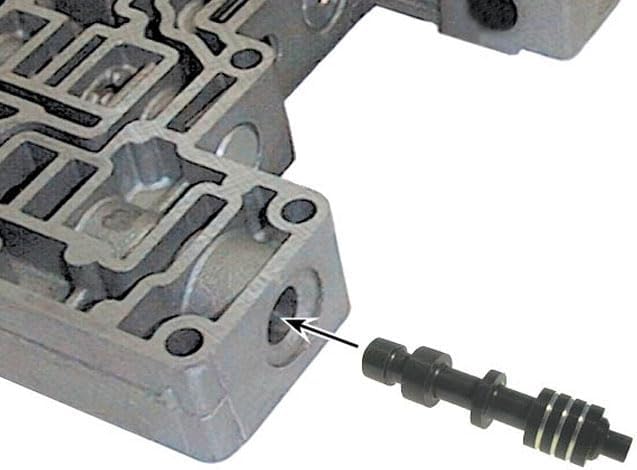
Sonnax's own documentation for the 4R70W and AODE main pressure regulator valve lays out exactly what a worn OE valve does to line pressure, and why it affects every range at once: regulator valve wear "allows critical fluid loss," and the resulting symptom list reads like a checklist for a no-movement complaint -- poor shift quality, soft shifts, low line rise, erratic buzz, premature clutch failure, premature band failure, uncontrolled pressure in Reverse, and low Reverse boost. Sonnax splits the part by generation: pre-'96 4R70W and AODE units use a 4-spool valve design, while '96-and-later units need a different valve -- the two generations aren't interchangeable, so confirm which valve body casting is on the bench before ordering. If the bore itself is worn oversize rather than just the valve, Sonnax also documents an oversized pressure regulator and boost valve kit for both generations.
On the Reverse-boost side specifically, the boost valve and sleeve that amplify pressure only in Reverse are a separate wear point from the main regulator valve, and a worn or stuck boost assembly can leave Reverse pressure low even when Drive reads fine -- or, in a severe case, drag overall line pressure down enough to affect both ranges. Pull the pan and check the filter and magnet for debris while it's open; a collapsed or saturated filter starves the pump's inlet and produces the same low-pressure-everywhere symptom as a worn pump or regulator valve, for a fraction of the cost of either.
When Pressure Is Normal: Input Shaft, Converter Splines, or a Rebuild Stack-Up
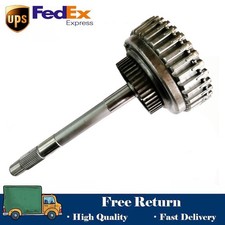
If line pressure comes back normal in both Drive and Reverse and the vehicle still sits still, stop looking at the valve body and start looking at what physically connects the engine to the gearset. Sonnax's documentation for its heavy-duty input shaft, which fits AODE, 4R70E, 4R70W, 4R75E and 4R75W units, states plainly that "input shaft failure is common as power levels are increased" in these transmissions, and the replacement part's design changes point straight at where the factory shaft gives up: improved turbine-end splines to prevent breakage, and revised sealing ring grooves for greater strength and fracture resistance. A shaft that's stripped at either end, or a torque converter with stripped turbine or stator splines, produces exactly this complaint -- the pump still turns, the clutches still get full, normal pressure, and the transmission still shifts internally, but none of that torque ever reaches the output because the physical connection between the converter and the gearset is broken. It's a failure mode that's easy to miss on a pressure test alone, because the hydraulics look completely healthy.
Recent rebuild history matters here too. If the transmission was just rebuilt or had the pump reinstalled, and the vehicle creeps forward even sitting in Neutral, that points at a different problem: a clutch stack-up error, where the pump was bolted down against a clutch pack that wasn't fully seated. That symptom -- movement in Neutral -- is the tell that separates a stack-up mistake from a broken shaft, and it's worth checking for before the unit comes back apart a second time.
Reverse Works, Drive Doesn't: Check the Forward Drum
Not every no-move is a both-directions complaint. If the vehicle backs up normally but will not pull away in Drive, the problem is usually inside the forward clutch circuit, and the stamped forward drum is the first suspect. Sonnax's technical notes on its Smart-Tech high capacity forward clutch drum (76655-01K) explain the mechanism: the OE snap ring groove creates high-stress points around the drum's circumference, the drum works in 1st, 2nd and 3rd, and it takes the worst of it on a forced 4-3 kickdown when the forward clutch reapplies at higher pressure. Forward piston pressure plus that groove stress splits the upper portion of the drum and separates it at the snap ring groove. Sonnax lists the complaints as no forward engagement, slipping in 1st, 2nd and 3rd, a broken drum and ratio codes.
A cracked drum will often still show normal line pressure, so this is another case where the gauge looks healthy and the hard part is broken. Inspect the drum at the snap ring groove whenever a forward clutch pack comes out, even if the frictions look fine. Sonnax also warns that its forged drum is not for use with the '04-'05 riveted-style sun gear shell; units with a front speed sensor and a riveted shell need the later non-riveted shell (OE 5L3Z7A019AB) or equivalent.
Diagnostic Order
- Check fluid level, condition and type. Confirm it's MERCON V, not a Dexron or generic Mercon substitute, and rule out an obviously low or burnt fill before doing anything else.
- Check the shifter linkage and manual valve detent. A misadjusted linkage can leave the valve body sitting between ranges on its own.
- Pull every stored and pending code and inspect connectors -- reverse lights, the TR/MLP range sensor, and the pan-rail harness -- for water intrusion or corrosion, even with no DTCs set.
- Install a mechanical gauge on the main line pressure tap and test Drive and Reverse, both at idle and with the brake held in gear. This is the fork in the diagnosis.
- If pressure is low or absent in both ranges, pull the pan, check the filter and magnet for debris, then inspect the main pressure regulator valve, its bore, and the Reverse boost valve for wear.
- If pressure reads normal in both ranges and the vehicle still won't move, check whether it creeps in Neutral (a rebuild stack-up error) versus staying still in Neutral (a broken input shaft or stripped converter splines).
- Confirm findings before ordering parts -- pre-'96 and '96-and-later 4R70W valve bodies use different pressure regulator valves, and the correct input shaft and converter combination depends on the vehicle's actual power level and application.
No movement in any gear feels like it has to be the worst-case transmission failure, but the fluid check, the linkage check, and a cheap line-pressure gauge rule out most of the inexpensive causes before an hour's gone into the car. Work it in that order and a full rebuild stops being the default answer.
Pressure checks out low across the board?
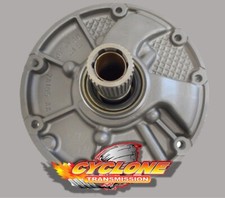
A worn pump is the single most common cause of a 4R70W that won't move in any range. This remanufactured pump assembly replaces the factory unit outright rather than betting on a rebuild of a worn bore. If your application differs, the full 4R70W collection covers every pump, valve body and boost valve variant by year.
Shop the 4R70W pump assembly →FAQ
What's the difference between a 4R70W that won't move at all and one that's just slipping?
Slipping means the transmission engages but engine rpm climbs faster than road speed under load -- the clutch or band is holding some torque but not all of it. No movement in any gear means there's zero drive in both Drive and Reverse with the engine revving cleanly, which points at something every range shares (fluid supply, pump, main pressure regulator valve, or the input shaft/converter connection) rather than a single worn clutch pack. If the complaint is only one range, start with that specific symptom instead -- a 4R70W that slips, or one with no Reverse only, each point at a narrower set of causes.
Can a bad transmission range sensor (MLPS) cause no movement in any gear?
It can, if the sensor is misaligned or reporting the wrong range, because the PCM uses that signal to confirm which range is commanded and can withhold shift commands if the readings don't match. It's a cheap, non-destructive check -- confirm the sensor's reported position matches the actual lever position with a scan tool before assuming the fault is internal. It's rarely the sole cause of a true no-movement-in-either-direction complaint on its own, but it belongs on the list of connectors and components to inspect before pulling the pan.
If line pressure tests normal in both Drive and Reverse, does that rule out the transmission?
No -- it rules out the hydraulic supply side (pump, filter, main pressure regulator valve), but it doesn't rule out a mechanical break between the engine and the gearset. Normal pressure in both ranges with no movement is actually the signature of a stripped input shaft or failed torque converter splines: the pump turns and the clutches apply at full, correct pressure, but none of that torque reaches the output because the physical connection between the converter and the gearset never happened.
What fluid does the 4R70W actually need, and can the wrong fluid cause this?
Ford's current fluid reference chart specifies MERCON V for the 4R70W, 4R70E, 4R75W and 4R75E, sold as Motorcraft XT-5-QMC in quarts or XT-5-DMC in 55-gallon drums. The same chart warns against any supplemental transmission fluid additive or treatment. Fluid that's severely low, burnt, or aerated can starve the pump enough to drop pressure in every range at once, which looks exactly like a pump or regulator-valve failure until it's been drained and checked.
Is a stripped input shaft something I can diagnose without pulling the transmission?
You can get close without a full teardown. If the line-pressure test comes back normal in both Drive and Reverse, and the vehicle doesn't creep in Neutral (which would point at a rebuild stack-up error instead), a stripped input shaft or torque converter spline failure is the leading suspect by elimination. Confirming it visually still means pulling the transmission or at minimum the torque converter, since the failure is on the shaft, the drum splines, or inside the converter itself -- there's no way to inspect those splines with the unit in the vehicle.
Sources
- Gears Magazine (ATRA) — "The Rear-View Mirror Is Clear: A 4R70W With No Reverse," January/February 2023. Backs the case-study pressure readings (Drive at spec, Reverse dropping to 30 psi), the PCM pressure-control voltage sequence (3.2V/130 psi cold idle, 4.3V warm, 1.8V then 3.6V under throttle), the air-check and boost-valve findings, and the confirmed root cause (water-shorted PCM from the reverse-light circuit). gearsmagazine.com
- Ford Motor Company / FCSD Chemicals and Lubricants — Automatic Transmission Fluid Chart by Transmission. Backs the MERCON V fluid specification for the 4R70W/4R70E/4R75W/4R75E, the Motorcraft XT-5-QMC/XT-5-DMC part numbers, and the caution against supplemental fluid additives. fcsdchemicalsandlubricants.com (PDF)
- Sonnax — Main Pressure Regulator Valve, 4R70W/AODE technical product page. Backs the worn-valve symptom list (poor shift quality, low line rise, premature clutch/band failure, uncontrolled Reverse pressure, low Reverse boost) and the pre-'96 vs. '96-later valve generation split. sonnax.com
- Sonnax — Heavy Duty Input Shaft, AODE/4R70E/4R70W/4R75E/4R75W technical product page. Backs the input-shaft failure mechanism under increased power, the 300M material and heat treatment, and the turbine-end spline and sealing-ring-groove design changes. sonnax.com
- Sonnax — Smart-Tech High Capacity Forward Clutch Drum Kit 76655-01K, technical product page. Backs the forward drum failure mechanism (snap ring groove stress, drum splitting at the groove, worst on a forced 4-3 kickdown), the no-forward / 1st-2nd-3rd slip / ratio code complaint list, and the riveted sun shell caution (OE 5L3Z7A019AB). sonnax.com
- Transmission Digest — Carman Klaber, "It's Not Just the Transmission," R&R Tech, February 2010. Backs the 1998 F-150 4.6L 4R70W barely-moves case: a replacement unit repeating the symptom, all solenoid codes, no power at pin 4 (red wire) at the transmission connector with PCM pins 71, 37 and 87 good, and the melted harness behind a broken retaining clip. transmissiondigest.com