"My 4R70W is making noise" isn't a diagnosis, it's a starting point, and the first fork in the road is whether the noise is a whine or a clunk. Those are two different mechanical events with two different repair paths. A whine is a continuous tone that comes from something spinning under load and slowly wearing, a bearing, a planetary set, a pump. A clunk is a single, sharp impact noise at a specific transition, a shift, a direction change, a load reversal, and it usually points at mechanical slack somewhere outside the transmission entirely. Mix the two up and you'll end up pulling a 4R70W to chase a driveline problem, or tearing into a differential looking for a noise that's actually a known bearing wear point inside the transmission case. This guide sorts both noise types by their documented causes on the 4R70W/4R75W platform, including a specific bearing failure Sonnax has flagged as a design issue and Ford's own driveline diagnosis chart for the clunks that aren't the transmission's fault at all.
Whine vs. clunk: tell them apart in two minutes before you touch anything
Before you chase parts, characterize the noise with the truck sitting still, then on a short road test. With the vehicle in Park and the engine running, is there a tone present at idle that climbs with RPM? That points at something on the pump or converter side, internal to the transmission. Now take it for a short, slow drive: does the tone instead track road speed and stay steady regardless of engine RPM, present in both drive and coast? That points at the output shaft bearing instead of the pump. A clunk gets diagnosed differently: note the exact transition it happens on. A clunk only on the shift from Reverse to Drive, or only on takeoff from a dead stop, or only on throttle-on/throttle-off transitions, is the signature of mechanical slack in the driveline rather than a transmission internal failure, and Ford's own workshop manual backs that up directly, covered below.
Whine source 1: the output shaft bearing (Sonnax's documented wear point)
Sonnax has published a direct warning about a 4R70W/4R75W bearing noise complaint that keeps getting misdiagnosed. The symptom seems to go away, or at least change character, once the converter locks up, which leads a lot of shops to condemn the torque converter. Sonnax's own qualifying test is simple: confirm the noise is present only while the output shaft is turning, not whenever the engine is running. They also note shops have mistakenly disassembled the differential chasing this same noise, so rule that out too before you start pulling parts. For locating it, a stethoscope on the case is the tool to use, and the noise is loudest at the rear of the case, just ahead of where the extension housing or transfer case adapter bolts on, which points at the output shaft support, not the planetary gearset or the differential.
On disassembly, the source is the bearing between the output shaft and the case; a bad one shows pitting or spalling on the rollers and on both races. Sonnax traces the problem to the bearing's design history: this location has used three generations of bearings since the AOD. Generation one was an open-faced bearing that used the output shaft itself as one race. Generation two was a robust, enclosed design with large rollers. Generation three, an enclosed bearing with fewer and smaller rollers, is the one showing this wear pattern, which Sonnax attributes to a probable design defect rather than normal wear-and-tear. Drive configuration doesn't matter here; the article reports roughly equal numbers of 2WD and 4WD cases affected. Catch it early and you're replacing a bearing; let it go and you risk damaging the case or the output shaft itself. Sonnax's own internal bearing kit for the platform (SBK-F6, covering 1993-2003 4R70W units) lists bearing noise and bearing failure as the symptoms it's built to address, and it covers several of the transmission's other internal bearing locations in the same kit, not just the output shaft.
Whine source 2: sorting pump, converter and planetary noise
Gears magazine, ATRA's technical publication, lays out a practical method for telling these three apart that applies directly to the 4R70W. All three components, the torque converter, the pump, and the planetary geartrain, can produce a whine, and the test for each is different. For the converter, likely sources are the bearings between the stator and pump and between the stator and turbine: listen in neutral, select any gear, and apply a little throttle; a noise that rises with throttle points at the converter. For the pump, the test is different: with the vehicle stationary in neutral, raise engine RPM; a rising pitch suggests a pump-related problem, though a clogged or leaking filter or air entering the intake can produce the same sound, so the pump itself may not be the actual fault. ATRA also recommends testing in reverse at idle, since line pressure typically rises there; a louder noise in reverse points at the pump, and gear-and-crescent style pumps (what the 4R70W uses) are the most sensitive to this. Check the converter hub and the pump's inner gear for wear, since wear there lets the gear shift toward the crescent and changes clearance.
For the planetary geartrain, pitch changes with vehicle speed and volume changes with load, and the trick is to rule out the converter and pump first, then use the transmission's gear-range application chart. Like most Ford overdrive automatics, the 4R70W's direct (third) gear runs a 1:1 ratio with no planetary member doing reduction work, so a whine that persists unchanged through third gear is probably not coming from the planetary set at all. A whine that's present in some gears but not others, by contrast, points straight at whichever planetary member is active in the gears where it shows up.
| Noise & pattern | Likely source | Fix | Source |
|---|---|---|---|
| Whine, tracks road/output speed, present in drive and coast, loudest at rear of case | Output shaft bearing (3rd-generation design) | Replace with a 2nd-generation-style bearing | Sonnax |
| Whine/tone that rises with throttle in any gear, fades in lockup | Torque converter stator/turbine bearings | Converter replacement | Gears Magazine (ATRA) |
| Rising-pitch whine with engine RPM, stationary in neutral; louder in reverse at idle | Pump wear, or filter/intake air leak mimicking pump noise | Check filter/intake first, then pump inspection | Gears Magazine (ATRA) |
| Whine present in some gears, absent in direct (1:1) third gear | Planetary gear set member active in the affected gears | Internal inspection by gear-range pattern | Gears Magazine (ATRA) |
| Clunk on Reverse-to-Drive shift | Axle lube level, axle backlash, pinion bearings, or U-joints | Check/fill axle lube, inspect U-joints and backlash | Ford F-150 workshop manual |
| Clunk on takeoff from a stop | Worn CV/U-joints with play, or loose axle mount | Inspect and replace U-joints/driveshaft; check mount | Ford F-150 workshop manual |
| High-pitched whine with cavitation symptoms, low/old fluid | Low fluid level or aerated ATF | Correct fluid level, use spec'd MERCON V | Motorcraft |
Clunk sources: Ford's own F-150 driveline chart
The 4R70W spent most of its service life behind F-150s, Crown Victorias, Mustangs and Explorers, and Ford's own F-150 workshop manual has a Noise, Vibration and Harshness symptom chart that lists exactly where to look for a clunk, and the transmission is not the listed cause for any of them. A loud clunk when shifting from Reverse to Drive is attributed to an incorrect axle lubricant level, excessive backlash in the axle, damaged or worn pinion bearings, or damaged or worn U-joints. A clunk that occurs as the vehicle starts to move forward following a stop is attributed to a worn driveshaft CV joint or U-joints with excessive play, or a loose axle mount. A clunk during acceleration or the transition from cruise to coast/deceleration is attributed to a damaged or worn CV joint. The same chart separately lists axle howling or whine as its own condition, caused by low axle lubricant, axle housing damage, worn wheel hub bearings, or a worn differential ring and pinion or its bearings, which is worth knowing because a rear-axle whine can easily get reported by a customer as "the transmission is whining" when it isn't.
Ford's prescribed checks follow directly: check and correct the axle lubricant level and look for excessive backlash, inspect the U-joints for wear or play with the rear wheels chocked, the transmission in Neutral, and the engine off, pulling and twisting the driveshaft at each joint to feel for play, and check for a loose axle mount. None of that work touches the transmission. If a clunk gets diagnosed by pulling a 4R70W pan before anyone checks axle backlash and U-joint play, the job is being done in the wrong order.
A rattle or click that stops after the 1-2 shift
Not every noise is a whine or a clunk. On 2000-and-later 4R70W units, Transmission Digest's November 2004 Tech/Talk summary describes a rattle or clicking sound from the transmission that lasts only until the 1-2 shift is completed. The cause is the intermediate clutch pack rattling in the case while it is released in first gear. The fix is the intermediate clutch anti-rattle clip, Ford part YL3Z-7A609-AA, and the summary notes that an odd-looking clip found on the bench after an overhaul is often the missing piece. If the noise only shows up after a rebuild, check that the clip went back in.
ATRA's 2009 seminar manual covers the related anti-rattle spring. Ford released an updated V-shaped spring steel strip, part 2L3Z-7F277-AA, that will not eat into the case or center support. ATRA notes it retrofits all the way back to the AOD and calls it a case saver on badly worn cases. Neither part fixes a bearing whine or a driveline clunk, so match the noise to the gear before ordering.
Diagnostic sequence: how to work through it in order
- Characterize first. Continuous tone or single impact? If it's a tone, does it track engine RPM (even in Park) or road/output speed? If it's an impact, what exact transition triggers it?
- For a tone, run the converter, pump and gear-range tests. Listen in neutral with throttle applied for converter noise, raise RPM stationary in neutral for pump noise, and check whether the whine persists through the 1:1 direct gear to rule the planetary set in or out.
- If the tone tracks road speed and is loudest at the rear of the case, stethoscope the area just ahead of the extension housing or transfer case adapter and suspect the output shaft bearing before assuming it's the converter or the differential.
- For any clunk, start outside the transmission. Chock the rear wheels, put the transmission in Neutral with the engine off, and pull/twist the driveshaft at each U-joint to feel for play. Check the axle fluid level and look for excessive ring-and-pinion backlash before assuming the transmission is involved.
- Check fluid level and condition early in either case. A low or aerated fill produces its own whine from pump cavitation that has nothing to do with a worn part.
Fluid note
None of the mechanical noise sources above are caused by the wrong fluid, but a low or aerated fill produces a whine of its own through pump cavitation, so rule it out early and cheaply before any teardown. The 4R70W specs Motorcraft MERCON V, a premium ATF built from hydroprocessed base oils with performance additives and dyed red for leak detection; it's the correct replacement spec across Ford, Lincoln and Mercury applications that previously called for standard MERCON. See our 4R70W fluid type and capacity guide for exact fill quantities.
Need parts for this job?
Our 4R70W parts page carries pumps, valve bodies, solenoid kits, and master rebuild kits for the 4R70W/4R75W platform. Checkout is on site.
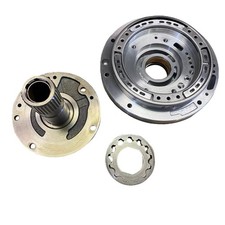
4R70W Remanufactured Pump Assembly 2004-2008
If the pump-side test above points at pump wear rather than a filter or intake leak, this is the actual part that fixes it. Sold by our sister store, CoreTransmissionParts.
Shop the part for this fix →Different build year, or chasing the output shaft bearing or a full rebuild instead? Browse the full 4R70W parts collection on CoreTransmissionParts.
FAQ
What's the difference between a 4R70W whine and a clunk?
A whine is a continuous tone that comes from a part spinning under load and wearing, like a bearing, a planetary gear set, or the pump. A clunk is a single, sharp impact noise tied to one specific moment, like a gear shift or a direction change, and it points to mechanical slack somewhere in the drivetrain rather than a part spinning itself worn. Sort which one you actually have before opening the transmission, because they point at completely different repairs.
Why does my 4R70W whine seem to go away when the torque converter locks up?
That's the exact pattern Sonnax warns gets misdiagnosed as a converter problem. A whine from the output shaft bearing area is loudest while the output shaft is spinning under load; in lockup, the clutch piston clamps the converter to the engine and changes the load path through the back of the case just enough that the tone can seem to fade or change character, even though the actual source is the bearing, not the converter. Confirm the noise only occurs while the output shaft is turning before you condemn the converter.
Is a clunk when shifting from Reverse to Drive on my F-150 or Mustang always a transmission problem?
No. Ford's own F-150 workshop manual lists a loud clunk on the Reverse-to-Drive shift as a symptom of incorrect axle lubricant level, excessive backlash in the axle, damaged or worn pinion bearings, or damaged or worn U-joints, none of which are inside the transmission. Check the rear axle and driveshaft first; a transmission teardown chasing this specific complaint is usually the wrong move.
What bearing actually fails and causes the 4R70W's rear-case whine?
Sonnax traces it to the bearing between the output shaft and the case, just ahead of where the extension housing or transfer case adapter bolts on. The design has gone through three generations since the AOD; only the third-generation bearing, which uses fewer and smaller rollers in an enclosed design, shows this wear pattern, and Sonnax recommends replacing it with the more robust second-generation-style bearing rather than another stock-style unit.
Can low or old transmission fluid cause a 4R70W to whine?
Yes. A low fill lets the pump draw air along with fluid, a condition called cavitation, and that produces its own high-pitched whine that has nothing to do with a worn bearing or gear. Check the fluid level and condition before you start pulling the pan apart chasing a mechanical cause; the 4R70W specs Motorcraft MERCON V, and using an old or wrong-spec fluid can make a borderline pump or converter noise worse.
Related guides
- 4R70W Torque Converter Shudder
- 4R70W Valve Body Problems and Testing
- 4R70W Pressure Control Solenoid Symptoms
- 4R70W Filter and Pan Service
- 4R70W Fluid Type and Capacity
Sources
- Sonnax, "4R70W/4R75W Mystery Bearing Noise" (tech resource). Backs the output shaft bearing wear point, the three bearing generations, the stethoscope location at the rear of the case, and the test for confirming the noise occurs only with the output shaft turning. sonnax.com
- Sonnax, SBK-F6 Bearing Kit product page, 4R70W 1993-2003 applications. Backs the bearing noise/bearing failure symptoms the kit addresses and the specific bearing locations it covers. sonnax.com
- Gears Magazine (ATRA), "Beyond the Basics: The Sound of Silence, Diagnosing Transmission Noises." Backs the converter/pump/planetary diagnostic tests, including the throttle-in-gear converter test, the stationary-RPM pump test, the reverse-idle pump test, and the gear-range method for isolating planetary noise. gearsmagazine.com
- Ford Motor Company, F-150 Workshop Manual, Section 205-00, "Driveline System - Diagnosis and Testing" (2005 F-150 edition). Backs all three driveline clunk symptom-to-cause entries (Reverse-to-Drive clunk, takeoff clunk, acceleration/deceleration clunk) and the separate axle howl/whine entry, with Ford's prescribed U-joint, axle lubricant, and backlash checks. blueovaltrucks.com
- Ford Motor Company / Motorcraft, MERCON V Automatic Transmission and Power Steering Fluid product page (FCSD Chemicals and Lubricants). Backs the MERCON V fluid specification and composition referenced in the fluid note. fcsdchemicalsandlubricants.com
- Transmission Digest, November 2004 Tech/Talk issue summary. Backs the 2000-and-later 4R70W rattle or click that lasts until the 1-2 shift, the intermediate clutch pack rattling while released in first gear, and the YL3Z-7A609-AA anti-rattle clip. transmissiondigest.com
- ATRA, 2009 Technical Seminar manual, Ford 4R70W/4R75E interchange section. Backs the updated V-shaped anti-rattle spring 2L3Z-7F277-AA, its retrofit back to the AOD and its use as a case saver. ATRA seminar PDF