P0741 is the generic OBD-II code for torque converter clutch circuit performance or stuck off. On a Ford 4R75W or 4R75E, the Crown Victoria, Grand Marquis, Town Car, F-150 and E-series unit, the code is almost never about a dead circuit. The PCM commanded the converter clutch to lock, watched engine speed and input speed refuse to come together, and logged a slip fault. The usual culprit is hydraulic: a worn valve in the bore, low converter pressure, or apply oil leaking away somewhere between the valve body and the converter. This guide covers how Ford's bypass converter applies, which PIDs prove the slip, where the 4R75 valve body wears, how to air check the apply circuit, and what the fix order should be.
What the PCM Measures Before It Sets P0741
Converter slip is subtraction: engine rpm minus input shaft rpm. Jeff Parlee of the Sonnax TASC Force, writing in Transmission Digest about Ford converter slip codes, says the "stuck off" label misleads people into reaching for a solenoid, and that a better description is excessive TCC slippage detected. Once slip passes a calibrated limit with lockup commanded, the code sets. He also notes that it may not set the first time: the PCM can require the failure more than once in an ignition cycle. That is why a quick test drive often fails to reproduce it.
On the 4R75 family this matters because of what the PCM can actually see. The electronic 4R75E carries a turbine shaft speed (TSS) sensor, so it measures input speed directly and slip is a clean number on the scan tool. An early 4R75W without TSS has to infer slip from engine speed, output speed and the commanded gear ratio, which makes speed sensor faults a more likely false trigger. Before you chase lockup, clear any P0715, P0717 or P0720 first. A slip code built on a bad speed signal is not a slip code.
How a Ford Bypass Converter Applies (It Is Backwards From GM)
Gregg Nader at Sonnax lays out the Ford design that the AODE, 4R70W and their 4R75 descendants share. The converter has three circuits: converter impeller in (CI), converter turbine out (CT), and converter bypass (CBY). Flow through CI and CT never reverses. From the moment the engine starts, bypass oil fills the space between the front cover and the lockup piston and holds the clutch released.
To apply, the PCM commands the TCC solenoid, the bypass clutch control valve moves, and CBY pressure is reduced. The valve restricts oil entering the bypass circuit and the pressure left between cover and piston exhausts, so converter pressure behind the piston pushes it into the cover. Because the PCM varies bypass pressure rather than switching it, there are three stages: full release, controlled modulated apply, and full apply.
That leads straight to the diagnosis. Anything that keeps bypass oil from bleeding off, or lets it leak back in, keeps the clutch partly released. And Nader is explicit that low converter (CT) pressure is the same as low apply pressure and results in TCC slip. Bore wear at the bypass sleeve and plunger, the bypass valve and the converter regulator valve lowers CT and apply pressure while weakening the valve's control of bypass oil. On a 200,000-mile Crown Vic, those are the first suspects.
Prove It on the Scan Tool First
Ford's own service bulletin for 2011 Crown Victoria and Grand Marquis 4R75E units, reprinted by Vehicle Service Pros, names the two PIDs that matter: TCC%, the solenoid command (duty cycle), and TC SLIP ACT, actual converter slip in rpm. Graph them together with throttle position, gear and transmission fluid temperature.
- Lockup commanded, slip near zero. Healthy. The converter clutch is holding.
- TCC% high, TC SLIP ACT stays high or wanders. The command is there and the clutch is not holding. That is P0741 territory and points at hydraulics or the clutch, not wiring.
- Slip that is fine cold and climbs as fluid temperature rises. A leak that grows as the oil thins: worn bores or stator support bushings.
- TCC% at zero and slip under 20 rpm. That is the opposite failure. The bulletin calls it an uncommanded or partial apply right after the 1-2 shift, often with P1742 stored, and sends you to the No. 7 check ball in the main control valve body (check ball EOAZ-7E195-B, upper gasket 1L3Z-7C155-AA, lower gasket 1W7Z-7D100-AB). An earlier Ford bulletin, 09-20-14, ran the same check on 2005-2010 4R70/75E-W vehicles.
If the command itself never shows up, or the solenoid fails an ohm check against the spec in your service information, the solenoid or its circuit really is the fault. Check the case connector for ATF wicking and the internal harness for chafe before buying a valve body.
Cause 1: Bypass Clutch Control Valve and Plunger Sleeve Wear
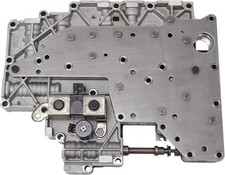
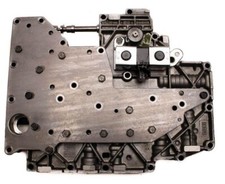
This is the number one hydraulic cause on the family. Sonnax's critical wear and vacuum test guide for the Ford 4R70E, 4R70W, 4R75E, 4R75W and AODE valve body ties the bypass clutch control valve (location 110, inboard) to codes 628, 741, 1741 and 1744, no lockup, TCC slip and low cooler flow. Low cooler flow is the clue people miss: the same worn valve that lets the clutch slip also starves the cooler and the rear lube circuit.
The plunger valve and sleeve at the outboard end of the same bore causes shudder, code 628, no lockup, delayed lockup and general TCC apply and release concerns. Sonnax's repair for each:
- Plunger valve and sleeve: 76948-04K or 76948-64K, both drop-in kits with no reaming. Sonnax says 76948-64K uses four .063 in. orifices to mimic the OE hydraulic design and is the better fit on 1996-and-later units where engine lugging and harsh TCC apply can occur if OE calibration is not respected. 76948-04K uses a single .030 in. orifice and gives a more pronounced lockup. On a stock 4R75 police car or F-150, use the 64K.
- Bypass clutch control valve bore: the oversized 76948-31 valve, which requires the 76948-TL6 or F-76948-FL6 reamer tooling. This is the fix when the bore itself fails a vacuum test, not just the sleeve.
Vacuum test with the valves in their rest position, per the guide. A low reading at the bypass bore is your answer, and it takes ten minutes with the valve body on the bench.
Shop the part for this fix
The Sonnax 76948-64 bypass clutch control plunger valve kit for the 4R75W restores OE lockup timing with a drop-in sleeve, no reaming. It is the first part to reach for when the plunger sleeve fails its vacuum test.
Get the 4R75W Sonnax bypass valve kit →Need a limit valve, solenoid or pump bushing instead? Browse the full 4R75W parts collection.
Cause 2: Low Converter Pressure
The same Sonnax guide flags the converter pressure limit valve (location 109) for low converter pressure and lube failures, with oversized kit 76948-58K (it requires the F-76948-TL47 tool and VB-FIX fixture). Low converter pressure is low apply pressure, so a worn limit valve produces P0741 even when the bypass valve is perfect.
Line pressure feeds all of it. The guide lists the main pressure regulator valve (location 111) for low line rise, soft shifts and premature clutch and band failure, with 76948-09 or 76948-17K for 1996-and-later units. Nader adds the other direction: a stuck converter regulator or excessive line pressure can crack the TCC piston, which also ends in a slip code. Put a gauge on line pressure before you open anything. A unit with low line rise and a P0741 has two symptoms of one problem.
Cause 3: The Apply Circuit Leak That Only Shows Up Hot
This is the cause that survives a perfect valve body job. Parlee's list of what makes a Ford converter clutch slip: erratic speed sensors, the TCC solenoid, worn TCC valve bores, a leak in the apply oil circuit, low line pressure, or a glazed or burned converter clutch. His verdict on which one it usually is: a leak in the apply circuit, most often at the rear pump stator bushings. He was writing about Ford's FNR5 and 4F27E, but the physics are the same on any Ford whose stator support bushings seal converter oil.
Those bushings keep the turbine shaft running true and seal apply oil from leaking to exhaust or release, working like sealing rings. A little wear means a small leak cold and a much larger one hot, which is exactly the customer who says it only acts up on the interstate after thirty minutes.
Air check it rather than guess. In the vehicle, Parlee's method is to remove the valve body, block the converter front passage in the case and blow air into the converter rear passage. It should hold like a good clutch pack. Bleed the air off slowly, because a wet circuit sprays fluid. On the bench, install the converter, hold it in the bellhousing by bolting a wrench across the front, and squirt ATF into both converter passages first. Check a known-good circuit once after new bushings so you know what tight feels like.
Cause 4: The Converter Clutch Itself
Sometimes the lining really is gone, usually after miles of slipping on worn valves. Black, burnt fluid with friction material in the pan and a slip number that never improves after the valve body and bushings are confirmed good point at the converter. Replace it after the circuit checks tight, not before, or the new converter cooks the same way.
Fluid and Service After the Repair
The 4R75E takes MERCON V. Ford's 2006 F-150 owner guide lists Motorcraft MERCON V, part XT-5-QM, at 13.9 quarts (13.2 L) for both the 4R70E and the 4R75E, and decodes the door label transmission code Q as the 4R75E. That is a total capacity: a pan drop gets you only part of it, so fill to the hot mark on the dipstick and recheck after a road test. Skip friction modifiers and "shudder fix" additives. They can mask slip long enough to get a truck off the lot, and the code comes back.
P0741 Fix Order for the 4R75
- Clear speed sensor codes first. P0741 is only valid if engine, turbine and output speeds are valid.
- Graph TCC%, TC SLIP ACT, gear, throttle and fluid temperature. Confirm slip with lockup commanded, and note whether it grows hot.
- Check fluid level and condition. Burnt fluid with lining debris changes the plan.
- Gauge line pressure and line rise.
- Pull the valve body and vacuum test the bypass clutch control valve, plunger sleeve and converter pressure limit valve. Inspect the No. 7 check ball while you are there.
- Repair the worn bores: 76948-64K for the plunger sleeve on a stock unit, 76948-31 if the valve bore is worn, 76948-58K for the limit valve.
- Air check the converter apply circuit. Replace pump stator bushings if it leaks.
- Replace the converter only after the circuit holds, then flush the cooler and refill with MERCON V.
FAQ
Is P0741 on a 4R75 usually a bad TCC solenoid?
Usually not. P0741 means the PCM commanded lockup and still measured too much converter slip, so the solenoid can be working perfectly while the clutch slips. On this family the more common causes are wear at the bypass clutch control valve and plunger sleeve in the valve body, low converter pressure, and apply oil leaking past the pump stator bushings. Prove the solenoid on live data before replacing it.
What scan tool PIDs show a 4R75 converter clutch slipping?
Ford's service bulletin for the 4R75E uses TCC% (the solenoid duty cycle command) and TC SLIP ACT (actual converter slip in rpm). With lockup commanded at a high TCC%, TC SLIP ACT should fall close to zero. If the command is high and slip stays well above that, the clutch is not holding.
Why does my 4R75 only set P0741 after it is fully warmed up?
Because the leak gets bigger as the fluid thins. Sonnax's Jeff Parlee notes that slight wear at the pump stator bushings causes a small loss of apply oil cold and a much larger one hot. Worn valve body bores behave the same way. That is why the code sets on the highway after half an hour and not on a cold test drive.
Which Sonnax bypass valve kit should I use on a 4R75W, 76948-04K or 76948-64K?
Sonnax says 76948-64K uses four .063 in. orifices to mimic the OE hydraulic design and is the better choice on 1996-and-later units where harsh TCC apply and engine lugging can occur, so it suits a stock 4R75. 76948-04K uses a single .030 in. orifice and gives a firmer lockup. If the bypass clutch control valve bore itself is worn, Sonnax lists the oversized 76948-31 valve, which requires its reamer tooling.
Working a 4R75 this week?
TCC solenoids, valve bodies, solenoid kits and rebuild parts — shipped fast from the USA.
Shop 4R75W parts →Sources
- Sonnax — "Ford 4R70E, 4R70W, 4R75E, 4R75W, AODE Critical Wear Areas & Vacuum Test Locations" (AODE-4R75E VacTestGuide, PDF). Backs the bypass clutch control valve (location 110) link to codes 628, 741, 1741 and 1744, no lockup, TCC slip and low cooler flow with oversized valve 76948-31 and its reamer tools; the plunger valve and sleeve symptoms with 76948-04K; the converter pressure limit valve (location 109) for low converter pressure and lube failures with 76948-58K; the main pressure regulator valve kits for 1996-later units; and testing valves in rest position. sonnax.com (PDF)
- Sonnax — "AODE/4R70W Series Bypass Clutch Control Valve Repair Options: When to Use Sonnax 76948-04K vs. 76948-64K," December 20, 2023. Backs the plunger valve and sleeve wear causing shudder, delayed or no lockup and converter codes on AODE, 4R70E/W and 4R75E/W units; the single .030 in. orifice in 76948-04K and its firmer lockup; the four .063 in. orifices in 76948-64K mimicking OE; its benefit on 1996-later applications; and both kits being drop-in with no reaming. sonnax.com
- Sonnax — "Ford Bypass Converter Clutch Circuits," Gregg Nader, September 21, 2003. Backs the CI, CT and CBY circuits; bypass oil holding the clutch released; apply by reducing CBY pressure; the three stages of apply; low CT pressure causing TCC slip; bore wear at the bypass sleeve, plunger, bypass valve and converter regulator valve; and high CT pressure cracking the TCC piston. sonnax.com
- Transmission Digest — "Body of Evidence" (FNR5/4F27E and code P0741), Jeff Parlee, Sonnax TASC Force, September 1, 2012. Backs P0741 meaning excessive TCC slip detected; slip calculated as engine speed minus input shaft speed; the code possibly needing more than one occurrence per ignition cycle; the list of slip causes; apply oil leaking at the pump stator bushings and worsening when hot; and the in-vehicle and bench air check procedures. transmissiondigest.com
- Ford Motor Company service bulletin for 2011 Crown Victoria 4R75E, as reprinted by Vehicle Service Pros ("Funny Shifting Ford Vic," December 12, 2016). Backs the TCC% and TC SLIP ACT PIDs; the uncommanded or partial TCC apply after the 1-2 shift with P1742; the TCC% zero and slip under 20 rpm test; the No. 7 check ball in the main control valve body; and parts EOAZ-7E195-B, 1L3Z-7C155-AA and 1W7Z-7D100-AB. vehicleservicepros.com
- Ford Motor Company — 2006 F-150 Owner Guide, Maintenance and Specifications (archived PDF). Backs the door label code Q = 4R75E and the 13.9 quart (13.2 L) Motorcraft MERCON V, XT-5-QM, capacity for the 4R70E and 4R75E. fordservicecontent.com (archive.org)