A 4T65E in true limp mode is unmistakable: you have reverse, and you have one forward gear, and that's it. No 1st, no 2nd, no 4th, no torque converter lockup. People often call a harsh-shifting transmission "limp mode" too, but that's a different condition with a different fix, and confusing the two sends a lot of money at the wrong repair. The real distinction comes down to what the TCM actually lost — a valid read on gear position, a solenoid it can no longer command, or just the adaptive headroom to keep shifts smooth.
This transaxle shipped across a huge range of GM front-wheel-drive cars and minivans from 1997 through 2011 — Impala, Grand Prix, Lumina, Regal, Century, Venture, Uplander, Monte Carlo and more — and the TCM's fail-safe strategy is consistent across nearly all of them, because the channel plate, pressure switch manifold and solenoid architecture carried forward with only minor revisions. Here's how to tell what you're actually dealing with.
What "Limp Mode" Actually Means Here
Limp mode, which GM's own service literature calls fail-safe or protection mode, is the TCM's answer to a condition it cannot safely control: it de-energizes the shift solenoids rather than risk commanding a gear it can't confirm. With no solenoid input at all, the valve body's hydraulic default lands the unit in 3rd gear, plus reverse, because that's the gear this family of transaxles defaults to mechanically when the shift solenoids go dead. You get one forward gear and reverse, period — no 1st, 2nd, 4th or torque converter lockup, and almost always a Check Engine light with a stored code to match.
That's the real thing. It is not the same as a transmission that still has all four gears but shifts like it's angry, which is a different and far more common complaint with its own separate cause below.
Pressure Switch Manifold Faults — Code P1810
The pressure switch manifold (also called the manual valve position switch) is a bank of discrete pressure switches that tell the TCM which gear the shift selector is mechanically sitting in — Park, Reverse, Neutral, Drive, and so on — by reading which internal clutch circuit has oil in it. P1810, a Trans Pressure Switch Malfunction, sets when the TCM sees a combination of those signals that doesn't correspond to any valid gear position. That mismatch can come from a genuinely bad switch, from corrosion or a loose connector on the switch's wiring, from a lost ground, or from a 12-volt supply dropout to the switch assembly itself.
This fault doesn't necessarily throw you into limp mode the instant it sets. GM's strategy allows the condition to run for roughly two drive cycles before the TCM commits to 3rd-gear protection mode, on the logic that it shouldn't punish the driver for one bad reading if the next one looks normal. If you're chasing an intermittent P1810 that hasn't forced limp mode yet, that's exactly why — and it's worth fixing before it becomes a no-warning stranding.
Solenoid Circuit Faults — Why the Internal Harness Is the Usual Suspect
The other path into limp mode is a solenoid the TCM can no longer command: a shift solenoid, the TCC PWM solenoid, or the EPC/pressure control solenoid losing power, ground, or signal continuity. A single solenoid failing on its own is usually an isolated part. But when multiple solenoid codes, or a solenoid code and a pressure-switch code, set together, that pattern almost always means a shared power or ground circuit has failed rather than three separate parts dying at once.
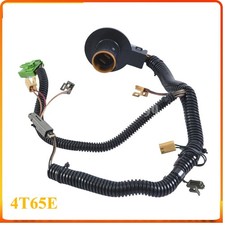
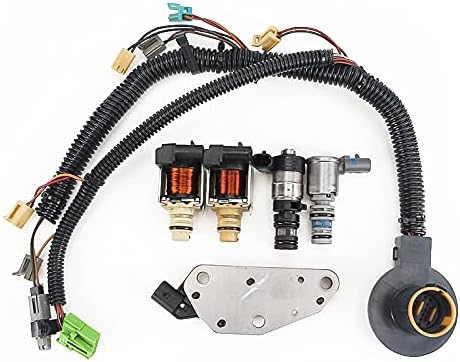
On a transaxle this old, the shared point that feeds several of those circuits together is the internal wiring harness — the loom that routes from the main connector, through the channel plate area, out to the solenoids and pressure switch manifold, sitting in hot ATF for the life of the vehicle. Insulation breaks down, strands corrode inside the crimped terminals, and a connector pin that's been thermally cycled for 15+ years develops resistance that a scan tool will read as an open or erratic circuit even though the part it feeds tests fine on the bench. If you've pulled codes for more than one solenoid circuit, or a solenoid and a PSM code at the same time, stop ohming individual solenoids and go straight to the harness and its connectors.
4T65E Internal Wiring Harness 2000-2011
This is the part that gets skipped when a shop replaces "the solenoid that tested bad" and the limp-mode code comes right back. If more than one circuit is throwing a fault at the same time, the harness feeding them is the actual failure point, not the solenoid at the end of it.
View the internal wiring harness →P1811 Is Not Limp Mode — But It Gets Mistaken for It
P1811, Maximum Adapt and Long Shift, is where most of the "my 4T65E went into limp mode" reports actually land, and it's a genuinely different failure. With P1811 set, the Check Engine light may not even illuminate, but the TCM has run out of adaptive room to compensate for shift times that have crept past its calibrated threshold, so it defaults to maximum line pressure. The transmission still has all four gears — it just bangs into every one of them, including shifts out of Park, because every clutch is being slammed home at full hydraulic force instead of a smoothed, adapted apply.
The logic behind the code is specific. Per Wayne Colonna's August 2003 Transmission Digest article on the 4T65-E, the PCM times every shift with the turbine speed sensor. If a shift takes longer than 0.65 second and the adapts cannot shorten it by raising line pressure, a counter increments, and two of those in one drive cycle sets P1811. If the shift finishes in time but the gear ratio shows slip lasting more than six seconds, it sets P0730 instead. On the scan tool, watch the shift time and TAP cell PIDs: one high cell points at that clutch, high TAP across every shift points at a pressure supply problem like the AFL valve.
Sonnax's technical documentation on the 4T65-E channel plate identifies the actuator feed limit (AFL) valve as a primary cause: the AFL valve regulates feed pressure to the EPC/pressure control solenoid and the 1-2/3-4 shift solenoid circuit, capped at a maximum of 115 psi, and as the cast channel plate bore wears, regulated pressure bleeds to exhaust instead of reaching the solenoids. The resulting symptom set according to Sonnax is exactly P1811's territory — max-adapt/long-shift, 2nd gear starts, falling out of 4th gear, and TCC slip severe enough to set its own code, P0741. The fix for a worn AFL bore is a repair valve kit that reams the bore oversize and restores a sealed fit, not a wholesale valve body swap.
The pressure control solenoid itself is the other common contributor: a sticking or electrically marginal PCS can't regulate line pressure accurately, which reads to the TCM as the same kind of slow, out-of-spec shift behavior that triggers P1811's adaptive ceiling. GM also addressed intermittent harsh P1811 shifts on several 4T65-equipped platforms through a TCM recalibration procedure under service bulletin 09-07-30-013A, which points at calibration strategy, not just hardware, as a contributing factor on some model years.
How to Diagnose It Before You Replace Anything
Pull codes first and read exactly which ones are present, because the fix branches hard from here. A P1810 alone points at the pressure switch manifold and its wiring. A solenoid-circuit code alone points at that specific solenoid. Multiple codes across different circuits point at a shared power/ground fault, almost always the internal harness. P1811 by itself, with all four gears still present but shifting harsh, points at the AFL valve or the pressure control solenoid, not the harness or the pressure switch manifold at all.
Check fluid level and condition before you touch any of it — it costs nothing and rules out a contributing factor. GM specifies DEXRON-VI for 4T65E-equipped vehicles, with the 2008 Impala owner's manual listing a 7.4 qt (7.0 L) automatic transmission fluid capacity and a note that more fluid is needed when the converter is drained. Aerated or badly contaminated fluid changes line pressure behavior enough to tip a marginal switch or solenoid circuit into setting a code it otherwise wouldn't, so confirming fluid is correct removes one variable before you start probing wiring.
From there, a scan tool that shows live PSM switch states and solenoid commanded-vs-actual status will usually tell you which circuit is lying before you ever drop the pan. A visual check of the main transmission connector and the channel plate area for fluid intrusion, corrosion, or a melted pin is the next step if the scan data points at wiring rather than a single component.
Confirm Before You Commit
Read the actual codes, not just the symptom. "Only 3rd gear and reverse" is real limp mode, driven by a pressure switch manifold fault or a solenoid circuit the TCM can no longer trust. "All four gears, but every shift bangs" is P1811, driven by the AFL valve or the pressure control solenoid, and it's a different repair entirely. If you're seeing multiple circuits fault together rather than one, check the internal wiring harness before you start replacing individual solenoids one at a time — that's the mistake that gets a part swapped and the code right back a week later.
Diagnosis points at a solenoid, the harness, or the PSM circuit?
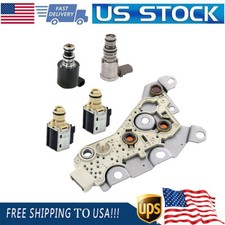
Pressure control and shift solenoid kits, internal wiring harnesses, and valve bodies for the 4T65E are in stock and ship fast.
Shop 4T65E parts →FAQ
What gear does a 4T65E default to in limp mode?
Third gear and reverse only. When the TCM loses the ability to safely command the shift and TCC solenoids, it de-energizes them and the transmission's internal hydraulic fail-safe logic lands the valve body in 3rd, which is the gear it defaults to with no solenoid input at all. You'll have reverse and one forward gear, with no 1st, 2nd, 4th or torque converter lockup, and usually a Check Engine light with a stored code.
Is P1811 the same thing as limp mode on a 4T65E?
No, and mixing these up sends people chasing the wrong repair. P1811 is Maximum Adapt and Long Shift: the TCM is still running all four gears, but it has run out of adaptive room to compensate for slow shift times and defaults to maximum line pressure, producing harsh, banging shifts. True limp mode is different and more severe: it comes from a pressure switch manifold fault or a solenoid circuit fault, and it removes gears entirely, leaving only 3rd and reverse.
What does code P1810 mean on a 4T65E and how does it relate to limp mode?
P1810 is a Trans Pressure Switch Malfunction. The pressure switch manifold, also called the manual valve position switch, sends the TCM a set of discrete voltage signals that correspond to which gear the shift selector is actually in mechanically. When the TCM sees a combination of those signals that doesn't match any valid gear position, it sets P1810. The fault does not force limp mode on the first occurrence; GM's strategy allows it to run for roughly two drive cycles before the TCM defaults to 3rd-gear protection mode to prevent commanding a gear the hydraulics can't confirm.
Can a bad internal wiring harness cause 4T65E limp mode?
Yes, and it's one of the more common root causes once you've ruled out a single bad solenoid. The 4T65E's internal wiring harness routes through the pan and channel plate area, where it sits in hot fluid for years and the insulation and connector pins degrade. When multiple solenoid or pressure-switch codes set at the same time rather than just one, that pattern points at a shared power or ground path failing, not three parts failing at once, and the internal harness is the most common single point that feeds several of those circuits together.
Will low or dirty fluid alone put a 4T65E into limp mode?
It can contribute, but fluid condition alone rarely triggers true limp mode by itself; it's far more likely to cause slip, flare or delayed engagement first. Aerated or contaminated fluid can affect the pressure switch manifold's readings indirectly by changing line pressure behavior, which in a marginal circuit can be enough to tip a borderline switch or solenoid fault into a code. GM specifies DEXRON-VI for 4T65E-equipped vehicles, with a 7.4 qt (7.0 L) capacity on the 2008 Impala, and checking that first costs nothing before you start chasing wiring.
Sources
- Sonnax — GM 4T65-E Channel Plate: Common Problems & Solutions (technical bulletin). Backs the actuator feed limit (AFL) valve's 115 psi regulation ceiling, the channel plate bore wear mechanism, and the resulting P1811 max-adapt, 2nd gear start, falling-out-of-4th, and TCC slip/P0741 symptom set. sonnax.com
- Sonnax — Sure Cure Kit (SC-4T65E) product page. Backs the valve body and channel plate compatibility of these repairs across 4T65-E applications from 1997 through 2011, including Buick, Chevrolet and Pontiac platforms. sonnax.com
- General Motors — 2008 Chevrolet Impala Owner Manual. Backs DEXRON-VI as the specified automatic transmission fluid and the 7.4 qt (7.0 L) fluid capacity figure referenced in the fluid-condition diagnostic step. assets.gm.com
- Transmission Digest — "AFL and AFL," TASC Force Tips. Backs the general actuator feed limit circuit mechanism — AFL pressure regulation below line pressure, its role feeding shift valves and the pressure control solenoid, and how falling AFL pressure causes default gear starts in GM electronically controlled automatics of this family. transmissiondigest.com
- Wayne Colonna, Transmission Digest — "The 4T65-E: 'Slip-Sliding Away,'" August 2003. Backs turbine speed sensor shift timing, the 0.65-second long-shift threshold, P1811 setting after two long shifts in one drive cycle, P0730 for slip over six seconds, and the shift time and TAP PIDs. transmissiondigest.com