A Grand Cherokee that shifts wrong is a different job from one that slips or will not move. The 545RFE in the 4.7L and 5.7L WK (2005-2010) has no bands and no hydraulic shift valves in the old sense. The PCM picks every shift by switching solenoids, and every shift is a clutch-to-clutch handoff timed by learned fill volumes. A harsh 2-3 can be a worn valve body bore, a bad clutch clearance, a wiped learned value or a controller commanding the solenoids wrong, and a valve body only fixes one of those.
This is the order we work WK shift complaints in, built on Chrysler's own 2007 WK diagnostics. If you have not confirmed the truck has a 545RFE (the 3.7L and 3.0L diesel trucks use the Mercedes NAG1), start with our 545RFE Grand Cherokee common problems guide. If the engine flares and the truck loses drive, that is a slip, and our Grand Cherokee slipping fix covers it.

Know Which Clutches Trade Places on Each Shift
You cannot diagnose a clutch-to-clutch transmission without the apply chart. Here is Chrysler's 545RFE chart from the WK road test procedure, with the gear ratio code the PCM sets for each gear from the P1790 procedure (WK road testing, P1790):
- 1st: UD + L/R (L/R only below 150 rpm output) + overrunning clutch. Code P0731.
- 2nd: UD + 2C. Code P0732.
- 2nd prime: UD + 4C. Code P1736.
- 3rd: UD + OD. Code P0733.
- 4th: OD + 4C. Code P0734.
- 5th: OD + 2C. Code P0735.
- Reverse: Reverse clutch + L/R. Code P0736.
- Limp-in: UD + OD (third) in Drive, UD + 2C (second) in the 2 position.
Read it as a list of handoffs. The 1-2 applies 2C. The 2-3 releases 2C and applies OD. The 3-4 releases UD and applies 4C. The 4-5 releases 4C and applies 2C again. A forced 3-2 kickdown releases OD and reapplies 2C. Once you know which clutch is coming on late or hard, you know which circuit, which CVI and which ratio code to look at.
Two WK details trip people up. First, on trucks with Electronic Range Select, Chrysler notes the display counts like a six-speed: second prime shows as third, third as fourth, and so on. Second, the limp-in default in Drive is third gear. A WK that pulls away soft and stays in one gear with the MIL on is usually in limp-in, not slipping.
Step 1: The Checks Chrysler Makes You Do First
The factory 45RFE/545RFE pre-diagnostic procedure is short, and every item on it can cause a shift complaint by itself (pre-diagnostic procedure):
- Pinion factor. Check it with the scan tool for the right tire size and reprogram if it is wrong. The PCM builds shift points from output speed.
- Fluid level. Low fluid alone causes many transmission symptoms. Chrysler specifies Mopar ATF+4 and says not to use additives (WK ATF). Check it hot, in Park, at about 180 F (WK fluid level check).
- Battery. Test only with a fully charged battery.
- DTC event data. Record stored, active and pending codes, and treat a pending code as matured.
- Shift lever position test. If it fails, you are diagnosing P0706, not a shift problem.
- Controller software. Chrysler tells you to check TSBs for PCM calibration updates because some shift conditions are fixed with a flash.
One line in that procedure explains a lot of "it started shifting weird after a battery job" complaints: a battery disconnect clears all DTC event data and resets learned transmission values to default, which Chrysler says can temporarily cause erratic shift schedules. Before you diagnose a harsh shift on a truck that just had the battery or PCM unplugged, run Quick Learn and the verification drive (below) and see what is left.
Step 2: Match the Complaint to the Circuit
Road test it in every range and note whether shifts are harsh, spongy, delayed or early. Chrysler's note is that engine flare usually means a clutch, the overrunning clutch, or line pressure. Then line the complaint up with the chart:
- Harsh or bumpy 1-2: 2C apply timing. Look at the 2C CVI and the switch valve, which strokes on the 1-2 to send oil to the 2C circuit.
- Flare or bang on the 2-3: 2C release, OD apply. Sonnax TASC Force member Caleb Perham explains in Transmission Digest that the switch valve bore plug strokes on the 2-3 and again on the 3-4 to feed the OD clutch, and that bore plug area takes the heaviest wear in the valve body.
- Flare or neutral on the 3-4: UD release, 4C apply. Expect P0734. Burnt OD or 4C clutches, cut accumulator seals and a broken accumulator plate all live here.
- Flare on the 4-5, slip in fifth: 4C release, 2C apply. Expect P0735.
- Hard or delayed forced 3-2: OD release, 2C apply. See Step 5; this is the one most often blamed on the wrong part.
- Bind-up, stalling or lockup complaints: solenoid switch valve, covered in Step 6.
Step 3: Read the Clutch Volume Indexes
The CVIs are the most useful shift data a WK gives you. Chrysler explains that the PCM continuously monitors and learns the volume of fluid it takes to apply each friction element, and that the volume rises as the friction material wears. It also notes that some mechanical failures drive the learned volume toward zero (P2701).
Each CVI only updates under specific conditions. For the 2C clutch, Chrysler says it updates during a 3-2 kickdown with throttle between 10 and 54 degrees and transmission temperature of at least 110 F (43 C). If you want a fresh 2C number, you have to make that kickdown happen hot.
How to use them:
- Low CVI (near zero): P2700-P2704 (inadequate element volume, L/R, 2C, OD, UD, 4C) set when a CVI drops below 5. For the 2C clutch, Chrysler's tree says that if the CVI is below 10, check the 2C circuit for leaks in the valve body, then air check the circuit and watch the piston stroke and return. A piston that does not return points at a broken return spring, a dislodged snap ring or a broken accumulator spring.
- High or climbing CVI: worn friction or a circuit leak that makes the clutch take more oil to fill. Record the number, run Quick Learn, drive it, and record again. A clutch that keeps climbing is losing oil or material.
Step 4: Do Not Chase P1790 by Itself
P1790 (fault immediately after shift) confuses people because it sounds electrical. It is not. Chrysler says it is only stored along with a gear ratio code and sets when that ratio code is stored within 1.3 seconds after a shift. It points at a probable hydraulic (line pressure) or mechanical problem, and Chrysler says to diagnose off the associated ratio code and consider mechanical causes first (P1790).
So P1790 with P0733 is an OD apply problem on the 2-3. P1790 with P1736 is a 4C apply problem on a kickdown into second prime. Use the chart above to name the clutch, then work that circuit.
Step 5: Pressure Switches, Line Pressure and the Solenoid Commands
The 545RFE checks its own pressure switches after shifts. In Chrysler's P0845 description, after a shift into a forward gear with the engine above 1000 rpm, the PCM briefly pressurizes clutch circuits that should be off to prove each pressure switch closes. If a switch fails twice, the code sets, the MIL comes on, and the transmission goes through an orderly shutdown to limp-in (P0845). That is why a truck that "shifts fine and then suddenly goes to third" often has a pressure switch code, not a broken clutch.
Chrysler's cause list for P0845 starts with the line pressure sensor, contaminated fluid, debris in the pan, a poor sensor connection and the 5-volt supply, and only ends at internal transmission and the PCM. Two of its checks are worth doing on every WK:
- Watch line pressure on the scan tool. One step in the tree checks that it holds steady between 85 and 95 psi (585-655 kPa) in each position tested.
- Key on, push the line pressure sensor connector inward. If the reading jumps to about 30 psi (207 kPa), the problem is the connection.
Solenoid circuit codes are a separate thing. Chrysler's WK system uses six solenoids and tests each circuit at power-up and every 10 seconds by pulsing it and looking for the inductive spike. Chrysler states plainly that these codes are electrical faults only and do not mean an internal failure (P2706 MS solenoid circuit).
Now the hard 3-2. A Transmission Digest case study covers a 545RFE behind a 5.7L that came in with P0734 and P0735 and a neutral on the 3-4. It got a reman unit for a failed accumulator plate, then had a delay and a bang on every forced 3-2. A second valve body did not fix it. A lab scope showed the multi-select and 2C solenoid patterns wrong with good wiring, and a new PCM on the latest calibration cured it. The lesson: when the hardware is new and the shift is still wrong, scope the solenoid commands before you buy parts.
Step 6: The Valve Body and the Solenoid Switch Valve
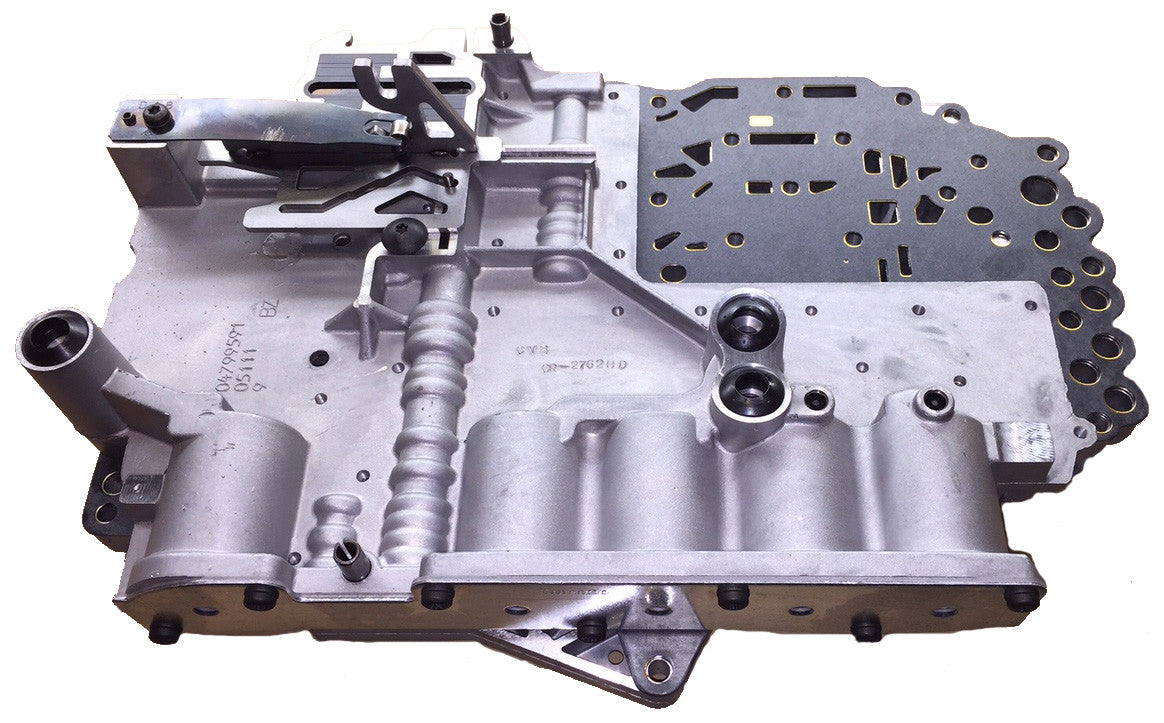
When the codes, CVIs and pressures point inside, the valve body is the usual suspect on a high-mile WK. Sonnax explains that the solenoid switch valve directs oil between the L/R clutch and the converter clutch, and also feeds the 2nd and OD clutches through two shuttle plugs at the end of the bore. As the bore wears, the valve and plugs stick, and Sonnax lists bind-up, codes 841, 868, 871, 988, 1775 and 1776, engine stall, failsafe, and lockup and TCC concerns as results.
Sonnax notes that the RFE family originally used a 0.420 in. large spool with 0.453 in. plugs and changed to a 0.453 in. spool around the 2010 model year. On a 2005-2009 WK that means the early valve. Sonnax recommends vacuum testing the bore instead of judging it by eye. If you do not have a vacuum station, a tested replacement valve body is faster than chasing the bore.
If the valve body checks good and the complaint is on the 2-3 or 3-4, look at the rest of the OD circuit before you close it up. Perham's other two areas are the stator dribbler valve, which pre-charges the OD circuit and changes apply timing when it is restricted or leaking, and clutch clearance: too tight shortens fill time and can bind, too loose lengthens fill time and the clutches drag and overheat. More on the clutch side in our 545RFE pressure testing guide.
After the Repair: Quick Learn and the Verification Drive
Chrysler calls for Quick Learn after a transmission, controller, solenoid pack, clutch or seal, or valve body replacement. It will not run unless the brakes are applied, the engine is above 500 rpm, throttle is under 3 degrees, the lever stays in Park until prompted and then in Overdrive until done, and oil temperature is between 60 F and 200 F (Quick Learn).
Then do the drive Chrysler uses to verify the repair (verification test): get it hot, check the level, then make 15 to 20 upshift runs from a stop to 60 mph at a steady 20 to 25 degrees of throttle, and five to eight wide-open kickdowns to first below 25 mph, holding at least 5 seconds in second and third between each. If any shift still feels wrong after that, Chrysler says to run the drive learn for the affected shifts.
For fluid specs on other vehicles, see our transmission fluid spec chart.
545RFE valve bodies, solenoid packs, shift kits and rebuild kits for the 4.7L and 5.7L Grand Cherokee — shipped fast from the USA.
Shop 545RFE parts →Shop the part for this fix
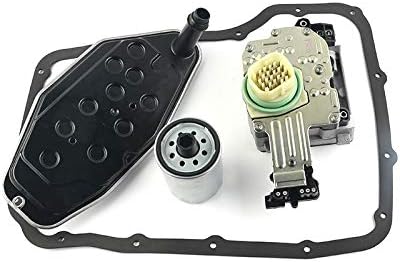
If the scope or the solenoid circuit tests point at the pack, the 1999-up RFE shift solenoid kit covers the white-connector, six-solenoid pack used in 2005-2009 Grand Cherokee 545RFEs.
Shop the RFE solenoid kit → All RFE-series partsFAQ
Why does my 545RFE Grand Cherokee shift hard from 2nd to 3rd?
On the 2-3 the PCM releases the 2C clutch and applies the overdrive clutch while the underdrive clutch stays on. A bang there usually points at the OD circuit: a worn solenoid switch valve bore plug, an OD clutch with the wrong clearance, or learned values that were reset by a battery disconnect. Check the OD CVI and any P0733 or P1790 before replacing parts.
Why is my Grand Cherokee stuck in third gear?
That is usually limp-in, not a mechanical failure. Chrysler's 545RFE clutch chart shows limp-in in Drive as underdrive plus overdrive, which is third gear, and limp-in in the 2 position as second. Pull the codes; a pressure switch, solenoid or power-feed fault puts the transmission there.
What is second prime on a 545RFE?
Second prime is the extra forward ratio that separates the 545RFE from the 45RFE. Chrysler lists it as underdrive plus 4C, used mainly on kickdowns, and its gear ratio code is P1736. On trucks with Electronic Range Select the scan tool and gear display count it as third, so a six-gear readout is normal.
Do I need to run Quick Learn after replacing the solenoid pack on a 545RFE?
Yes. Chrysler calls for Quick Learn after a transmission, controller, solenoid pack, clutch or seal, or valve body replacement. The scan tool needs the brakes applied, the engine above 500 rpm, throttle under 3 degrees and oil temperature between 60 and 200 F, then the verification drive lets the adaptives settle.
Related 545RFE guides
Sources
- Chrysler 2007 Grand Cherokee (WK) service information, 45RFE/545RFE. Backs the clutch application chart, ERS gear display and limp-in gears, the pre-diagnostic checklist and battery-disconnect warning, ATF+4 and level check, P1790 set condition and gear-to-code table, CVI theory and the P2701 tree, P0845 pressure switch test and line pressure checks, solenoid circuit monitoring, Quick Learn conditions and the verification drive. road testing / clutch chart, pre-diagnostic, P1790, P2701, P0845, P2706, ATF, fluid level, Quick Learn, verification test
- Transmission Digest — "545RFE Transmission with Hard Forced 3-2 Shifts." Backs the case of a reman 545RFE with a delayed, harsh forced 3-2 that a second valve body did not fix, the lab-scope finding on the multi-select and 2C solenoid patterns, and the cure with a new PCM on the latest calibration. transmissiondigest.com
- Transmission Digest — "Troubleshooting RFE Overdrive Clutch Failure: Three Key Areas," Caleb Perham (Sonnax TASC Force). Backs the switch valve stroke on the 1-2, the bore plug movement on the 2-3 and 3-4, the stator dribbler valve, and how clutch clearance changes fill time. transmissiondigest.com
- Sonnax — "All in the Family: Identification and Repair of Chrysler Solenoid Switch Valve Problems." Backs the switch valve and shuttle plug function, the symptom and code list, the 0.420 in. to 0.453 in. spool change around 2010, and vacuum testing. sonnax.com
- Sonnax — "Identifying Chrysler RFE Solenoid Changes Through the Years." Backs the white six-solenoid pack (2000-2009) and gray five-solenoid pack (2010) split. sonnax.com