P1744 is one of those codes that sends people in circles on a TorqShift truck. One scan tool calls it "TCC system performance," another says "excessive slip," a parts counter catalog says "solenoid," and Ford's own OBD paperwork for the 5R110W talks about P0741 instead. The truck usually tells the same story every time, though: the tach sits a couple hundred rpm high at highway speed, the fluid runs hotter than it should, and lockup either never happens or drops out under a pull.
This post sorts out what P1744 actually is on a 5R110W, what the PCM has to see before it will set it, how to reproduce that test on a road test so you are not guessing, and the short list of hydraulic and mechanical causes that are documented on this unit. Specs and code definitions come from the ATSG TorqShift manual, Ford's OBD monitor summaries, Transmission Digest and Sonnax, all listed under Sources at the bottom.
What P1744 means on a 5R110W
The ATSG 5R110W diagnostic code chart lists the TCC codes in this order: P0742 (TCC solenoid circuit shorted to ground), P0743 (TCC solenoid circuit failure), P0744 (TCC solenoid circuit shorted to power), then P1744, described as "TCC slippage detected during engagement. Mechanical or Hydraulic concern." That is word for word the same description ATSG gives P0741 on the page before it. In other words, P1744 is not an electrical code. The PCM commanded the converter clutch on, the circuit checks passed, and engine speed still did not come down to turbine speed.
Why two numbers for the same failure? P1xxx codes are Ford's manufacturer-specific range, and P1744 is Ford's older converter clutch performance code. Ford's 2010 OBD system summary lists P1744 as the "mechanical functional" TCC code for the 4R100, the four-speed the TorqShift replaced in the Super Duty, and P0741 as the "mechanical functional, stuck off" code for the other units. Ford's 2004 summary for the 6.0L trucks lists only P0741 for the 5R110W slip check. In the field, Transmission Digest documents 5R110W trucks setting P1744, worded as "excessive TCC slip or slip speed out of range," for a no-lockup complaint. So depending on calibration and tool, the same converter slip fault can show up as P1744, P0741, or both. The test behind them is the same, and so is the diagnosis.
What the PCM is testing before it sets the code
Knowing the monitor's rules is the difference between reproducing the fault on the first drive and chasing it for a week. Ford publishes the torque converter clutch monitor in its OBD system summaries. The entry conditions for the mechanical stuck-off check in the 2010 summary are:
| Monitor item | Ford 2010 OBD summary value |
|---|---|
| Throttle | Steady |
| Engine torque | Positive drive torque (pulling, not coasting) |
| Transmission fluid temp | 70 to 225 degrees F |
| Commanded TCC for 0 rpm slip | 60 to 100 percent duty |
| Shifting | Not shifting |
| Sensors that must be OK | TSS and OSS |
| Fail threshold, stuck off | Slip across the converter greater than 100-200 rpm, or speed ratio below 0.93 |
| Monitoring duration | 5 lock-up events |
Ford's 2004 summary for the 5R110W uses the same idea with a plain "slip across torque converter greater than 100 rpm" threshold over 5 lock-up events. The 2016 summary tightens the wording to slip greater than 100 rpm for 3 seconds after each of 3 lock events, and says all the TCC codes except the stuck-on code light the MIL. Different years, same logic: commanded fully on, steady load, slip above roughly 100 rpm, repeated enough times that it is not a one-off.
Two things fall out of that. First, the PCM is doing simple math: engine rpm minus turbine shaft speed. If engine is at 1,750 rpm and TSS reads 1,600, that is 150 rpm of slip and a speed ratio of about 0.91, which fails both tests. At 1,650 engine and 1,600 TSS you have 50 rpm and a ratio near 0.97, which passes. Second, the monitor requires TSS and OSS to be healthy. A noisy or dropping TSS signal makes the slip math meaningless, so any speed sensor code gets fixed first. Our 5R110W P0715 guide covers the TSS side.
Reproduce it on a road test
Clear the code, and set your scan tool to graph engine rpm, TSS, OSS, commanded TCC (pressure, current or duty, whatever your tool shows), TFT and commanded gear. Then drive it the way the monitor wants it driven:
- Get TFT above 70 degrees F and preferably to normal operating temperature. Below 70 the mechanical check does not run.
- Run in Drive with Tow/Haul off first. ATSG notes that the Tow/Haul switch changes shift and TCC scheduling, so test both ways once you know the baseline.
- Keep your foot off the brake. ATSG lists the brake pedal position switch as an input the PCM uses to release the converter clutch. A sticking BPP switch or a driver riding the pedal will drop lockup and confuse your data.
- Hold a steady throttle on a flat road at 45-60 mph in 5th or 6th, wait for full lockup command, then add a moderate amount of throttle and hold it.
Read the graph like this:
- Commanded on, engine never drops to TSS. No apply oil reaching the clutch. Think plugged solenoid feed, a solenoid that is not producing pressure, or the pump sleeve problem below. This is the typical after-overhaul P1744.
- Locks at light throttle, flares under load. The clutch has some apply but not enough capacity. Low apply pressure from a leak in the apply path (stator tube seal, worn pump bores) or a lining that has already been slipping.
- Erratic slip that comes and goes, often with a shudder. Unstable apply pressure. Sonnax ties this pattern to bore wear at the converter pressure limit valve on 2005-later pumps.
- Engine and TSS locked together, but the driver feels shudder. On a 6.0L, rule out a light-load misfire before you condemn anything in the transmission.
Ten-minute electrical checks
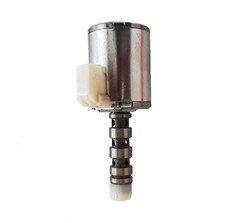
P1744 is a performance code, but confirm the electrical side before you drop the pan, because it takes no time. Per ATSG, the TCC solenoid is a directly proportional variable force solenoid: the PCM varies current from 0 to 1 amp, and 1 amp equals maximum output pressure. It shares pin 7 (VPWR, also feeding the PC-A line pressure solenoid) at the case connector, and pin 8 is the TCC ground signal. Resistance across pins 7 and 8 should be 4.1 to 4.7 ohms at 72 degrees F, and it will read a little higher hot.
If your tool can command the TCC, check actual current against commanded. Transmission Digest's 5R110W no-lockup case started exactly there: the TCC command signal was verified with an amp meter before anything else. Once you know current is reaching the solenoid, the fault is downstream of the wiring. While you are under the truck, look at the fluid. Dark fluid, a burned smell, or fine friction material on the pan magnet tells you the converter lining has been slipping for a while, and the repair now has to include the converter.
The documented causes, in the order I check them
1. Plugged TCC solenoid feed orifice
Transmission Digest's first step on a 5R110W setting P1744 is to pull the solenoid body and inspect the solenoid feed orifice. It is 0.018-0.021 in. and sits in a recess where debris collects. A plugged feed lets the PCM command full current with nothing coming out the other side. Clean it before you buy anything. If it is clear, Transmission Digest's next step is a new TCC solenoid and another road test.
2. Debris in the solenoid body gasket TCC feed hole
A Transmission Digest bulletin (January 2008) covers a 5R110W with no lockup after an overhaul: lockup commanded, no rpm drop, slip code stored. Metal from the original failure had come out of the cooler and lodged in the TCC feed hole of the solenoid body gasket. Their fix was a thorough cooler flush, a new inline filter in the cooler line manifold, and replacing any auxiliary cooler that would not flush clean. Do not wash the solenoid body gasket in solvent and reuse it; the rubber beading swells and distorts.
3. Converter clutch control valve sleeve and retainer position
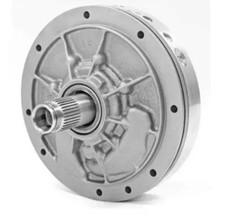
The same 2008 bulletin documents a pump rebuilt with the converter clutch control valve sleeve pushed too deep in its bore, which opens the converter clutch apply circuit to exhaust. Wayne Colonna's 2024 Transmission Digest article gives the bench check: either lockup valve retainer position works as long as the oil feed holes in the sleeve are visible when the sleeve is installed. Pushed in too far, the sleeve limits valve travel and you get no lockup. Later pumps only allow one retainer position.
4. Stator tube scarf-cut seal
Colonna lists the stator tube scarf-cut sealing ring as a P1744 cause once the solenoid and orifice are ruled out. A missing or damaged ring bleeds apply oil off before it reaches the clutch. This one requires pulling the unit.
5. Converter pressure limit valve bore wear (2005-later pumps)
Sonnax describes bore wear at the converter pressure limit valve in 2005-later 5R110W pumps causing erratic or soft TCC apply, TCC slip codes and lining failure, and in extreme cases high enough converter pressure to balloon the converter. Their kit 36940-06K replaces OE valves with a .298 in. or .312 in. balance spool and does not fit pumps with the .402 in. valve, so measure before ordering. If the pump is apart anyway, wet air check that bore.
6. The converter
If apply oil is reaching the converter and it still slips, the lining is worn out. Colonna's advice for a unit that is original to the truck: if a new solenoid does not fix it, replace the torque converter. Fix whatever caused the slip at the same time, or the new converter goes the same way.
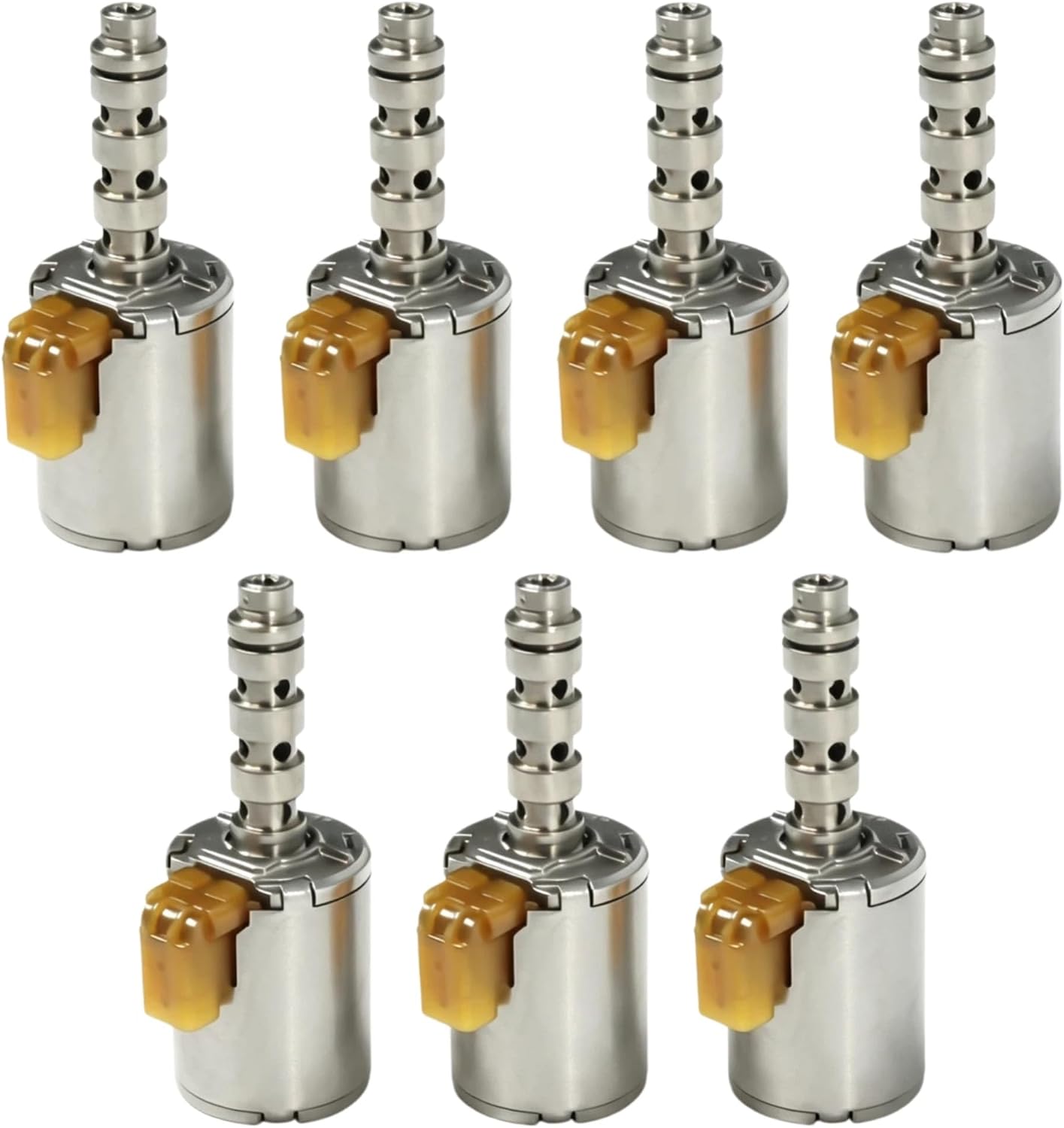
Shop the part for this fix: 5R110W 7-piece master solenoid set
Complete TorqShift solenoid set (OEM 3C3Z-7G383AB) including the TCC solenoid, for when the feed orifice is clean and the TCC solenoid is not building apply pressure.
See the solenoid set at CoreTransmissionPartsThe repair, start to finish
- Fix any TSS or OSS code first. The slip monitor depends on both.
- Pull the pan and solenoid body. Inspect pan debris, clean the 0.018-0.021 in. TCC feed orifice, and use a new solenoid body gasket.
- Replace the TCC solenoid if the orifice was clear, or the full solenoid set on a high-mileage unit with original solenoids.
- If the code returns, pull the unit: check the stator tube scarf-cut ring, the converter clutch control valve sleeve depth and feed hole visibility, and the converter pressure limit valve bore. Replace the converter if the lining slipped.
- Flush the cooler, replace the inline cooler line filter, and replace any auxiliary cooler that will not flush clean.
- Refill with MERCON LV. Ford's Motorcraft fluid chart authorizes it for the 5R110 TorqShift, including back-service on earlier trucks. The 2009 Super Duty owner guide lists about 17.5 qt (16.6 L) including the cooler. Set the final level hot.
- Clear codes and repeat the same road test. Engine rpm and TSS should lock within a few rpm and stay together under a moderate tip-in, well under the 100 rpm threshold.
Keeping it from coming back
Repeat P1744s on this unit almost always trace to one of two things: cooler debris that was never flushed out after the first failure, or a pump that went back together with the clutch control valve sleeve in the wrong spot or a worn pressure limit bore. Flush the cooler every time, change the inline filter, and treat the pump cover as part of the converter clutch system. On trucks that tow, keep fluid on schedule and watch TFT; a converter clutch that slips 100-200 rpm under load at highway speed is generating heat the entire time it is doing it.
Need parts for this job?
Our 5R110 parts page carries the TCC solenoid, complete solenoid kits, pumps, valve bodies and rebuild kits for the TorqShift, all on our own checkout.
FAQ
What does P1744 mean on a 5R110W?
P1744 means the PCM commanded the torque converter clutch on and measured too much slip between engine speed and turbine shaft speed. The ATSG 5R110W code chart describes it as TCC slippage detected during engagement, a mechanical or hydraulic concern. It is not a wiring code; the electrical TCC faults are P0740, P0742, P0743 and P0744.
Is P1744 the same as P0741?
They point at the same failure. ATSG gives both codes the same slip description for the 5R110W, Ford's OBD monitor documents use P0741 for the 5R110W and list P1744 as the 4R100 mechanical code, and Transmission Digest documents 5R110W trucks setting P1744. Diagnose either one the same way: prove slip with engine rpm against TSS, then work through the hydraulic causes.
How much slip sets P1744?
Ford's 2010 OBD summary sets the stuck-off fault when slip across the converter exceeds 100-200 rpm or the speed ratio drops below 0.93 with the TCC commanded fully on, over 5 lock-up events. The check only runs at steady throttle under positive drive torque, with fluid between 70 and 225 degrees F and the transmission not shifting.
Will a new TCC solenoid fix P1744?
Sometimes. Transmission Digest's first step is cleaning the 0.018-0.021 in. solenoid feed orifice, then replacing the TCC solenoid if the orifice was clear. If the code returns, the stator tube scarf-cut seal, the lockup valve sleeve position in the pump, worn converter pressure limit valve bores on 2005-later pumps, and the converter lining are the next suspects.
Can I keep driving with P1744?
The truck will usually still move, but with lockup disabled the converter slips constantly at highway speed and heats the fluid. That is hard on the unit, especially when towing, and a lining that is already slipping only gets worse. Get it diagnosed before the next long trip or heavy pull.
Related guides
- 5R110W P0741: TCC Stuck Off Causes & Fix
- 5R110W TCC Lockup Explained and Diagnosis
- 5R110W Torque Converter Lockup Shudder Fix
- 5R110W P0742: TCC Stuck On Causes & Fix
- 5R110W Pump Failure Symptoms and Replacement
- 5R110W vs 4R100: Differences, Interchange, and Which Is Stronger
Sources
- ATSG, Ford 5R110W (TorqShift) technical manual (2004). Backs the TCC code chart order (P0742, P0743, P0744, P1744) and the P1744/P0741 "TCC slippage detected during engagement, mechanical or hydraulic concern" description, the directly proportional 0-1 A TCC solenoid, case connector pins 7 and 8 at 4.1-4.7 ohms at 72 degrees F, and the BPP switch, Tow/Haul and TFT inputs to TCC scheduling. ATSG manual (PDF)
- Ford Motor Company OBD system summaries: 2004 MY diesel (5R110W TCC monitor, P0741 slip over 100 rpm, 5 lock-up events), 2010 MY (P1744 mechanical functional for the 4R100, P0741 stuck off, entry conditions 70-225 degrees F, 60-100 percent commanded duty, slip over 100-200 rpm or speed ratio under 0.93, TSS and OSS required), and 2016 MY diesel (slip over 100 rpm for 3 seconds after each of 3 lock events). 2004 (archive.org) / 2010 (archive.org) / 2016 (archive.org)
- Transmission Digest, Wayne Colonna, "What to do about a Ford 5R110W with no lock up" (2024). Backs the 5R110W P1744 "excessive TCC slip" complaint, the amp-meter command check, the 0.018-0.021 in. solenoid feed orifice, solenoid replacement, stator tube scarf-cut seal, lockup valve retainer and sleeve position, and converter replacement on an original unit. transmissiondigest.com
- Transmission Digest, January 2008 issue tech bulletins. Backs the after-overhaul no-lockup causes (converter clutch control valve sleeve pushed too deep, cooler debris in the solenoid body gasket TCC feed hole), cooler flush, inline filter and auxiliary cooler replacement, and not reusing a solvent-washed gasket. transmissiondigest.com
- Sonnax, 5R110W Converter Pressure Limit Valve Kit 36940-06K. Backs 2005-later pump bore wear causing TCC slip codes, erratic apply, lining failure and converter ballooning, and the .298/.312 in. versus .402 in. valve fitment. sonnax.com
- Ford Customer Service Division Motorcraft ATF quick reference chart, and the 2009 F-250/350/450/550 Owner's Guide (archived). Back MERCON LV for the 5R110 TorqShift and the 17.5 qt (16.6 L) capacity including the cooler. Ford ATF chart (PDF) / Ford owner guide (PDF, archive.org)