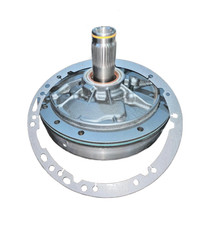
Front pump failure on the Ford 5R110W TorqShift gets diagnosed by feel more than any other failure on this unit -- "it felt like it slipped, so it's probably the pump" -- and that habit burns a lot of good pumps and misses a lot of bad ones. The pump on this transmission is a high-volume gerotor design that runs out of oil fast if it's starved, and TransGo's own technical bulletin for it lists at least four distinct ways to kill it: a bad electrical ground, oil starvation, converter bushing clearance that's too tight, and sustained high line pressure from aggressive tuning. Each one leaves different physical evidence inside the pump, and each one gets diagnosed and fixed differently. This guide walks through the real symptom set, the failure mechanisms with the actual clearances and torque specs behind them, and what a correct replacement job looks like.

Symptoms That Point to the Pump
Low or inconsistent line pressure caused by a failing pump shows up as a cluster of related complaints rather than one clean code. A shop diagnostic chart cited by BD Diesel ties slipping in forward or reverse and delayed engagement directly to worn clutches plus low line pressure from a worn pump, and the same source lists a major pump failure, alongside a cracked case or shattered converter, as one of the causes of a total no-movement condition. A metallic noise from the front of the case that changes with RPM is worth checking, but on its own it is not proof -- the only way to confirm a pump problem rather than guess from noise or feel is a mechanical line pressure gauge on a road test.
TransGo's own figures for a healthy, stock-programmed 5R110W give you something concrete to check against: roughly 150-170 psi at light-load cruising speed, 200-235 psi on hard throttle upshifts, with brief spikes to around 280 psi on full-throttle starts. Readings that sit well below that range, or that bounce around instead of tracking throttle input cleanly, point to the pump, a stuck pressure regulator valve, or a pressure control solenoid problem -- in that order of likelihood once fluid level and filter condition are confirmed good.
What Actually Kills This Pump
TransGo's technical bulletin for the 5R110W pump is unusually direct about this, because its own tech line fields the same calls repeatedly: there is more than one way to destroy this pump, and the physical evidence left behind tells you which one happened.
Electrical ground failure. A bad ground anywhere in the charging or chassis circuit can make current arc through the transmission looking for a path to ground, and TransGo states plainly that this welds the inner gear to the pump plate -- and only the inner gear, leaving the outer gear undamaged. The bulletin names the #G101 main battery ground (passenger side, front of engine on diesel applications) as the single most critical connection, and says the nut, cable, and block stud must all be removed and cleaned with no exceptions if it's dirty. It also flags aux ground straps hidden behind the engine that commonly get damaged during cab-off head gasket jobs and are easy to forget.
Oil starvation. A restricted filter, a dry cold start, or aggressive TCM shift programming starves the gear pocket of lubrication, and TransGo's bulletin shows this damage pattern as visually distinct from a ground failure: both gears are blued and damaged about equally, rather than just the inner one. That evenness is the tell -- a ground failure is a localized arc point, while starvation damages the whole gear pocket at once.
Converter bushing clearance too tight. If the pump bushing or the torque converter has been changed, the bushing-to-hub clearance has to be rechecked, and TransGo specifies a window of .0025 in minimum to .0045 in maximum. The bulletin warns that some replacement bushings on the market only provide about .001 in of clearance to a properly sized hub -- tight enough to seize the bushing to the hub, spin it inside the pump body, and generate metal that welds the inner gear to the pump plate. That failure looks identical to a ground failure on visual inspection, which is why TransGo calls out checking the actual clearance with a feeler gauge rather than assuming.
Sustained high line pressure. Aggressive aftermarket tuning that commands high line pressure accelerates wear on the inner pump gear over time, and TransGo is blunt about the ceiling: there is no fix that saves the pump once the PCM is commanding around 300 psi in the forward gears. Excessive stall time, such as repeated drag-strip launches, is called out as an equally reliable pump killer. If a customer's tune is pushing pressure that high, the conversation needs to happen before the rebuild, not after the next failure.
Torque converter breakdown contaminating the pump from outside. This is a different failure path than the four above -- the pump itself may be fine until converter debris gets to it. BD Diesel's technical writeup on this transmission states that a failed converter's debris moves through the hydraulic system and contaminates the valve body, solenoids, cooler, and pump, scoring the pump body and gears from the outside and creating internal leakage that drops line pressure. That drop produces slow engagement and clutch slippage, and eventually burned clutches if it isn't caught. A teardown documented by Gears Magazine (an ATRA publication) on a 5R110 brought in for a no-movement complaint found exactly this pattern downstream: a commonly-needed coast clutch drum replacement at higher mileage and burnt direct clutches, consistent with contamination and pressure loss rather than a single clean part failure.
Diagnosing a Pump You Suspect Has Failed
Start with the cheap checks before pulling anything apart. Confirm fluid level and condition -- low fluid or badly degraded ATF produces some of the same delayed-engagement symptoms as a worn pump and costs nothing to rule out. Then put a mechanical gauge on it and road test against TransGo's stock figures above; a pump that holds pressure fine at idle but falls off under load points more toward wear than a seized or scored gear set.
If the symptom is a total loss of pressure or a seized pump, the ground-voltage check matters as much as the pressure gauge. TransGo's bulletin specifies hooking a voltmeter's negative lead to the battery's negative post, then probing the frame, transmission case, engine, and body with the positive lead, looking for voltage above 0.05V key-on engine-off and 0.10V with the engine running. Readings up to roughly 0.40-0.50V on gas applications or 0.90V on two-battery diesel trucks are called acceptable, but only briefly, during cranking -- anything higher than that during cranking is explicitly flagged as capable of killing the pump outright. This check takes five minutes and rules out (or confirms) a ground problem before you commit to a full pump teardown.
Once the pump is out, the gear inspection described above (both gears evenly damaged versus only the inner gear welded) tells you whether you're dealing with starvation or a ground/bushing-clearance problem, which changes what you fix before reassembly -- a new pump assembly does nothing if the underlying ground fault or bushing clearance isn't corrected first, and the replacement will fail the same way.
Shop the 5R110W overhaul rebuild kit →
Replacement: The Specs That Matter
A pump swap done without checking clearances just sets up the next failure. TransGo's bulletin calls out several points that are easy to skip under time pressure:
- Reuse the OE bushing when possible. Some 5R110W pumps have an off-center bushing bore that Ford finished in place at the factory, which is another reason not to swap a good bushing for a new one unnecessarily. If it must be replaced, use a proper centering/alignment tool rather than a band alone -- TransGo notes pump half outside diameters can vary up to .007 in, which is enough to throw off alignment with a band-only method.
- Torque specs: pump-to-pump bolts torque to 23 lb-ft, pump-to-case bolts torque to 20 lb-ft. Impact guns are explicitly called out as unacceptable for this assembly.
- Gear face clearance: .0015 in to .0025 in.
- Converter bushing-to-hub clearance: .0025 in minimum to .0045 in maximum, checked with a feeler gauge against the actual converter hub the pump will run with, not a spec-sheet assumption.
- Gear orientation: the OE pump gears carry ID marks that must be visible once installed, which also confirms the outer gear's chamfered side is facing correctly into the pump body. TransGo is blunt that if the outer gear's ID mark is not visible after installation, the pump will seize on the road test or shortly after.
- Prelube and fill: never install the gears dry -- lube the gear pocket and both gears with ATF only (no assembly gel), pour roughly 3-4 quarts of ATF into the torque converter before installing it, then pre-fill the unit with 8 quarts of ATF, run the engine about 15 seconds, shut it off, add 5 more quarts, and complete the fill procedure from there.
- Reset Keep Alive Memory before first startup. Skipping this makes the computer run at a higher startup pressure than necessary, which TransGo notes is hard on a freshly installed pump.
2008 Is a Hard Cutoff for Pump Interchange
Trucks built before 2008 use an external in-line cooler filter and a 1-notch pump; 2008-and-later trucks deleted that external filter and use a 2-notch pump instead. TransGo's bulletin confirms a 2-notch pump can be used on an older, external-filter truck in a pinch, but only if the external filter's feed hole is permanently plugged first. It does not work the other way: installing a 1-notch, inline-filter-type pump on a 2008-or-later truck with no external filter risks starving the gear train of lube if the transmission cooler ever becomes restricted or plugged, since that truck has no secondary filtration point to catch debris before it reaches the pump.
Generation matters inside the pump too. Per the Sonnax Transmission Report on 5R110W pump problems (June 2015), the line pressure regulator, converter pressure limit, converter clutch control, converter anti-drainback and thermal cooler bypass valves all live in the pump, not the pan valve body. Sonnax lists three pump generations: the Gen 1 pump in 2003-2004 units carries casting RF3C3P-7B324-AA or -AB and was redesigned for 2005-up partly because of low pressure at the main pressure regulator valve; Gen 2 and Gen 3 covers carry 5C3P 7A105-AA / RF5C3P-7B324 castings with an Al11Si3Cu alloy ID (a harder, more wear-resistant 11 percent silicon cover); and the Gen 3 body for 2008-later trucks without the external cooler filter adds a 9C3P-7A103-AC number near the bolt circle. Check those numbers before you mix a cover and body or chase low line pressure with a solenoid.
Pump Wear That Shows Up as a Converter Clutch Code
Because the converter clutch control and converter pressure limit valves live in the pump, a worn or misassembled pump can set a TCC slip code (P0741 or P1744) long before it causes a line pressure complaint. The ATSG 5R110W manual's pump breakdown shows the converter clutch control valve with its sleeve, plug and spring, the converter pressure limit valve, the anti-drainback valve and the thermostatic cooler bypass valve all in that one casting. Sonnax documents bore wear at the converter pressure limit valve in 2005-later pumps causing erratic or soft TCC apply, TCC slip codes, lining failure and, in extreme cases, converter ballooning; their kit 36940-06K fits pumps with the .298 in. or .312 in. valve, not the .402 in. version. A Transmission Digest bulletin (January 2008) adds a rebuild-error version of the same complaint: a converter clutch control valve sleeve pushed too deep in its bore opens the converter clutch apply circuit to exhaust, and the truck comes back with no lockup and a slip code right after overhaul. If a pump is on the bench for any reason, wet air check those bores and confirm the sleeve feed holes are visible before it goes back in. Our 5R110W P1744 guide covers the road-test side of that diagnosis.
This matters most when a pump is sourced used or from a parts truck rather than bought new for the specific application -- confirm the notch count against the build year before it goes in, not after.
FAQ
What are the first symptoms of a failing 5R110W pump?
The earliest signs are usually delayed engagement into Drive or Reverse, a noticeable lag before the truck moves, slipping that comes and goes with throttle, and sometimes a whine or growl from the front of the case that tracks with engine RPM. A mechanical line pressure gauge reading low or erratic across the gear range, rather than holding TransGo's stock figures of roughly 150-170 psi at light-load cruise and 200-235 psi on hard throttle upshifts, is the confirming test rather than guessing from feel alone.
What actually causes a 5R110W pump to fail?
TransGo's technical bulletin for this pump lists several distinct failure paths: a bad electrical ground that arcs through the transmission and welds the inner gear to the pump plate, oil starvation from a restricted filter or dry startup that blues both gears evenly, converter bushing clearance that is too tight and seizes to the hub, and sustained high line pressure from aggressive tuning that accelerates inner gear wear with no mechanical fix once the PCM is commanding around 300 psi. Separately, a failed torque converter spreads friction debris through the pump and can score the gears and housing from the outside in.
How do I tell a ground failure from oil starvation on a seized 5R110W pump?
Pull the pump and look at both gears side by side. TransGo's bulletin shows that a bad ground or an overly tight bushing clearance welds and discolors only the inner gear while the outer gear stays clean, because the arcing happens at that single contact point. Oil starvation from a restricted filter, dry startup, or aggressive TCM programming blues and damages both gears about equally, since the whole gear pocket was running without adequate lubrication rather than one localized hot spot.
What are the correct torque and clearance specs for a 5R110W pump?
Per TransGo's pump alignment bulletin, the pump-to-pump bolts torque to 23 lb-ft and the pump-to-case bolts torque to 20 lb-ft, with impact guns specifically called out as unacceptable for final torque. Gear face clearance should fall between .0015 in and .0025 in, and the converter bushing-to-hub clearance should fall between .0025 in minimum and .0045 in maximum -- running tighter than that risks seizing the bushing to the converter hub and generating metal debris that welds the inner gear to the pump plate.
Can I use a pre-2008 5R110W pump on a 2008-and-later truck, or vice versa?
Not safely in both directions. TransGo's bulletin confirms that 2008-and-later trucks dropped the external in-line cooler filter and use a 2-notch pump, while pre-2008 trucks with the external filter use a 1-notch pump. A 2-notch pump can be used on an external-filter truck only if the external filter feed hole is permanently plugged first, but a 1-notch pump should never go on a truck with no external filter, because the gear train can be starved for lube if the cooler ever becomes restricted or plugged.
Related 5R110W guides
Sources
- TransGo — 5R1-PMP-ALIGN pump alignment and failure-analysis bulletin (2018). Backs every pump failure mechanism covered here: electrical ground failure welding the inner gear, oil-starvation damage patterns, converter bushing-to-hub clearance spec (.0025-.0045 in) and the seizure risk of undersized replacement bushings, sustained high line pressure as a pump killer with stock pressure figures (150-170 psi cruise, 200-235 psi upshift, ~280 psi spike, no fix above ~300 psi), pump-to-pump/pump-to-case torque specs (23/20 lb-ft), gear face clearance (.0015-.0025 in), gear ID-mark/chamfer orientation, the ground-voltage test procedure and thresholds, the ATF prelube and fill procedure, and the 1-notch/2-notch pump interchange cutoff at the 2008 model year. transgo.com (PDF)
- Gears Magazine (ATRA) — "5R110: A Dead Stop, No More Movement," April 2020. Backs the teardown case of a freshly rebuilt 5R110 pump with welded/broken gears, the coast-clutch-drum and direct-clutch wear pattern commonly found in high-mileage rebuilds, the converter prefill practice before installation, and the engine/chassis ground-voltage check performed as part of root-cause diagnosis. gearsmagazine.com
- Transmission Digest — "What to do about a Ford 5R110W with no lock up," Wayne Colonna, November 2024. Backs the pump assembly's role in torque converter lockup control (lock up solenoid feed orifice, stator tube scarf-cut seal, lock up valve retainer location), used here to confirm that lockup-related complaints can originate in the pump housing itself rather than only in clutch or converter wear. transmissiondigest.com
- BD Diesel — "Ford 5R110W TorqShift: Common Failures & Build Upgrades." Backs the symptom cluster of slipping and delayed engagement tied to worn clutches and low line pressure, pump failure as a cause of total no-movement conditions, and the mechanism by which torque converter debris contaminates and scores the pump, valve body, solenoids, and cooler. bddiesel.com
- Sonnax — Transmission Report Vol. 6 No. 2, "5R110W Pump Problems & Variations," June 2015 (PDF). Backs the list of control valves housed in the 5R110W pump, the three pump generations and their casting IDs (RF3C3P-7B324, 5C3P 7A105-AA, Al11Si3Cu, 9C3P-7A103-AC), and the 2005 redesign driven by low pressure at the main pressure regulator valve. sonnax (PDF)
- ATSG — Ford 5R110W (TorqShift) technical manual (2004). Backs the pump-housed converter clutch control valve, sleeve, plug and spring, converter pressure limit valve, anti-drainback valve and thermostatic cooler bypass valve. ATSG manual (PDF)
- Sonnax — 5R110W Converter Pressure Limit Valve Kit 36940-06K. Backs 2005-later pump bore wear causing erratic TCC apply, slip codes, lining failure and converter ballooning, and the .298/.312 in. versus .402 in. valve fitment. sonnax.com
- Transmission Digest — January 2008 issue tech bulletins. Backs the after-overhaul no-lockup condition caused by a converter clutch control valve sleeve installed too deep in the pump. transmissiondigest.com