On a 4R100 the EPC solenoid was one of the usual suspects, and a lot of techs carry that habit straight over to the 5R110W. The name changed, though, and so did the job. Ford calls the line pressure solenoid in the TorqShift PC-A, and it sits in a solenoid body with no shift valves behind it. Every clutch apply in this transmission is metered by its own solenoid, but all of them are fed from the line pressure that PC-A sets. When PC-A is wrong, everything downstream is wrong with it.
This post covers how PC-A works, what it looks like when it fails in each direction, the codes that actually point at it, how to prove it with a gauge before you pull the pan, and the one detail that makes it more work to replace than any other solenoid in the unit. The specs come from ATSG, TransGo, Sonnax, Gears and Transmission Digest, listed under Sources at the bottom.
What PC-A does, and why it fails high
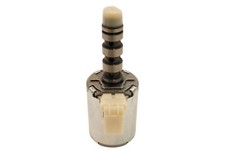
Per Transmission Digest's TorqShift overview, PC-A is an inversely proportional three-port solenoid. The PCM varies its current between 0 and 1 amp, and 0 amp equals maximum pressure in the oil circuit. Sonnax's 5R110W solenoid chart lists it as "EPC/PC-A, line pressure, inversely proportional." Two of the shift solenoids work the same way (SSPC-A for the coast clutch and SSPC-D for the direct clutch); the other four, including TCC, are directly proportional.
That design is the whole story of how this solenoid fails. If the circuit opens, the connector backs off, or the PCM driver quits, PC-A gets zero current and line pressure goes to maximum. The truck still moves. It just slams every engagement and every shift. Ford chose that on purpose: a unit with too much pressure is harsh, a unit with too little pressure burns clutches.
The PCM does not command a fixed number. It calculates line pressure from inputs, and ATSG's 5R110W manual spells out two that matter for diagnosis. The intake air temperature sensor feeds line pressure and shift scheduling. And on 6.0L diesel trucks, a failed accelerator pedal position (APP) sensor makes the PCM run higher than normal line pressure on purpose to protect the unit, which ATSG says will show up as harsh upshifts and harsh engagements. So a harsh-everywhere complaint with an APP code stored is not a PC-A complaint yet.
Symptoms, by failure direction
Sort the complaint into one of three buckets before you do anything else.
- High line pressure, every range. Harsh Park-to-Reverse and Neutral-to-Drive engagements, firm upshifts, and a hard converter apply. This is the classic open-circuit or zero-current PC-A. It can also be the PCM defaulting high because of a sensor fault, as above.
- Low line pressure. Delayed or soft engagements, flares between shifts, slipping under load, and TCC slip codes. A PC-A that is stuck toward high current or has a worn spool can cause this, but so can the pump, and on the 5R110W the pump is the more common reason (more on that below).
- Erratic pressure. Shift quality that changes from one shift to the next, or changes when you wiggle the harness. That points at the circuit, the connector, or debris in the solenoid screen rather than a dead coil.
One thing to keep in mind with this unit: the 5R110W has no line pressure sensor. ATSG's list of what lives in the solenoid body is seven variable-force solenoids, five normally closed pressure switches, the TFT sensor, the manual valve and an over-pressurization relief ball. Only the five shift solenoids ever had pressure switches, and Sonnax notes the PCM was never programmed to monitor those switches anyway; they were dropped from late-2004 production. So the computer cannot see actual line pressure. It can see an electrical fault in the PC-A circuit, and it can see the ratio or apply time come out wrong. Everything in between is your gauge.
The codes that point at PC-A
ATSG's 5R110W diagnostic code chart lists four codes against the line pressure control solenoid:
| Code | ATSG description | What it tells you |
|---|---|---|
| P0748 | PC-A solenoid circuit failure | General electrical fault in the circuit |
| P0960 | PC-A solenoid circuit open | Open coil, open wire or unplugged connector: expect maximum line pressure |
| P0962 | PC-A solenoid circuit shorted to ground | Chafed wire or a shorted coil |
| P0963 | PC-A solenoid circuit shorted to power | Short to voltage in the harness or connector |
Every one of these is electrical. None of them means the solenoid is regulating the wrong pressure. A PC-A with a sticking spool or a plugged screen can pass the PCM's circuit check and still give you a bad line pressure number, and that is why a clean scan does not clear it.
Before you condemn the solenoid on a 6.0L truck, read Wayne Colonna's case in Transmission Digest. A 2005 F-350 stored P0753, P0752 and P0973, all described there as pressure control solenoid A faults, plus P2700. The solenoid was fine. The water-in-fuel sensor in the fuel/water separator was leaking diesel, the fuel wicked up the C138E harness along the left frame rail, and the PCM on the driver-side inner fender had about a pint of fuel inside it. The fix was a PCM and a new sensor (6C3Z-9C264-A). If you see a spread of pressure control codes on a 6.0L, look at that harness before you order parts.
Prove it with a gauge
This is the step that keeps you from buying a solenoid you did not need. The 5R110W has a line pressure tap on the case. Use a big gauge: TransGo recommends a 600 psi gauge for pre-repair testing, because these units can run far past normal pressure when something is wrong.
ATSG's line pressure chart for the 5R110W (all values approximate):
| Range | Idle | Stall (WOT) |
|---|---|---|
| P / N | 50 psi | — |
| R | 100 psi | 320 psi |
| D | 70 psi | 320 psi |
| 3 | 80 psi | 260 psi |
| 2 | 80 psi | 215 psi |
| 1 | 80 psi | 270 psi |
ATSG's precautions go with that chart, and they are not optional. Clear on-board codes and fix electrical faults first, because certain sensor failures cause high line pressure and failsafe actions that make the readings meaningless. Test all ranges at idle before any stall test. If pressure is low at idle, do not stall-test it at all. Never hold wide open throttle for more than 5 seconds. Set the parking brake and block the wheels.
Read the gauge like this:
- High in every range, even at idle. Unplug nothing yet. Check the PC-A circuit for an open, check the connector at the case, and check for APP or other sensor codes that put the PCM into a high-pressure default. If the circuit is good and the command is normal, the solenoid itself or a stuck pressure regulator is next.
- Normal at idle, won't rise at stall. Pressure is not responding to the command. That is PC-A, its screen, or the pressure regulator side of the pump.
- Low in every range. Think pump first, solenoid second. Low in only one range points at a leak in that range's circuit, not at PC-A.
Watch for the dangerous version of high pressure. TransGo calls out a common 5R110W high line pressure error of around 450 psi, especially in Reverse with throttle, and says that sooner or later it blows the Low/Reverse snap ring lugs off the case. Broken lugs mean a new case. If a truck came in with no Reverse or slipping in Reverse, look at those lugs early so you know what the job really is.
When it is the pump, not the solenoid
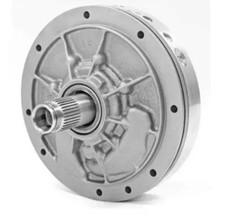
PC-A only sends a signal pressure. The main pressure regulator valve in the pump is what actually makes line pressure. Sonnax's oversized pressure regulator valve kit (36940-03K) exists because that bore wears: excess valve-to-bore clearance lets line pressure exhaust, and Sonnax lists the results as low line pressure and TCC concerns, with codes 1744 and 1783. A worn regulator bore also cuts converter and cooler feed. The fix is a vacuum test of the bore and, if it fails, reaming to fit the oversize valve, which Sonnax says requires their VB-FIX fixture with the VB-06 base plate.
Pump halves also matter. TransGo notes the pump was redesigned in 2005: 2003-2004 bodies (casting 3C3P, stator RF3C3P) use a wear plate with two slots, and 2005-up (RF5C3P) use a plate with no slots. Complete pumps swap across years, but mixed halves or the wrong plate can give you a no-move after repair that looks exactly like a pressure control failure.
So if the gauge says low and the PC-A circuit is clean, the pump is the more likely answer on a high-mileage unit.
Testing and replacing PC-A
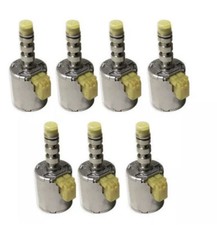
On the bench, Jarad Warren's Gears article gives the fast way to find PC-A in a tray of look-alikes. Hold the solenoid snout toward you with the connector up. PC-A has its ID marks centered on the snout and a stepped back. SSPC-A and SSPC-D have marks low with a stepped back. The directly proportional group (TCC, SSPC-B, SSPC-C, SSPC-E) has marks high and a flat back. Gears puts all of them at around 4.5 ohms, and ATSG's resistance chart gives 4.1-4.7 ohms at 72°F for the shift solenoids. Resistance only proves the coil. A solenoid can read perfect and still have a stuck spool or a torn screen, which is why the gauge test comes first.
Here is the catch on replacement. ATSG states that every solenoid except the line pressure solenoid can be serviced without removing the solenoid body from the case. PC-A is the exception. Plan for pulling the solenoid body, and use the job to inspect the channel plate screen and gasket and the manual valve. The solenoids are keyed so they only fit their own bore and are held by a large E-clip.
If you have to replace the internal harness or the whole solenoid body, ATSG and Sonnax both say it is fine to mix a switch-equipped body with a switchless harness, or the other way around, because the switch input was dropped from the calibration before 2003 production. Put new seals on any pressure switches that stay in.
Shop the part for this fix: 5R110W EPC (PC-A) solenoid
The line pressure solenoid by itself, for when the circuit checks out, the gauge confirms it, and the other six solenoids are fine.
See the EPC solenoid at CoreTransmissionPartsAfter the repair: fluid and relearn
Fill with the right fluid. The 5R110W was released on MERCON SP, and TD notes it is not interchangeable with MERCON or MERCON V. Ford's current Motorcraft ATF quick reference chart lists the 5R110 TorqShift under MERCON LV and authorizes MERCON LV for back-service. Wrong fluid changes friction and shift feel, and it will make a good PC-A look bad.
Then let the PCM relearn engagements. ATSG's procedure after a calibration change or repair: warm the fluid to 130°F (54°C) on the TFT reading, then do five Park-to-Reverse, five Drive-to-Reverse, five Reverse-to-Drive and five Neutral-to-Drive engagements, each five seconds apart. Skip it and the customer comes back with a firm engagement complaint that has nothing to do with the part you installed.
The short version
- PC-A sets line pressure and fails high: 0 amp equals maximum pressure.
- P0748, P0960, P0962 and P0963 are electrical codes. They do not prove pressure is wrong.
- On a 6.0L, check the C138E harness for diesel before you replace anything.
- Put a 600 psi gauge on it and compare to 50/100/70 psi at idle and 320 psi stall in R and D.
- Low pressure with a clean circuit is usually the pump regulator bore.
- PC-A is the only solenoid that needs the solenoid body out.
- Refill with MERCON LV and run the engagement relearn at 130°F.
Need parts for this job?
Our 5R110 parts page has the PC-A solenoid, complete solenoid kits, pumps split by 2003-2004 and 2005-up, shift kits and rebuild kits, all on our own checkout.
FAQ
What does the pressure control solenoid do on a 5R110W?
The pressure control solenoid, called PC-A by Ford, sets line pressure for the whole transmission. It is an inversely proportional solenoid, so the PCM sends it between 0 and 1 amp and 0 amp equals maximum pressure. Every shift solenoid is fed from the line pressure it sets.
What are the symptoms of a bad 5R110W EPC solenoid?
An open or unpowered PC-A drives line pressure to maximum, so you get harsh engagements and firm shifts in every gear. A sticking or worn solenoid can give low or erratic pressure instead, with delayed engagements, flares and slipping. Codes P0748, P0960, P0962 or P0963 point at the circuit.
What should 5R110W line pressure be?
ATSG lists approximately 50 psi in Park and Neutral, 100 psi in Reverse and 70 psi in Drive at idle, and about 320 psi in Reverse and Drive at stall. Test at idle first, never stall-test a unit that is low at idle, and never hold wide open throttle longer than 5 seconds.
Do you have to drop the valve body to replace the 5R110W PC-A solenoid?
Yes. According to ATSG, every solenoid in the 5R110W can be serviced without removing the solenoid body except the line pressure solenoid. Plan for removing the solenoid body and use the time to inspect the screen, gasket and manual valve.
Can a 5R110W have low line pressure with a good EPC solenoid?
Yes, and on high-mileage units it is common. Sonnax documents wear in the pump pressure regulator bore that exhausts line pressure and causes low pressure and TCC concerns. If the PC-A circuit tests good and the gauge reads low, vacuum test the regulator bore before replacing the solenoid.
Related guides
- 5R110 Shift Solenoid Symptoms and Testing
- 5R110W Valve Body Symptoms
- 5R110W Harsh Shift Causes
- 5R110W Limp Mode Causes
- 5R110W Slipping: Causes and Fix
Sources
- Transmission Digest, "Ford 5R110W ('TorqShift')." Backs PC-A as an inversely proportional three-port solenoid run from 0 to 1 amp with 0 amp equal to maximum pressure, MERCON SP not being interchangeable with MERCON or MERCON V. transmissiondigest.com
- Transmission Digest, Wayne Colonna, "Dealing with PCM fault codes on the Ford 5R110W." Backs the 2005 F-350 6.0L case: P0753, P0752, P0973 and P2700 caused by a leaking water-in-fuel sensor wicking diesel up the C138E harness into the PCM, and sensor part number 6C3Z-9C264-A. transmissiondigest.com
- TransGo, SK 5R110W-A shift kit instructions (2019). Backs the 600 psi gauge recommendation, the common high line pressure error around 450 psi in Reverse that breaks the Low/Reverse snap ring lugs, and the 2003-2004 vs 2005-up pump casting and wear plate differences. TransGo instructions (PDF)
- Gears Magazine (ATRA), Jarad Warren, "Ford 5R110: Money in Your Pocket." Backs the snout ID marks for PC-A, SSPC-A/D and the directly proportional group, and the roughly 4.5 ohm solenoid resistance. gearsmagazine.com
- Sonnax, 5R110W Solenoid Identification and Functions, and 5R110W Pressure Switches Notice. Backs PC-A as the EPC/line pressure solenoid, which solenoids are inversely proportional, the PCM never monitoring the pressure switches, their removal from late 2004 on, and mixing switch and switchless parts. sonnax.com (solenoid ID) and sonnax.com (pressure switches)
- Sonnax, Oversized Pressure Regulator Valve Kit 36940-03K. Backs pressure regulator bore wear causing low line pressure and TCC concerns (codes 1744 and 1783), vacuum testing, and the VB-FIX / VB-06 tooling. sonnax.com
- Ford Customer Service Division, Motorcraft ATF quick reference chart. Backs MERCON LV for the 5R110 TorqShift and authorization to back-service with MERCON LV. Ford ATF chart (PDF)
- ATSG, Ford 5R110W (TorqShift) technical manual (2004, print). Backs the line pressure chart and test precautions, the PC-A code descriptions, the solenoid body contents, the APP and IAT line pressure inputs, PC-A being the only solenoid that requires solenoid body removal, and the engagement relearn procedure. ATSG manual (PDF)