Before you crawl under a 5R55W-equipped Explorer, Mountaineer, or Ranger with a tube of sealant, know this: the single most common cause of a "leak" at the front of this transmission is not a bad seal at all. It is too much fluid in the pan. This unit has no dipstick, the fill procedure is easy to get wrong, and the vent that is supposed to relieve pressure is also the first place extra fluid goes looking for an exit. Chase the real leak before you replace parts that were never the problem.


The Fake Leak: Overfilling the Converter Housing
Start here because it saves the most comebacks. The installation guide that remanufacturers ship with a replacement 5R55S/W states it in capital letters for a reason: the number one cause of fluid leaks from the converter housing is overfilling the transmission. An overfilled unit pushes fluid out the vent, the fluid runs down the outside of the bell housing, and it lands on the ground directly below the front of the transmission — the exact spot you would expect a front pump seal to drip from. A tech who sees fluid there and immediately pulls the pump is about to do unnecessary work.
This happens because the 5R55S/W has no fill tube and no dipstick. Fluid goes in and the level gets checked through a T30 Torx plug in the bottom of the pan, with Ford special tool 307-437 (or an equivalent fill adapter) threaded into the hole. The guide's procedure: pump in 8 quarts, bring the fluid to 80-120°F at a 650 rpm idle, cycle the shifter through every range, then pump in roughly 2 more quarts before you start checking. Once you have put in about 10 quarts total, pull the hot tool from the hole. No fluid means add more; fluid in a steady translucent stream or a rapid drip means you are at the correct level, and you reinstall the plug immediately. Guess at this step, or skip the warm-idle cycling, and you will either underfill it or push it past full.
Top it off with the right fluid, too. Sonnax's 5R55 history notes the family left the factory on MERCON V, and Motorcraft MERCON V (XT-5-QMC quarts) is Ford's fluid for MERCON V applications. Ford's own Motorcraft product sheet warns against using MERCON V where MERCON SP, LV or ULV is specified, so do not grab a newer-spec bottle off the shelf to finish the fill on this unit.
There is a second contributor the same guide flags: AC condensation. Water can collect in the vent pocket on top of the converter housing and work its way into the transmission, which both dilutes the fluid and adds volume that has to go somewhere — usually out the vent. The guide's fix is a bead of silicone across the top of the converter housing to keep condensation out of that pocket. If a customer's truck leaks worse in humid weather or right after the AC has been running hard, check that pocket before you check the pump seal.
The vent itself is a separate, replaceable part: a three-piece tube assembly (front fitting, middle fitting, rear fitting) that pops apart by squeezing the tabs. If the tube is cracked, kinked, or missing a fitting, it will dump fluid externally far below a normal overfill threshold. The OEM replacement for both the 5R55S and 5R55W is part number 6L2Z-7034-CA.
Leak Point 1: The Pan Gasket
Once you have confirmed the fill level is correct, the pan is the first real leak point to check, because it is the lowest point on the case and the easiest to inspect without a lift. Fluid shows up as a fresh stain centered under the pan, usually worst near the rear sump where fluid pools when the truck is parked. Common causes are a hardened or torn gasket, a pan that was reinstalled without cleaning the old gasket material off the mating surface, or bolts that backed out over time. On this transmission the drain plug and the T30 level plug both thread into the pan itself, so check those two first — a loose drain plug looks identical to a gasket leak until you look closely.
The fix is straightforward: drop the pan, clean both mating surfaces completely, inspect the pan flange for warping (a flange that is not flat will leak again no matter how good the new gasket is), and install a new filter and gasket. Torque the drain plug to 19 ft-lbs (26 Nm) and the level check plug to 89 in-lbs (10 Nm) per the installation guide — both are light torques, and overtightening either one on the aluminum pan or the plastic-bodied check tool creates a new leak faster than it fixes the old one.
Leak Point 2: The Front Pump Seal
A real front pump seal leak looks similar to an overfill leak but behaves differently: it is present even after you have confirmed the fluid level is correct and the vent tube is intact, and it tends to get worse under load (towing, hard acceleration) because line pressure at the pump rises with demand. The seal lives between the pump housing and the torque converter hub, so fluid tracks down the face of the converter housing and off the bottom of the bell housing. Age, heat cycling, and a converter hub that has worn a groove into the seal's lip are the usual causes.
This is also the seal most likely to get damaged during any pump service, torque converter swap, or transmission removal — it is a press-fit part, and levering a pump out carelessly destroys the seal on the way out whether it needed replacing or not. Any time the pump or converter has been disturbed, replace this seal as a matter of course rather than hoping it survived.
Leak Point 3: The Rear Extension Housing Seal
At the opposite end of the case, where the driveshaft yoke enters the transmission, the extension housing seal does the same job the pump seal does at the front: sealing a rotating shaft against case pressure. When it fails, fluid runs down the underside of the extension housing and drips near the center of the vehicle, well behind the pan — a useful way to tell it apart from a pan or pump leak at a glance.
This seal gets enough OE failures on the 5R55W/S that the aftermarket has a dedicated fix for it. Alto introduced a metal-clad replacement extension housing seal, part number 049406A, specifically for this application: 2.485 in. OD, 1.265 in. height, with a medium-long boot. Transmission Digest's product coverage lists it as fitting 5R55W/S model years 2002-2010, in addition to the AODE (1992-1995) and 4R70W (1993 and later) families that share the same rear seal design. Replacement is a driveshaft-out job: pull the shaft, pry the old seal, and drive the new one in square so the boot seats evenly against the case.
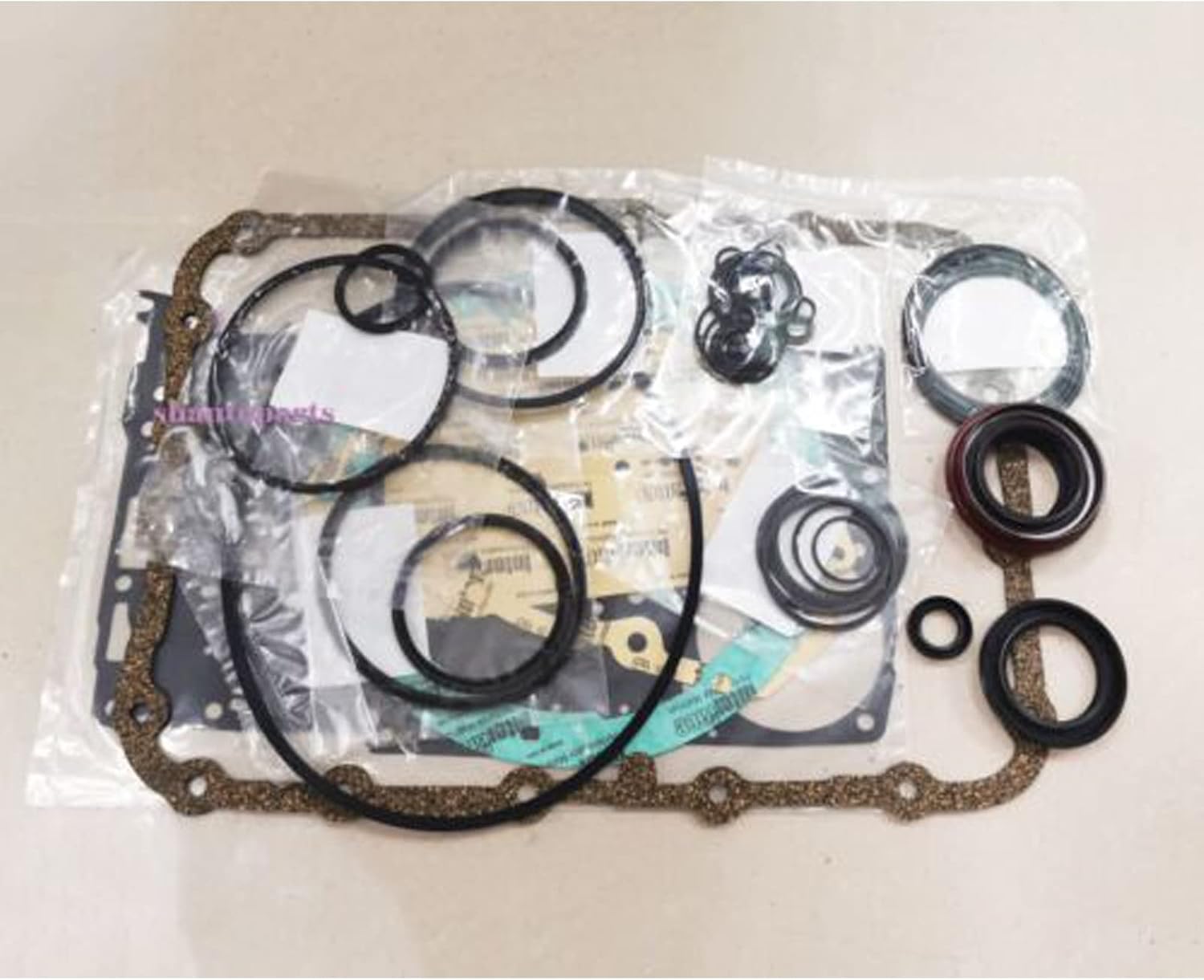
5R55W Overhaul Gasket & Seal Kit 2002-2010 → or browse all 5R55W parts
Leak Point 4: Foaming Fluid Pushed Out the Vent
The last leak point is not a worn-out gasket at all — it is a symptom of wear somewhere else in the transmission. Sonnax documents, in the application notes for its 56361J-01K servo pin bore sleeve kit, that the 5R55N, 5R55W, and 5R55S are prone to foaming the fluid in the sump from excess exhaust and valve body wear, and that this results in fluid out the vent and improper fill indications. The mechanism: as valve body bores wear, fluid leaks past valves and out exhaust slots inside the unit, which aerates it. Aerated fluid takes up more apparent volume, so it both reads falsely high on a level check and pushes real fluid out the vent under normal operating pressure — the same symptom an overfill produces, but caused by internal wear instead of a fill mistake.
If you have confirmed the fill level is correct, the vent tube is intact, and the pan, pump, and extension seals all check dry, but the truck still weeps fluid out the vent, suspect valve body bore wear rather than another external seal. The servo pin bores in particular wear fast enough on this family to cause their own internal cross-leaks and contribute to the same foaming. We cover that failure in detail, including the specific bores that wear first and the sleeve kits that fix them, in our 5R55W and 5R55S servo pin bore wear guide.
How to Diagnose It Without Guessing
- Confirm the fill level first. Hot, at idle, through the T30 plug with tool 307-437 or equivalent. Do not evaluate any "leak" until this is known good.
- Clean the case completely with brake cleaner or a degreaser, then dry it. A clean case lets fresh fluid show you exactly where it starts.
- Road test and recheck. Drive it until it is at normal operating temperature, park it, and look at the case from front to back before the fluid has a chance to run and pool somewhere misleading.
- Match the location to the source. Fluid centered under the pan is the gasket or a plug. Fluid off the front of the bell housing is the pump seal, or an overfill you have not ruled out yet. Fluid near the driveshaft yoke is the extension seal. Fluid at the vent itself with everything else dry and full is foaming from internal wear.
- If it is still a mystery, dye it. Ford's leakage inspection for the 5R55S (2005 Mustang manual, section 307-01) calls for ATF-specific UV tracer dye, 164-R3706 or equivalent, at 30 ml (1 oz) per 3.8 L (4 quarts) of fluid capacity. Run the engine, shift through all gears several times, check the back of the block and the top of the converter housing, then go under with a UV light. Ford's own note: the source is usually above or forward of where the drip shows up, because of airflow and gravity.
- Do not forget the small seals. Ford's external leak chart for this family also lists the cooler line fittings and their O-rings, the external speed sensor O-rings (three of them), the manual control lever seal, and the O-ring seals at the solenoid body harness connector, on either the harness end or the solenoid body. A wet case connector is a leak, not a sweaty transmission.
- Do not torque your way out of it. Ford cautions against trying to stop a leak by tightening past spec; it can damage the case threads.
- Fix the cause, not just the symptom. A new gasket on a warped flange, or a new pump seal on a converter hub with a worn groove, will leak again on the same schedule as the part you just replaced.
Resealing a 5R55W this week?
Overhaul gasket and seal kits, pan and filter kits, extension housing seals, and the fill tool to get the level right the first time — shipped fast from the USA.
Shop 5R55 parts →FAQ
Is my 5R55W actually leaking, or is it just overfilled?
Check the fill level before you touch a gasket. The 5R55S/W installation guide used by remanufacturers states plainly that overfilling the transmission is the number one cause of fluid leaks from the converter housing, because the extra fluid gets pushed out the vent and runs down the bell housing where it looks exactly like a front pump seal leak. There is no dipstick on this unit, so the level is only correct when it is checked through the T30 fill plug with the fluid hot and the engine idling. If the truck was just serviced and now it is leaking at the front, check the level before you condemn the pump seal.
Where do 5R55W fluid leaks usually start?
In order of how often they show up: the pan gasket at the bottom of the case, the front pump seal where fluid tracks down from the bell housing (often actually an overfill venting out, not the seal itself), the rear extension housing seal where the driveshaft enters, and internal foaming that pushes fluid out the vent on units with worn valve body bores. Each has a distinct location and a distinct fix, and guessing which one it is before cleaning and re-checking wastes a gasket or a seal.
What torque do I use on the pan and fill plug when I reseal a 5R55W?
The 5R55S/W installation guide lists the bottom pan drain plug at 19 ft-lbs (26 Nm) and the T30 oil level check plug at 89 in-lbs (10 Nm). Both are light torques for an aluminum pan and a plastic-bodied check tool, and overtightening either one is a fast way to create a new leak or crack the plug.
Can foaming or aerated fluid look like a leak on a 5R55W?
Yes. Sonnax documents that the 5R55N, 5R55W and 5R55S are prone to foaming the fluid in the sump from excess exhaust and valve body wear, and that this results in fluid out the vent and improper fill indications. Aerated fluid also reads artificially high on a level check, which can lead to a tech adding less fluid than the unit actually needs, or chasing a leak that is really a wear condition inside the valve body.
Will a new pan gasket fix a leak that keeps coming back?
Only if the gasket was the actual cause. A warped pan flange, a stripped bolt hole, or fluid running down from a leak higher on the case (the pump seal or the vent) will all show up at the pan seam and get blamed on the gasket. Clean the case, dry it, run the truck, and look at where the fluid first appears before you reseal anything a second time.
Sources
- 5R55S & 5R55W Installation Guide (remanufacturer service documentation). Backs the statement that overfilling is the number one cause of fluid leaks from the converter housing, the AC-condensation vent-pocket note and silicone bead fix, the T30 fill/level plug procedure with Ford special tool 307-437, the fluid fill steps (8 quarts, warm to 80-120°F at 650 rpm, cycle through gears, add roughly 2 more quarts before checking), dry fill capacities of 11.2 quarts (3.0L/3.9L) and 12.4-12.7 quarts (4.0L/4.6L), the drain plug torque of 19 ft-lbs (26 Nm) and level plug torque of 89 in-lbs (10 Nm), the three-piece vent tube assembly and OEM replacement part 6L2Z-7034-CA, and the post-repair instruction to verify no leaks are present. static.summitracing.com/.../vre-7800a-4s.pdf
- Sonnax — Overdrive & Intermediate Servo Pin Bore Sleeve Kit, 56361J-01K. Backs the statement that the 5R55N, 5R55W and 5R55S are prone to foaming the fluid in the sump from excess exhaust and valve body wear, and that this results in fluid out the vent and improper fill indications, plus the servo pin bore cross-leak mechanism referenced in the foaming section. sonnax.com/parts/2207-overdrive-intermediate-servo-pin-bore-sleeve-kit
- Sonnax — "Figuring Out the 5R55 Alphabet," Bob Warnke, September 19, 2007. Backs the general principle that leakage past worn valves and exhaust slots aerates the fluid during operation, which can raise the apparent fluid level and lead to erratic readings or fluid escaping the case, and the 5R55W-then-5R55S model year progression (W in Explorer/Mountaineer for 2002-2003, S taking over for 2004-2005). sonnax.com/tech_resources/195-figuring-out-the-5r55-alphabet
- Transmission Digest — "Alto introduces new extension housing seal for Ford 5R55W/S, AODE, 4R70W," Alex Crissey, May 19, 2023. Backs the Alto metal-clad extension housing seal, part no. 049406A, with dimensions of 2.485 in. OD and 1.265 in. height (medium long boot), and its listed application coverage of 5R55W/S model years 2002-2010, AODE 1992-1995, and 4R70W trucks 1993 and later. transmissiondigest.com
- Ford Motor Company / Motorcraft — MERCON V Automatic Transmission and Power Steering Fluid product details. Backs Motorcraft MERCON V part numbers (XT-5-QMC, XT-5-5Q3M), its use in Ford vehicles requiring MERCON V or MERCON-type fluid, and the warning not to use it where MERCON SP, LV or ULV is specified. fcsdchemicalsandlubricants.com
- Ford Motor Company, 2005 Mustang Workshop Manual (5R55S), section 307-01, Leakage Inspection (PDF). Backs the UV dye procedure (164-R3706, 30 ml per 3.8 L), the note that the source sits above or forward of the drip, the external leak paths (pan, cooler lines and fittings, external sensor O-rings, manual lever seal, solenoid body harness connector O-rings, converter area) and the caution against over-torquing to stop a leak. themustangsource.com (Ford service PDF)