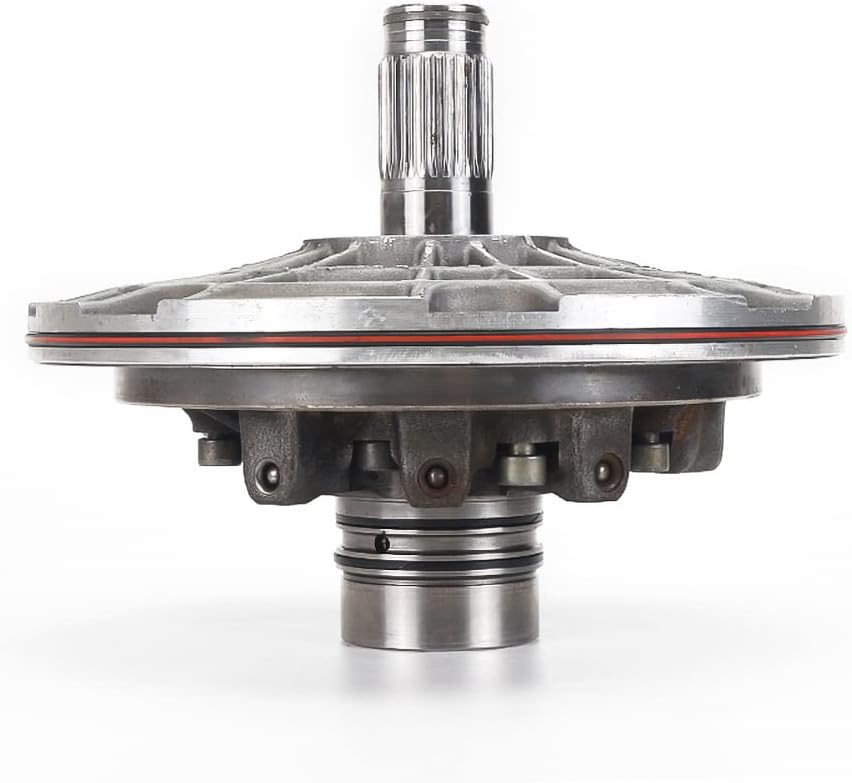
"Bad pump" gets used as a catch-all diagnosis on the 5R55W, and that is part of the problem. The front pump assembly on this transmission does three separate jobs -- it generates line pressure, it houses a flow control valve that regulates how much of that pressure gets rerouted back to the suction side, and its bushing supports the torque converter hub. Each of those three things fails differently, produces a different symptom pattern, and has a different fix. Treat them as one problem and you either replace a good pump or miss the part that is actually worn. This guide breaks out what each failure actually looks like, how to tell a flow control valve from a bushing from a downstream boost valve problem, and what to buy for each one.

Confirm You Have a 5R55W Before You Diagnose the Pump
Ford reused the 5R55 family name across several transmissions with real internal differences, and pump parts are not shared across all of them. Per Sonnax's own identification reference, the 5R55W went into Explorer and Mountaineer models starting in 2002, with the 5R55S taking over for those platforms around 2004-2005, and the related 5R55N used in Rangers and other applications shares the general architecture but is not parts-interchangeable in most areas. Confirm the transmission tag or cross-check the VIN before ordering a pump, flow control valve, or bushing kit -- the symptoms below overlap heavily across the 5R55N/S/W family, but the part numbers for the actual fix do not always carry over cleanly.
Symptom Set 1: The Pump Flow Control Valve
The flow control valve sits inside the pump body and is designed to improve pump efficiency by rerouting excess line pressure back to the suction side rather than letting it go to waste. Sonnax's listing for its replacement kit, part number 56200-03K, names the exact failure symptoms it's designed to fix: delayed engagement, no movement, pump noise, and low line pressure. The cause is wear in the OE canister and plunger -- the plunger can stick open or start leaking, and the canister's O-ring relaxes over time, letting pressure bleed past it that should be staying in the line circuit.
In practice this shows up as a vehicle that sits in Park or Neutral fine, then takes a beat longer than it should to engage Drive or Reverse, especially right after startup before the fluid has warmed and before RPM has climbed. Some owners describe it as fine once the engine is revving but hesitant or dead at idle -- consistent with a valve that needs more pump output before it seats correctly. A whining or growling noise from the pump area that changes with RPM, independent of engine noise, points the same direction.
Sonnax's fix replaces the OE canister and plunger with a harder canister that better supports the plunger valve, a case-hardened plunger with annular grooves to prevent side-loading, a replacement spring, and a larger O-ring to stop pressure loss at the pump face. It is listed as a drop-in replacement that supersedes the earlier 56200-02K kit -- meaning this isn't a theoretical fix, it's a specific, known wear point with a specific, known part number that's been through at least one design revision already.
Symptom Set 2: The Pump Cover / Bell Housing Bushing
This is a completely different failure living in the same housing. The bushing supports the torque converter hub where it rides in the pump cover, and Sonnax's listing for its replacement bushing (part 56001X) ties worn bushing clearance to a different symptom pair: repeat front seal leakage and converter hub wear. The underlying cause is excessive hub-to-bushing clearance combined with the OE bushing's soft babbitt lining wearing out faster than the bimetal replacement.
If your actual complaint is "I just replaced the front seal and it's leaking again" rather than a shift or engagement problem, the bushing -- not the seal -- is the far more likely root cause. A seal cannot hold against a converter hub that's wobbling in an oversized bushing bore, so replacing the seal alone just buys a few thousand miles before the same leak comes back.
One install detail matters here: Sonnax specifies this bushing as a finish-in-place part, meaning it has to be machined after installation to set the correct inside diameter and location, with a listed housing bore of 1.741 in, shaft diameter of 1.615 in, and width of 0.630 in. Sonnax's own warning is specific: pre-finished aftermarket bushings may cause pump drive hub interference or pump leakage, because the installed inside diameter varies from unit to unit once a pre-finished part goes in. This is not a bushing you drive in and walk away from -- it needs a shop with the machining capability to finish it correctly, or the "fix" can produce the same leak it was meant to cure.
Shop the Sonnax flow control valve kit →
Symptom Set 3: When It Isn't the Pump At All
Pump failure gets blamed for symptoms that actually originate downstream, in the valve body circuits the pump is feeding. Two of the most common look-alikes:
No Reverse with poor line rise. Sonnax states plainly that Ford vehicles with 5R55W and 5R55S transmissions "frequently exhibit problems such as poor line rise, erratic line pressure, delayed engagement, no Reverse, poor shift quality and burnt clutches" -- a symptom list that reads almost identically to the pump flow control valve list above -- and traces this specific pattern to wear in the OE boost sleeve, not the pump. The way to tell them apart without guessing: Sonnax's recommended check is a vacuum test at the boost valve ports. A failure to hold the minimum specified vacuum, or visible wear on inspection, points to the boost sleeve rather than the pump.
Overdrive planetary destroyed from lack of lubrication. Wayne Colonna, writing for Vehicle Service Pros, documents a separate pump-adjacent failure chain on the 5R55N/S/W family: a malfunctioning cooler bypass/thermal valve in the valve body reduces oil flow from the front pump assembly to the coast clutch drum and the center lube feed for the overdrive planetary, while rear lube to the main gearbox stays fed because the pressure regulator valve supplies it independently. Colonna notes the flow control valve in the pump also regulates feed oil to the pressure control solenoids, and that it can "regulate inconsistently, especially after an overheat failure and/or over torque" -- producing the unpredictable symptom pattern he describes as "one shift cycle all the shifts work well and the next shift cycle you never know what you are going to get." The overdrive planetary itself ends up starved of lubrication and gets destroyed, even though the root failure sits in the thermal valve and flow control circuit rather than in a worn gear.
The practical takeaway: before you condemn the pump, rule out the boost valve with a vacuum test and check the cooler bypass/thermal valve and solenoid regulating valve in the valve body if the complaint is inconsistent shifting rather than a clean engagement or noise problem. A pump replacement will not fix a boost sleeve or a stuck thermal valve.
Diagnosing It on the Bench or Under the Truck
Ford's own 5R55W/S diagnostic manual sets the starting point: put a mechanical gauge on the line pressure tap and read it at idle in every range before any stall test. Ford's idle spec is 75-120 psi in Park and Neutral on both engines, 80-110 psi in Drive on the 4.0L and 100-135 psi on the 4.6L, and 145-190 psi (4.0L) or 175-215 psi (4.6L) in Reverse. Per Ford's line pressure results chart, low at idle in all ranges points at low fluid, a faulty filter or filter seal, loose valve body bolts, pump or pump gasket leakage, case leakage, or the valve body/separator plate, which is exactly the pattern a worn flow control valve produces. Ford also cautions against stall testing with low line pressure, and never more than 5 seconds at wide open throttle.
Before pulling anything apart, verify fluid level the Ford way, because there is no dipstick. With TFT on the scan tool at 81-120 F and the engine idling in Park, pull the 3/16 inch Allen level plug in the pan; a thin stream or drip is full. Ford lists MERCON V and about 12.6 quarts total. Low fluid or badly degraded ATF produces some of the same symptoms (delayed engagement, hesitant movement at idle) as a worn pump, and costs nothing to rule out.
If the complaint is a leak rather than a shift or engagement problem, the diagnosis is more visual: pull the converter and inspect the hub for scoring, and check how much play exists between the hub and the pump cover bore by hand. Excessive play with no obvious seal defect points to the bushing, not the seal.
Because the flow control valve sits inside the pump body, confirming it as the cause does typically require pulling the transmission and opening the pump -- there's no way to isolate it with the unit still in the vehicle. That's the point where most shops decide whether a $60 valve kit and a $230 finish-in-place bushing job make more sense than a complete pump assembly swap, which sidesteps the machining step entirely and comes with a tested gear set and bushing bore in one unit.
Diagnosed the pump as the problem?
The flow control valve kit, the bell housing/pump cover bushing, or a complete replacement pump assembly -- whichever fits what you found on the gauge, shipped fast from the USA.
Shop 5R55 parts →FAQ
What are the first symptoms of a failing 5R55W pump?
The earliest signs are usually delayed engagement into gear, no movement right after startup until RPM climbs, a whine or noise from the pump area, and low or erratic line pressure on a gauge. Sonnax's own listing for the pump flow control valve kit names delayed engagement, no movement, pump noise, and low line pressure as the symptom set tied to a worn flow control canister and plunger valve inside the pump.
What causes the 5R55W pump flow control valve to fail?
The OE flow control valve reroutes excess line pressure back to the pump's suction side to improve efficiency. Over time the canister wears and the plunger valve can stick open or start leaking past a relaxed O-ring, which bleeds off line pressure and produces the delayed-engagement and low-pressure symptoms. Sonnax's 56200-03K kit addresses this with a harder canister, a case-hardened plunger with annular grooves, and a larger O-ring.
Is a worn pump bushing the same thing as a bad flow control valve?
No, they are different failures that happen to sit in the same housing. The flow control valve is a pressure-regulating valve inside the pump body. The bell housing / pump cover bushing is a bearing surface that supports the converter hub. Sonnax's bushing listing ties worn bushing clearance to repeat front seal leaks and converter hub wear, not to delayed engagement or low line pressure, so a tech should check both failure points separately rather than assuming one explains the other.
Can a 5R55W pump problem cause no Reverse?
Indirectly, yes, but no Reverse combined with poor line rise more often traces to the boost valve or boost sleeve downstream of the pump rather than the pump itself. Sonnax states that 5R55W and 5R55S units frequently show poor line rise, erratic line pressure, delayed engagement, no Reverse, poor shift quality, and burnt clutches, and traces this pattern to wear in the OE boost sleeve. A vacuum test at the boost valve ports is the way to confirm that before replacing the pump.
Do I need to replace the whole pump or just the flow control valve and bushing?
If the pump body, gears, and bushing bore are within spec and the only failure is the flow control valve sticking or leaking, the Sonnax 56200-03K valve kit is a drop-in fix without replacing the whole pump. If the bushing clearance is excessive or the pump housing itself is scored or cracked, a full pump assembly replacement is the more reliable repair, since a finish-in-place bushing requires machining to set the correct inside diameter and isn't a simple swap.
Related 5R55W guides
Sources
- Sonnax — Pump Flow Control Valve Kit, part 56200-03K (product listing). Backs the flow control valve's function (rerouting excess line pressure to the pump's suction side), the failure symptoms (delayed engagement, no movement, pump noise, low line pressure), the wear mechanism (canister and plunger wear, O-ring relaxation), and the fix design (harder canister, case-hardened grooved plunger, larger O-ring, drop-in replacement superseding kit 56200-02K). sonnax.com
- Sonnax — Bell Housing/Pump Cover Bushing, part 56001X (product listing). Backs the pump cover bushing's role supporting the converter hub, the symptoms of excessive clearance (repeat front seal leakage, converter hub wear), the finish-in-place bushing design and dimensions (1.741 in bore, 1.615 in shaft, 0.630 in width), and the warning against pre-finished aftermarket bushings causing hub interference or leakage. sonnax.com
- Sonnax — Boost Valve Kit (product listing). Backs the overlapping symptom list for 5R55W/5R55S units (poor line rise, erratic line pressure, delayed engagement, no Reverse, poor shift quality, burnt clutches), the root cause in OE boost sleeve wear rather than the pump, and the vacuum-test method used to confirm it. sonnax.com
- Vehicle Service Pros — "Ford 5R55N/S/W's Overdrive Planetary Failure," Wayne Colonna, March 2014. Backs the lubrication-starvation failure chain from a malfunctioning cooler bypass/thermal valve reducing pump-fed oil to the coast clutch drum and overdrive planetary, the flow control valve's role feeding pressure control solenoids, the overheat/over-torque trigger for inconsistent valve regulation, and the resulting erratic-shift symptom pattern. vehicleservicepros.com
- Sonnax — "Figuring Out the 5R55 Alphabet," Bob Warnke, September 19, 2007. Backs the 5R55W-to-5R55S model year progression in Explorer/Mountaineer (5R55W from 2002, 5R55S taking over around 2004-2005) and the limited parts interchange with the related 5R55N, used here to confirm transmission identification before ordering pump parts. sonnax.com
- Ford Motor Co. / Mitchell — 2002 Ford Explorer 5R55W/S Diagnosis. Backs the line pressure specifications for the 4.0L and 4.6L, the "low at idle in all ranges" cause list including pump and pump gasket leakage, and the caution against stall testing with low line pressure. txnj.net (Ford service PDF)
- Ford Motor Co. / Mitchell — 2002 Explorer & Mountaineer 5R55W/S Servicing. Backs the no-dipstick fluid level check procedure (TFT 81-120 F, 3/16 in level plug), MERCON V, and the 12.6 qt approximate capacity. txnj.net (Ford service PDF)