Ask a quick-lube counter what a "transmission flush" does for a 62TE and you will usually hear some version of "it gets all the old fluid out, which is better than a drain and fill." Pull the actual Chrysler service documentation for this transmission and that claim has a problem: nowhere in it does an external flush machine appear at all. What does appear is a fluid level and condition check using a special tool, and a pan-drop drain-and-fill with a new filter. That is the whole documented procedure. This is what that procedure actually involves, what it replaces by volume, and why a six-speed with an electronic solenoid pack this sensitive is a worse unit than most to guess on.

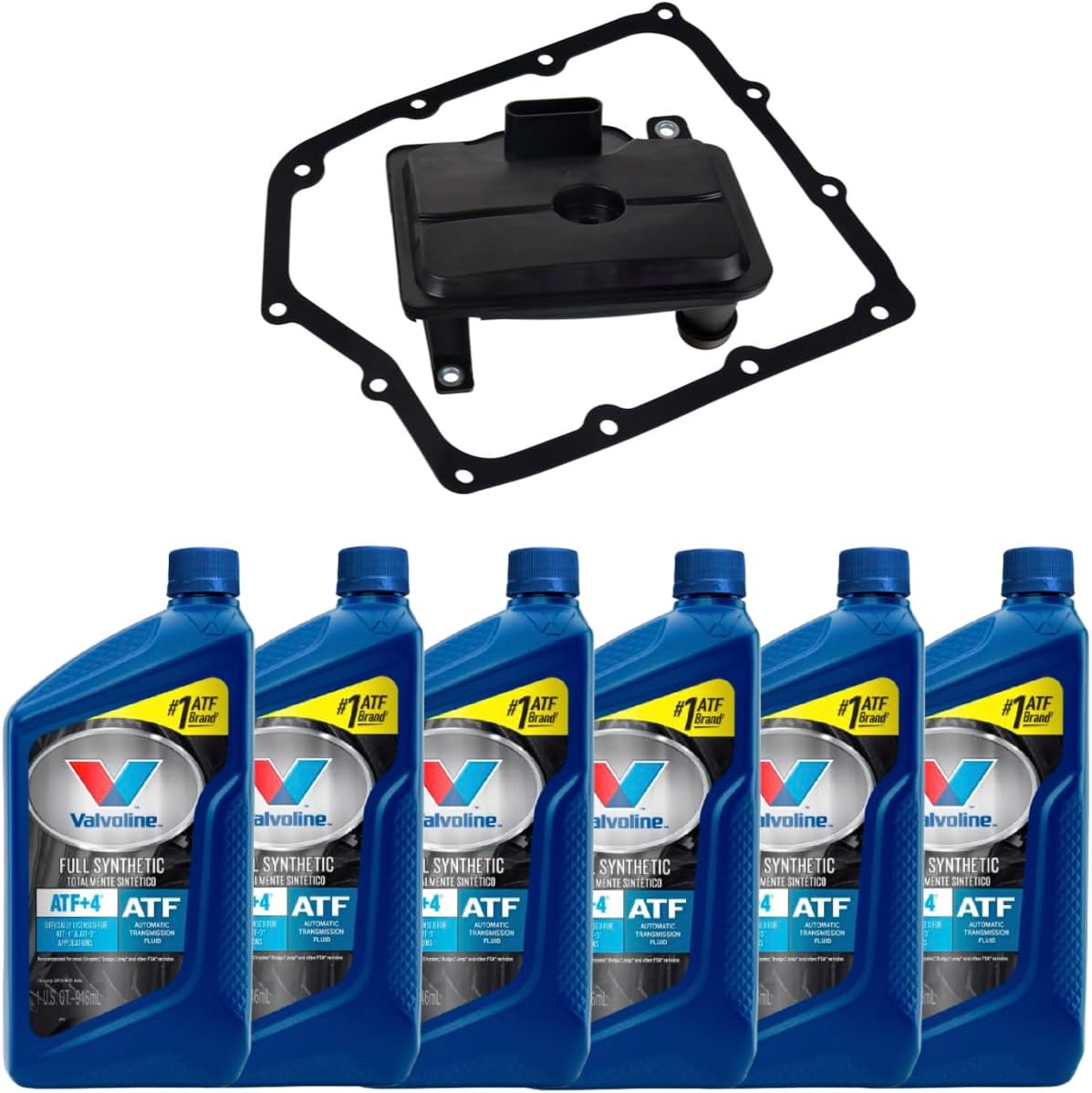

What Chrysler's Own Service Literature Actually Describes
FCA service bulletin 21-046-15 covers a 2015 run of Grand Caravans and Town and Countrys with harsh shifting complaints on the 62TE (sales code DG2). The parts list calls for 1 quart of ATF+4, part number 05013457AA, and the repair procedure sends the technician to TechCONNECT, under Service Info > 12 - Transmission and Transfer Case > Automatic - 62TE > FLUID > Standard Procedure > FLUID LEVEL AND CONDITION CHECK [1]. The fix, if the level is low, is to "adjust the transmission fluid to the correct level." That is the entire documented repair. No flush step, no machine, no mention of pushing fluid through the cooler circuit.
That matters because the 62TE does not have a conventional dipstick you pull, wipe and read. A service procedure distributed by Transtar for this transmission spells out why: with no factory dipstick, the level check requires Miller special tool 9336A, inserted into the fill tube until it contacts the pan (about 16.7 inches), after the vehicle has been shifted through every mode with the engine idling and the fluid warmed for at least two minutes. The reading off the tool's 10 mm marks then gets checked against a temperature-versus-level chart, because the correct level on this unit changes with fluid temperature [2]. There is no way to "top it off and see" on a 62TE the way you might on a transmission with a stick and hot/cold marks.
Why This Unit Punishes Guesswork More Than Most
The 62TE's entire shift strategy runs through one solenoid pack bolted to the valve body: six shift solenoids (low/reverse and 2/4 are normally open; low clutch, underdrive, overdrive and direct clutch are normally closed), a line-pressure variable-force solenoid, a temperature sensor, and five pressure switches built the same way as the switches in Chrysler's 604-family pack [3]. Those pressure switches are electrical contacts sitting directly in the fluid path, not simple mechanical valves, and they are also the circuit most responsible for triggering failsafe. Sonnax's own parts data for this transmission family lists failsafe mode, bind-up and wrong-gear starts as symptoms tied to worn or contaminated solenoid switch valve bores feeding codes 841, 868, 871 and 988 [4]. Whatever reaches that pack through the cooler lines reaches those switches directly. On a transmission built this way, "it's just fluid" is a bigger assumption than it is on a simpler three- or four-speed unit with no electronic pressure switches in the circuit at all.
None of Chrysler's documented 62TE service steps touch that pack during a routine fluid service. The level check and the pan-drop both work around it entirely, which is consistent with keeping an external fluid source away from the one part of the transmission that is both electrical and failsafe-critical.
What a Drain-and-Fill Actually Replaces, By the Numbers
A pan-drop drain-and-fill is an honest partial service, and the numbers say so plainly. Chrysler's own fluid capacity data for the 62TE, reproduced in a 2024 NHTSA filing, lists 5.5 quarts (5.2 liters) of ATF+4 for a service/refill and 9.0 quarts (8.5 liters) for the complete dry-fill system at overhaul [5]. Divide those and a single pan-drop service turns over roughly 61 percent of the total fluid in the unit. The rest sits in the torque converter, the cooler, the cooler lines and the valve body passages, none of which a pan drop reaches.
| Services performed | Fraction of original fluid remaining | Approximate turnover |
|---|---|---|
| One pan-drop drain-and-fill | ~39% | ~61% replaced |
| Two services | ~15% | ~85% replaced |
| Three services | ~6% | ~94% replaced |
That math is the real argument in favor of a flush: getting closer to 100 percent turnover in one visit. It is also exactly the convenience that puts fluid from a shared machine, and whatever chemistry that machine's seller added to the pitch, in direct contact with the one component in this transmission built around electronic pressure switches. Chrysler's documented alternative is simpler: repeat the pan-drop. Two services in a season gets you to roughly 85 percent turnover using nothing but the procedure already in the service manual.
The factory 62TE pan also has no drain plug, so each of those pan-drops means tipping a full pan of ATF over the crossmember rather than pulling a plug and letting it run into a catch pan. A replacement pan with a threaded drain plug, which is how most aftermarket 62TE pan kits are built, turns a staged two- or three-service plan into a 20-minute job each time instead of a full pan removal every round.
Shop the part for this fix: 62TE aluminum oil pan with filter
For a proper pan-drop service, CoreTransmissionParts carries a complete aluminum 62TE oil pan and filter kit built for this exact job.
View the 62TE aluminum pan and filter kit at CoreTransmissionPartsBrowse all 62TE parts at CoreTransmissionParts for solenoid packs, valve bodies and rebuild kits if the fluid turns out to be the symptom, not the cause.
Where an External Flush Machine Adds Risk Without Chrysler's Backing
Chrysler has never published a 62TE procedure that names an external flush or fluid-exchange machine, approved or otherwise. That silence is itself informative when you look at how other manufacturers have addressed the same question in writing. General Motors' corporate service bulletin 04-06-01-029 states it directly for its own automatic transmissions: "The use of external transmission fluid exchange or flush machines is not recommended for the automatic or manual transmission. Use of external machines to replace the fluid may affect the operation or durability of the transmission. Transmission fluid should only be replaced by draining and refilling following procedures in Service Information" [6]. GM's bulletin is not Chrysler's document and does not govern the 62TE, but it is the clearest written OEM statement in the industry on exactly this machine, and the 62TE's documented procedure already lines up with its conclusion: drain, refill, follow the service information, nothing routed through an external box between vehicles.
The practical risk with a shared flush machine is straightforward. It connects to the cooler lines and pushes new fluid through the whole unit, case and solenoid pack included, and whatever fluid or additive chemistry was in that machine from the last several vehicles goes through your 62TE's five pressure switches along with it. A pan-drop never routes anything through the pack at all.
Quick Learn Is Not Optional After a Fluid Service
Whichever method is used, the service does not end when the pan goes back on. Chrysler's Quick Learn procedure has to run through a scan tool afterward, and the documented conditions are specific: the brakes applied, engine speed above 500 rpm, throttle position under 3 degrees, the shift lever held in each commanded position until prompted, and calculated transmission oil temperature between 60°F and 200°F [2]. The same documentation is blunt about skipping it: "Operating the vehicle in any manner without performing the procedures described above can cause immediate damage to the transmission" [2]. A fluid service that is otherwise done correctly, by the book, with the right ATF+4, still leaves the unit exposed if this step gets skipped.
The Short Version for the Bench
- Chrysler's documented procedure: a special-tool level check (no stock dipstick) and a pan-drop drain-and-fill with a new filter. No flush machine appears anywhere in that documentation [1][2].
- What one pan-drop replaces: about 5.5 of 9.0 quarts, roughly 61 percent of total system fluid, because the converter, cooler and cooler lines do not drain with the pan [5].
- Get more turnover without a machine: repeat the pan-drop. Two services get you to roughly 85 percent; a drain-plug pan makes each round quick.
- Why this unit is less forgiving of guesswork: five electronic pressure switches and six shift solenoids sit in one pack that both methods already route around during fluid service [3][4].
- Never skip: the Quick Learn procedure after any fluid service that cycles the transmission [2].
Filter and gasket kits, drain-plug pans, ATF+4 service kits and the special dipstick tool for 2007-up 62TE units, all on our own checkout.
Shop 62TE parts →FAQ
Can you flush a 62TE transmission with a machine?
Chrysler's own service literature for the 62TE never describes an external flush machine. The documented procedure is a fluid level and condition check using special tool 9336A, and a pan-drop drain-and-fill with a new filter when the fluid is due for service. A separate FCA bulletin, 21-046-15, lists the same ATF+4 part number and the same Service Information path for a level check, with no flush step anywhere in it.
Why does a 62TE pan drop only replace part of the fluid?
Chrysler's own fluid capacity data, reproduced in a 2024 NHTSA filing, lists 5.5 quarts (5.2 liters) for a service refill against 9.0 quarts (8.5 liters) for the complete dry-fill system. A pan drop only reaches the pan and the filter; the torque converter, the cooler, the cooler lines and the valve body passages hold onto the rest. One service replaces roughly 61 percent of the total fluid; a second replaces roughly 85 percent; a third gets to roughly 94 percent.
Why is checking 62TE fluid level different from most transmissions?
The 62TE has no conventional dipstick you can pull and wipe. The documented procedure uses special tool 9336A inserted about 16.7 inches into the fill tube, read against a temperature-versus-level chart after the transmission has been cycled through the gears and warmed up for at least two minutes. Guessing the level without that tool and chart is how units end up overfilled or underfilled, which on its own can cause harsh or erratic shifting.
Do you need to run Quick Learn after a 62TE fluid service?
Yes. After any fluid service that involves cycling the transmission, Chrysler's procedure calls for the TCM Quick Learn through a scan tool, with the brakes applied, engine speed above 500 rpm, throttle angle under 3 degrees and calculated oil temperature between 60 and 200 degrees F. Operating the vehicle without completing that procedure can cause immediate damage to the transmission.
Related guides
Sources
- FCA US LLC — Technical Service Bulletin 21-046-15, "Low Transmission Fluid Level," July 16, 2015 (NHTSA-hosted PDF). Backs the ATF+4 part number (05013457AA), the Service Information path for the 62TE fluid level and condition check (Service Info > 12 - Transmission and Transfer Case > Automatic - 62TE > FLUID > Standard Procedure), and that the documented repair is adjusting the fluid to the correct level, with no flush step described. static.nhtsa.gov (PDF)
- Transtar/Transend — "62TE Automatic Transmission: Fluid Level Check Procedures" and Quick Learn Procedure guide. Backs the lack of a factory dipstick, the Miller special tool 9336A level-check procedure (insertion depth, warm-up time, temperature-versus-level chart), and the Quick Learn conditions (brakes applied, engine speed above 500 rpm, throttle angle under 3 degrees, oil temperature 60-200°F) with the warning that skipping it can cause immediate transmission damage. resources.transend.us (PDF)
- Jeff Parlee, Sonnax TASC Force, "Solenoid-Pack Information for the Chrysler 62TE," Transmission Digest, September 1, 2011. Backs the 62TE solenoid pack composition: six shift solenoids (low/reverse and 2/4 normally open; low clutch, underdrive, overdrive and direct clutch normally closed), the line-pressure variable-force solenoid, temperature sensor, and five pressure switches built like the 604-family pack. transmissiondigest.com
- Sonnax, "Chrysler 62TE Valve Body Layout" parts reference. Backs failsafe mode, bind-up and wrong-gear starts as listed symptoms of worn or contaminated solenoid switch valve bores on this transmission family, tied to codes 841, 868, 871 and 988. sonnax.com
- Chrysler fluid capacity data, reproduced in NHTSA filing INRD-EA24003, 2024 (NHTSA-hosted PDF). Backs the 62TE service/refill capacity of 5.5 quarts (5.2 liters) of ATF+4 and the complete dry-fill overhaul capacity of 9.0 quarts (8.5 liters), used for the turnover-percentage math in this article. static.nhtsa.gov (PDF)
- General Motors — Corporate Bulletin No. 04-06-01-029I, "Unscheduled Supplemental Services (Including Flushing Services and Additives)," September 2017 (NHTSA-hosted PDF). Backs the industry-standard OEM position, cited here as a comparison rather than Chrysler's own text, that external transmission fluid exchange or flush machines are not recommended and that fluid should only be replaced by draining and refilling per Service Information. static.nhtsa.gov (PDF)