P0740 on a 66RFE gets treated like a parts cannon problem: pull the solenoid block, throw a new one at it, clear the code, move on. Sometimes that's the right call. Just as often the truck is back in two weeks with the same light, because P0740 is a generic OBD-II code and generic codes describe a symptom, not a part. Before you order anything, it's worth knowing exactly what the TCM measured to set this code, what it didn't measure, and the one 66RFE-specific service bulletin that can make this whole diagnosis a five-minute job instead of a teardown.
Related reading: 66RFE torque converter lockup shudder fix and 66RFE valve body symptoms and testing.
What Actually Sets P0740
P0740 is Torque Converter Clutch Circuit Malfunction - deliberately broad wording. On Chrysler's RFE-family transmissions, the TCM commands the converter clutch through an EMCC (electronic modulated converter clutch) ramp-in and a FEMCC (full electronic modulated converter clutch) full-apply stage, and it watches actual converter slip the whole time. A documented 68RFE case on this exact code, built on the same hydraulic control strategy, lays out the set conditions in detail: in EMCC mode, once input speed is above roughly 1750 rpm, the TCC solenoid is driven to maximum duty cycle but still can't pull engine speed to within 60 rpm of input speed; in FEMCC mode, the solenoid is fully energized and slip is still allowed to exceed 100 rpm for 10 seconds. Either condition sets the code, and the TCM can take up to five minutes of driving before the MIL actually illuminates - which is why the fault can feel intermittent even when it isn't.
P0740 versus the Chrysler numeric codes
The generic P0740 sits on top of a separate set of Chrysler-specific numeric codes that most independent shops actually use day to day. Sonnax's own 66RFE parts and symptom reference lists codes 841, 846, 868, 871, 876, 988, 1775 and 1776 against specific symptoms - solenoid electrical circuit faults, intermittent solenoid codes, pressure-control out-of-range conditions, and TCC apply/release concerns including no-lockup and repeated converter failure. A scan tool that only surfaces the generic P0740 can mask which of those more specific faults is actually present. Pull both code sets with a capable scan tool before you decide what part is wrong.
The 66RFE's TCC Hardware Isn't Identical to the 68RFE's
It's tempting to treat every RFE-family transmission as interchangeable, and for some things that's close enough. It isn't for valve body identification. Sonnax's Chrysler valve body reference splits the family in two: the 45RFE, 545RFE, 65RFE and 66RFE share a gray pass-through solenoid pack connector ('09-and-later) and the CHR141 valve body, identified by natural metal-colored springs. The 68RFE is a separate lineage - CHR143 ('08-earlier) or CHR144 ('09-later) - identified by purple and orange springs. Put a 68RFE-spec valve body kit on a 66RFE and you're working on the wrong platform, even though the two units get talked about in the same breath constantly.
Where the two units do share logic is the converter clutch control strategy itself. Transmission Digest's own account of the 68RFE's solenoid pack history confirms that across the RFE lineage, the L/R clutch solenoid historically did double duty as the TCC solenoid - it wasn't until 2019 that Chrysler added a dedicated TCC solenoid to the 68RFE (identifiable by a new blue connector), freeing the L/R solenoid to control only the L/R clutch. There's no equivalent documented split for the 66RFE. Treat the 66RFE's L/R solenoid as carrying TCC duty as well as clutch-apply duty until you've confirmed otherwise on the specific unit in front of you.
The pressure numbers from a real case
GEARS Magazine (ATRA's trade publication) documented a case on the shared RFE hydraulic architecture that's worth reading before you touch anything. The complaint was transmission overheating and vibration at freeway speed; a road test with a pressure gauge and scan tool connected showed temperature climbing from about 195°F to 230°F while TCC slip increased, eventually storing a TCC-out-of-range code. On the bench, TCC release pressure measured 20 psi where it should have read 5 psi or lower, and TCC apply pressure measured only 85 psi against a 120 psi line pressure - a 35 psi shortfall the author attributed to an internal hydraulic leak, not an electrical fault. A vacuum test on the circuit, which should hold at least 18 in-Hg, dropped to zero almost immediately. Teardown found converter debris in the pan, a worn solenoid switch valve in the valve body, and a worn TCC accumulator piston in the pump. None of that shows up by swapping a solenoid and clearing the code.
66RFE TCC Solenoid Block & Torque Converter at CoreTransmissionParts
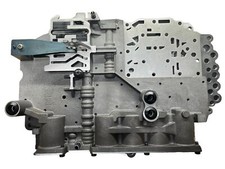
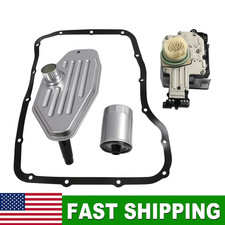
The L/R-TCC solenoid lives inside the 66RFE's shift solenoid block (OEM 52119895AH, 2004-2018), and a worn or defect-prone converter is the other half of this diagnosis. CoreTransmissionParts stocks both as a second source if you need parts beyond what's shown above - confirm exact year and fitment before ordering.
Browse 66RFE solenoid block →Rule Out the TSB First - It's a Five-Minute Check
Before any pressure testing, confirm whether the truck in front of you falls inside Chrysler Technical Service Bulletin 21-037-14. It covers 2015 Ram 2500 Pickup, Ram 3500 Pickup, and Ram 3500 Cab Chassis trucks equipped with the 6.4L engine (sales code ESB or ESA) and the 66RFE six-speed automatic, sales code DFP, built between September 10, 2014 and October 1, 2014. A small batch of torque converters from that window were machined with friction-disc oil grooves cut too wide, which lets the converter slip under heavy load and wear prematurely - a mechanical fault that can present on a scan tool as exactly the kind of excess-slip, out-of-range TCC complaint that trips P0740.
The check itself doesn't require pulling the transmission. Remove the starter to get a sightline into the bellhousing, then rotate the engine clockwise by hand until the torque converter's barcode label is visible through the opening. If the converter's serial number falls between TTP2544xxxxx and TTP2734xxxxx, it's in the affected range and gets replaced with Chrysler part RL259301AA, refilled with ATF+4 (part 05013457AA). If the serial number is outside that range, the bulletin doesn't apply and the slip has to be chased on its own merits with the pressure and vacuum tests below.
A Diagnostic Order That Doesn't Start With the Solenoid
- Pull every code, not just P0740. Check for 841, 846, 868, 871, 876, 988, 1775 or 1776 alongside it - Sonnax ties those to specific solenoid electrical faults and pressure-control out-of-range conditions, and a cluster of codes points you somewhere different than P0740 alone.
- Check the build date and VIN against TSB 21-037-14. If the truck is a 2015 Ram 2500/3500 with a 6.4L and 66RFE built in that narrow September-October 2014 window, check the converter serial number before doing anything else.
- Check fluid level and condition. Stellantis specifies ATF+4 for this family, and Chrysler's own parts list for the 66RFE calls out ATF+4 (05013457AA) when the converter is serviced. Low or burnt fluid thins the film in the TCC regulator and accumulator bores and produces the same low-pressure symptom as a worn bore.
- Test the solenoid circuit electrically - resistance, continuity to ground, connector condition at the 52119895AH-style solenoid block - before condemning it. A circuit code can be entirely in the wiring or connector, not the solenoid itself.
- Pressure-test the TCC release and apply circuits against the benchmarks above: release near 5 psi or lower, apply tracking close to line pressure. A 15-35 psi shortfall on apply, or release pressure sitting well above 5 psi, points at a leaking valve body bore or pump, not the solenoid.
- Vacuum-test the valve body's TCC regulator and switch valve bores. The GEARS benchmark is at least 18 in-Hg holding; a bore that drops to zero quickly is worn enough to bleed apply pressure on its own.
- If everything above is clean, look at the converter itself - repeated converter failure and TCC slip are both listed as documented 66RFE symptoms independent of any solenoid or valve body fault.
The Fix
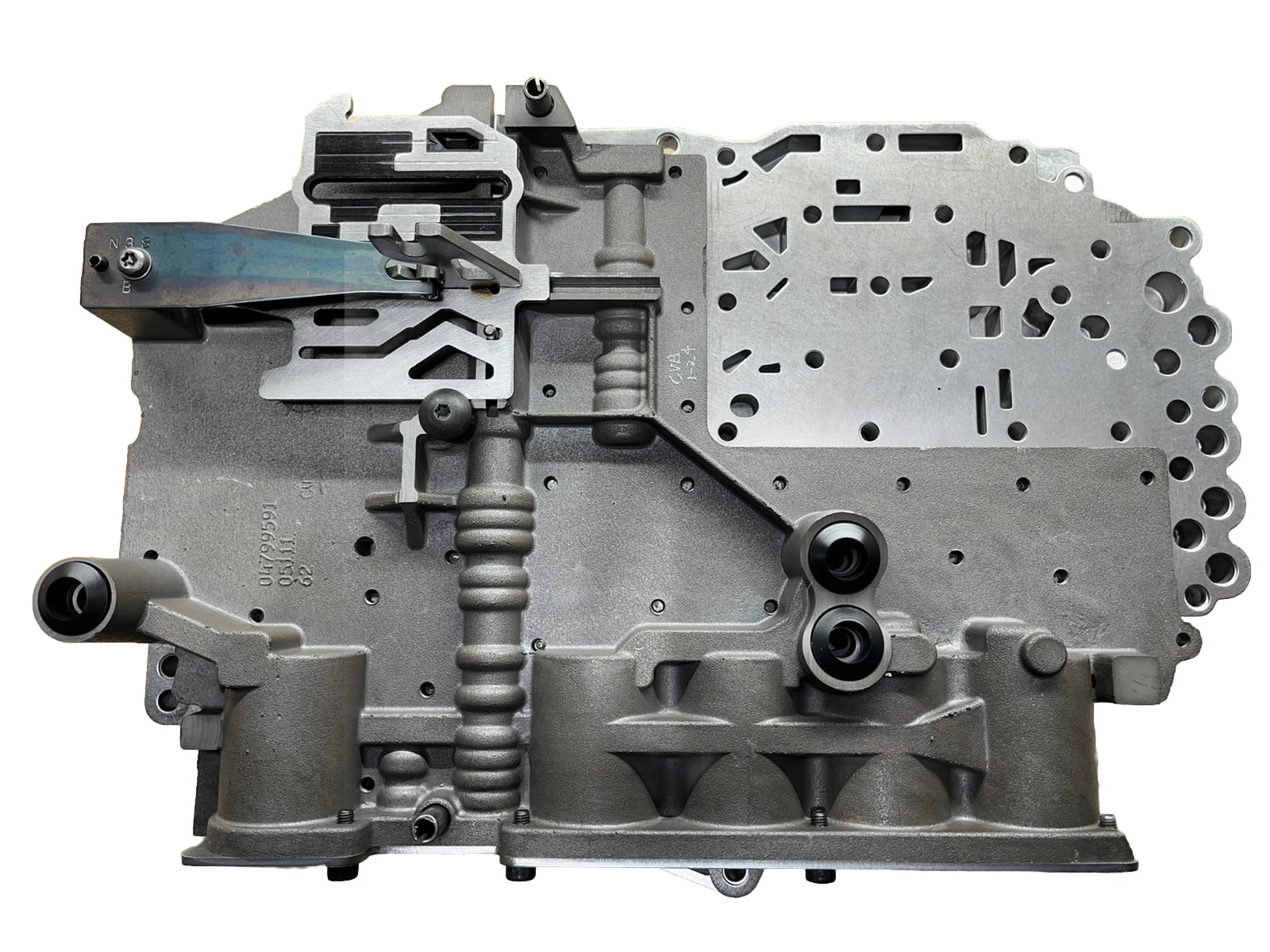
Match the repair to what testing actually found, not to what's cheapest to swap first. A circuit that fails electrically gets the solenoid block or harness replaced - GBI's 66RFE TCC solenoid and full solenoid kit above cover both the single-solenoid and full-pack approach. A valve body that fails the vacuum test gets the worn switch valve and TCC regulator/accumulator bores addressed; Sonnax sells dedicated kits for this family, including a TCC Regulator Valve Kit (44912-11K), TCC Accumulator Valve Kit (44912-18K), and TCC Apply Limit Switch Valve Kit (44912-36K, or the oversized 44912-41K on a worn bore), which is exactly the class of repair the GEARS case called for. A converter inside the TSB 21-037-14 serial range gets replaced outright. In every case, confirm the fluid is ATF+4, correctly filled and in good condition, and flush the cooler if the converter was slipping - debris from a slipping clutch migrates straight back into whatever valve body or solenoid block you just repaired.
After the repair, clear the codes and drive it loaded and hot with the scan tool connected. A code that stays clear on a cold five-minute lap and comes back on the highway with a load behind it is telling you the same thing it told you the first time - the circuit still can't hold the slip or pressure it's being asked to hold.
Working a 66RFE this week?
TCC solenoids, solenoid kits, remanufactured valve bodies, and master rebuild kits for the 66RFE — shipped fast from the USA.
Shop 66RFE parts →FAQ
What does P0740 mean on a 66RFE?
P0740 is the generic OBD-II code for Torque Converter Clutch Circuit Malfunction. It fires when the TCM cannot bring commanded TCC slip within target during lockup, or sees an electrical fault in the TCC control circuit, for longer than its set-time window. It is a catch-all code - it does not by itself tell you whether the cause is electrical, hydraulic, or a bad converter.
Is P0740 the same as the Chrysler 841, 868, 871, or 988 codes on an RFE transmission?
No. Sonnax lists the 66RFE's own numeric fault codes - 841, 846, 868, 871, 876, 988, 1775 and 1776 - covering specific solenoid electrical faults, pressure-control out-of-range conditions, and TCC apply/release concerns. P0740 is the generic OBD-II layer sitting on top of those; a scan tool pulling only the generic code can hide which specific Chrysler fault is actually present, so pull both code sets before you order parts.
Does a P0740 code always mean the TCC solenoid is bad?
No. GEARS Magazine documented a case on the shared RFE hydraulic architecture where a TCC-circuit complaint traced back to a worn solenoid switch valve in the valve body and a worn TCC accumulator piston in the pump, not a failed solenoid. Pressure testing found TCC release pressure at 20 psi where it should read 5 psi or lower, and apply pressure 35 psi short of line pressure - an internal leak, not an electrical fault. The solenoid is the cheap, easy part to swap first, which is exactly why it gets blamed before it's tested.
Is my 66RFE covered by the torque converter TSB for this problem?
Only a narrow build window. Chrysler TSB 21-037-14 covers 2015 Ram 2500, Ram 3500 Pickup, and Ram 3500 Cab Chassis trucks with the 6.4L engine and 66RFE (sales code DFP) built between September 10 and October 1, 2014, where torque converter friction discs were machined with oil grooves cut too wide, causing slip under heavy load. The fix checks the converter's serial number through the bellhousing (rotate the engine to read the barcode after removing the starter) and replaces the converter only if the serial falls in the affected range. Outside that build window, this TSB does not apply, and excess TCC slip has to be diagnosed on its own merits.
What fluid does a 66RFE need, and does it matter for this code?
Stellantis specifies ATF+4 for the RFE family, including the 66RFE, per the Ram owner's manual fluids section, and Chrysler's own TSB parts list for the 66RFE calls out ATF+4 (part 05013457AA) as the fluid to use when the torque converter is serviced. Low or burnt fluid thins the film in the TCC regulator and accumulator bores and produces the same low-apply-pressure symptom as a worn valve body bore, so confirm fluid level and condition before condemning any hydraulic part.
Shop 66RFE torque converter →
Sources
- GEARS Magazine (ATRA) - "Solving a 68RFE Mystery Code." Backs the documented pressure-test case on this shared RFE hydraulic architecture: TCC release pressure of 20 psi (spec 5 psi or lower) and TCC apply pressure of 85 psi against 120 psi line pressure, the 18 in-Hg vacuum-test benchmark, the EMCC/FEMCC set-condition logic (60 rpm slip threshold above 1750 rpm input speed; 100 rpm slip for 10 seconds in full apply), and the teardown finding of a worn solenoid switch valve and worn TCC accumulator piston as the actual root cause. gearsmagazine.com
- Transmission Digest - Wayne Colonna, "Spotting different 68RFE designs through the years to avoid issues." Backs the RFE-family solenoid pack history: the L/R clutch solenoid historically doubled as the TCC solenoid across the lineage until Chrysler added a dedicated, blue-connector TCC solenoid to the 68RFE in 2019. transmissiondigest.com
- Sonnax - Chrysler 45RFE, 545RFE & 68RFE Valve Body Identification. Backs the 66RFE's valve body lineage: the 65RFE and 66RFE share the '09-later gray-connector solenoid pack and CHR141 valve body with the 45RFE and 545RFE, a separate lineage from the 68RFE's CHR143/CHR144 valve body. sonnax.com
- Sonnax - Chrysler 66RFE Transmission parts and symptom listing. Backs the 66RFE's own numeric fault codes (841, 846, 868, 871, 876, 988, 1775, 1776), the documented TCC symptoms (no lockup, TCC slip, harsh apply, low release pressure, repeated converter failure), and the specific valve-body repair kits (TCC Regulator Valve Kit 44912-11K, TCC Accumulator Valve Kit 44912-18K, TCC Apply Limit Switch Valve Kit 44912-36K/41K). sonnax.com
- National Highway Traffic Safety Administration - Chrysler Technical Service Bulletin 21-037-14 (SB-10063738-0335), November 12, 2014. Backs the 66RFE-specific example of a defective torque converter batch: 2015 Ram 2500, 3500 Pickup and 3500 Cab Chassis trucks with the 6.4L engine and 66RFE (sales code DFP) built September 10 - October 1, 2014, affected converter serial range TTP2544xxxxx-TTP2734xxxxx, repair parts RL259301AA (converter) and 05013457AA (ATF+4), identified by reading the converter's barcode through the bellhousing after starter removal. static.nhtsa.gov
- Stellantis / Mopar - 2022 Ram 2500/3500 Owner's Manual, Chassis Fluids and Lubricants. Backs the ATF+4 fluid specification for the RFE family including the 66RFE and the manufacturer's warning that using a different fluid may affect transmission function. vehicleinfo.mopar.com
Shop 66RFE TCC solenoids, solenoid kits, remanufactured valve bodies, and master rebuild kits — shipped fast from the USA.
Shop 66RFE parts →