The 6L80 sits under a huge slice of the 2006-2019 GM fleet: Silverado and Sierra 1500, Tahoe, Yukon, Suburban, Escalade, Camaro, CTS and Corvette. So the fluid-change question comes up constantly, and for two completely different reasons. Either the truck is healthy and the owner is protecting a unit worth protecting, or something already feels wrong and fresh fluid looks like the cheap way out.
Those are not the same purchase. Here is what the service costs, what GM specifies and what GM deliberately leaves out, and how to tell which situation you are in before the money is gone.


What GM Actually Specifies for a 6L80
DEXRON-VI. Not DEXRON-HP. GM's own owner literature is blunt about this. In the 2017 Chevrolet Silverado 1500 owner manual, the Recommended Fluids and Lubricants table lists two separate entries: "Automatic Transmission (6-Speed Transmission) — DEXRON-VI Automatic Transmission Fluid," and directly beneath it, "Automatic Transmission (8-Speed Transmission) — DEXRON-HP Automatic Transmission Fluid (GM Part No. 19331925)." Same truck, same model year, two different fluids depending on which unit is bolted in.
That matters because plenty of counter help and quick-lube techs now reach for DEXRON-HP by reflex, since it is what the newer 8L and 10L units take. The manual carries an explicit caution on this page: use of the incorrect automatic transmission fluid may damage the vehicle, and the damage may not be covered by the vehicle warranty. If your truck has a 6L80, you want licensed DEXRON-VI and nothing else.
GM's current TechLink capacities chart applies the same logic across the lineup. Fluid is assigned by RPO code, not by transmission family name, and DEXRON-VI, DEXRON-HP and DEXRON-ULV are three separate, non-interchangeable service fills. The 6L80 carries RPO MYC; the 6L90 is MYD.
The quart figure GM will not print
Here is what trips people up pricing this job. Open the Capacities and Specifications table in that same owner manual and you get cooling system by engine, engine oil with filter by displacement, fuel tank by body style, transfer case fluid at 1.6 quarts and wheel nut torque at 140 lb-ft. There is no automatic transmission line at all.
That is on purpose. GM wants this unit filled to a level at a temperature, not to a number of quarts, because how much comes back depends on your pan, how long the vehicle sat, and how much is still hanging in the converter and cooler lines. The closest published GM figure for the family is in the TechLink chart, which lists the 6L90 (RPO MYD) at a 5.7 L / 6.0 qt fluid change capacity on DEXRON-VI. The 6L80 is the same architecture with a shorter case and smaller clutch packs.
The honest planning number off the bench: a stock 6L80 pan drop gives back roughly 5 to 7 quarts, and the whole system with converter and cooler is closer to 11 to 12. Buy two gallons and you have margin; buy one and you are short if the converter dumps.
How Often You Pay, and the Chart Most Owners Never See
GM publishes two maintenance charts for these trucks: Additional Required Services — Normal, and Additional Required Services — Severe. On the normal chart, running all the way out to 240 000 km / 150,000 miles, there is no automatic transmission fluid and filter row at all. Tires, engine oil, cabin filter, air cleaner, evap system, spark plugs, transfer case, coolant, belts, brake fluid, clutch fluid. No transmission.
On the severe chart, the row appears, marked three times: 72 000 km / 45,000 mi, 144 000 km / 90,000 mi, and 216 000 km / 135,000 mi. Every 45,000 miles.
GM defines severe service in the same section as vehicles mainly driven in heavy city traffic in hot weather, mainly driven in hilly or mountainous terrain, frequently towing a trailer, used for high-speed or competitive driving, or used for taxi, police or delivery service. Think about what a 6L80 actually lives under. A half-ton that tows a boat twice a summer, a Suburban doing school runs in Phoenix, a Tahoe in fleet service — all severe by GM's own definition. So the budget is not one service at 100,000 miles. It is three services by 135,000.
DIY Cost, Line by Line
- Licensed DEXRON-VI, two gallons. ACDelco GM Original Equipment runs about $60 a gallon, so call it $120. Eight quarts covers a pan drop with real margin. Do not substitute a universal multi-vehicle ATF that only claims to be suitable for DEXRON-VI applications.
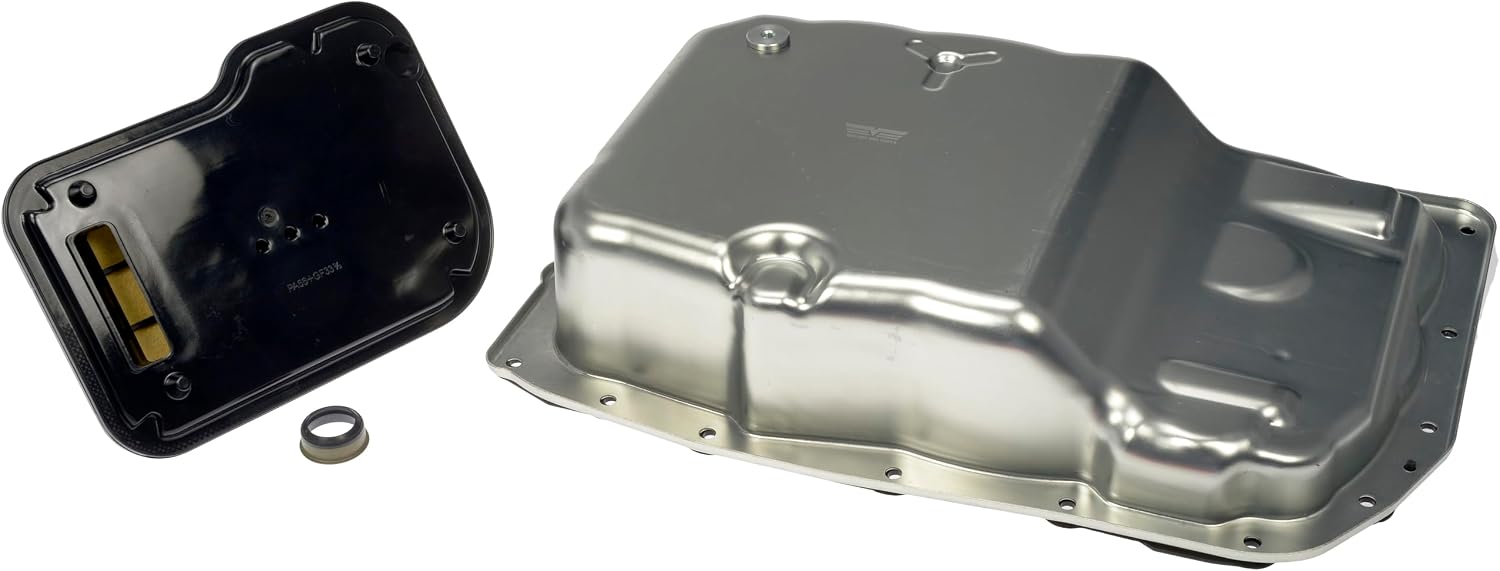
- Filter and pan gasket kit. $60 to $70 for a quality kit. The common GM service number for 2006-2019 6L80 pans is 24236933; ACDelco's current catalog splits that into filter 24236517 plus filter seal 24225347. Confirm the box matches your year before the pan comes off.
- Optional: a pan with a drain plug. A 6L80 pan kit with a drain plug and filter runs about $165. The factory pan has no drain plug, and that single fact is most of what makes this job miserable.
DIY total: roughly $180 to $190 in parts for the basic pan-and-filter, plus about two hours.
The part that catches people out: most 6L80 trucks have no dipstick
From 2007 through roughly 2013, GM shipped these trucks with no transmission dipstick and no fill tube you can reach from above. Later trucks got the dipstick back, and the 2017 manual walks through the full procedure: a cold check band at 27 C to 32 C (80 F to 90 F), the accurate hot check at 71 C to 93 C (160 F to 200 F), adding less than 0.5 L (1 pt) at a time and never overfilling.
If yours has no dipstick, you set the level at the oil level control plug in the bottom of the pan instead. The published procedure for the 6L80 and 6L90 is: fill through the fill tube plug hole or the level check plug hole, start the engine, move the selector through every range pausing about three seconds in each, then with the engine idling in Park and the transmission fluid temperature between 86 F and 122 F, pull the level control plug. A fast drip is correct. A steady stream means overfilled, so let it run down to a drip. Nothing coming out means low, so add until it streams slightly and settles back to a drip.
Two things follow. You need a scan tool or the driver information center to read fluid temperature, and you need a transfer pump that can push fluid uphill into the pan. That is why this job costs more than a 4L60E pan service even though the parts look similar.
Shop Cost, and Why the Range Is So Wide
A shop quote for a 6L80 fluid and filter service typically lands between $250 and $450. Nothing shady accounts for the spread:
- Labor time. Most shops book a pan-and-filter at 1.5 to 2.0 hours on this unit. Part of that is the pan, and part is sitting there idling the engine waiting for fluid temperature to reach the window before the level can be set. You are paying for the wait.
- Fluid volume and markup. Six to eight quarts of licensed DEXRON-VI at shop pricing is a real line item.
- Whether the pan has a drain plug. If it does not, the fluid comes out the only way it can, and the shop prices for the mess.
- Add-ons. A cooler flow test, a cooler flush, a thermal bypass valve, or a full machine exchange each move the number.
The cooler flow test is worth understanding rather than refusing on reflex. GM bulletin 02-07-30-052J covers essential tool J-45096 TransFlow, which cycles DEXRON-VI through the cooler circuit with shop air injected into the fluid stream to agitate and remove contaminated ATF and debris, then measures actual flow in gallons per minute. On a unit that has been run hot, or that had debris in the pan, that number tells you whether the cooler is restricted before you put new fluid into a circuit that cannot move it.
What you should not get billed for on a plain fluid-and-filter service is a Service Fast Learn Adapts procedure. ATRA technical bulletin 1392 lists exactly when it is required: internal service or overhaul, valve body repair or replacement, control solenoid valve assembly replacement, TCM software or calibration update, or any service performed in response to a shift-quality concern. A pan and filter is none of those. If a shop wants scan-tool relearn time on a maintenance service, ask which of those five it falls under.
Pan Drop, Machine Exchange, or Both
A pan drop replaces roughly half the fluid, because the converter and the cooler keep the rest. It also gets you the two things a machine exchange cannot: a new filter, and a look at the magnet. A machine exchange replaces nearly all of it, costs roughly double in fluid alone, and does nothing about the filter. On a 6L80 with unknown history, do the pan drop with a new filter first, then an exchange at the next service once you know the unit is clean.
One warning specific to this family. The plate-style cooler in these vehicles is a non-serviceable component, and the remanufacturer service guide for the 6L80 and 6L90 states flatly that it cannot be properly flushed and should be replaced when a failed unit has put debris into the circuit. If your transmission just came apart, "we flushed the cooler" is not the same as "the cooler is clean," and that is how a fresh unit gets killed in 5,000 miles.
When a Fluid Change Is the Wrong Purchase
Read this part twice if you came here because the truck is doing something.
Fresh fluid does not fix a hydraulic problem. The 6L80 family has a well-documented wear point in the pressure regulator valve bore, and Sonnax lists the resulting complaints directly: erratic line pressure, high line pressure, low line pressure, clutch slippage, harsh shifts, low cooler flow, no cooler flow, overheated transmission, soft shifts and converter concerns. Notice that low or no cooler flow and overheated transmission are both on that list. A truck that cooks its fluid every 20,000 miles may not have a fluid problem at all. It may have a worn PR bore that is not sending oil to the cooler in the first place, which is a valve kit and a pump job, not an ATF purchase.
The other one to rule out is the 3-5-Reverse clutch housing. ATRA's technical coverage on the 6L80 (RPO MYC) and 6L90 (RPO MYD) documents cracks in the 1-2-3-4 / 3-5-Reverse housing producing slips in Reverse, slips in 3rd, slips in 5th, delayed Reverse engagement and intermittent hard shifts into 3rd and 5th, with severity changing as transmission temperature changes. P0776 often sets alongside. Per ATRA, that code sets when the TCM sees an incorrect oncoming clutch ratio or flare with the 3-5-R clutch commanded for 2.25 seconds and input shaft speed more than 60 to 100 RPM off the anticipated value; once it sets, the TCM commands maximum line pressure, inhibits TCC and freezes the adaptives. Inspection is visual plus a soapy-water air test on the drum; updated housings carry a dot-matrix stamping.
So the decision tree is short. Fluid red or light brown, magnet carrying fuzz, no complaints? Buy the fluid and the filter and drive it another 45,000 miles. Fluid dark and burnt, or the truck slips, flares, bangs into 3rd, or runs hot? A $300 service is money you will spend again in three months on top of the real repair. Pressure test it and pull the codes first.
Doing It Right: The Steps That Matter
- Level ground. This unit is filled to a level, and a truck on a sloped driveway reads wrong no matter how careful the rest of the job is.
- Big drain pan. Drop the rear of the pan first so it tips away from you.
- Clean the case sealing surface completely and check it for dents and high spots before the new gasket goes near it.
- New filter, correct for your year, with the filter seal seated squarely in the case bore. A seal that rolls on installation gives you a low-pressure complaint that looks exactly like a worn pump.
- Torque the pan bolts evenly in a crisscross pattern to the figure in the service information for your year. The failure mode here is always overtightening: crushed gasket, dimpled flange, slow leak you chase twice.
- Set the level properly. Dipstick trucks: hot check at 160 to 200 F, idling, in Park. No-dipstick trucks: level control plug, idling, in Park, 86 to 122 F, fast drip. Overfilled aerates the fluid and is as damaging as low.
What the Service Actually Buys You
At roughly $185 in parts every 45,000 miles, preventive fluid and filter service on a 6L80 works out to about four tenths of a cent per mile. A 6L80 rebuild — on this unit that usually means the 3-5-R clutch, the housing and a converter — is a four-figure invoice and the vehicle off the road for a week. That is the entire argument, and it is why GM put this service on the severe chart at 45,000 miles instead of leaving it off the way they did on the normal one.
FAQ
How much does a 6L80 fluid and filter change cost?
Doing it yourself, plan on roughly $180 to $190 in parts: two gallons of licensed DEXRON-VI and a filter and pan gasket kit. At a shop, expect $250 to $450 depending on labor rate, fluid markup, whether your pan has a drain plug, and whether a cooler flow test or a full exchange is included. The 6L80 costs more to service than an older 4L60E mostly because the level has to be set at a specific fluid temperature, and that wait is billable time.
What transmission fluid does a 6L80 take?
DEXRON-VI. GM's owner literature for these trucks lists DEXRON-VI Automatic Transmission Fluid for the 6-speed automatic, and lists DEXRON-HP separately for the 8-speed in the same model year. They are not interchangeable, and the manual warns that using the wrong fluid may cause damage that is not covered by the vehicle warranty. Buy licensed DEXRON-VI, not a universal multi-vehicle ATF.
How many quarts does a 6L80 pan drop take?
GM does not publish a figure for the 6L80, and the transmission is deliberately left out of the owner manual's capacities table because the unit is meant to be filled to a level at temperature rather than by the quart. The closest published GM number is the 6L90 at 5.7 L / 6.0 qt for a fluid change. In practice a 6L80 pan drop gives back about 5 to 7 quarts, and the full system including converter and cooler is closer to 11 to 12. Buy two gallons.
How often should a 6L80 get a fluid and filter change?
Every 45,000 miles under GM's severe-service schedule, which marks the row at 45,000, 90,000 and 135,000 miles. There is no transmission fluid and filter row on GM's normal-service chart at all for these trucks. Since GM's own definition of severe includes towing a trailer, hilly terrain, hot-weather city traffic and taxi, police or delivery duty, most 6L80 vehicles qualify. Treat 45,000 miles as the number.
Will a fluid change fix my 6L80 slipping or shuddering?
Usually not. Slips in Reverse, 3rd or 5th, delayed Reverse, or intermittent hard shifts into 3rd and 5th on this unit point at the 1-2-3-4 / 3-5-Reverse clutch housing, often with P0776 stored. Pressure complaints and overheating point at pressure regulator valve bore wear, which can also cause low or no cooler flow. Both are mechanical repairs. Diagnose before you spend the money, because fresh fluid on a slipping 6L80 buys you a few weeks at most.
Sources
- General Motors — 2017 Chevrolet Silverado 1500 Owner Manual (PDF). Backs the DEXRON-VI service fill for the 6-speed automatic and the separate DEXRON-HP fill (GM Part No. 19331925) for the 8-speed, plus the warranty caution on incorrect fluid (Recommended Fluids and Lubricants, p. 462); the severe-service definition of heavy city traffic in hot weather, hilly or mountainous terrain, frequent trailer towing, high-speed or competitive driving, and taxi, police or delivery service (p. 452); the Additional Required Services charts showing no automatic transmission fluid and filter row on the normal schedule and marks at 45,000 / 90,000 / 135,000 miles on the severe schedule (pp. 455, 457); the cold check at 27-32 C (80-90 F) and hot check at 71-93 C (160-200 F) dipstick procedure, adding less than 0.5 L (1 pt) at a time (pp. 364-365); and the Capacities and Specifications table listing transfer case fluid at 1.6 qt and 140 lb-ft wheel nut torque with no automatic transmission entry (pp. 468-469). chevrolet.com
- GM TechLink — "Transmission Capacities & Fluids" (U.S. and Canada), rev. 05-2025 (PDF). Backs the 6L90 (RPO MYD) fluid change capacity of 5.7 L / 6.0 qt on DEXRON VI, and the point that GM assigns transmission fluid by RPO code with DEXRON VI, DEXRON HP and DEXRON ULV as distinct, non-interchangeable service fills. gm-techlink.com
- General Motors — Bulletin 02-07-30-052J, "Automatic Transmission Oil Cooler Flow Test Essential Tool J-45096 TransFlow," May 2015 (NHTSA PDF). Backs the description of the cooler flow test: DEXRON-VI cycled through the cooling system with high-pressure air injected into the fluid stream to agitate and remove contaminated ATF and debris, and an electronic flow meter reading cooler flow in gallons per minute. static.nhtsa.gov
- ATRA — Technical Bulletin 1392, "6L45, 6L50, 6L80, 6L90 Service Fast Learn Adapts," July 2011 (PDF). Backs the list of repairs that actually require the Service Fast Learn Adapts procedure (internal service or overhaul, valve body repair or replacement, control solenoid valve assembly replacement, TCM software or calibration update, or any service in response to a shift-quality concern) and the 70-115 C (158-239 F) fluid temperature condition. atracom.blob.core.windows.net
- ATRA — 2012 Technical Manual, GM 6L80/6L90 section, "Slips in Reverse, 3rd, 5th — P0776 Possibly Set" (PDF). Backs the 1-2-3-4 / 3-5-Reverse housing crack complaint list (slips in Reverse, 3rd and 5th, delayed Reverse engagement, intermittent hard shifts into 3rd and/or 5th, severity changing with transmission temperature), the P0776 set criteria of 2.25 seconds commanded with input shaft speed 60-100 RPM off anticipated, the TCM response of maximum line pressure with TCC inhibited and adapts frozen, and the soapy-water air test plus dot-matrix stamping inspection. atracom.blob.core.windows.net
- Sonnax — "6L80 Series Pressure Regulator Valve Kits: Now, No Drilling Required," and kit 104520-15K. Backs the pressure regulator bore wear complaint list quoted above: erratic line pressure, high line pressure, low line pressure, clutch slippage, harsh shifts, low cooler flow, no cooler flow, overheated transmission, soft shifts and converter concerns. sonnax.com
- Moveras — "6L80 & 6L90 Installation Guide," rev. 1.0 31AS (PDF). Backs the no-dipstick fill procedure (fill through the fill tube plug hole or the level check plug hole, shift through all ranges pausing three seconds in each, final level check with the engine idling in Park at 86-122 F, fast drip correct and steady stream meaning overfilled) and the statement that the plate cooler in these vehicles cannot be properly flushed, is non-serviceable, and should be replaced. moveras.com