P0961 is Line Pressure Control Solenoid Valve Performance, and the word that matters in that name is performance. It is not P0962 or P0963, which are circuit-low and circuit-high faults. It is not P0960, an open circuit. Performance means the module commanded a line pressure, watched what came back, and the two did not agree.
That distinction is the whole job. A circuit code points you at a wire. A performance code points you at everything between the driver in the module and the pressure regulator valve in the pump cover, and on a 6L80 that path runs through parts that are both electrical and hydraulic. Plenty of these units get a control module they did not need for a thirty-dollar valve problem, and plenty get a valve body kit when the module was genuinely bad. The order you test in is what keeps you out of both holes.
Related reading: our 6L80 P0842 fluid pressure sensor writeup and the 6L80 valve body testing guide, both of which overlap heavily with this diagnosis.
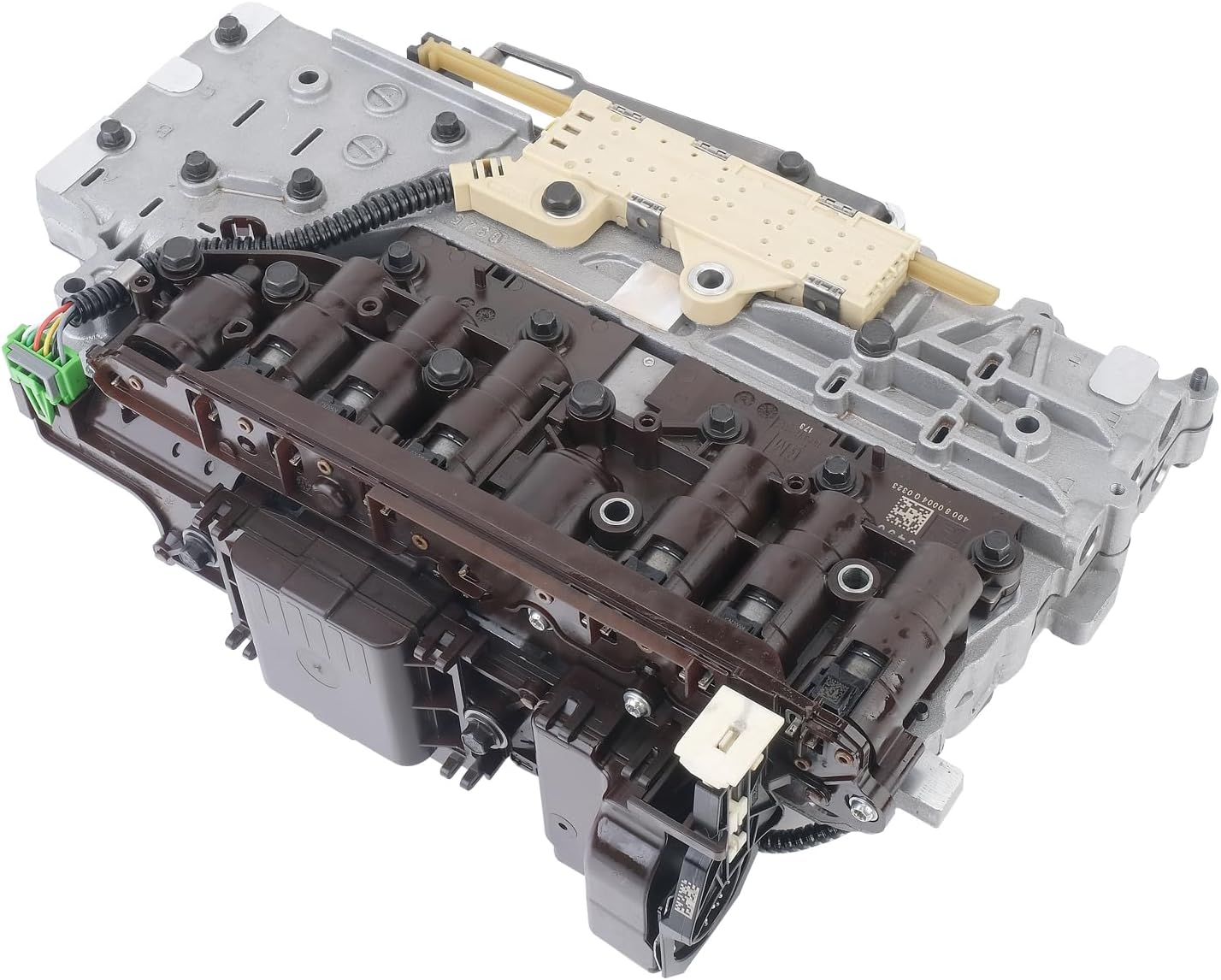
How the 6L80 actually makes line pressure
Most techs picture a fixed-displacement gear pump dumping over a regulator. The 6L series does not work that way. It uses a variable displacement vane-style oil pump integral to the bellhousing, and the pressure regulator valve lives in the pump cover on every application in the family. The 6L45, 6L50, 6L80 and 6L90 all share the design and layout, per the GEARS Magazine teardown of 6L80/6L90 pressure issues.
Here is the chain, in order:
- The TEHCM (Transmission Electro-Hydraulic Control Module) energizes the line pressure control solenoid with a specific current.
- That solenoid output pressure acts on the pressure regulator valve in the pump cover.
- The regulator valve position controls the position of the pump slide.
- Slide position changes pump displacement, which changes volume, which - against the resistance of the circuit - is what actually creates pressure.
The relationship is inverse. Less current to the solenoid closes off its exhaust port and raises control pressure, which raises line. More current opens the exhaust and drops it. The published GM current range for this solenoid runs from roughly 0.1 amp at maximum line pressure to about 1.1 amps at minimum, so you are watching a solenoid that sits near the high-current end at light load and drops current when the truck asks for clamp.
Two things follow from that design. First, the solenoid does not meter line pressure directly - it moves a valve that moves a slide. Break any link in that chain and the command still goes out perfectly while nothing happens downstream. Second, the line pressure control solenoid is built into the TEHCM and is not separately serviceable. There is no pulling one solenoid out of this unit.
Step 1: fluid level, done by the book
This is not filler. A variable displacement pump that pulls air cannot hold commanded pressure, and an aerated charge produces exactly the commanded-versus-actual divergence P0961 watches for. Do it properly before you touch a scanner menu.
The GM procedure in the Silverado owner manual is specific: shift through every range holding three seconds in each, return to Park, then let the engine idle at 500 to 800 rpm for at least one minute before reading. The hot check - the accurate one - is done with transmission fluid temperature between 71 and 93 C (160 to 200 F). The cold check is reference-only and runs 27 to 32 C (80 to 90 F). Read fluid temperature off the DIC or the scan tool, not by feel, because level rises with temperature and a close-enough reading is how units come back.
Fluid spec is DEXRON-VI for every 6-speed application, per the GM recommended fluids and lubricants table. Not DEXRON-III, and not a universal multi-vehicle ATF unless it explicitly carries a current DEXRON-VI service-fill license. DEXRON-VI runs a lower viscosity and a different friction profile on purpose, and this unit shift calibration is written around it.
Sonnax Pressure Regulator Valve Kit 104520-15K
The drop-in fix for a worn 6L80 pressure regulator bore: hardcoat anodized valve with lengthened spools that ride in the unworn part of the bore, annular grooves to stop side-load wear, and a replacement outer spring. Current revision, no pump drilling required.
See the 104520-15K kit at Core Transmission Parts →Step 2: read the pressure, and look for the flatline
Put the scan tool on commanded line pressure and actual line pressure, then bring RPM up in Park and watch. Healthy behavior is a rise - pressure tracks RPM and tracks commanded torque. It should never be one flat number.
The single most useful signature on this unit comes from the Sonnax TASC Force writeup on 6L series no-movement and abnormal pressure conditions: line pressure stuck at about 60 to 68 psi with no RPM rise whatsoever is the line pressure solenoid stuck in exhaust mode. The detail that makes it diagnostic is the next sentence in that same article - unplugged is no different. Disconnect the transmission connector, run the test again, and if the number does not move off 60 to 68 psi, the hydraulic side is already sitting at its default and the solenoid is not modulating anything.
There is a second number worth memorizing from the same source. If line pressure is 30 psi or less at idle, suspect a missing pressure regulator boost valve retaining roll pin. That condition usually still has some movement, but nothing about it is normal, and it is a rebuild error that turns up in units somebody else just had apart.
Back the scan data with a real gauge at the line pressure tap when the numbers are ambiguous. The TEHCM reports pressure through the pressure switch manifold, and a switch fault will lie to you in a way a mechanical gauge will not.
Step 3: grounds, connector, and the module
Before condemning hardware, check the powertrain grounds and the transmission pass-through connector. Poor grounding is a recognized cause of GM pressure-control performance codes, and it costs nothing to rule out. Pull the connector, look for fluid intrusion and spread terminals, and load-test the grounds rather than eyeballing them.
If the solenoid is genuinely failed - shorted winding, stuck armature, internal driver fault - the fix on a 6L80 is a replacement or remanufactured TEHCM. There is no individual solenoid service. When you do that, verify the TEHCM part number and program file match the VIN. Sonnax specifically calls out an incorrect part number or an incorrectly programmed TEHCM as a cause of no-movement and no-upshift complaints. Also expect a temporary no-move during the OE relearn: the documented workaround is to remove the scanner, remove the key, open and close the driver door, then wait 15 to 20 minutes.
Step 4: the hydraulic causes, which are the ones people miss
Pressure regulator bore wear
This is the big one. Sonnax documents that 6L45, 6L50, 6L80 and 6L90 units exhibit line pressure and cooler/converter/lube flow problems from excess wear in the pressure regulator bore, caused by continuous oscillation of the valve. Where the bore wears decides the symptom, and this is worth committing to memory:
- Balance spool end worn: critical fluid loss, resulting in high line pressure, harsh shifts, and overheating from reduced cooler and converter flow.
- Outboard spool worn: robs converter feed pressure and lowers line pressure, resulting in soft shifts and burnt clutches.
Both ends produce a commanded-versus-actual mismatch, which is why one code covers two opposite complaints. Vacuum test the bore rather than guessing - Sonnax publishes a vacuum test guide for this valve body family with the port locations and the minimum in-Hg each port has to hold. If a port will not hold, the bore is done, and no amount of solenoid work fixes it.
The repair is a replacement valve, not a cleaning. Sonnax kit 104520-15K is the drop-in pressure regulator valve kit for the family: hardcoat anodized aluminum valve, lengthened critical spools that operate in the non-worn portion of the bore, annular grooves that help center the valve and reduce future side-load wear, and a replacement outer spring that adds a modest 5 psi across the pressure curve. It replaces the older 104520-14K and, unlike that kit, requires no pump drilling. The oversized version is 104520-16K for bores too far gone for the drop-in. Either way, the pump has to come out to install it.
The rust inhibitor trap on service pump covers
This one has bitten a lot of shops. Per a Transmission Digest tech tip covering 2006-2015 GM cars and trucks with the 6L80 or 6L90 (RPO MYC or MYD), after installing service pump cover P/N 24248573 a transmission may have low line pressure - and if it is not caught and corrected, clutches get damaged during operation.
The cause is rust inhibitor material in the service cover, a thick waxy substance, sticking the pressure regulator valve (#233) or the isolator valve (#236), or plugging the small orifice (#5) in the isolator valve sleeve (#237). The inspection is straightforward: press the isolator sleeve inward, let pin #223 drop out of the cover, pull the sleeve, remove the isolator valve, and check that orifice for plugging. Do this before the cover goes on, not after the comeback.
Pump slide and slide spring
If the slide cannot react, pressure cannot follow command. GEARS lays out what to check when a bellhousing or pump cover has been machined, or bought already re-machined, and these are the numbers:
- Slide and rotor end clearance: 0.0008 to 0.002 in (0.02032 to 0.0508 mm), checked with green plastigage laid across the slide and rotor in several positions, cover bolted and torqued, then separated and measured. Too tight and the slide sticks or the rotor damages the bore.
- Slide spring end clearance: at least 0.020 in, measured with a straight edge across the slide and a feeler gauge between the spring and the straight edge. If the spring wedges between cover and bellhousing the slide will not react, and you get erratic pressure and shift feel complaints.
- Input endplay: typically 0.004 to 0.006 in. These are net-build units with no endplay adjustment, so machining moves it and almost nobody checks.
Inspect the spring bore itself while you are in there. GEARS notes the spring frequently wears into the bore; touch it up with a die grinder rather than reassembling over it.
Metal contamination from a failed converter
When a converter comes apart, metal migrates back into the pump and out into the cooler, and it damages the pump cover and the bellhousing mating surface. That debris then sticks valves and solenoids. If you find a distressed converter, understand that replacing it and the pump fixes the root cause but leaves the valve and solenoid damage behind - address both, or the code comes back. Replace the cooler or flush it properly; you are not rinsing that clean with a squirt bottle.
Putting it in order
The sequence that resolves most of these without wasted parts:
- Fluid level and condition at the correct temperature, on the correct DEXRON-VI fill.
- Grounds and the transmission pass-through connector.
- Scan data plus a mechanical gauge: does pressure rise with RPM, or flatline at 60 to 68 psi?
- Unplug the solenoid and repeat. No change means the hydraulic side is sitting at default.
- Drop the pan, pull the TEHCM, vacuum test the pressure regulator bore and the boost valve circuit.
- Worn bore, stuck slide, plugged isolator orifice, or missing roll pin - fix it hydraulically.
- Only after all of that does a TEHCM go on the invoice, programmed to the VIN.
Need parts for this job?
Pressure regulator valve kits, pump slide springs, filters, TEHCM gasket and screen kits, vacuum test plates, DEXRON-VI and the tools that make the pump work go faster - all in one place.
Shop 6L80 parts →Shop the part for this fix
If the vacuum test failed at the pressure regulator bore, the valve kit is the fix, and the pump has to come out anyway. Core Transmission Parts stocks both revisions plus the pump slide hardware that usually goes with the job.
6L80 pressure regulator and pump pressure parts
Drop-in kit 104520-15K for standard wear, oversized 104520-16K for bores past the drop-in, plus pump slide pivot pin and spring kit 104553-03K for the erratic-pressure side of the same job.
Shop 6L80 parts at Core Transmission Parts →FAQ
What does P0961 mean on a 6L80?
P0961 is Line Pressure Control Solenoid Valve Performance. It is a performance code, not a circuit code. The control module is not reporting an open or a short - it is reporting that it commanded a line pressure and the transmission did not deliver it. That means the fault can be electrical inside the TEHCM or purely hydraulic in the pump, and the code alone does not tell you which.
Can low transmission fluid cause P0961 on a 6L80?
Yes, and it is the first thing to rule out. A low or aerated charge lets the variable displacement pump pull air, so commanded pressure and actual pressure separate exactly the way the code is watching for. Check level by the GM procedure: idle at 500 to 800 rpm, shift through the ranges holding three seconds each, then read the dipstick with fluid temperature between 71 and 93 C (160 to 200 F) for the hot check.
Do I have to replace the whole TEHCM to fix P0961 on a 6L80?
Only if the solenoid itself is the fault. The line pressure control solenoid is built into the TEHCM and is not separately serviceable, so a genuinely failed solenoid means a replacement or remanufactured TEHCM programmed to the VIN. But a large share of P0961 jobs are hydraulic - a worn pressure regulator bore, a stuck pump slide, or a plugged isolator orifice - and a new TEHCM will not fix any of those.
What line pressure should a 6L80 make?
Line pressure should rise with engine RPM and with commanded torque, not sit at one number. The classic failure signature is line pressure stuck at roughly 60 to 68 psi with no RPM rise at all, which is the line pressure solenoid stuck in exhaust. Unplugging the solenoid reads no different. Separately, if pressure is 30 psi or less at idle, suspect a missing pressure regulator boost valve roll pin.
Is it safe to drive a 6L80 with P0961 set?
No. P0961 usually means clamp pressure is wrong in one direction or the other. Too low burns clutches quickly. Too high hammers the unit and starves cooler and converter flow, which cooks the fluid. Either way the damage compounds every mile, and a cheap solenoid or valve job turns into a full rebuild.