A customer brings in a Silverado that flares on the 3-4, lights the dash, and the code reader prints the word solenoid. The parts counter has a 6L80 solenoid kit on the shelf. Sometimes that is the right part. Often it is not, and the transmission was telling you something else in the only vocabulary it has.
The 6L80 is unusual that way. Its solenoids are sealed inside the control solenoid valve assembly — the TEHCM — and GM's own bulletins on this unit spend as much effort telling you not to replace that assembly as telling you when to. This is a guide to reading the difference before you spend the customer's money.
Related reading: our 6L80 P0748 pressure control solenoid writeup and the 6L80 valve body testing guide.
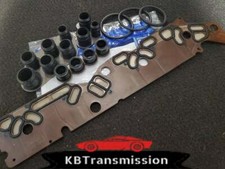
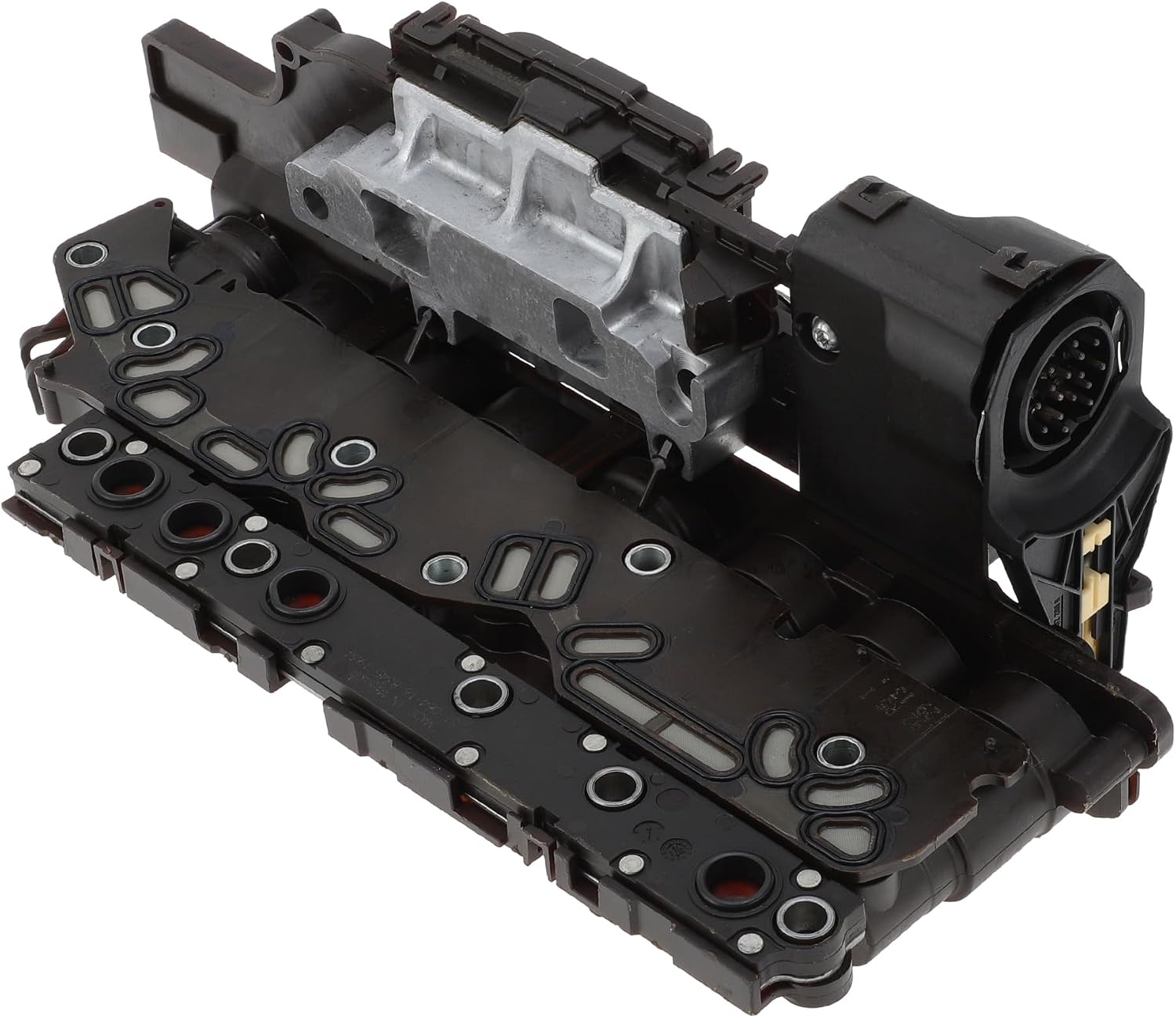
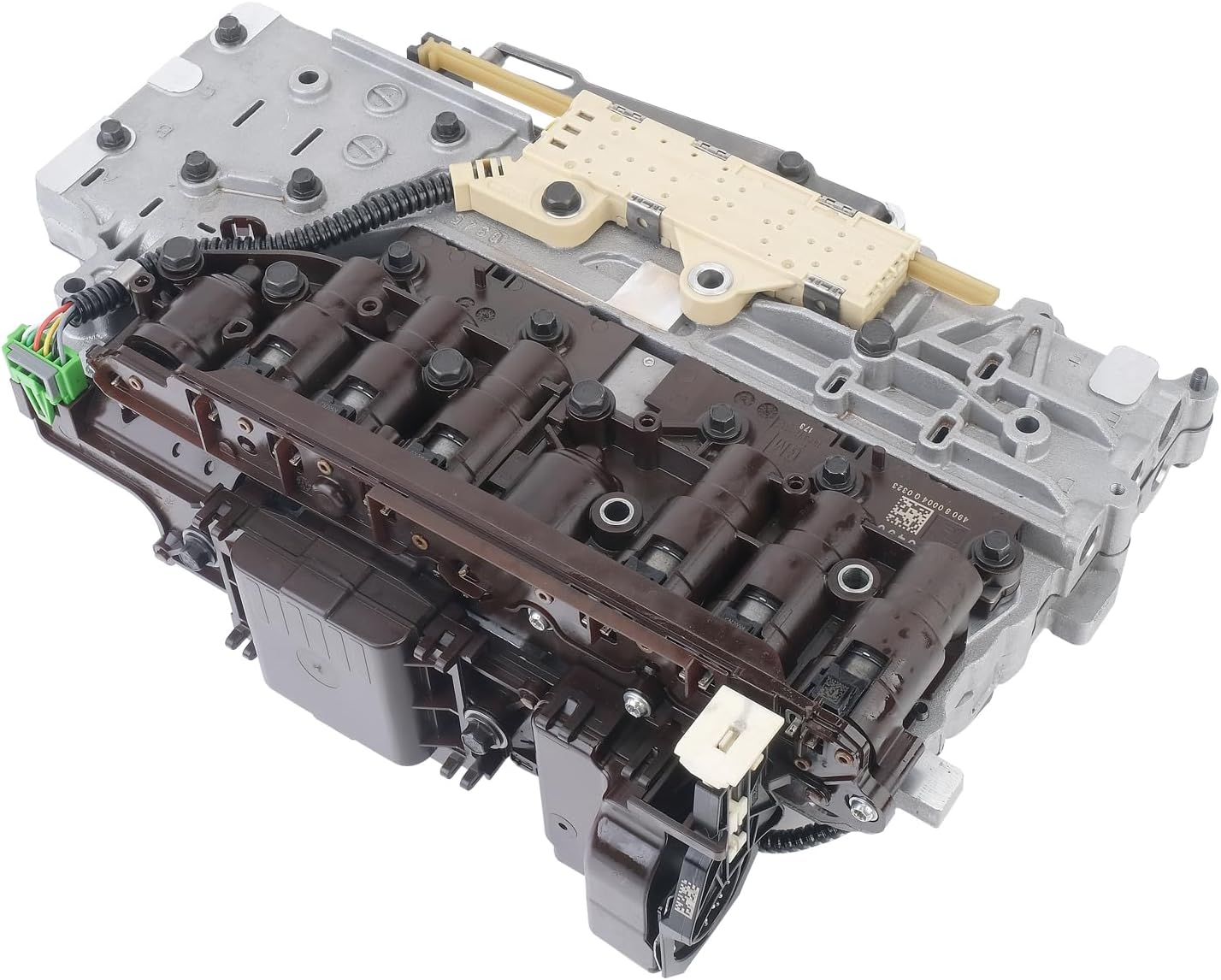
What the 6L80 actually calls a shift solenoid
Every 6L80 built from 2006 forward puts the transmission control module, the solenoids, the pressure switches and the fluid temperature sensor into one assembly that bolts to the valve body inside the pan. GM's parts catalog calls it the Control Solenoid (w/ Body and TCM) Valve Assembly. Everyone in the trade calls it the TEHCM.
Sonnax describes the internals plainly: the eight solenoids are connected to the TCM through a lead frame, and the whole arrangement is over-molded into the plastic housing, not accessible or serviceable separately. There is no two-pin shift solenoid you unbolt from the valve body the way you do on a 4L60E. That one design decision changes the diagnostic order, because the cheap confirmation test — ohm it, air-check it on the bench, swap it — is off the table.
The naming is the second trap. Read a GM bulletin or an ATRA writeup on this unit and the solenoids are identified by number and function, not by the "shift solenoid A/B" shorthand a generic code reader prints. The code family ATRA documents as setting on TEHCM-equipped 6L and 6T units, in any combination, reads like this:
- P0562 — system voltage low
- P0742 — TCC stuck on
- P0776 — Solenoid 2 stuck off
- P0796 — Solenoid 3 stuck off
- P0965 / P0969 — Solenoid 2 and Solenoid 3 performance
- P2714 / P2715 / P2719 — Solenoid 3 stuck off, stuck on, performance
- P2762 — TCC solenoid performance
Notice what is there and what is not. Most of what a 6L80 sets when it shifts badly are pressure control solenoid codes, not on/off shift solenoid codes. The clutch apply work on this transmission is done by variable-bleed pressure control solenoids, so a code named after "solenoid 2" or "solenoid 3" is reporting a clutch circuit, not a mechanical shift valve. Order parts off the shorthand and you order the wrong thing.
Symptoms that genuinely point at the solenoid side
What a solenoid-side fault tends to look like from the driver's seat:
- A missing gear, not all of them. One clutch circuit drops out and you lose the gears that clutch serves. No 4th, 5th and 6th is one pattern. No reverse, 3rd and 5th is another. Everything else still shifts.
- Flare or neutral on one specific shift, repeatable, in the same place every time.
- Symptoms that move with temperature. ATRA's coverage of the known internal TEHCM fault makes this point directly: the symptoms are likely to be intermittent and temperature-sensitive, so you may see one set of symptoms one day and a different set the next.
- Several unrelated solenoid codes at once. One circuit failing is a circuit. Four failing together is a module or its power supply.
- Failsafe with no pressure rise. Sonnax documents the signature for a line pressure solenoid stuck in exhaust mode: line pressure parked at roughly 60 to 68 psi with no RPM rise whatsoever — and the detail worth memorizing, unplugged is no different. A dead circuit and a stuck solenoid read identically on a gauge.
What it does not look like: a slow, even decline in shift quality across every gear over 20,000 miles. That is fluid, clutch wear or a valve bore, and no solenoid fixes it.
Three faults that look like a shift solenoid and are not
1. P0796 with a clean pan on a 2015-2016 truck
This one alone is worth the read. GM bulletin 16-NA-027, February 2016, covers 2015-2016 Chevrolet Silverado, Suburban and Tahoe and GMC Sierra, Yukon and Yukon XL with the 6L80 (RPO MYC). The condition: no 4th, 5th and 6th gears, malfunction indicator lamp on, DTC P0796 active or history. A textbook pressure control solenoid code.
The cause GM gives is a broken 4-5-6 clutch (with output carrier shaft) hub assembly. The tell is the part most techs read backwards: with this condition, the fluid pan will be clean containing little or no debris, and the fluid will also be clean with no distress. Clean pan, missing gears, solenoid code. GM then closes the loop in writing — if the 4-5-6 clutch hub is found broken, the TEHCM is not the cause and should not be replaced.
On a 2015-2016 truck with P0796, a clean pan is not evidence that the hard parts are healthy. It is a fingerprint.
2. Harsh shifts and shudder on a low-mileage truck
GM bulletin 22-NA-182, December 2022, lists harsh shifting, shudder, surging, stalling, neutral/flare and transmission overheating on 6L80-equipped vehicles — including complaints that appear after the transmission has been overhauled. The cause in the bulletin: a twisted cooler line on low mileage vehicles. Untwist it, or replace it if the rubber stays misshaped, then reset the fluid level.
The same bulletin gives a number worth writing on the wall. The thermal bypass valve on the 6L80 and 6L90 opens at 158°F (70°C), and it is external to the transmission — unlike the 10-speeds, where the TBV sits inside the valve body. If you have an overheat complaint and the cooler lines are straight, the TBV is next. Neither of those is a solenoid, and both will make one look guilty.
3. Low system voltage
P0562 sits on ATRA's list for a reason. Solenoid codes are current and voltage reports, so a module fed a marginal supply files accurate complaints about circuits that are physically perfect. Load-test the battery, verify charging output, and inspect the powertrain ground straps and case ground for corrosion or a loose fastener before you order anything. It costs nothing and it saves modules.
The failure that really is the module
There is one documented internal TEHCM fault worth knowing by date. ATRA's GEARS Magazine coverage reports that Bosch had an issue with a capacitor internal to the TEHCM that could disrupt microprocessor operation. On a bad day for that capacitor, the effect on TEHCM operation could be dramatic; on a good day, everything was normal. That is exactly the intermittent, temperature-sensitive, multiple-code presentation described above.
GM and Bosch identified the window: model year 2018, TEHCM build date 7209 (July 28, 2017) through build date 7262 (September 19, 2017). To read the build date, find the 13-digit number inked on the TEHCM just below the QR code and read positions 5 through 8, left to right. ATRA's recommendation for a unit inside that window is to plan on replacing the TEHCM even if it is not currently acting up, because the odds are not in your favor and a comeback is worse.
One more structural fact from that article: the 6L45, 6L50, 6L80, 6L90, 6T70, 6T75 and 6T80 all use the same Bosch-built TEHCM design and the same microprocessor. Part numbers differ and are not interchangeable, but a microprocessor-related fault is a family problem, not a single-model problem.
Testing before you buy
You cannot back-probe a solenoid that is sealed in an over-mold, so the sequence has to prove the fault by elimination and by command response.
Scan data first, in this order
- Capture the freeze frame before clearing anything. Clearing codes to see whether they return destroys the record of what the truck was doing when it failed.
- Count the codes. One solenoid code with a matching drivability symptom is a circuit investigation. A spread of solenoid, pressure switch and performance codes together is a module or power investigation.
- Watch the commanded solenoid parameter in live data, driving or loaded in the bay. Continuous, changing output means the path between module and solenoid is intact and the fault is downstream. No changing output sends you to the external harness and case pass-through connector looking for an open, a short or corrosion.
- Put a mechanical gauge on the mainline port. If commanded pressure moves and the gauge does not, you have separated the command from the hydraulic result, which is the whole game.
Air-test the solenoids for real
The one tool that gets past the over-mold is the Kent-Moore test kit. Transmission Digest documents it: DT-47825 is the kit for the 6L80 and 6T70, and the test harness supplied in that kit is for the 6L80 specifically — the 6T70 harness is DT-47825-20 and is sold separately, while the 6T40 uses DT-48616. The kit contains a solenoid plate with air fittings, a gauge and a harness that connect to the vehicle's system and to the TEHCM, so with a scan tool issuing the commands, each individual solenoid can be air tested for proper operation. Kent-Moore also offers a signal generator to simulate input and output speed signals. As Transmission Digest puts it, that beats spending over $500 needlessly on a replacement.
Read the pan before you commit
Two things in the pan decide the job. Metal means the converter and pump are involved, and a fresh module dropped into a contaminated system gets the same diet that killed the last one. A clean pan with missing gears, on a 2015-2016 truck with P0796, sends you back to 16-NA-027 and the 4-5-6 clutch hub.
Replacement: what you are actually buying
If the diagnosis lands on the module, you are buying a TEHCM — new, remanufactured, or as part of a complete control valve body assembly. Match the application first. Sonnax splits its remanufactured units by generation:
- C5 generation — typically Cadillac 2010-2011, Chevrolet 2010-2013, GMC 2010-2011
- C6 generation — typically Cadillac 2012-2015, Chevrolet 2011-2020, GMC 2011-2020, Isuzu 2012-2016
Those ranges overlap on purpose, which is why Sonnax tells you to verify by matching your OE part number to the number on the part page rather than by model year. Get it wrong and the truck will not move: Sonnax lists an incorrect part number, or an incorrectly programmed TEHCM, as a documented no-movement or no-upshift cause. Verify the part number and program file against the VIN before anything goes back together.
Assembly details people get wrong
- Do not leave the TEHCM filter gasket out. Sonnax lists that exact omission as a no-movement cause, typically with no or low line pressure. It is rare because it is obvious, and it still happens.
- Clutch select valves go in first, springs outboard. Installed backwards, they cost you forward, reverse or both — and line pressure will read perfectly normal the whole time.
- Verify the separator plate matches the valve body type. A Type 2 plate on a Type 1 valve body is a no-forward condition; the correct Type 1 plate, part #24245720, uses seven check balls, and early Type 1 bodies cannot be updated to the later eight-check-ball plate. Reverse the mismatch and you get no 3rd and no reverse. Line pressure reads normal in both cases, which is why this one hides.
- A 6L90 valve body on a 6L80 is a no-reverse condition. Check the casting before you bolt it up.
Programming and the relearn
The TEHCM contains the transmission control module, so a replacement arrives carrying somebody else's calibration. It has to be reprogrammed to the VIN on the vehicle with a J2534 device and a battery charger connected, then given a fast adapt so the module stops shifting on the old unit's learned values. Skip the adapt and the customer gets harsh shifts, wrong shift points, and sometimes new codes on a transmission you repaired correctly.
And the quirk that has cost people a second teardown: Sonnax notes that during OE programming or the relearn process, a temporary no-move condition may occur. The fix is not to pull the pan. Remove the scanner, take the key out of the ignition, open and close the driver door, wait 15 to 20 minutes and come back. It is usually good to go.
Keeping it from coming back
- Fix the debris source. The 6L series mostly arrives with pump and converter involvement, and that metal migrates into the cooler and back through the system. Verify the cooler flows clean before the pan goes on.
- Check the cooler lines on any post-overhaul comeback. Bulletin 22-NA-182 exists because a twisted line produces a symptom list that reads exactly like a bad rebuild.
- Clean and protect the case connector during any pan service on a salt-belt truck. Corrosion there sets electrical codes that look like internal module faults.
- Use DEXRON VI and set the level by fluid temperature, not by a quart count. Level moves pressure, and pressure is what these solenoids exist to control.
- Handle the module with an ESD strap. It is a computer, and a static hit on the bench does not announce itself until the truck is out the door.
Need the part for this one
If the circuit tests intact, the hydraulics respond to command, and the codes point inside the over-mold, the repair is the module — not a solenoid. If the unit falls in the 2018 capacitor build-date window, replace it on purpose rather than on a comeback. The full 6L80 catalog has the valve bodies, gasket and screen kits and Sonnax valve kits that go with the job.
6L80 TEHCM, OEM 24275873 →FAQ
Can you replace just one shift solenoid on a 6L80?
No. Sonnax states that the eight solenoids are connected to the transmission control module through a lead frame and over-molded into the plastic housing, not accessible or serviceable separately. There is no single solenoid you unbolt from the valve body the way you can on a 4L60E. If the fault is genuinely inside the assembly, the repair is a new or remanufactured TEHCM, or a complete control valve body with the module attached.
What are the symptoms of a bad 6L80 shift solenoid?
The most reliable pattern is losing a specific set of gears rather than all of them, because one clutch circuit drops out and takes only the gears that clutch serves with it. Expect a repeatable flare or neutral on one shift, a check engine light with a solenoid or solenoid-performance code, and symptoms that come and go with temperature. A gradual decline in shift quality across every gear points at fluid, clutch wear or a valve bore instead.
Why do several solenoid codes set at once on a 6L80?
Because the solenoids share one module, one lead frame and one power feed. A spread of solenoid, pressure switch and performance codes appearing together is far more likely to be the module or its supply than four separate solenoid failures. Start with system voltage and the ground straps, since P0562 sits at the top of ATRA's list of codes that set in this pattern, then look at the TEHCM build date before you condemn anything.
Does a replacement 6L80 TEHCM need programming?
Yes, and there is no way around it. The assembly contains the transmission control module, so a replacement arrives with a calibration that does not belong to your vehicle. It has to be reprogrammed to the VIN on the vehicle with a J2534 device and a battery charger connected, then given a fast adapt so it stops shifting on the previous unit's learned values. Sonnax warns that an incorrect part number or an incorrectly programmed TEHCM can cause a no movement or no upshift condition.
Can you drive a 6L80 with a shift solenoid code set?
Usually yes, in failsafe, which typically means a fixed gear, no converter lockup and harsh engagements while the module defaults line pressure high rather than let clutches slip. It will get to the shop under its own power. It is not something to tow with or ignore for weeks, because running the converter unlocked at high line pressure builds heat, and heat is what finishes off the clutch packs you are trying to save.