Most scan tools print P0751 as Shift Solenoid "A" Performance or Stuck Off. That generic SAE wording is what gets people in trouble on a 6L80, because it makes the code sound like the 4L60E version of the same number - go buy a 1-2 shift solenoid, bolt it in, done. GM spells it out for this unit as Shift Solenoid Valve 1 Performance - Stuck Off, and the word that matters is performance.
A performance code is not an electrical code. The module already checked the circuit and found nothing wrong with it - a bad circuit sets a circuit fault instead. P0751 means the electrical side passed, the module commanded a state change, and the hydraulic result did not show up in the ratio math. Something between the solenoid winding and the clutch pack refused to move.
Related reading: our 6L80 valve body testing guide and the 6L80 P0748 write-up, which covers the electrical side of the same TEHCM.
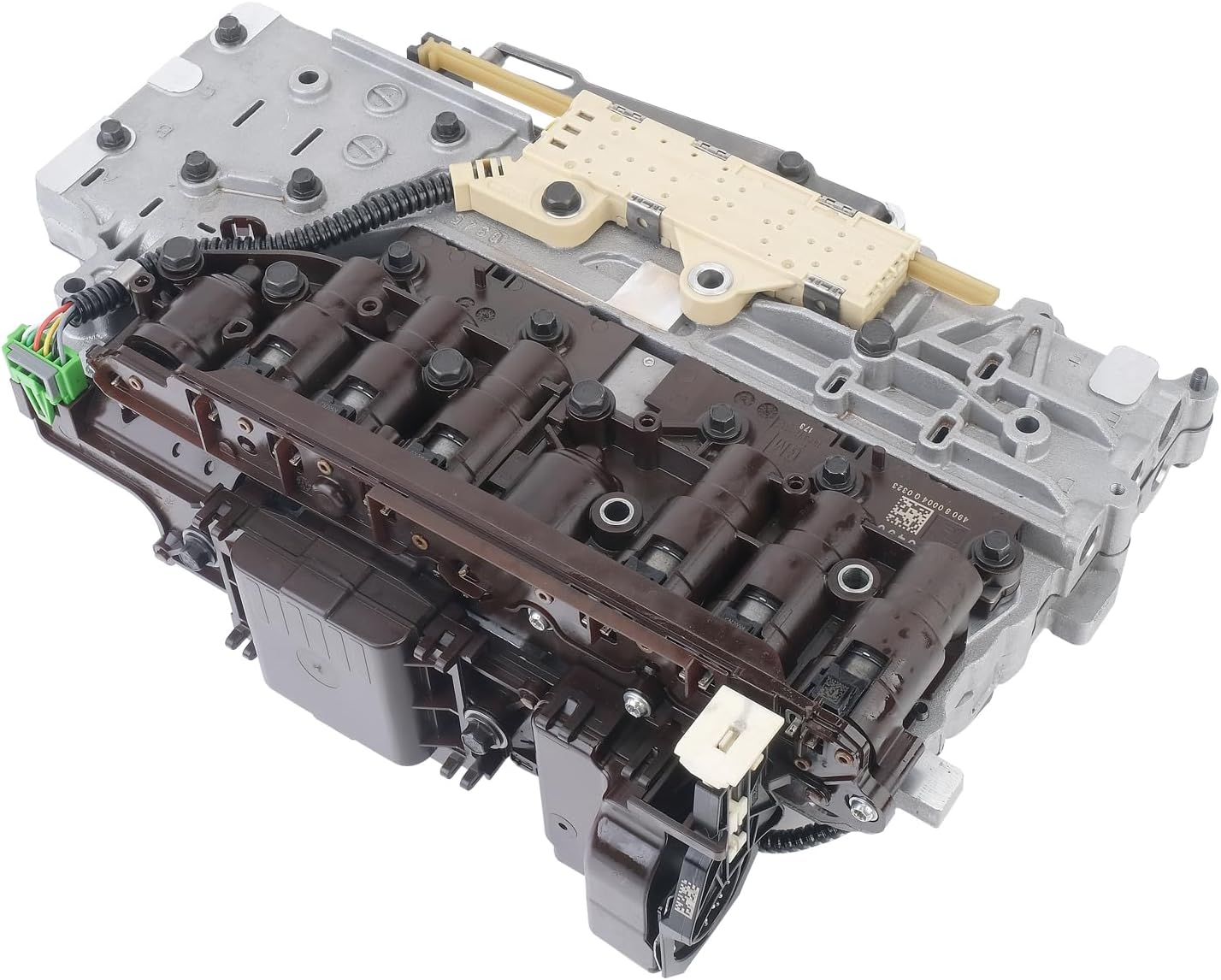
What shift solenoid 1 actually does in a 6L80
Forget the 4L60E mental model. The 6L80 does not use shift solenoids to run individual upshifts. It uses five pressure control solenoids to modulate the clutches directly, and two simple on/off shift solenoids to steer signal oil to the clutch select valves - the valves that decide which clutch a given control solenoid is currently feeding. Shift solenoid 1 is one of those two.
Mechanically it is an on/off solenoid with a plunger and metering ball. Commanded on, the plunger blocks the exhaust and signal oil builds, pushing clutch select valve 2 against its spring into the applied position. De-energized, the signal exhausts and the spring returns the valve. In broad strokes, SS1 is commanded on in Park, Reverse, Neutral and manual first with engine braking, and commanded off across the D1-6 range.
That is why P0751 on a 6L80 is a range and clutch-select complaint, not a "my 1-2 shift is bad" complaint. When the module sees a commanded state that the speed sensors say did not happen - the calculated ISS/OSS ratio does not land on the gear it asked for - it flags the solenoid that was supposed to make it happen. The ratio targets on these units run roughly 4.03, 2.36, 1.53, 1.15, 0.85 and 0.67, with 3.06 in Reverse, so a miss is obvious in the data.
The trap: a good solenoid that looks failed
Here is the part that costs shops money. Every solenoid in this transmission is fed by one valve - the actuator feed limit valve, also called the solenoid regulator or solenoid modulator valve. Sonnax describes its job plainly: it takes line pressure and regulates it down to a lower, consistent maximum feed for the solenoids, typically in the 80 to 115 psi range, so every solenoid has a stable supply to meter from.
The AFL valve is one of the busiest valves in the unit, and its aluminum bore wears. When it does, Sonnax spells out both failure directions: AFL feed that is too high floods the solenoid beyond its ability to exhaust and strokes the shift valve inappropriately, while AFL feed that is too low leaves the shift valves unable to stroke fully. Either case produces shift concerns, clutch failures and solenoid codes.
Read that back against what P0751 is telling you. The circuit is fine. The winding pulled current. The valve did not move. That is exactly the fingerprint of a worn AFL bore, and Sonnax says it directly - a worn solenoid modulator or AFL valve can create issues that make a perfectly functioning solenoid appear to have failed. The Sonnax 6L45-6L90 valve body layout backs it up in print: Code P0751 is listed in the symptom column next to the AFL and shift/TCC repair parts, not next to a solenoid.
Sonnax Shift & TCC Kit 6L45-6L90-MINI
This is the kit Sonnax lists against Code P0751 on its own 6L80 valve body layout. It packages the actuator feed limit, TCC regulator and pressure regulator repairs behind solenoid performance codes. If the valve body is coming off anyway, this is the one to have on the bench.
View the Sonnax 6L45-6L90-MINI kit →Symptoms that ride along with P0751
- Wrong gear start - the truck pulls away in a gear it should not be in, most often third.
- Harsh or slammed engagement into Drive or Reverse, or a delayed engagement that shows up cold.
- Flare or slip on a specific shift, or a shift the module commands and you never feel.
- Failsafe after a few miles, often with P0751 joined by clutch pressure control performance codes - P0776, P0796, P2714 or P2723.
- Transmission fluid temperature running above normal, because a clutch that is not fully applied is a clutch that is slipping.
Diagnosing it in order
1. Fluid level, condition and temperature first
These units run DEXRON VI and they are level-sensitive, because the check is done hot through a plug rather than with a dipstick. Low fluid aerates the pump feed and every solenoid downstream reads the result. While you are under there, look at the cooler lines: GM Service Bulletin 22-NA-182 (March 2024) covers 6L80, 6L90, 8L90, 10L80, 10L90 and 10L1000 vehicles with harsh shifting, shudder, surge, neutral/flare and transmission overheating, and names a twisted cooler line as a cause - untwist it or replace it, then recheck the level. That is a free find on a truck that would otherwise get a valve body.
2. Capture the full code set and freeze frame before clearing
P0751 alone and P0751 with three clutch pressure control performance codes are two different jobs. A single code points at one circuit or one valve. A cluster points upstream - at the AFL valve feeding all of them, at line pressure, or at the module. Record the freeze frame before you clear anything.
3. Watch the ratio math on a test drive
Graph input speed sensor, output speed sensor, commanded gear and the shift solenoid 1 commanded state together, then drive it. Divide ISS by OSS and compare against the target ratios above. You want the moment the commanded state changes and the calculated ratio does not follow, or follows late. If SS1 is commanded on in Reverse and the ratio never lands near 3.06, you have confirmed the failure in data instead of by feel. Keep the fluid pressure switch states on the same graph - they say whether the manual valve and range circuit agree with the shifter.
4. Put a mechanical gauge on it
Do not use the module's own pressure parameter to grade the module. Hook a real gauge to the mainline port and watch idle pressure and rise. Sonnax gives the signature worth memorizing: when the TEHCM line pressure solenoid ends up stuck in an exhaust mode, line pressure sits around 60 to 68 psi with no RPM rise whatsoever - and unplugged reads no different. If you see a flat 60-something that never rises, stop chasing SS1. You have a line pressure problem that will write solenoid performance codes all day long.
5. Drop the pan and read the debris
Cut the filter open. Clutch material means you are past diagnosis and into a rebuild conversation; bright metal points at the pump or the converter. Then check the checkballs. ATRA's GEARS Magazine documented the #1 checkball in the 6L45/6L50/6L80/6L90 upper valve body wearing from its original 0.250 in. down to 0.180 in. or less, at which point it stops sealing against the spacer plate, lodges in it, or blows through. That ball sits in the 1-2-3-4 clutch feed circuit, and its failure shows up as no forward, slipping in forward, or a cold neutral in first, sometimes with P2723 or P2724. Follow that article's instruction literally: replace all of the checkballs during any valve body service on these units.
6. Vacuum test the valve body on the bench
This is the step that separates a diagnosis from a parts swap. With the valve body off, vacuum test the AFL valve and both clutch select valve locations. The Sonnax vacuum test guide for the 6L45-6L90 family shows the exact ports, notes that OE valves are tested in their rest position unless stated otherwise, and names the repair part for each location. A low reading is bore wear - which you cannot see with your eyes and can measure in ninety seconds with a hand pump.
Sonnax Actuator Feed Limit Valve Kit 104740-47K
The drop-in fix when the AFL bore fails a vacuum test. The sleeve and valve assembly gives the valve a new, unworn bore while the sleeve seals off existing wear, and the correct spring for limit pressure comes in the kit - no reaming required. Sonnax lists solenoid performance codes, wrong gear starts, harsh shifts and soft shifts as what it addresses.
View the AFL valve kit 104740-47K →The fix, by what you actually found
Worn AFL bore
Two paths. The drop-in kit 104740-47K installs without machining and handles moderate wear. For heavier wear, the oversized valve 104740-12 goes in after the bore is reconditioned with tool kit F-104740-TL12. Sonnax adds a condition that gets skipped: proper AFL action depends on correct line pressure supply to the AFL valve in the first place. If line pressure is also wrong, the pressure regulator and boost valve repair belongs on this job, not the next one.
Sticking or worn clutch select valve
Since SS1 works through clutch select valve 2, a stuck or worn select valve produces this exact code with a perfectly good solenoid. Clutch select valve kit 104740-31K covers that bore. One assembly detail from Sonnax that ruins otherwise good rebuilds: the clutch select valves go in first, springs outboard. Installed backwards, you get a loss of forward, reverse, or both - with normal line pressure, which is exactly the combination that sends people back into a transmission they just built.
Wrong separator plate
Worth a hard look on any 6L80 that has been apart before. The Sonnax no-movement writeup is specific: a Type 2 separator plate on a Type 1 valve body gives no forward, and a Type 1 plate (P/N 24245720, seven checkballs) on a Type 2 body gives no third and no reverse. Line pressure reads normal in both cases. Early Type 1 valve bodies cannot be updated to the later eight-checkball plate.
Actually a bad TEHCM
It happens - but it is the conclusion, not the opening bid. Condemn the module only after the fluid is right, pressure rises, the valve body passed a vacuum test, and the ratio data still shows a commanded state that never produced a hydraulic result. If you do replace it, verify the part number against the VIN and program it before operation: Sonnax warns that an incorrect or incorrectly programmed TEHCM will itself cause a no-movement or no-upshift condition. One more quirk worth knowing - a temporary no-move can appear during the OE relearn. Pull the scanner, pull the key, open and close the driver door, wait fifteen to twenty minutes, and it is usually good to go.
Putting it back together, and keeping the next one away
- Replace every checkball, not just the one that looks bad.
- Verify separator plate type against the valve body before it goes on.
- Clutch select valves in first, springs outboard.
- Air check the valve body before the pan goes on. Two minutes here catches an assembly error while it is still cheap.
- Fill with DEXRON VI only, then set the final level hot at the check plug, not cold on the bench.
- Drive the relearn. These adapt, and a fresh valve body with stale adapts feels wrong until it has cycled through the range enough times.
AFL bore wear is a mileage-and-heat problem. Cooked fluid stops protecting an aluminum bore that strokes constantly, and every extra degree shortens that clock. Service fluid and filter on a real interval instead of the lifetime-fill marketing, keep the cooler circuit unobstructed - the entire point of bulletin 22-NA-182 - and if the truck tows, treat cooling as part of the transmission rather than an accessory.
FAQ
Can you replace just shift solenoid 1 on a 6L80?
No. On the 6L80 and 6L90 the solenoids are part of the TEHCM assembly bolted to the valve body, and they are not sold or serviced as individual pieces the way a 4L60E shift solenoid is. If the solenoid itself is genuinely at fault, the part you are buying is a TEHCM. That is one more reason to prove the hydraulic side is good before you condemn anything - the wrong call here is expensive.
Is P0751 on a 6L80 the same as P0751 on a 4L60E?
Same code number, different transmission and different repair. On a 4L60E, shift solenoid A is a serviceable part in the valve body that runs the 1-2 shift valve. On a 6L80, shift solenoid 1 is an on/off solenoid inside the TEHCM that sends signal oil to a clutch select valve, and it is not serviced separately. Diagnostic articles written for the 4L60E version of this code will send you down the wrong path on a 6L80.
Can I drive a 6L80 with P0751 set?
Short distances, carefully. The module will usually drop into failsafe with a fixed gear and no converter lockup, which is drivable to a shop. What you do not want is to keep driving a truck that is starting in the wrong gear or slipping, because a partially applied clutch generates heat and heat is what turns a valve body repair into a rebuild. Get it read and off the road.
Will a shift kit fix P0751 on a 6L80?
It can, if the root cause is bore wear in the actuator feed limit or clutch select circuits - which is common enough that Sonnax lists Code P0751 against its 6L45-6L90 shift and TCC kit. It will not fix a low fluid level, a twisted cooler line, a worn checkball, a wrong separator plate, or a genuinely failed module. Vacuum test first, then buy parts to match what failed.
Need parts for this job?
Valve body repair kits, actuator feed limit and clutch select valve kits, separator plates, checkball sets, filters, pan gaskets and DEXRON VI - everything this repair touches, in one 6L80 collection.
Shop 6L80 parts →Shop 6L80 parts →
Related 6L80/6L90 guides
Sources
- Sonnax - GM 6L45, 6L50, 6L80, 6L90 Valve Body Layout — Backs the listing of Code P0751 in the symptom column against the actuator feed limit and shift/TCC repairs (Shift & TCC Kit 6L45-6L90-MINI, Actuator Feed Limit Valve Kit 104740-47K, Oversized Actuator Feed Limit Valve 104740-12, Clutch Select Valve & Bore Sizing 104740-BST31), and the location of the AFL and clutch select valves in the upper and lower valve bodies. https://www.sonnax.com/tech_resources/1052-gm-6l45-6l50-6l80-6l90-valve-body-layout
- Sonnax - Uncovering the Root Cause of Pressure & Complaints: The Critical Role of Solenoid Modulator & AFL Valves (Maura Stafford, January 25, 2023) — Backs the AFL valve function and the 80-115 psi regulated solenoid feed range, the too-high and too-low feed failure modes on an on/off solenoid circuit, and the core point that a worn solenoid modulator or AFL valve can make a perfectly functioning solenoid appear to have failed. https://www.sonnax.com/tech_resources/1208-uncovering-the-root-cause-of-pressure-complaints-the-critical-role-of-solenoid-modulator-afl-valves
- Sonnax - GM 6L45/50, 6L80/90 No Movement Conditions: Analysis & Repair Tips (Jim Mobley, March 8, 2023) — Backs the 60-68 psi stuck-in-exhaust line pressure signature with no RPM rise and the note that unplugged reads no different; the Type 1 / Type 2 separator plate mismatch symptoms and plate P/N 24245720 with seven checkballs; the clutch select valves-first, springs-outboard assembly rule; the incorrect or incorrectly programmed TEHCM causing no movement or no upshift; and the temporary post-programming no-move relearn quirk. https://www.sonnax.com/tech_resources/1216-gm-6l45-50-6l80-90-no-movement-conditions-analysis-repair-tips
- Sonnax - GM 6L45, 6L50, 6L80, 6L90 Vacuum Test Guide — Backs the bench vacuum-test procedure and port locations for the actuator feed limit and clutch select valve circuits, the instruction to test OE valves in the rest position unless otherwise indicated, and the rule that a low vacuum reading indicates bore wear. https://www.sonnax.com/tech_resources/439-gm-6l45-6l50-6l80-6l90-vacuum-test-guide
- GEARS Magazine (ATRA) - What's Old Is New Again: 6L45/6L50/6L80/6L90 No Forward, Slips Moving Forward (Steve Garrett, August 6, 2024) — Backs the #1 checkball wearing from 0.250 in. to 0.180 in. or less, its location in the upper valve body 1-2-3-4 clutch feed circuit, the no-forward / slipping / cold-neutral-in-first symptoms with P2723 or P2724, and the instruction to replace all checkballs during any valve body service. https://gearsmagazine.com/magazine/whats-old-is-new-again-6l45-6l50-6l80-6l90-no-forward-slips-moving-forward/
- General Motors Service Bulletin 22-NA-182, March 2024 (NHTSA-hosted PDF) — Backs the twisted cooler line as a documented cause of harsh shifting, shudder, surge, stall, neutral/flare and transmission overheating on 6L80, 6L90, 8L90, 10L80, 10L90 and 10L1000 equipped vehicles, and the instruction to untwist or replace the line and then recheck the fluid level. https://static.nhtsa.gov/odi/tsbs/2024/MC-10251353-0001.pdf