A 6L90 that drives forward normally and does nothing in Reverse is one of the few complaints on this unit that tells you where to look before you put a hand on it. Reverse, third and fifth share an apply component. Forward — first, second, fourth, sixth — does not. So when Reverse dies by itself, or dies along with third and fifth, the 3-5-Reverse circuit is the suspect, and the list of things that can starve that circuit is short enough to work through in an afternoon.
What makes this job expensive is guessing. Plenty of 6L90s get a control module or a whole remanufactured unit for a no-reverse complaint that was a checkball out of its pocket, three seals left out of a clutch housing, or the wrong valve body bolted to the case. All three are documented, all three are cheap, and all three look identical from the driver's seat.
The short version: Sonnax lists the common 6L80/6L90 no-reverse causes as an out-of-place no. 5 checkball, an incorrect separator plate or gasket set, an improperly indexed snap ring, cracked welds in the 3-5-R drum, a stuck 3-5-R clutch regulator valve in the upper valve body, or a TEHCM solenoid fault. Add one more if the valve body was recently replaced: a 6L80 valve body on a 6L90 case gives you forward and no reverse, because the center support holes in the upper casting have a different offset between the two models.
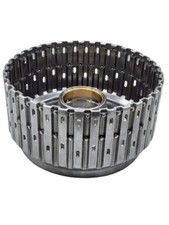


Why Reverse, Third and Fifth Travel Together
The 6L90 (RPO MYD) is the heavy-duty version of the 6L80. Structurally the two are close, but roughly 25% of the internal components were upgraded for torque capacity, and the case was stretched 1 3/8 in. to house stronger input and output gearsets and a different output shaft. That length difference is not cosmetic, and it is the reason for one of the failures further down this page.
The apply component that matters here is the 3-5-Reverse clutch, which lives in a welded assembly with the 1-2-3-4 clutch. It is applied in third, in fifth, and in Reverse. Look at the condition list GM published for this unit in bulletin 09-07-30-004J and the pattern is right there: slip when Reverse is selected or no reverse, delayed engagement into reverse, harsh shifts from second to third, harsh shifts from fourth to fifth or slips in fifth, and slips on acceleration when passing. Those are not five problems. That is one clutch circuit failing in the three gears that use it.
So the first question on any 6L90 no-reverse is not "what part do I need." It is: does the truck also have a third-gear or fifth-gear complaint? If it does, you are in the drum and the seals. If Reverse is the only thing missing and everything else is clean, the valve body and the hydraulic routing move to the top of the list.
Cause 1: The Wrong Valve Body (Reverse Died Right After a Repair)
This one belongs first because it is free to check and it wastes the most time. A 6L80 valve body will physically bolt to a 6L90 case, and a 6L90 valve body will bolt to a 6L80. Sonnax's TASC Force tips on the subject are direct about the result: the center support holes in the upper casting have a different offset between the models, so with the wrong valve body installed the unit will have forward but no reverse, because the case ports do not line up with the ports in the upper casting.
The identification trick is the machined-down boss on the upper casting — a "C" boss for 6L80 (RPO MYC), a "D" boss for 6L90 (RPO MYD). Sonnax warns not to lean on it as your only check, because some valve bodies have no bosses machined down at all. If the unit lost Reverse the day a valve body, a TEHCM or a remanufactured assembly went in, pull it and compare castings before you order anything.
The same logic covers the rest of the assembly errors. Sonnax's no-movement analysis lists the no. 5 checkball out of place as a straight no-reverse, and the Type 1 separator plate (24245720, seven checkballs) installed on a Type 2 valve body as no third and no reverse. Swap the plates the other direction and you get no forward instead. None of that sets a code on its own. It is a visual inspection and a gasket set.
Cause 2: The Cracked 1-2-3-4 / 3-5-R Clutch Housing
This is the headline failure on the unit and it has both a GM bulletin and an ATRA bulletin behind it. Per GM bulletin 09-07-30-004J, 2006-2008 vehicles with the 6L80 or 6L90 may lose Reverse because of a cracked 1-2-3-4 / 3-5-R clutch housing. ATRA bulletin 2012-54 covers the same defect and adds the detail that matters on the road test: the cracks affect the 3-5-Reverse area of the clutch drum, and their severity changes with temperature and input torque. That is why the customer tells you it backs up cold in the morning and refuses to at the end of the day.
The inspection is a soapy water air test, and GM publishes it both ways:
- Assembled housing: apply soap compound to the weld area, hold your thumb over the air bleed passage, spray compressed air into the 3-5-R clutch feed hole, and watch the weld for bubbles.
- Disassembled housing: soap the weld area, thumb over the air bleed passage, air into the housing, inspect the weld for bubbles.
- Bubbles anywhere in the weld means a new housing. There is no repair.
ATRA adds the shortcut: an updated housing carries a DOT MATRIX stamping. No stamping means the housing predates the supplier change and you have to inspect it, no exceptions. Two cautions come with the replacement. ATRA warns that the bearing supporting the housing must be present in the new housing — some early GM replacements shipped without it, and shift feel suffers if it is missing. GM warns that the 6L80 got a design change to the 1-2-3-4 piston, the 1-2-3-4 piston housing and the 3-5-R piston for the 2008 model year, and installing a 2008 6L80 complete housing assembly into a 2007-or-older 6L80 can produce a 2-3 shift flare or 3-5-R clutch distress.
Cause 3: The Three Inner Seals
Worth its own heading because it is the most common way a rebuilt 6L90 leaves the bench with no reverse. GM 09-07-30-004J states it plainly: when installing a new 1-2-3-4 / 3-5-R housing into a 2007 or older unit, install all three inner seals — failure to install these seals can result in no reverse, no forward, or distressed clutches. The seals are called out as items 7, 8 and 9 in the bulletin illustration.
The related item in the same bulletin is the pump cover clutch fluid seal rings. Transmissions built for 2006, 2007, 2008 and early 2009 used a one-piece seal ring; starting December 2008 GM moved to a two-piece design. The one-piece rings leak and typically show up as a harsh 2-3 shift at low mileage. If you find one-piece rings, replace them with new one-piece rings (ring kit 24248581) — the pump cover itself does not need to be replaced. Do not put one-piece rings on a two-piece pump cover; the two-piece cover is identified by a notch in the seal ring groove that accepts the tab on the two-piece ring. Orientation matters on installation, and getting it wrong buys you a repeat.
Shop the part for this fix: 6L90 1-2-3-4 and 3-5-Reverse Clutch Seal Pack
If the drum is coming out, these are the seals GM's bulletin says you cannot skip — the 1-2-3-4 and 3-5-Reverse clutch seal set for the 6L90. Cheap next to a second teardown when the unit comes back with no reverse.
Get the 3-5-R clutch seal pack →Need the drum, the pistons or a full kit? Browse the full 6L90 parts collection.
Cause 4: The 3-5-R Clutch Regulator Valve
If the drum air-tests clean and the assembly is right, the valve body is next. Sonnax lists the 3-5-R clutch regulator valve as a known sticker that produces no reverse plus shift complaints, and notes that line pressure typically reads normal when it does — which is exactly why a pressure test alone will not find it.
ATRA's 6L50/6L80/6L90 update material goes further and names the valve by code. For the family of clutch pressure control "stuck off" codes — P0756, P0766, P0776, P0796, P2714, P2723 — it leads with DO NOT REPLACE TEHCM FOR THESE CODES, then lists the causes common to all of them: checkballs not sealing on the spacer plate, a damaged spacer plate with worn checkball holes, undersized or incorrect bore plugs, debris, and cracks or seal leakage in the suspect drum. Bore plugs should measure 0.4528 in. plus or minus 0.0001 in. (11.502 mm plus or minus 0.004 mm). For P0776 specifically, the instruction is to inspect the 3-5-R clutch regulator valve in the upper valve body for wear and sticking, then inspect the drum for cracks and its seals for leakage.
Bore wear on these valves is a vacuum-test finding, not a visual one. If the bore leaks down, a reamed-and-sleeved repair kit puts it back in spec; a used valve body out of the same era usually carries the same wear.
What the Codes Will and Will Not Tell You
A mechanical no-reverse frequently stores nothing at all, because the module reports a ratio error in gears it can measure and it does not monitor Reverse the way it monitors a forward gear. The code that does show up on the way to a no-reverse is P0776, and ATRA bulletin 2012-54 publishes its set conditions in full:
- The TCM detects an incorrect oncoming clutch gear ratio, or flare, when the 3-5-R clutch is commanded to apply for 2.25 seconds and input shaft speed is more than 60 to 100 RPM off the anticipated value.
- No P0716, P0717, P0722, P0723 or P1825 active or failed this key on.
- Ignition voltage between 8.6 and 18.0 volts, fluid temperature at or above 32°F (0°C), TCM high side driver one enabled.
- Average driven wheel speed 80 RPM or more, side-to-side wheel speed difference 150 RPM or less for six seconds, input shaft speed above 60 RPM.
- PC solenoid 2 commanded on, and third (1.532:1) or fifth (0.852:1) gear ratio achieved.
When P0776 sets, the module commands maximum line pressure, inhibits TCC and freezes the shift adapts — so a customer who keeps driving hands you a hot, adapt-frozen unit on top of the original crack. If you are chasing that code in detail, the full breakdown is in our 6L90 P0776 guide.
The Diagnostic Order That Works
- Scan first, record freeze frame. Note any P0776 and its freeze frame values before you clear anything.
- Check the range input. With the shifter in Reverse, the internal mode switch should read L/L/H/H on the scan tool per ATRA's state table, PRNDL should display REVERSE and the P/N switch should read IN GEAR. If the states do not track the shifter, you have a range problem, not a clutch problem — check the cable, the lever and the detent before condemning the switch.
- Set the fluid level correctly. The 6L90 has no dipstick. Level is set at the control plug in the center of the drain plug with the fluid between roughly 85°F and 120°F (30-50°C), on level ground, after cycling the shifter slowly through the ranges. Low fluid produces a soft or absent Reverse that mimics everything above.
- Gauge the mainline. Sonnax's readings for this family: flat at roughly 60-68 psi with no rise as RPM comes up points to the line pressure solenoid stuck in exhaust; below 30 psi at idle points to a missing boost valve roll pin in the pressure regulator. Normal pressure with no reverse sends you straight to the 3-5-R circuit.
- Drop the pan and look at the filter. ATRA documents cracked filters — OE and aftermarket — letting air into the hydraulic circuits and causing slipping, no forward or no reverse, and notes that if you find a crack or separation at the seam you may need to pull the pump and inspect it for damage.
- Air test the drum. Soapy water on the weld, thumb on the bleed passage, air into the 3-5-R feed. Bubbles equal a new housing.
Fluid and Refill
Any repair that opens the unit ends with the right fluid and the right level. Per GM's 2025 transmission capacities and fluids chart, the 6L90 (RPO MYD) uses DEXRON-VI with a fluid change capacity of 5.7 liters / 6.0 quarts. That is the service fill for a pan drop and filter, not a dry fill — a unit that came out of the truck with the converter drained takes considerably more, and it gets set at the level plug either way.
Do not substitute a generic multi-vehicle ATF here. DEXRON-VI was specified for this family from launch, and its lower, more stable viscosity is part of how the clutch apply timing and the line pressure calibration were developed.
Matching the Fix to the Cause
| What you found | The repair |
|---|---|
| No reverse immediately after a valve body or TEHCM swap | Verify the valve body matches the case (C boss = 6L80, D boss = 6L90); the center support port offset differs |
| No reverse and no third after a rebuild | Wrong separator plate type — Type 1 plate 24245720 on a Type 2 valve body |
| No reverse, forward normal, no codes | No. 5 checkball out of place; verify gasket set and plate |
| Reverse slips or is delayed, changes with temperature, plus 3rd/5th complaints, P0776 | Cracked 1-2-3-4 / 3-5-R housing; air test and replace, verify the support bearing is in the new one |
| No reverse right off the bench after a drum replacement | Missing inner seals (items 7, 8, 9) in the 1-2-3-4 / 3-5-R housing |
| Harsh 2-3 at low mileage on a 2006 to early 2009 build | One-piece pump cover clutch fluid seal rings — replace with kit 24248581, correct orientation |
| No reverse with normal line pressure and shift complaints | 3-5-R clutch regulator valve sticking in the upper valve body; check bore wear and plug size (0.4528 in.) |
| Slipping, no forward or no reverse, air in the circuits | Cracked filter — replace, and inspect the pump for damage |
Need parts for this job? We stock the 6L90 hardware these repairs call for — clutch drums, bonded piston sets, overhaul seal and gasket kits, valve bodies, Zip Kits, filters and master rebuild kits. Browse all 6L90 parts →
Keeping It From Coming Back
A no-reverse repair that lasts comes down to three habits. Air test the drum every time the unit is apart, even when the complaint was something else — the crack is progressive, and finding it on the bench costs nothing. Never reuse the inner seals or the pump cover rings on a housing swap. And finish with an adaptive reset and a relearn drive if a P0776 was in memory, because those adapts froze while the module was commanding maximum line pressure and they do not describe a healthy transmission.
On the prevention side, heat is what turns a hairline weld crack into a no-reverse. Keep the cooler circuit honest — lines not kinked or twisted, bypass functioning — and service the fluid on a real interval instead of a lifetime-fill assumption. ATRA's overtemp guidance for this family starts at inspecting the cooler lines for restrictions, and notes that a line that has run kinked for a long time often takes a set and needs replacing rather than straightening.
FAQ
Why does my 6L90 have no reverse but drive forward fine?
Reverse uses the 3-5-Reverse clutch, which forward gears one, two, four and six do not. Anything that starves that one circuit takes Reverse while leaving normal forward operation intact: a cracked 3-5-R clutch housing, missing inner seals on that housing, a no. 5 checkball out of place, the wrong separator plate, or a stuck 3-5-R clutch regulator valve in the upper valve body.
Can a 6L90 lose reverse without setting a check engine light?
Yes, and it is common. A mechanical or hydraulic loss of Reverse often stores no code at all. The code you may see, P0776, only sets under a specific list of conditions that includes third or fifth gear ratio having been achieved and the 3-5-R clutch being commanded to apply for 2.25 seconds. No code does not mean no problem, and it does not mean the module is at fault.
Will a 6L80 valve body work on a 6L90?
It will bolt on and it will not work correctly. Sonnax documents that the center support holes in the upper casting have a different offset between the 6L80 and the 6L90, so the case ports do not line up. The result is forward gears with no reverse. The machined boss on the upper casting helps identify the casting — C for 6L80, D for 6L90 — but some valve bodies have no machined boss, so compare the castings directly.
How do I check a 6L90 3-5-R drum for cracks?
Soapy water and compressed air, per GM bulletin 09-07-30-004J. On an assembled housing, apply soap compound to the weld area, hold your thumb over the air bleed passage, spray compressed air into the 3-5-R clutch feed hole and watch for bubbles at the weld. Disassembled, soap the weld, cover the bleed passage and air the housing. Any bubbles mean the housing is scrap. An updated housing carries a DOT MATRIX stamping; if the stamping is absent you must inspect.
What fluid and how much does a 6L90 take?
DEXRON-VI, and GM's 2025 capacities chart lists the 6L90 (RPO MYD) fluid change capacity at 5.7 liters / 6.0 quarts. That figure is a service refill after a pan and filter, not a dry fill. There is no dipstick — the level is set at the control plug in the drain plug with the fluid at roughly 85°F to 120°F on level ground.
Related guides
- 6L90 P0776: Causes, Set Conditions and the Fix
- 6L90 Slipping: Causes and the Fix
- 6L90 Valve Body Problems and How to Test Them
- 6L90 Limp Mode: Causes, Codes and the Real Fix
- 6L80 No Reverse: Diagnosis and Fix
Sources
- General Motors Service Bulletin 09-07-30-004J (February 2014, via NHTSA). Source for the condition list including slip or no reverse and delayed reverse engagement, the cracked 1-2-3-4 / 3-5-R clutch housing cause, the assembled and disassembled soapy-water air test procedures, the warning that omitting the three inner seals can cause no reverse or no forward, the 2008 6L80 piston design change caution, the one-piece versus two-piece pump cover seal rings, and ring kit 24248581. static.nhtsa.gov/odi/tsbs/2014/SB-10043845-3346.pdf
- ATRA Technical Bulletin 2012-54 — GM 6L80/6L90, Slips in Reverse, 3rd, 5th, P0776 Possibly Set. Source for the full P0776 set and enabling conditions, the 1.532:1 third and 0.852:1 fifth ratios, the module response (maximum line pressure, TCC inhibited, adapts frozen), the cracks affecting the 3-5-Reverse area of the drum and changing with temperature and input torque, the DOT MATRIX stamping, and the missing support bearing caution. atracom.blob.core.windows.net/manuals/individual/2012/2012-54.pdf
- ATRA — 6L50, 6L80, 6L90 Updates and Product Issues. Source for the "do not replace TEHCM" guidance on the clutch pressure control stuck-off codes, the P0776 instruction to inspect the 3-5-R clutch regulator valve in the upper valve body plus the drum and seals, the 0.4528 in. / 11.502 mm bore plug specification, the internal mode switch state table (Reverse = L/L/H/H), the cracked filter causing slipping with no forward or no reverse, and the cooler line restriction guidance. atracom.blob.core.windows.net/webinars/gm/6l50_80_90_updates.pdf
- Sonnax — Addressing GM 6L80, 6L90 No Reverse Condition (TASC Force Tips). Source for the common no-reverse cause list (no. 5 checkball, incorrect separator plate or gaskets, improperly indexed snap ring, cracked welds in the 3-5-R drum, stuck 3-5-R clutch regulator valve, TEHCM solenoid), the center support hole offset between 6L80 and 6L90 upper castings producing forward with no reverse, and the C/D boss identification caveat. sonnax.com/tech_resources/1613
- Sonnax — GM 6L45/50, 6L80/90 No-Movement Conditions: Analysis & Repair Tips. Source for the no. 5 checkball out of place equalling no reverse, the Type 1 separator plate 24245720 on a Type 2 body giving no third and no reverse, the 3-5-R clutch regulator valve sticking with normal line pressure, and the 60-68 psi and under-30-psi line pressure readings. sonnax.com/tech_resources/1216
- Transmission Digest — GM 6L80, 6L90 No-Reverse Condition Explanation (Tory Royce, Sonnax TASC Force). Source for the 6L90 being the heavier-duty variant with about 25% of internals upgraded and a case lengthened 1 3/8 in. for stronger input and output gearsets and a different output shaft. transmissiondigest.com/gm-6l80-6l90-no-reverse-condition-explanation
- General Motors — 2025 Transmission Capacities & Fluids (GM TechLink). Source for the 6L90 (RPO MYD) fluid change capacity of 5.7 liters / 6.0 quarts and the DEXRON-VI fluid specification. gm-techlink.com/wp-content/uploads/2025/06/TechLink-transmission-fluid-capacities-2025_A.pdf