P0776 on a 6L90 has probably sold more control solenoid valve assemblies than any other code in the family, and a good share of those units came back. The code says "Pressure Control Solenoid B Stuck Off," so the reflex is to replace the thing with the word solenoid in it. But GM does not set this code by looking at a solenoid. It sets it by watching whether the 3-5-R clutch actually holds torque in 3rd and 5th, then running an intrusive upshift to prove it.
Read the factory monitor table once and the diagnostic order sorts itself out. Here is what P0776 is measuring on a 6L80 or 6L90, what GM found when it tore these units down, and the bench sequence that separates a leaking bore plug from a cracked clutch housing.
The short version: GM lists P0776 under the Variable Bleed Solenoid group and tags it [C35R] — the 3-5-Reverse clutch. It sets in steady-state 3rd or steady-state 5th when gearbox slip hits 400 RPM and an intrusive command to the next gear succeeds [1]. That means the module proved the next clutch works and only the 3-5-R apply failed. GM's own bulletin 09-07-30-004G points the same complaint at a cracked 1-2-3-4 / 3-5-R clutch housing weld, not at the TEHCM [2]. Check fluid, then valve body end plugs and the 3-5-R clutch regulator valve, then air-check the housing. The solenoid is last.
What GM Actually Measures Before It Sets P0776
These numbers come straight out of GM's 11 OBDG07 TRANS Diagnostics document, 6L80/6L90 common section, rather than a code-lookup site. The thresholds are the whole story. [1]
| Parameter | Threshold |
|---|---|
| Component group | Variable Bleed Solenoid (VBS) |
| Circuit tag | [C35R] — 3-5-Reverse clutch |
| Fail Case 1 | Steady State 3rd Gear, commanded gear = 3rd |
| Fail Case 2 | Steady State 5th Gear, commanded gear = 5th |
| Gearbox slip | Greater than or equal to 400 RPM |
| Intrusive test (Case 1) | Command 4th gear; 4th must be attained |
| Intrusive test (Case 2) | Command 6th gear; 6th must be attained |
| Gear fail counter | 3 or more counts |
| C35R clutch fail counter | 14 or more counts |
| Ignition voltage | 8.5996 to 31.999 volts |
| Engine speed | 400 to 7500 RPM, stable for 5 seconds or more |
| Fluid temperature | Greater than or equal to -6.656 °C |
| MIL | One trip |
| Disabled by TCM codes | P0716, P0717, P0722, P0723, P182E |
Follow the logic. The 6L90 uses the 3-5-R clutch in 3rd, in 5th, and in Reverse. The module sits in a steady 3rd, sees the input turning 400 RPM faster than the output can explain, then commands 4th. If 4th arrives cleanly, the 4-5-6 clutch, the pump, line pressure and the input geartrain are all healthy. The only thing that failed to hold was 3-5-R. Same test in 5th, only it steps up to 6th.
Two things fall out of that. First, GM wants three gear-level fail counts and fourteen C35R clutch fail counts before it commits, so this is not a code that sets on one bad sample. By the time the light is on, the clutch has been slipping repeatedly. Second, the monitor is disabled when input or output speed sensor codes are set. [1] If you have P0716 or P0722 stored with it, fix the speed signal first — every number in that table is derived from ratio math that needs clean ISS and OSS data.
It is also worth knowing the mirror image. GM lists P0777 as PC Solenoid B Stuck On [C35R], testing in steady-state 1st with the same 400 RPM slip trigger. [1] Stuck-on means 3-5-R is dragging when it should be released, which fights the 1-2-3-4 clutch and cooks both.
The Hydraulic Path You Are Actually Diagnosing
Clutch Pressure Control Solenoid 2 does not feed the 3-5-R clutch directly. It sends a signal pressure to the 3-5-R clutch regulator and boost valve, and that valve is what routes line pressure into the clutch. When the solenoid is commanded on, signal pressure to the regulator valve goes high and strokes the valve open. Pressure Switch 1 is your confirmation: with the circuit working correctly it reads 0 in 3rd, 5th and Reverse. [7]
That single scan-tool PID does most of the work for you. Command 3rd, watch PS1. If the switch state does not change the way it should, the regulator valve is not stroking, and no amount of solenoid replacement changes that.
The reason the valve does not stroke is usually leakage, and Sonnax has documented exactly where. In the 6L45/6L50/6L80/6L90 valve body, the end plugs at the clutch regulator valves seal the actuator and solenoid feed pressure that controls each valve as clutches apply. Repeated valve impact and spring motion wear the plug-to-bore mating surface until that feed pressure bleeds off. Sonnax lists the result plainly: shift concerns and burnt clutches in those specific circuits. [4] Lose signal pressure at the 3-5-R regulator and the valve reacts late or not at all, which reads to the module exactly like a solenoid stuck off.
The valve itself sticks, too. Sonnax's Jim Mobley notes the 3-5-R clutch regulator valve is known to stick, causing no Reverse and shift complaints — and that line pressure will typically be normal with that condition. [3] That last part matters. A normal pressure gauge reading does not clear the valve body. Contrast it with a line pressure solenoid stuck in exhaust, which Mobley describes as pressure parked at roughly 60–68 psi with no RPM rise at all. [3] Two very different fingerprints.
While you are in there, the No. 5 checkball out of place is a no-Reverse condition, and it can be intermittent. [3] Also confirm the separator plate matches the body: a Type 2 plate on a Type 1 body gives no Forward, and Type 1 plate 24245720 on a Type 2 body gives no 3rd and no Reverse — again with normal line pressure. [3]
GM Bulletin 09-07-30-004G: The Cracked Housing
This is the one that turns a valve body job into a teardown, and GM published it years ago. Bulletin 09-07-30-004G covers 2006-2009 Corvette and STS-V, 2007-2008 Escalade, Silverado and Sierra, 2008-2009 HUMMER H2 and Pontiac G8 with the 6L80 or 6L90 (RPO MYC, MYD). The listed complaints are slip in Reverse or no Reverse, delayed Reverse engagement, harsh 2-3 shifts, harsh 4-5 or slipping 5th, slipping on acceleration when passing, and DTC P0776, P2715 or P2723 active or in history. [2]
GM's stated cause: a cracked 1-2-3-4 / 3-5-R clutch housing. [2]
Line up the symptom list against the clutch application chart and it is obvious. Slipping 3rd, slipping 5th and no Reverse are the three places 3-5-R does the work. A crack in that housing weld bleeds apply pressure, the clutch never gets full clamp, slip climbs past 400 RPM, and the module writes P0776.
GM's inspection is a soap-and-air test you can run without disassembling the housing: [2]
- Apply soap compound to the weld area of the housing.
- Hold your thumb over the air bleed passage.
- On a fully assembled 1-2-3-4 and 3-5-R housing, spray compressed air into the 3-5-R clutch feed hole.
- Watch the weld for bubbles. Bubbles means a new housing.
GM notes that complete, assembled 1-2-3-4 / 3-5-R clutch housings are supplied with all pistons, seals, clutches, bearing and internal parts, so nothing has to be built up before it goes in. [2] Bench tooling exists for this exact check if you do enough of these to justify it.
Do Not Default to the TEHCM
GM has said this in writing on the sister code. Bulletin 16-NA-027 covers 2015-2016 6L80 trucks with no 4th, 5th or 6th and DTC P0796, caused by a broken 4-5-6 clutch hub assembly. GM's instruction is direct: if that hub is found broken, the Control Solenoid (w/ Body and TCM) Valve Assembly is not the cause and should not be replaced. [6]
The bulletin adds a diagnostic tell worth memorizing: with a broken hub, the pan is clean with little or no debris and the fluid is clean with no distress. [6] A clean pan is not proof the hard parts are fine.
The same discipline applies to P0776. Confirm the solenoid mechanically by watching pressure switch response and attained gear ratio before you condemn the module. Shift-time data helps too — flared shifts landing near 0.70 seconds point at an internal clutch problem rather than a solenoid. [7]
The Bench Order That Works
- Scan and sort. Pull all codes. If P0716, P0717, P0722, P0723 or P182E is present, the P0776 monitor was disabled and any P0776 in history is stale — fix the speed sensor side, clear, retest. [1]
- Fluid level, condition and type. The 6L90 is DEXRON VI only. GM's 2025 capacity table lists the 6L90 (RPO MYD) at 5.7 liters / 6.0 quarts for a fluid change. [5] No dipstick on most, so set the level at the check plug at operating temperature. Dark or burnt fluid with clutch material means the 3-5-R pack is already gone.
- Pressure switch behavior. Command 3rd and 5th and watch PS1. It should read 0 in 3rd, 5th and Reverse when the regulator valve strokes correctly. [7]
- Line pressure. Gauge it. Normal pressure with the complaint present pushes you toward the regulator valve and end plugs, not the pump. Flat 60-68 psi with no rise is a different fault entirely. [3]
- Drop the pan and pull the valve body. Inspect the 3-5-R clutch regulator valve bore and the end plugs. Vacuum test the bores — Sonnax's threshold for these castings is a minimum of 18 in-Hg held at the test port. [4] Verify No. 5 checkball placement and separator plate type while it is apart. [3]
- Air-check the housing. If the valve body checks out, or if the fluid told you the clutch is burnt, run GM's soap-and-air test on the 1-2-3-4 / 3-5-R housing weld before you reassemble anything. [2]
6L90 Friction Clutch Kit
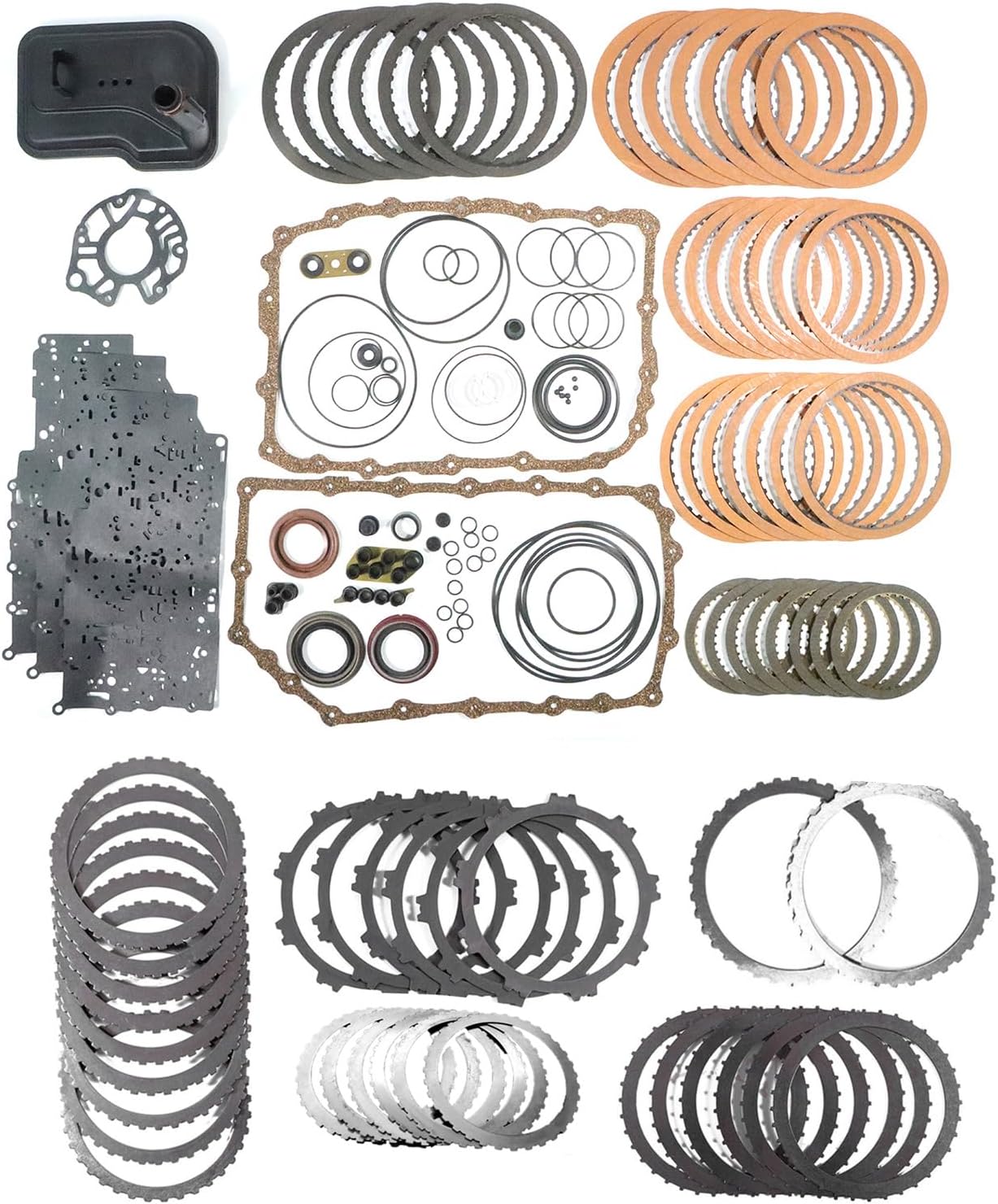
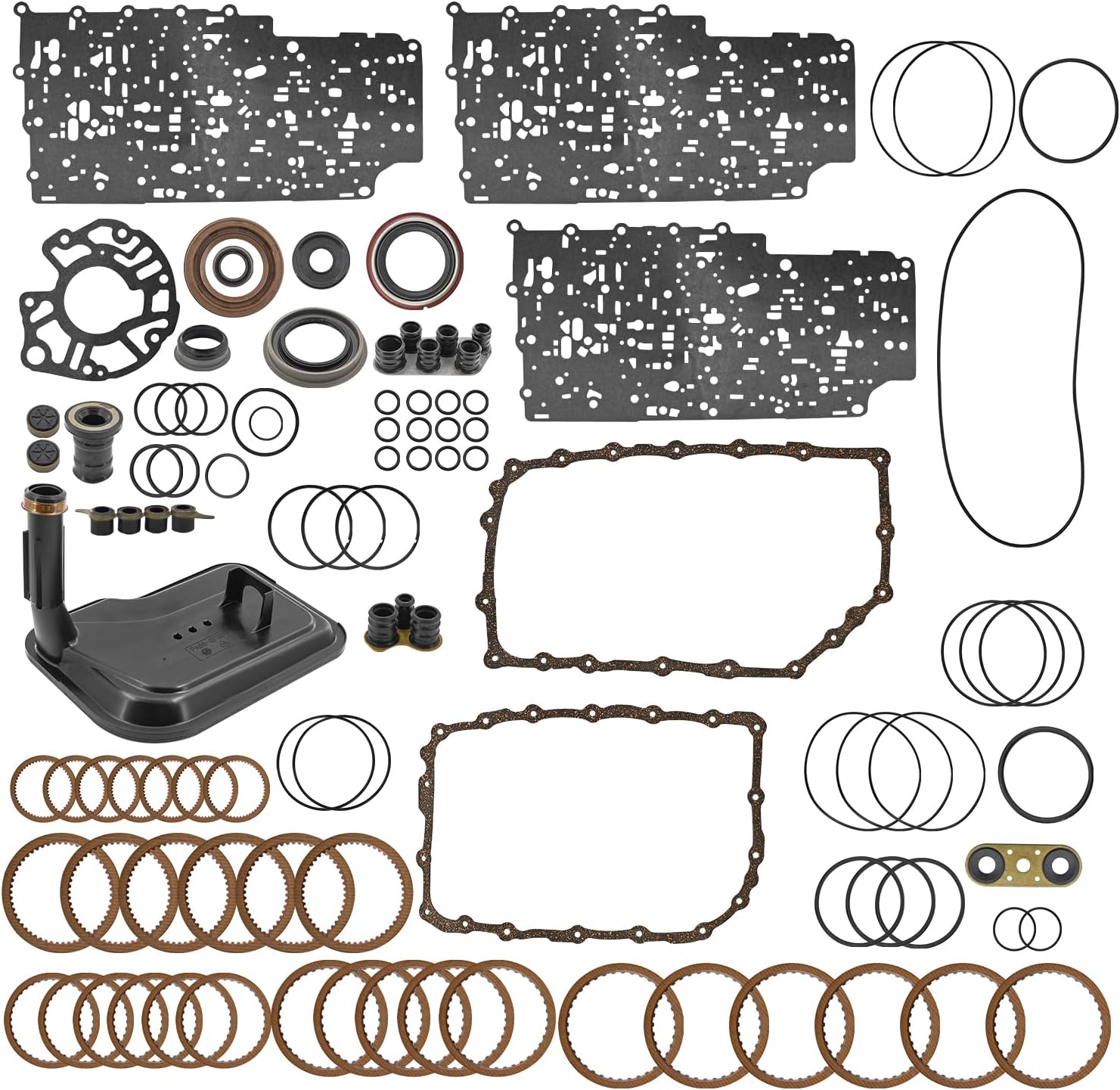
If the fluid came out dark and the 3-5-R pack is glazed, the clutch set has to go back new — a valve body repair over cooked frictions just resets the fail counter. Full friction kit for the 6L90, plus the rest of the model's hard parts and rebuild kits at the collection link below.
See the 6L90 friction clutch kit →Preventing the Repeat
Two things put these back on the lift. The first is heat. GM's bulletin 22-NA-182 covers harsh shift, shudder, surge, neutral/flare and overheating on 6L80 and 6L90 units, and it names a twisted cooler line as a cause on low-mileage vehicles. It also documents that the thermal bypass valve on the 6-speeds is external to the transmission and opens at 158°F (70°C). [8] Inspect and untwist or replace the line, and confirm the TBV is actually opening, before you hand the unit back.
The second is oil. End plug and valve bore wear comes from side-loaded valves stroking in dirty fluid. A unit that goes back out on a plugged cooler or a stretched service interval wears the same bores again and returns with the same code. Flush or replace the cooler whenever the fluid came out dark, and refill with DEXRON VI at the correct level. [5]
3-5-R clutch packs, bonded piston sets, valve body kits, end plug kits, filters, pan gaskets, DEXRON VI and the drum leak tester for the 6L90 — shipped fast from the USA.
Shop 6L90 parts →FAQ
What does P0776 mean on a 6L90?
GM defines it as Pressure Control Solenoid B Stuck Off, and tags the circuit [C35R] for the 3-5-Reverse clutch. It is a performance monitor, not an electrical one. The module sees the 3-5-R clutch slipping 400 RPM or more in steady 3rd or steady 5th, commands an intrusive shift to the next gear, and sets the code when that next gear arrives normally while the 3-5-R apply did not.
Can a cracked clutch housing cause 6L90 P0776?
Yes, and GM published it. Bulletin 09-07-30-004G names a cracked 1-2-3-4 / 3-5-R clutch housing as the cause of slipping or no Reverse, delayed Reverse engagement, harsh 2-3 shifts and DTC P0776, P2715 or P2723 on 6L80 and 6L90 units. GM's check is a soap compound and compressed air test at the housing weld, watching for bubbles at the 3-5-R clutch feed hole.
Should I replace the TEHCM for P0776?
Not as a first move. GM says outright on the sister code P0796 that when the hard part is broken the control solenoid valve assembly is not the cause and should not be replaced. Confirm the solenoid mechanically first by watching pressure switch 1 and attained gear on a scan tool. Flared shifts near 0.70 seconds point at an internal clutch problem, not a solenoid.
Why does the 3-5-R clutch affect 3rd, 5th and Reverse?
Because one clutch pack does all three jobs in the 6L90 gearset. That is why the symptom list on this code looks scattered: slipping 3rd, harsh or slipping 5th, and no Reverse are the same failure viewed from three gears. It is also why a single leak at the 3-5-R clutch regulator valve or a cracked housing weld produces all of them at once.
What fluid and capacity does a 6L90 take?
DEXRON VI only. GM's 2025 transmission capacity table lists the 6L90, RPO MYD, at 5.7 liters or 6.0 quarts for a fluid change. That is a service fill, not a dry fill after a rebuild or converter replacement, which takes considerably more. Set the final level at the check plug with the fluid at operating temperature rather than trusting a single number.
Sources
- GM — 11 OBDG07 TRANS Diagnostics, 6L80/6L90 Common Section (factory OBD monitor documentation). Backs the P0776 monitor in full: component group Variable Bleed Solenoid, circuit tag [C35R], Fail Case 1 steady state 3rd gear with intrusive command to 4th, Fail Case 2 steady state 5th gear with intrusive command to 6th, gearbox slip greater than or equal to 400 RPM, 3 gear fail counts and 14 C35R clutch fail counts, ignition voltage 8.5996–31.999 V, engine speed 400–7500 RPM stable for 5 seconds, fluid temperature at or above -6.656 °C, one-trip MIL, and the disable list P0716, P0717, P0722, P0723, P182E. Also backs P0777 as PC Solenoid B Stuck On [C35R] tested in steady state 1st. gsi.ext.gm.com — 11 OBDG07 TRANS Diagnostics (PDF)
- General Motors — Service Bulletin 09-07-30-004G, March 2012 (via NHTSA). Backs the model and RPO coverage (6L80/6L90, MYC/MYD), the complaint list including slip or no Reverse, delayed Reverse engagement, harsh 2-3 shifts and DTC P0776, P2715 or P2723, the stated cause of a cracked 1-2-3-4 / 3-5-R clutch housing, the four-step soap-and-compressed-air weld inspection at the 3-5-R clutch feed hole, and the availability of complete assembled housings. static.nhtsa.gov — GM Bulletin 09-07-30-004G (PDF)
- Sonnax — Jim Mobley, GM 6L45/50, 6L80/90 No Movement Conditions: Analysis & Repair Tips. Backs the 3-5-R clutch regulator valve being known to stick and causing no Reverse and shift complaints with normal line pressure, the 60–68 psi no-rise signature of a line pressure solenoid stuck in exhaust mode, the No. 5 checkball out of place as an intermittent no-Reverse condition, and the separator plate mismatches including Type 1 plate 24245720 on a Type 2 body giving no 3rd and no Reverse. sonnax.com/tech_resources/1216 — No Movement Conditions
- Sonnax — O-Ringed End Plug Kit 104740-23K (GM 6L45, 6L50, 6L80, 6L90). Backs end plug wear at the clutch regulator valves leaking the actuator and solenoid feed pressure that controls the valves as clutches apply, the resulting shift concerns and burnt clutches, the loss of Reverse and latch pressure at worn clutch select valve plugs, and the 18 in-Hg minimum vacuum test threshold for these bores. sonnax.com/parts/1707-o-ringed-end-plug-kit
- GM TechLink — Transmission Capacities & Fluids, 2025. Backs the 6L90 fluid specification and capacity: RPO MYD, 5.7 liters / 6.0 quarts fluid change capacity, DEXRON VI. gm-techlink.com — Transmission Capacities & Fluids (PDF)
- General Motors — Service Bulletin 16-NA-027, February 2016 (via NHTSA). Backs the instruction that when the 4-5-6 clutch hub assembly is found broken on a DTC P0796 complaint, the Control Solenoid (w/ Body and TCM) Valve Assembly is not the cause and should not be replaced, and that this failure presents with a clean pan containing little or no debris and clean fluid with no distress. static.nhtsa.gov — GM Bulletin 16-NA-027 (PDF)
- Vehicle Service Pros — Diagnosing Transmission Solenoid Performance Trouble Codes. Backs Clutch Pressure Control Solenoid 2 controlling the 3-5-Reverse clutch regulator and boost valve, that energizing the solenoid raises pressure at the regulator valve to stroke it open, that pressure switch 1 indicates 0 in 3rd, 5th and Reverse when the circuit is working, the guidance to verify solenoid mechanical operation through pressure switches and gear ratio before replacement, and flared shift times near 0.70 seconds indicating an internal clutch problem. vehicleservicepros.com — Diagnosing Transmission Solenoid Performance Trouble Codes
- General Motors — Service Bulletin 22-NA-182, March 2024 (via NHTSA). Backs the harsh shift, shudder, surge, neutral/flare and transmission overheating complaint set on 6L80 and 6L90 units, the twisted cooler line cause on low-mileage vehicles, and the thermal bypass valve opening temperature of 158°F (70°C) with the TBV external to the transmission on the 6-speeds. static.nhtsa.gov — GM Bulletin 22-NA-182 (PDF)