“It’s slipping” is where the conversation starts on a 6L90, and it is almost never where the diagnosis starts. This is a clutch-to-clutch six speed with no bands and no one-way roller clutch carrying the upper gears, which means every gear is held by a specific pair of clutches and every clutch is shared across a specific group of gears. Work out which gears are affected and you have named the part before the pan comes off.
What follows is the order I work a 6L90 slip complaint in: ratio math off the scan tool, then a pressure gauge, then air and soap, then the pan. Every specification, part number and procedure below comes from GM service bulletins or Sonnax technical material, and the documents are linked at the bottom.


Step one: prove it is slipping, with numbers
An owner saying “slipping” may be describing a slip, a flare, a converter clutch that is cycling, or an engine misfire under load. Separate them with input and output speed before touching anything.
Per GM’s own specification tables for the Hydra-Matic 6L90, the gear ratios are 4.03, 2.36, 1.53, 1.15, 0.85 and 0.67, with reverse at 3.06. Graph transmission input speed and output speed on the scan tool, divide one by the other, and compare the result to the commanded gear:
- Calculated ratio matches the commanded gear and stays there under load. Not slipping. Look at the engine, or at converter clutch slip speed if the complaint is a shudder.
- Ratio drifts above the commanded number under throttle and recovers when you lift. That is a slipping clutch, and which gears it happens in is the diagnosis.
- Ratio only runs away during a shift, then catches. That is a flare: the off-going clutch releases before the on-coming clutch has capacity. Usually a pressure, valve or adapt problem rather than a burned pack.
- Converter clutch slip speed swinging while the ratio holds. Converter or TCC control, not a holding clutch.
Write down the exact gears. On this unit that list is the map.
The clutch map: which gears share which clutch
The 6L90 uses five clutches, and each one is applied in more than one range. That overlap is what makes the failure pattern readable:
- Slips in reverse, third and fifth — the 3-5-R clutch. Those three ranges are the only places it is applied, so losing all three at once is its signature.
- Slips in fourth, fifth and sixth — the 4-5-6 clutch.
- Slips in first through fourth — the 1-2-3-4 clutch.
- Slips in second and sixth — the 2-6 clutch.
- Slips in reverse and manual first only — low and reverse.
A complaint that does not fit any of those groups is usually not a clutch at all. It is line pressure, a sticking valve, or fluid.
Cause 1: a cracked 1-2-3-4 / 3-5-R clutch housing
This is the one that produces the classic reverse-plus-third pattern, and GM documented it in bulletin 09-07-30-004J. The bulletin’s condition list reads like a symptom checklist off the service counter: slip when reverse is selected or no reverse, delayed engagement into reverse, harsh second-to-third shifts, harsh fourth-to-fifth or slips in fifth, slips on acceleration when passing, and DTC P0776, P2715 or P2723 stored as active or history in the TCM.
The stated cause is a cracked 1-2-3-4 / 3-5-R clutch housing, specifically a cracked weld. Clutch apply oil escapes through the crack, the pack never sees full apply pressure, and it cooks itself. New frictions in that housing burn again in short order, which is why this test matters more than the teardown does.
The soap-and-air test, straight out of the bulletin
It works with the housing assembled or apart, which means it can be done early:
- Apply soap compound to the weld area of the housing.
- Hold your thumb over the air bleed passage.
- On a fully assembled 1-2-3-4 and 3-5-reverse housing, spray compressed air into the 3-5-R clutch feed hole. With the housing apart, spray air into the housing.
- Watch the weld area for bubbles. Bubbles mean a new housing.
Two traps in that bulletin are worth memorizing. First, on a 6L90 (RPO MYD) the complete assembled housing is part number 24238695 for 2007 and 2008 applications; the 6L80 (MYC) 2008-up equivalent is 24238694, and they are not interchangeable backward. GM states plainly that installing a 2008 6L80 complete housing assembly into a 2007 or older 6L80 may result in a 2-3 shift flare or 3-5-R clutch distress, because the 1-2-3-4 piston, the piston housing and the 3-5-R piston were all redesigned for the 2008 model year. Second, when a new housing goes into an older unit, all three inner seals must be installed; leaving them out gives you no reverse, no forward, or distressed clutches.
One relative in the same family: a broken or cracked 3-5-R drum weld produces a no-reverse or slipping-reverse complaint with third and fifth gone as well, and Sonnax notes line pressure typically looks completely normal while it happens. Normal pressure does not clear a clutch of suspicion on this transmission.
Cause 2: the pump cover leak that starves the 1-2-3-4 clutch
If the slip is in first through fourth, or the truck launches soft and shudders and then drives fine once it is moving, the leak is usually upstream of the clutch, in the pump.
GM preliminary information PIP5175D covers slip or shudder during a launch in first, second, third or fourth, delayed engagement into drive, and a clunk or bump during the 1-2 shift, and notes the concerns may only be present at operating temperature. The listed models are 6L80 (MYC) units built in the Silao, Mexico plant rather than the 6L90, but the pump cover, stator support and 1-2-3-4 apply circuit are the same architecture, and the test is worth running on a 6L90 with the same complaint before anything comes apart.
The cause GM names is loose stator support to pump cover bolts causing a leak at the stator support to pump cover gasket. The test:
- Remove the fluid pan and the transmission control assemblies.
- Wearing eye protection, apply compressed air to the 1-2-3-4 clutch apply passage and watch for air leaking out of the compensator feed passage in the pump cover.
- If nothing escapes there, listen for excessive air leakage inside the unit, and look up through the case opening between the pump stator support and the 1-2-3-4 / 3-5-R clutch housing for a gap, a misaligned gasket, or fluid weeping out.
GM is emphatic about how you check those bolts: never with a hand tool. Use your fingers, or a socket turned by hand, and try to rotate them counterclockwise. They are torqued at the factory and are never meant to be loosened, so a torque-wrench check destroys the evidence. If any bolt turns, or the gasket is misaligned or leaking, the pump cover must be replaced (cover kit 24248573) and the 1-2-3-4 clutch plates inspected for distress — frictions 24224147, six of them, and steels 24258080, five. Reset the transmission adapts afterward or the complaint comes back in the customer’s hands.
While you are in there: the pump cover seal rings
Bulletin 09-07-30-004J also flags leaking 1-2-3-4 and 3-5-R clutch fluid seal rings on the pump cover assembly as a cause of harsh 2-3 shifts, and calls it typically a low-mileage issue. Units built in 2006, 2007, 2008 and early 2009 used a one-piece seal ring in production; starting December 2008 GM moved to a two-piece design. One-piece rings that leak get replaced with new one-piece rings (ring kit 24248581) and the pump cover itself does not have to come out of the parts budget. Do not install one-piece rings on a two-piece cover, which you identify by the notch in the seal ring groove that accepts the tab on the two-piece ring. Orientation matters too; installed wrong, the harsh 2-3 comes straight back.
Cause 3: line pressure, before you blame a clutch
Put a gauge on it. Sonnax’s analysis of no-movement and low-pressure conditions across the 6L45, 6L50, 6L80 and 6L90 gives usable targets for what a failed unit looks like:
- Pressure stuck around 60 to 68 psi with no rise on RPM whatsoever — a TEHCM line pressure solenoid stuck in exhaust mode.
- Below 30 psi at idle — a missing boost valve roll pin in the pump.
- Zero line pressure and no movement at all — a missing pump pressure relief ball and spring.
- Normal pressure, still no or partial engagement — stuck clutch regulator valves (1-2-3-4 or 3-5-R), clutch select valves installed backwards, a missing TEHCM filter gasket, or a mismatched separator plate. Sonnax warns specifically that Type 1 and Type 2 separator plates are not interchangeable and a mismatch creates a forward or reverse failure; the Type 1 plate with seven checkballs is 24245720.
This step is what keeps you from rebuilding a unit whose clutches burned because of a cheap valve, and from replacing a valve body on a unit whose clutches are already scrap. Vacuum test the valve bodies rather than eyeballing the bores. A worn bore passes a visual inspection and fails a vacuum gauge.
Cause 4: the 4-5-6 clutch and a backing plate that cones
A slip confined to fourth, fifth and sixth — usually felt as the truck falling on its face in overdrive on a grade, or with a trailer behind it — points at the 4-5-6 pack. Sonnax identifies two mechanical reasons it burns that are not the driver’s fault: insufficient clutch piston-to-plate apply surface area, which causes clutch plate failure especially when apply pressures exceed OE specifications, and flexing and bowing of the backing plate, described as coning and named as a primary source of clutch failure. Their heavy-duty 4-5-6 apply piston kit (104960-01K, for OE-style 36-tooth frictions and OE steels) answers both with a modified apply piston, a piston dam and apply ring that spread the load over more surface, and a more rigid backing plate.
Before you blame the pack alone, rule out the two 4-5-6 killers that are not friction wear. Per GEARS Magazine's 2019 article on 6L80/90 clutch failure, a failed cooler bypass valve typically overheats and burns the 4-5-6 clutch, so replace or bypass that valve during the repair. The same article notes a fractured 4-5-6 dampener shaft makes the clutch appear not to apply at all, and in severe cases the shaft snaps off the drum; GM changed the manufacturing process, so replace the shaft and dampener rather than reusing it.
If the unit is coming apart anyway and it lives behind a 6.0L or a 6.6L pulling weight, that is the upgrade worth the extra hour. A stock 4-5-6 pack that burned once will burn again under the same load.
Cause 5: the fluid, and when the fluid is not the answer
Check this first because it is the cheapest, but read the limit GM puts on it. Bulletin 20-NA-142 states that shudder and surging on 6L80 and 6L90 units may be caused by additives in the transmission fluid being depleted during vehicle operation — specifically additives that assisted with regulating a consistent slip rate of the clutches. The correction is three drain-and-fills of 6 quarts of DEXRON VI each, running the transmission through all six forward ranges, reverse and neutral between drains, with the filter replaced on the last one so the new element never sees old fluid.
Two hard limits sit in that same bulletin. It applies only to vehicles at or under 50,000 km (30,000 miles); above that, GM calls for the torque converter and the transmission oil filter to be replaced instead. And if there is metallic debris in the pan, the procedure stops cold: remove the transmission and replace the converter. Metal in the pan means a slip complaint is already a rebuild, and no amount of fresh fluid changes that.
The order that saves you a teardown
- Scan for codes. P0776, P2715 and P2723 together on a reverse or third complaint send you straight to the clutch housing test.
- Graph input and output speed, calculate the ratio in each gear, and write down exactly which gears slip.
- Drop the pan. Look for metallic debris and read the fluid. Debris ends the diagnosis and starts the rebuild.
- Put a gauge on line pressure and compare against the numbers above before condemning any clutch.
- With the pan and control assemblies off, air-test the 1-2-3-4 apply passage and check the pump cover gasket and stator support bolts by hand.
- Soap-and-air the 1-2-3-4 / 3-5-R housing weld, assembled or not.
- Only then decide between a valve body repair, a pump cover, a clutch housing, or a full rebuild.
Six of those seven steps happen before the transmission comes out of the truck, and any one of them can end the job early.
Shop the part for this fix
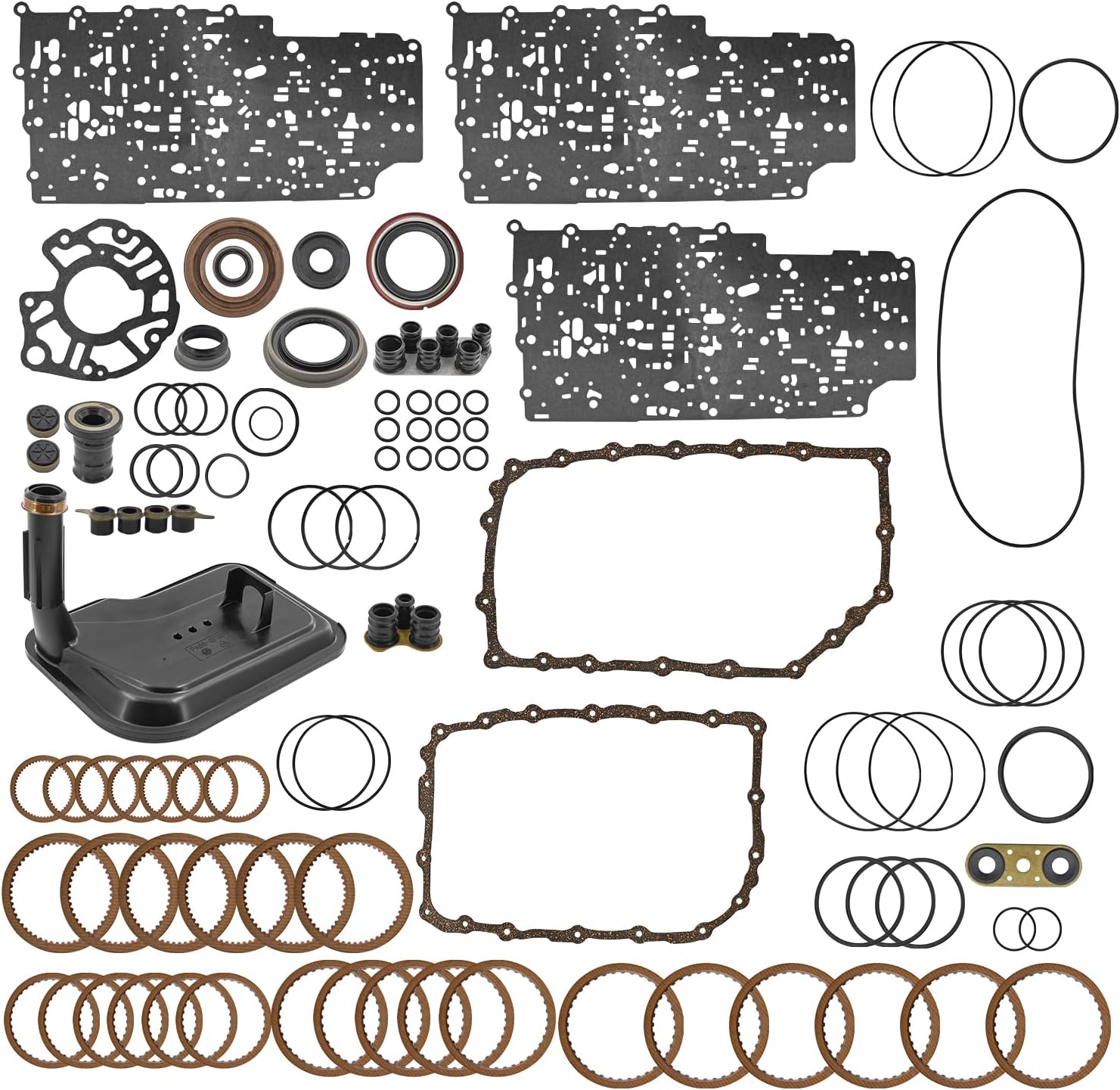
A slip that turns out to be burned clutches needs frictions, steels, pistons and seals in one box. CoreTransmissionParts stocks the 6L90 master rebuild kit with clutches, and the 1-2-3-4 / 3-5-reverse clutch seal pack on its own if the housing tests good and the seals are what leaked.
6L90 Master Rebuild Kit with Clutches →Need parts for this job?
Master rebuild kits, bonded piston sets, pressure regulator valve kits, valve bodies and clutch modules for the 6L90, in stock with secure on-site checkout.
Shop 6L90 parts →FAQ
Why does my 6L90 slip in reverse and third gear at the same time?
Because reverse, third and fifth all use the same clutch. The 3-5-R clutch is applied in all three ranges, so losing it takes out that exact group and nothing else. GM bulletin 09-07-30-004J names this pattern directly, listing slip or no reverse, delayed reverse engagement, slips in fifth and slips on acceleration when passing, with DTCs P0776, P2715 or P2723. The usual cause is a cracked weld in the 1-2-3-4 / 3-5-R clutch housing, and you find it with soap and shop air rather than a scan tool.
How do I tell slipping from a shift flare on a 6L90?
Watch input speed against output speed. A slip holds the commanded gear but the calculated ratio drifts high under load and recovers when you lift, so engine speed rises with no shift. A flare happens only during a shift, when the releasing clutch lets go before the applying clutch has capacity, and the ratio runs away for a moment in between. Divide input speed by output speed and compare to the commanded gear, using 4.03, 2.36, 1.53, 1.15, 0.85 and 0.67 for first through sixth. A ratio that never settles on the commanded number is a slip; one that only breaks up mid-shift is a flare.
Can low fluid or bad fluid make a 6L90 slip?
Yes, and it is the cheapest thing to rule out first. GM bulletin 20-NA-142 states the cause of shudder and surging on these units as additives in the fluid being depleted during operation, specifically the additives that regulated a consistent clutch slip rate. The fix in that bulletin is three drain-and-fills of 6 quarts of DEXRON VI each with the filter replaced last. It also caps the approach at 30,000 miles and tells you to stop if there is metallic debris in the pan, which means the converter comes out instead.
What line pressure should a 6L90 have, and what does low pressure mean?
Sonnax documents a line pressure that sits stuck around 60 to 68 psi with no rise on RPM when the line pressure solenoid is stuck in exhaust mode, and pressure below 30 psi at idle when the pump boost valve roll pin is missing. A unit with zero pressure and no movement can be missing the pump pressure relief ball and spring. The point is that a pressure gauge separates a hydraulic problem from a clutch problem before anything is taken apart, because burned clutches with normal line pressure and burned clutches with 25 psi are two different repairs.
Is a slipping 6L90 worth fixing or should it be replaced?
It depends on whether the slip is hydraulic or mechanical. A stuck clutch regulator valve, a worn valve bore, a leaking pump cover seal ring or loose stator support bolts are repairs that do not require a full teardown. Burned clutch packs, a cracked clutch housing weld or a broken 3-5-R drum weld mean the unit comes apart, and at that point a master rebuild kit with new frictions, steels and bonded pistons costs a fraction of a replacement transmission. Diagnose which one you have before pricing anything.
Related guides
- 6L80 / 6L90 3-5-R Clutch Failure
- 6L90 P0776: Causes and Fix
- 6L90 Valve Body Problems and How to Test Them
- 6L90 Rebuild Wear Points
- 6L90 Common Problems and Fixes
Sources
- General Motors, Service Bulletin 09-07-30-004J, February 2014 (hosted by NHTSA) — The condition list for a cracked 1-2-3-4 / 3-5-R clutch housing on 6L80 and 6L90 units (RPOs MYC, MYD) including slip or no reverse, delayed reverse engagement, harsh 2-3 and 4-5 shifts, slips in fifth and DTCs P0776, P2715 and P2723; the soap-compound and compressed-air weld inspection assembled and disassembled; complete housing part numbers 24238694 (MYC) and 24238695 (MYD); the warning that a 2008 housing in a 2007 or older unit may cause a 2-3 flare or 3-5-R clutch distress; the three inner seals; and the one-piece versus two-piece pump cover clutch fluid seal rings with ring kit 24248581. https://static.nhtsa.gov/odi/tsbs/2014/SB-10043845-3346.pdf
- General Motors, Preliminary Information PIP5175D, June 2020 (hosted by NHTSA) — Slip or shudder during a launch in first through fourth, delayed engagement into drive and a clunk during the 1-2 shift traced to loose stator support to pump cover bolts or a misaligned gasket; the compressed-air test into the 1-2-3-4 clutch apply passage watching the compensator feed passage; the instruction never to check those bolts with a hand tool; pump cover kit 24248573, 1-2-3-4 frictions 24224147 and steels 24258080; and the adapt reset requirement. https://static.nhtsa.gov/odi/tsbs/2020/MC-10178309-9999.pdf
- General Motors, Service Bulletin 20-NA-142, May 2022 (hosted by NHTSA) — Depleted fluid additives as the stated cause of shudder and surging on 6L80 and 6L90 units, with those additives described as regulating a consistent clutch slip rate; the three-drain correction using 6 quarts of DEXRON VI per fill with the filter replaced last; the 50,000 km / 30,000 mile limit; and the instruction to remove the transmission and replace the torque converter when metallic debris is found in the pan. https://static.nhtsa.gov/odi/tsbs/2022/MC-10213032-0001.pdf
- General Motors Media — 2016 Chevrolet Silverado HD Specifications — The Hydra-Matic 6L90 gear ratios of 4.03, 2.36, 1.53, 1.15, 0.85 and 0.67 with reverse at 3.06, used here as the reference set for calculating gear ratio from input and output speed. https://media.gm.com/dld/content/media/us/en/chevrolet/spec-tables/2016/3500-hd/_jcr_content/par/sectioncontainer/par/download_0/file.res/16-Chevrolet-Silverado-HD-Specifications.pdf
- Sonnax — GM 6L45/50, 6L80/90 No Movement Conditions: Analysis and Repair Tips — Line pressure stuck at roughly 60 to 68 psi with no rise on RPM from a line pressure solenoid stuck in exhaust; pressure below 30 psi at idle from a missing boost valve roll pin; zero pressure from a missing pump pressure relief ball and spring; stuck 1-2-3-4 and 3-5-R clutch regulator valves and reversed clutch select valves with normal line pressure; the Type 1 versus Type 2 separator plate mismatch and plate 24245720; and the broken 3-5-R drum weld. https://www.sonnax.com/tech_resources/1216-gm-6l45-50-6l80-90-no-movement-conditions-analysis-repair-tips
- Sonnax — Heavy Duty 4-5-6 Clutch Apply Piston Kit 104960-01K — Insufficient clutch piston-to-plate apply surface area causing clutch plate failure when apply pressures exceed OE specifications, and flexing and bowing (coning) of the backing plate as a primary source of clutch failure on 6L80 and 6L90 units with OE-style 36-tooth frictions and OE steels. https://www.sonnax.com/parts/3809-heavy-duty-4-5-6-clutch-apply-piston-kit
- ATRA / GEARS Magazine — Steve Garrett, "Tackling Clutch Failure in the GM 6L80/90," June 2019 — A failed cooler bypass valve as a typical cause of 4-5-6 clutch overheating and failure, and a fractured 4-5-6 dampener shaft making the clutch appear not to apply, with GM's manufacturing update. https://gearsmagazine.com/magazine/tackling-clutch-failure-in-the-gm-6l80-90/