The complaint arrives the same way every time. A 3/4-ton with a 6L90 behind it, 120,000 miles on the clock, and somewhere around 45 to 70 mph at light throttle the truck feels like it has drifted onto the rumble strips. Let off, or roll into the throttle hard enough to drop a gear, and it goes away. GM describes the same sensation in its own shudder bulletin as driving over rumble strips or a concrete road surface with rough expansion joints.
That feel is the torque converter clutch slipping and grabbing rapidly while it is trying to hold a controlled amount of slip. The useful word in that sentence is controlled. This converter clutch is not a switch. It is a modulated device held at a deliberate slip speed, and four separate things have to be right for that to work smoothly: the fluid, the apply pressure, the cooler flow through the release circuit, and the friction interface inside the converter. Shudder is what you feel when any one of them goes out of range.
The short version: Test in this order — fluid condition and level, line pressure, cooler flow, then the converter. Sonnax puts converter replacement last on its lockup flowchart because normal cooler flow with low pressure is a clamping problem outside the converter, and normal pressure with low flow is a restriction. On a high-mileage 6L90 the two parts that most often cause the shudder without touching the converter are the TCC regulator valve bore and its spring.


How the 6L90 Holds Converter Clutch Slip
Understanding the failure means understanding what the hydraulics are doing at cruise. Sonnax lays out the circuit clearly in its converter clutch control material: the TC solenoid takes the electrical command from the module and outputs a pressure that strokes the TC control valve, which is the gateway for apply and release oil. Once that valve strokes, an apply regulator takes over and manages clutch slip rate and the load on the piston.
Two circuits matter. Release oil flows between the cover and the piston and holds the piston away from the cover — flow, not just pressure, is what keeps a two-path converter released. Apply oil clamps the piston to the cover, and the design typically limits apply pressure at the piston to around 130 psi.
Here is the part that explains the wear pattern: as torque changes, the TC solenoid and the TC regulator work together to control slip speed, which is the RPM difference between engine and turbine. The module watches slip and solenoid current and makes continuous micro-adjustments through the regulator valve. Sonnax's own note on that is blunt — that constant activity equates to bore wear. The valve that makes this converter clutch smooth is the same valve that wears itself out doing the job.
The Causes, in the Order You Should Test Them
1. Fluid condition and level
Do this first, always, because it is the cheapest and because a controlled-slip clutch lives and dies on fluid friction characteristics. The 6L90 (RPO MYD) takes DEXRON-VI, and GM's 2025 transmission capacities chart lists a fluid change capacity of 5.7 liters / 6.0 quarts. That is the service refill after a pan and filter, not a dry fill — a unit pulled with the converter drained takes considerably more.
There is no dipstick. Level is set at the control plug inside the drain plug, on level ground, with the fluid in the specified temperature window after cycling the ranges. Fluid that comes out dark, smells burnt, or is a quart low will produce a shudder all by itself, and no amount of valve body work fixes it. If the fluid is the cause, one exchange ends the complaint. If a fluid exchange helps for a few hundred miles and the shudder returns, you have a mechanical cause and the fresh fluid just masked it briefly.
2. A broken TCC regulator valve spring
This is the single best diagnostic trick on the list, and almost nobody checks it. Sonnax documents a failure mode on the 6L45, 6L50, 6L80 and 6L90 where the TCC regulator valve spring in the lower valve body breaks, producing a vibration or shudder complaint specifically at low speeds with steady throttle on a level road or an incline.
The tell is on the scan tool. Per Sonnax, if you watch TCC slip during steady throttle and slip remains a constant zero RPM during the shudder or vibration, pull the lower valve body and inspect the spring. That is backwards from what most techs expect — the instinct says shudder means slipping, so the slip number should be climbing. A zero-slip reading during an active shudder sends most people back to the engine to chase a misfire. It is a broken spring, and it is a cheap part inside a manageable job.
3. TCC regulator valve bore wear
The same valve wears its bore, and that is the higher-mileage version of the same story. Sonnax's repair kit for that bore (104740-46K, covering 6L45, 6L50, 6L80 and 6L90) lists the complaint set as overheated fluid, failsafe mode, harsh shifts and harsh TCC apply, loss of fuel economy, high TCC slip RPM, and codes P0741 and P0742. The mechanism is straightforward: wear at the bore reduces apply pressure and converter charging, so the valve can no longer hold the commanded slip steadily. Stuck toward apply gives you a harsh grab; stuck toward release gives you slip or no apply at all.
Because the leak is internal, line pressure at the tap can read perfectly normal while the TCC circuit is starving. That is why a pressure test alone does not clear the valve body. The repair is a reamed bore with an oversized valve — the Sonnax kit uses extended spool lands so the valve rides in unworn casting, plus a lengthened shuttle valve and hardcoat anodized aluminum to slow the wear cycle down.
4. Cooler flow and the release circuit
Release flow is the quiet one. Sonnax publishes a number worth writing on the wall: when the flow of TCC release oil dips below 0.45 GPM, the TCC piston starts to drag on the cover. A dragging piston is a clutch that is applying when it should not be, and it burns the lining while it does it.
That flow is easy to lose on a truck. ATRA's 6L80/6L90 material points at kinked cooler lines near the radiator as a frequent restriction on these units, and warns that a line that has run kinked for a long time takes a set and needs replacing rather than straightening. Add a partially plugged cooler after any previous failure and you get the same result. Sonnax's decision matrix is worth memorizing:
- Normal cooler flow, low transmission pressure — not enough clamping force; the problem is outside the converter.
- Normal pressure, low cooler flow — a flow restriction; bypass the cooler lines and retest.
- Normal pressure and normal flow, shudder persists — replace the converter.
5. The converter itself
When it is the converter, it is usually the friction interface, and this family has a documented reason for that. Sonnax's technical advisory on the 6L80/6L90 describes the factory JMBX 300mm converter as a single-disc, non-captive clutch running around 50 RPM of lockup slip, with a 0.150 in. piston and roughly 0.020 in. woven carbon friction material. CMM scanning of the covers shows waviness, with undulations most pronounced opposite the welded pads. A rigid piston pressed against an uneven cover cannot conform, and the thin woven carbon in between takes the punishment until the piston and cover make metal-to-metal contact and start filling the pan with debris.
ATRA documents the end state on high-mileage MYC and MYD units directly: excessive TCC slip, possibly with a P0741, caused by the TCC friction material delaminating, with converter replacement as the repair. If the pan has fine gray sludge on the magnet and the slip number climbs under load, you are not going to fix it in the valve body.
Shop the part for this fix: Sonnax 6L90 TCC Regulator Valve Kit 104740-46K
This is the bore repair that puts commanded TCC slip back under control — the kit Sonnax builds for the exact wear that causes high slip, harsh apply and P0741 on a 6L45, 6L50, 6L80 or 6L90. Worth doing any time the valve body is off for a shudder.
Get the TCC regulator valve kit →Need the spring, a filter kit or a complete valve body? Browse the full 6L90 parts collection.
Reading It on the Scan Tool
Set up a graph with four PIDs before the road test and get the shudder to happen while you are recording: engine speed, input shaft speed (turbine), TCC slip speed and transmission fluid temperature. Add TCC solenoid commanded current if your tool supports it. Drive it at the speed the customer describes — light steady throttle, level road, transmission not shifting.
| What the slip PID does during the shudder | Where to look |
|---|---|
| Slip spikes upward as the shudder occurs | Friction interface or apply pressure — fluid, TCC regulator bore wear, or converter lining |
| Slip sits at a constant zero RPM during the shudder | Broken TCC regulator valve spring in the lower valve body (Sonnax) |
| Slip climbs steadily with load and will not come down | Delaminating TCC friction material; converter replacement |
| Shudder present with the converter clutch commanded off | Not the TCC — look at driveline, misfire, or fuel trim data |
| Fluid temperature climbing well above normal with the shudder | Cooler restriction or dragging piston; check flow before condemning parts |
That last row matters more than it looks. Sonnax points out that shudder is not always the TCC, and GM's own bulletin on the subject carries the same caution — sometimes what is reported as shudder is fish bite, chuggle, surge or vibration from somewhere else. Command the converter clutch off with a bidirectional tool, or drive it in a gear where the clutch is not applied. If the shudder survives that, stop working on the transmission.
The Repair, in Order of Cost
- Fluid exchange with DEXRON-VI, plus pan and filter. Set the level at the control plug in the specified temperature window. Road test the same route. A fluid-caused shudder is gone immediately and stays gone.
- Line pressure and cooler flow test. Gauge the mainline, then measure cooler flow. Use the 0.45 GPM release-flow threshold as your pass/fail on the flow side, and bypass the cooler lines to confirm a restriction before replacing anything.
- Lower valve body inspection. Look at the TCC regulator valve spring first, especially if slip read a flat zero. Vacuum-test or measure the TCC regulator bore. Replace with the oversized kit rather than swapping in a used valve body from the same era, which almost certainly carries the same wear.
- Converter replacement. Only after pressure and flow both check out. When the converter goes, flush and flow-check the cooler circuit and replace the filter, or the debris that killed the first one kills the second.
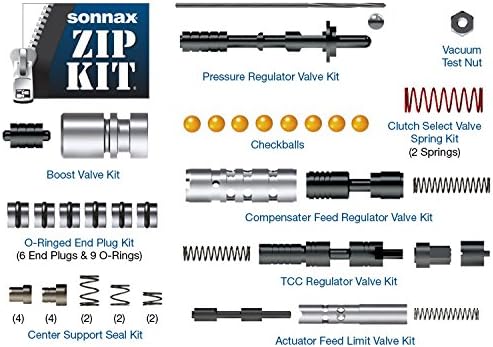
Need parts for this job? We stock the 6L90 hardware these repairs call for — TCC regulator valve kits, valve body Zip Kits and complete valve bodies, filter and pan kits, DEXRON-VI fluid, cooler bypass upgrades and master rebuild kits. Browse all 6L90 parts →
Keeping It From Coming Back
Three habits keep a repaired 6L90 from shuddering again. First, service the fluid on a real interval instead of a lifetime-fill assumption — a controlled-slip converter clutch is generating heat continuously by design, and the fluid is a wear item. Second, protect the cooler circuit: inspect the lines for kinks every time the unit is out, flow-check after any failure, and consider a bypass upgrade on a truck that tows, because everything in this article gets worse with heat. Third, when the valve body is already off for something else, do the TCC regulator bore while it is on the bench. The wear is progressive and driven by normal operation, so on a 100,000-mile unit it is not a question of whether the bore has moved, only how far.
FAQ
What does 6L90 torque converter shudder feel like?
Most drivers describe it the way GM does in its own shudder bulletin: like driving over rumble strips or a concrete road with rough expansion joints. It shows up at a steady cruise, usually light throttle, when the transmission is not shifting. It is not a misfire pattern that changes with engine load the way a bad coil does, and it disappears the moment the converter clutch releases, which is the single best clue that you are chasing the transmission and not the engine.
Can bad transmission fluid cause TCC shudder in a 6L90?
Yes, and it is the cheapest thing on the list, so it goes first. The converter clutch in this family is not slammed on and off - it is held at a controlled slip, which means the friction material and the fluid are working together continuously. Fluid that has lost its friction modifiers, been overheated, or been topped up with the wrong specification changes that friction behavior and the clutch starts to stick and release rapidly. GM specifies DEXRON-VI for the 6L90 and lists a 5.7 liter / 6.0 quart fluid change capacity.
Does a shudder always mean the 6L90 torque converter is bad?
No. Sonnax's own troubleshooting order puts the converter last for a reason. Low line pressure with normal cooler flow points to a clamping problem outside the converter. Normal pressure with low cooler flow points to a restriction - Sonnax notes the piston starts dragging on the cover once release flow drops below 0.45 GPM. Only when pressure and flow both check out does the converter itself become the answer.
What TCC slip reading should I see on a healthy 6L90?
You want slip that tracks what the module is commanding: a small, steady difference between engine RPM and input shaft RPM at cruise, collapsing toward zero as lockup fully applies. Sonnax describes the 6L80/6L90 converter as operating at roughly 50 RPM of lockup slip. Slip that spikes during the shudder points to the friction interface or the hydraulic side. Slip that reads a constant zero RPM while the vehicle is shuddering points somewhere else entirely - see the broken regulator valve spring below.
Will a shift kit or valve body repair fix a 6L90 shudder?
It will if the shudder is coming from the TCC control circuit, which on a high-mileage 6L90 is common. The TCC regulator valve modulates constantly to hold the commanded slip, and that constant movement wears the bore. Sonnax's repair kit for that bore lists overheated fluid, failsafe mode, harsh TCC apply, lost fuel economy and codes P0741 and P0742 as the complaints it addresses. If the converter itself has delaminated friction material, no valve body work will save it.
Related guides
- 6L90 P0741: Torque Converter Clutch Circuit Performance
- 6L80 TCC Shudder: Diagnosis Step by Step
- 6L90 Valve Body Problems and How to Test Them
- 6L90 Slipping: Causes and the Fix
- 6L90 Fluid Change: Cost, Capacity and Procedure
Sources
- Sonnax — Transmission Hydraulics Fundamentals, Part IV: Converter Clutch Control. Source for the TC solenoid and TC control valve acting as the gateway for apply and release oil, the apply regulator controlling slip rate and piston loading, release flow holding the piston off the cover in a two-path converter, the roughly 130 psi apply pressure limit at the piston, and the note that continuous slip-control modulation equates to bore wear. sonnax.com/tech_resources/713
- Sonnax — Troubleshooting Lockup Issues. Source for the 0.45 GPM TCC release-flow threshold below which the piston drags on the cover, and the diagnostic matrix separating low pressure with normal flow, normal pressure with low flow, and both normal (replace the converter). sonnax.com/tech_resources/97
- Sonnax — TCC Regulator Valve Spring 104740-45K (GM 6L45, 6L50, 6L80, 6L90). Source for the broken lower valve body TCC regulator valve spring causing vibration or shudder at low speed with steady throttle, and the diagnostic that TCC slip remaining a constant zero RPM during the shudder points to that spring. sonnax.com/parts/4690-tcc-regulator-valve-spring
- Sonnax — TCC Regulator Valve Kit 104740-46K (GM 6L45, 6L50, 6L80, 6L90). Source for bore wear at the TCC regulator valve reducing apply pressure and converter charging, the complaint list (overheated fluid, failsafe mode, harsh shifts and TCC apply, lost fuel economy, high TCC slip, P0741 and P0742), and the extended-land oversized valve repair with hardcoat anodized aluminum. sonnax.com/parts/5074-tcc-regulator-valve-kit
- Sonnax — 6L80, 6L90 Technical Advisory: Consider an Updated Converter in Your Next Rebuild. Source for the JMBX 300mm single-disc non-captive converter clutch, the 0.150 in. piston thickness, the roughly 0.020 in. woven carbon friction material, the approximately 50 RPM lockup slip, and the CMM-measured cover waviness opposite the welded pads leading to piston-to-cover contact and pan debris. sonnax.com/tech_resources/845
- ATRA — 6L50, 6L80, 6L90 Updates and Product Issues. Source for excessive TCC slip with possible P0741 on high-mileage MYC and MYD units caused by TCC friction material delamination with converter replacement as the repair, and for the cooler line restriction guidance including lines kinked near the radiator taking a set. atracom.blob.core.windows.net/webinars/gm/6l50_80_90_updates.pdf
- General Motors Service Bulletin 19-NA-121 (April 2020, via NHTSA). Source for GM's own description of TCC shudder as a shake or shudder during light throttle acceleration at steady speed, described as driving over rumble strips or a concrete road surface with rough expansion joints, and for the caution that shudder is not always caused by the torque converter clutch and can be fish bite, chuggle, surge or vibration. static.nhtsa.gov/odi/tsbs/2020/MC-10174268-9999.pdf
- General Motors — 2025 Transmission Capacities & Fluids (GM TechLink). Source for the 6L90 (RPO MYD) DEXRON-VI specification and the 5.7 liter / 6.0 quart fluid change capacity. gm-techlink.com/wp-content/uploads/2025/06/TechLink-transmission-fluid-capacities-2025_A.pdf