People assume the 8L90 replaced the 6L90 because eight is a bigger number than six. It did not. GM built these two units to do different jobs, and the proof is sitting in a GM service bulletin from 2024: the 6L90 is still specified behind the 6.6L L8T gas V8 and the 6.6L L5P Duramax in 2021 through 2024 Silverado and Sierra 2500HD and 3500HD trucks. The 8L90 is nowhere in that list. One is a heavy-duty six-speed that never left. The other is a light-duty and medium-duty eight-speed built around ratio spread and fuel economy.
That distinction changes the answer to almost every question people ask about these two. Here is the builder-to-builder version, with GM's own numbers and the field data that matters when one of them is on your bench.
Related reading: our 6L80 vs 6L90 comparison and the 8L90 pressure testing guide.
The Numbers, Side by Side
The 8L90 column below comes straight off GM Powered Solutions' published specification sheet for the unit (RPO AH2R, N8X ratio set). The 6L90 fluid data comes from GM's 2025 TechLink transmission capacities and fluids chart for RPO MYD. GM does not currently publish a public spec sheet for the 6L90 the way it does for the 8L90, so the 6L90 ratio and rating figures below are the long-circulated GM-sourced numbers rather than a document I can hand you a link to. The fluid, application and cooling rows are all bulletin-verified.
| Spec | 6L90 (RPO MYD) | 8L90 (RPO N8X / AH2R) |
|---|---|---|
| Speeds | 6 | 8 |
| Full ratio set | 4.02 / 2.36 / 1.53 / 1.15 / 0.85 / 0.67 | 4.56 / 2.97 / 2.08 / 1.69 / 1.27 / 1.00 / 0.85 / 0.65 |
| Reverse | 3.06 | 3.82 |
| Ratio spread | 6.04 | 7.0 |
| Max engine torque (GM published) | Not currently published | 460 lb-ft (624 Nm) |
| Max gearbox torque (GM published) | Not currently published; 885 lb-ft output widely cited | 665 lb-ft (900 Nm) |
| Max vehicle weight (GM published) | — | GCVW up to 22,500 lb (10,227 kg) |
| Current HD truck application | Yes — 2500HD / 3500HD, L8T and L5P, through 2024 | No |
| Fluid (GM spec) | DEXRON VI | DEXRON HP |
| Fluid change quantity (GM chart) | 5.7 L / 6.0 qt | 7.0 L / 7.4 qt |
| Total fill (GM spec sheet) | — | 10.3 L excluding cooler volume |
| Weight | — | 218 lb (98.9 kg) |
| Converter | Application specific | 258 mm, 2-path ECCC, turbine damper |
| Gearsets / clutches | Three planetary sets, five clutches | Four gearsets, five clutches |
| Control solenoids | TEHCM in pan | 2 on-off + 6 variable force (one per clutch, one TCC) |
| Case | Cast aluminum, removable bell | Die-cast aluminum, 2-piece main, bell integrated |
| Thermal bypass valve opens | 158 F (70 C), external | 194 F (90 C), external |
| Max shift speed | — | 6,000 rpm |
| Assembly | — | Toledo, OH and Silao, Mexico |
Read the application row before anything else. That single line answers the strength question more honestly than any torque number, because it is GM telling you where each unit belongs.
What GM Bought With Two More Gears
The 8L90 runs four gearsets and five clutches, and GM packaged it deliberately so it would occupy the same space as the previous 6L80 and 6L90 family of six-speeds. GM's own sheet states the goal plainly: up to 5 percent more efficient than the 6L90 while handling torque capacity up to 665 lb-ft (900 Nm).
The efficiency comes from ratio spread. The 8L90 spans 7.0 overall against the 6L90's 6.04, with a numerically steeper 4.56 first gear for launch and a 0.65 top gear for cruise. Because there are eight ratios covering that spread instead of six, the steps between gears are smaller, so the engine spends more time near its efficient rpm band and less time falling into a hole after every shift. Add a 258 mm two-path ECCC converter with a turbine damper and six variable force solenoids, one per clutch plus one for the converter clutch, and you get a unit that shifts noticeably faster and smoother than the six-speed while weighing 218 lb.
What GM did not buy was load capacity. Every one of those gains is a drivability and efficiency gain. The 6L90 kept the heavy-duty work because it was built as the strengthened version of the 6L80 with a beefier input gearset and wider output gears, and because a six-speed with fewer clutch packs has an easier time managing sustained tow loads than an eight-speed built to a fuel economy target.
Different control philosophy on the bench
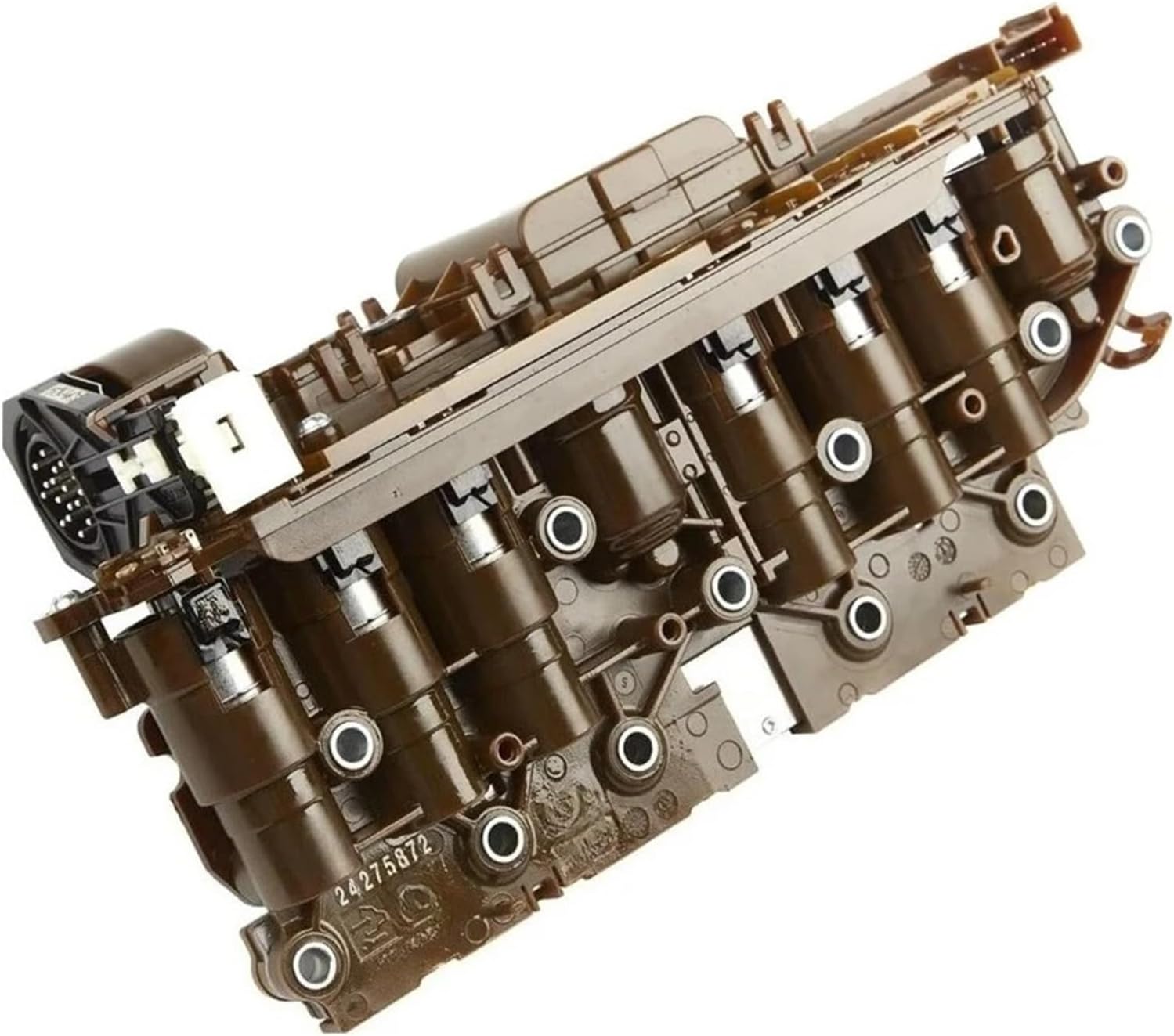
This is where the two units stop resembling each other. The 6L90 puts its electronics in the TEHCM inside the pan, with the solenoids carried on the module. The 8L90 runs a separate control solenoid valve body with two on-off solenoids handling shift pattern and six variable force solenoids handling shift quality. Each of those VFS circuits feeds a small signal circuit through a signal accumulator piston before it strokes a clutch control valve.
Practically: on a 6L90 you chase valves, checkballs, a separator plate or the TEHCM. On an 8L90 you chase low-flow solenoid signal circuits and the control valves they feed. Same manufacturer, completely different diagnostic path.
Fluid: The Difference That Kills 8L90s
These units do not share fluid, and there is no gray area. GM's 2025 TechLink transmission capacities and fluids chart specifies DEXRON VI for the 6L90 (RPO MYD) at a 5.7 L / 6.0 qt fluid change quantity, and DEXRON HP for the 8L90 (RPO N8X) at 7.0 L / 7.4 qt. GM's own 8L90 spec sheet lists a total capacity of 10.3 L excluding cooler volume and calls out DEXRON High Performance ATF specifically, noting it was developed for a more consistent viscosity profile and less degradation over time.
The reason this matters is the control system described above. The 8L90 leans on six variable force solenoids pushing small signal circuits to stroke clutch control valves, and those circuits are calibrated around a specific fluid viscosity. Put the heavier DEXRON VI in and signal response changes, apply timing drifts, the TCM's adaptive tables chase a target they cannot reach, and the customer feels harsh shifts, a 2-1 clunk on deceleration and converter clutch shudder. Going the other way is no better: DEXRON HP is thinner than the clutch and bushing clearances in a 6L90 were designed around.
If an 8L90 lands on your lift with a shudder complaint and no service history, verify the fluid before you pull anything.
Sonnax 154740-29K Pressure Regulator & O-Ringed Shuttle Valve Kit (8L90)
This is the exact kit Sonnax names as the fix for runaway 8L90 line pressure — the failure that cracks worm tracks and shatters drums. If you are rebuilding an 8L45 or 8L90 valve body, this goes in every time.
View the 8L90 pressure regulator kit →The Shudder Bulletin That Only Names One of Them
GM Service Bulletin 18-NA-355, dated August 2019, covers "shake and/or shudder during light throttle acceleration between 25 and 80 mph (40 and 128 km/h) at steady speed." The listed transmissions are 8L45 and 8L90 only. The 6L90 does not appear anywhere in it.
The affected vehicle list is long: 2016 through 2019 ATS and CTS, 2016 through 2018 CT6, 2015 through 2017 Escalade and Yukon, 2016 through 2019 Camaro, 2017 through 2019 Colorado and Canyon, 2015 through 2019 Corvette, and 2015 through 2018 Silverado and Sierra. GM's stated cause is torque converter clutch shudder, and the correction is a fluid exchange, not a teardown. The bulletin is explicit that diagnosis beyond the customer complaint is not required if the vehicle was built before the listed production breakpoints.
The procedure itself is worth knowing, because a pan drop will not do it. GM specifies filling a DT-45096 TransFlow cooler flush machine with 20 quarts of HP fluid and running the exchange through the cooler lines. There is a prep step most shops skip: if the TransFlow supply reservoir still has DEXRON VI in it, you have to purge the machine and convert it to the blue label Mobil 1 Synthetic LV ATF HP fluid first, or you are pushing the wrong fluid into the transmission you are trying to fix.
One honest caveat. The exchange works best on early-stage shudder. If the vibration returns after a correct flush, the converter clutch lining is already damaged and the converter has to come out.
Cooling: The Spec Almost Nobody Checks
Per GM Service Bulletin 22-NA-182 (March 2024, replacing PIP5792E), which covers the 6L80, 6L90, 8L90, 10L80, 10L90 and 10L1000 together, the thermal bypass valve open temperatures are not the same across the family:
- 6L80 / 6L90: TBV opens at 158 F (70 C), external to the transmission
- 8L90: TBV opens at 194 F (90 C), external to the transmission
- 10L80 / 10L90 / 10L1000: 143 F (61 C), inside the valve body on most applications
That is a 36-degree gap between the six-speed and the eight-speed before fluid is routed to the cooler. A customer who moved from a 6L90 truck to an 8L90 truck and now watches a higher trans temp reading is usually watching a unit behave exactly as GM designed it.
Before you chase an overheat complaint into the transmission, the same bulletin says to inspect for a twisted rubber cooler line, which turns up on low mileage vehicles and can set DTC P27EC in the TCM on ETRS units (RPO MHS, MQC). Untwist it, replace it if it stays misshaped, then set fluid level per the service procedure. That is a ten-minute check that has saved a lot of unnecessary teardowns.
Failure Patterns: They Break Differently
6L90: TCC regulator bore wear and separator plate traps
The signature 6L90 valve body complaint is bore wear at the TCC regulator valve. Sonnax lists the symptom set for GM 6L45, 6L50, 6L80 and 6L90 valve bodies as codes P0741 and P0742, high TCC slip rpm, overheated fluid, failsafe mode, harsh shifts, harsh TCC apply and loss of fuel economy. The mechanism is simple once you see it: wear at that bore reduces TCC apply and converter charge pressure. If the valve sticks in the apply position you get harsh TCC apply. If it sticks in the release position you get no TCC apply or slip.
Diagnose it by vacuum testing the port. If it will not hold the recommended minimum in-Hg, or the wear is visible, the bore is done. For moderately worn bores Sonnax's drop-in kit 104740-46K uses significantly lengthened inboard and outboard spools so the valve operates in unworn portions of the casting, plus a longer outboard shuttle valve that seals better and resists cocking in the bore. For casting wear past that, the oversized kit 104740-07K requires reaming with tool F-104740-TL7 and VB-FIX. Either way, use the hardcoat anodized aluminum valves; the OE material is what wore out in the first place.
The second 6L90 trap is a parts-matching problem, not a wear problem. ATSG's Wayne Colonna documented a 6L80-series rebuild where an incorrect valve body separator plate blocked supply pressure to the 3-5-R regulator valve and the 3-5-R clutch would not apply at all. GM changed the 3-5-R clutch feed partway through production: the early valve body fed directly from the number 5 shuttle ball to the number 7 metering check ball, while the later design walls off that passage and routes the circuit through an added slot in the spacer plate and a slot in the channel plate. The net effect is that the later design has a controlled exhaust rather than a controlled apply.
Get that pairing wrong and it costs you a teardown. A late plate on an early valve body loses 3-5-R feed and floods SS2. An early plate on a late valve body blocks 3-5-R feed. In both cases line pressure reads normal, which is exactly what sends people down the wrong road.
8L90: signal accumulator wear, runaway line pressure, and wiring
The chronic 8L90 complaint is shift quality, and Sonnax traces it to wear in the signal accumulators of the control solenoid valve body. Each VFS circuit carries a signal accumulator piston that damps pressure and flow instability so the related clutch control valve behaves, and those pistons wear the cast aluminum bore they ride in. Because the solenoids are low flow, any signal fluid lost through that wear path has an outsized effect downstream. Sonnax reports the S3 and S4 locations are generally the worst, which is why their smaller kit 154740-06K services four of the seven bores while the full shift Zip Kit covers all seven.
Vacuum test to find it, or use gauge pins if you do not have a vacuum tester. One installation detail matters more than it sounds: when you fit the sleeve and end plug, the step on the plug faces down toward the spring and into the sleeve, and the plug must sit flush. An end plug sitting proud will not let the two casting halves seal, and you get cross leaks and pressure loss on a valve body you just rebuilt.
The second 8L90 failure destroys parts. Sonnax has documented cracks in the worm tracks of 8L45 and 8L90 valve bodies caused by line pressure going too high. Line pressure on these units should peak around 315 psi, but Sonnax evaluations have measured above 415 psi. The cause is a worn pressure regulator valve lineup combined with a line pressure blow-off spring calibrated too high, over 400 psi in some cases. Excessive leakage at the PR valve keeps it from stroking to the low-pressure position, and once pressure runs away it can crack the casting outright or shatter a drum. A cracked worm track is not repairable; the valve body is scrap. Sonnax's guidance is to replace the pressure regulator lineup and the blow-off spring every single time and hold maximum pressure in the 300 to 315 psi range.
Third, and this one is a good reminder before you condemn any 8L90: not every failsafe is hydraulic. Craig Sarokoff documented a 2018 Express 2500 with a 2.8L diesel and an 8L90 that intermittently dropped to failsafe, sometimes in second and sometimes in eighth, and always kept reverse. The scan tool pulled P2670 (Actuator High Control Circuit Group 2 Low Voltage) and U0402. GM's diagnostic information for P2670 points at terminal 19 of the transmission X175 connector, a gray wire with a brown tracer that supplies voltage to six solenoids inside the unit, and notes the code sets when the circuit shorts to ground for more than one second. The cause was a harness rubbed through by a bolt tip under the battery. Read the code description before you pull the pan.
6L90 Master Rebuild Kit with Clutches
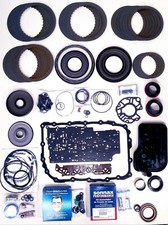
Frictions, steels, gaskets, seals and pistons for the GM 6L90 in one box — the kit for when the heavy-duty six-speed comes apart. In stock and shipping from the USA.
View the 6L90 master rebuild kit →Interchange: The Short Version
No, an 8L90 is not a bolt-in replacement for a 6L90. GM's own spec sheet says the 8L90 was packaged to fit the same space as the previous 6L80 and 6L90 family, and that is exactly as far as it goes. It is a packaging statement about vehicle architecture, not a parts statement.
The 8L90 uses a two-piece main case with the bell integrated into the main case, where the 6L90 uses a removable bellhousing. It needs its own TCM calibration, its own 258 mm two-path ECCC converter, its own cooler circuit with a 194 F thermal bypass valve instead of a 158 F one, and DEXRON HP instead of DEXRON VI. Internally there is no crossover at all: different gearset count, different clutch layout, different solenoid architecture, different valve body family. The Sonnax part numbering makes the point on its own, since 6L90 valve body kits live in the 104740 series and 8L90 kits live in the 154740 series with no shared components between them.
Anyone doing this as a retrofit is doing a powertrain swap with control and cooling work, not a transmission swap.
Which One Do You Actually Want?
If you are towing, hauling, or running behind a 6.6L, the 6L90 is the unit GM itself kept in the trucks that do that work. Bulletin 22-NA-182 lists RPO MYD in 2021 through 2024 Silverado and Sierra 2500HD and 3500HD alongside the 10L1000 codes. The 8L90 is not in that list, and GM's published GCVW ceiling for it is 22,500 lb.
If you are in a half-ton, a Camaro, a Corvette or an Escalade and you care about how the thing drives, the 8L90 is the better transmission by a wide margin. Eight ratios across a 7.0 spread, smaller steps, faster clutch-to-clutch shifts, and a converter clutch strategy that keeps the engine locked up more of the time. It just demands the correct fluid and a pressure regulator that has not worn out.
The failure mode that decides it for most owners is not gear count anyway. It is maintenance. A 6L90 run on DEXRON VI with a healthy TCC regulator valve will outlast an 8L90 that got topped off with the wrong fluid at 60,000 miles. Get the fluid right, check the cooler lines, watch line pressure on the eight-speed, and both of these units will do the job they were designed for.
Need parts for this job?
Rebuild kits, valve body components, solenoids, filters and hard parts for both the 6L90 and the 8L90, organized by unit so you order the right thing the first time.
Shop 6L90 parts → Shop 8L90 parts →Shop 6L90 parts → Shop 8L90 parts →
FAQ
Is the 6L90 stronger than the 8L90?
For load carrying, yes. The clearest evidence is what GM still builds. GM Service Bulletin 22-NA-182 lists the 6L90 (RPO MYD) behind the 6.6L L8T and 6.6L L5P Duramax in 2021 through 2024 Silverado and Sierra 2500HD and 3500HD. The 8L90 is not in those trucks. GM's own 8L90 specification sheet caps that unit at 460 lb-ft maximum engine torque, 665 lb-ft maximum gearbox torque and 22,500 lb GCVW, which is light-duty and medium-duty territory. The 8L90 wins on ratio spread and shift quality. The 6L90 wins on load.
Does the 8L90 take the same fluid as the 6L90?
No, and this is the mistake that destroys 8L90s. GM's 2025 transmission capacities and fluids chart specifies DEXRON VI for the 6L90 (RPO MYD) and DEXRON HP for the 8L90 (RPO N8X). They are different viscosity grades built for different hydraulic calibrations. DEXRON VI in an 8L90 shows up as torque converter clutch shudder, harsh shifts and overheating. Never top off one with the other.
Will an 8L90 bolt in where a 6L90 was?
GM designed the 8L90 to fit the same vehicle envelope as the 6L80 and 6L90 family, and its own spec sheet says so. That is a packaging statement, not an interchange statement. The 8L90 uses a two-piece main case with the bell integrated into the main case, its own TCM calibration, a 258 mm two-path ECCC converter, a different cooler circuit with a 194 F thermal bypass valve, and a different fluid. Nothing internal crosses over. Treat it as a full powertrain swap.
What is GM bulletin 18-NA-355 and does it apply to the 6L90?
It does not apply to the 6L90. Bulletin 18-NA-355, dated August 2019, covers shake or shudder during light throttle acceleration between 25 and 80 mph on 8L45 and 8L90 transmissions only, across 2015 through 2019 Silverado, Sierra, Corvette, Camaro, Escalade, Yukon, ATS, CTS, CT6, Colorado and Canyon. The cause is torque converter clutch shudder and the fix is a fluid exchange to the blue label Mobil 1 Synthetic LV ATF HP using 20 quarts through a DT-45096 TransFlow machine. The 6L90 is not a listed model.
Why does an 8L90 run hotter than a 6L90?
Because GM calibrated the thermal bypass valve differently. Per GM bulletin 22-NA-182, the external thermal bypass valve opens at 158 F (70 C) on the 6L80 and 6L90 but at 194 F (90 C) on the 8L90. That is a 36-degree difference before fluid ever reaches the cooler, so a warmer 8L90 is often behaving exactly as designed. The same bulletin points to a twisted rubber cooler line as a real cause of genuine overheating on low mileage vehicles, so inspect the lines before condemning the unit.
Related Guides
- 6L80 vs 6L90: Differences, Interchange, and Which One You Have
- 6L80 vs 8L90: Differences, Interchange and Which Is Stronger
- 6L90 Valve Body Problems and How to Test Them
- 6L90 Rebuild Wear Points
- 8L90 Pressure Testing: Ports, Specs and Procedure
- 8L90 Rebuild Wear Points
Sources
- GM Powered Solutions — 8L90 Hydra-Matic 8-Speed Automatic Transmission features and specifications (2022). Official GM figures used throughout: 460 lb-ft maximum engine torque, 665 lb-ft (900 Nm) maximum gearbox torque, 420 hp maximum engine power, the full N8X ratio set (4.56 / 2.97 / 2.08 / 1.69 / 1.27 / 1.00 / 0.85 / 0.65, reverse 3.82), 7.0 ratio spread, 218 lb (98.9 kg) weight, 258 mm two-path ECCC converter with turbine damper, 10.3 L fluid capacity excluding cooler volume, DEXRON High Performance ATF, 6,000 rpm maximum shift speed, GCVW up to 22,500 lb, four gearsets and five clutches, two-piece die-cast main case with integrated bell, two on-off plus six variable force solenoids, assembly in Toledo OH and Silao Mexico, and the "up to 5% more efficient than the previous 6L90" claim. poweredsolutions.gm.com (PDF) — product page: poweredsolutions.gm.com
- GM TechLink — 2025 Transmission Capacities & Fluids chart (U.S. and Canada). The fluid specification and change quantity for both units: 6L90 (RPO MYD) — 5.7 L / 6.0 qt, DEXRON VI; 8L90 (RPO N8X) — 7.0 L / 7.4 qt, DEXRON HP. Also confirms the wider family split (10L80/10L90/10L1000 on DEXRON ULV). gm-techlink.com (PDF)
- General Motors Service Bulletin 18-NA-355 (August 2019), hosted by NHTSA. Shake and/or shudder during light throttle acceleration between 25 and 80 mph at steady speed; applies to 8L45 and 8L90 only; the full affected model and year list; torque converter clutch shudder as the stated cause; the fluid exchange correction using a DT-45096 TransFlow machine filled with 20 quarts of HP fluid; the requirement to purge and convert the TransFlow reservoir if it still holds DEXRON VI; and the note that diagnosis beyond the customer complaint is not required before the production breakpoints. static.nhtsa.gov (PDF)
- General Motors Service Bulletin 22-NA-182 (March 2024, replaces PIP5792E), hosted by NHTSA. Thermal bypass valve open temperatures for the 6L80/6L90 (158 F / 70 C, external), 8L90 (194 F / 90 C, external) and 10L80/10L90/10L1000 (143 F / 61 C, in the valve body on most applications); the twisted rubber cooler line as a cause of overheating on low mileage vehicles; DTC P27EC on ETRS transmissions (RPO MHS, MQC); and the model table showing RPO MYD (6L90) in 2021–2024 Silverado and Sierra 2500HD/3500HD with the L5P and L8T engines. static.nhtsa.gov (PDF)
- Sonnax — TCC Regulator Valve Kit 104740-46K (GM 6L45, 6L50, 6L80, 6L90). The 6L90 TCC regulator bore wear symptom list (P0741, P0742, high TCC slip rpm, overheated fluid, failsafe mode, harsh shifts, harsh TCC apply, loss of fuel economy); the cause (bore wear reduces TCC apply and converter charge pressure; stuck apply gives harsh apply, stuck release gives no apply or slip); the drop-in repair with lengthened inboard and outboard spools and a longer outboard shuttle valve; hardcoat anodized aluminum valve material; vacuum testing as the go/no-go check; and the oversized alternative 104740-07K with tooling F-104740-TL7 and VB-FIX. sonnax.com
- Sonnax — "Watch Out for High Pressure in GM 8L45, 8L90 Valve Bodies," Chris Leach (April 2024). Cracked worm tracks in the 8L90 valve body casting; line pressure should peak near 315 psi but has been measured above 415 psi; the worn pressure regulator valve lineup plus a blow-off spring calibrated over 400 psi as the root cause; catastrophic drum failure from runaway pressure; the recommendation to replace the PR lineup and blow-off spring at every rebuild and hold maximum pressure to 300–315 psi with kit 154740-29K and relief ball spring 154740-18. sonnax.com
- Sonnax — "Tips for Tackling 8L45, 8L90 Shift Repairs with Sonnax Signal Accumulator Pistons," Caleb Perham (July 2023). Chronic 8L90 shift quality problems traced to wear in the control solenoid valve body signal accumulators; S3 and S4 as the worst-wearing of the seven bores; vacuum testing and gauge pins as the diagnostic methods; kit 154740-06K covering four of seven bores versus the full shift Zip Kit; and the end plug installation detail (step facing down into the sleeve, plug flush, or the casting halves will not seal and you get cross leaks). sonnax.com
- Transmission Digest — "Dealing with GM 6L series rebuild issues," Wayne Colonna (December 2021). The 6L80-series 3-5-R clutch feed change: the early valve body feeding directly from the number 5 shuttle ball to the number 7 metering check ball, the later design walling off that passage and routing the circuit through an added spacer plate slot and a channel plate slot, and the resulting controlled exhaust rather than controlled apply. Also the failure modes from mismatching plates: a late plate on an early valve body loses 3-5-R feed and floods SS2; an early plate on a late valve body blocks 3-5-R feed. transmissiondigest.com
- Transmission Digest — "8L90 Intermittent Failsafe Diagnosis and Cause," Craig Sarokoff (August 2026). The 2018 Express 2500 2.8L diesel 8L90 case: intermittent failsafe in second and eighth with reverse retained, codes P2670 (Actuator High Control Circuit Group 2 Low Voltage) and U0402-74; GM diagnostic information pointing to terminal 19 of the transmission X175 connector, a gray wire with brown tracer supplying voltage to six solenoids; the code setting on a short to ground longer than one second; and the root cause being a harness chafed through by a bolt tip. transmissiondigest.com