Every shop that touches a Super Duty gets asked the same question at some point: flush it, or just drop the pan? The honest answer on a 6R140 is that the two services are not interchangeable, and the gap between them is bigger than most owners expect. A flush machine can turn over nearly all the fluid in one visit. A pan drop replaces roughly half. But the machine does that by running the engine and pump while fluid is actively leaving and entering the case at the same time, and that balance is where things go wrong on a transmission that depends on seven calibrated solenoids to do anything at all.
Here is what each service actually does to the fluid, the real mechanical risk the flush carries, the capacities and fluid spec documented for this unit, and the drain-refill-repeat procedure that gets you most of the benefit without betting the valve body on a machine you don't control.


What a "flush" actually is
A flush, in the shape most shops run it, is a machine fluid exchange. The machine taps into the cooler lines, pulls old ATF out of the circuit, filters or discards it, and pumps new fluid back in while the engine idles and the pump keeps turning. Done correctly it replaces nearly all of the fluid in one visit, including what is trapped in the torque converter and cooler, which a pan drop never touches. That is the appeal, and on a simple hydraulic transmission it is a reasonable service.
The 6R140 is not a simple hydraulic transmission. Per ATSG's original write-up on the unit in Transmission Digest, it runs seven solenoids and none of them are on/off types — every one is a pulse-width-modulated regulating solenoid, calibrated at the factory as either normally high or normally low, with a banding number that has to match the valve body's programming. The hydraulics a flush machine is pushing fluid through are being actively shaped by that control strategy the entire time the machine runs.
The real risk: the exchange has to stay balanced
The mechanical hazard behind every fluid exchange machine is the same, and it is old enough to be documented in the patents that cover how these machines work. US Patent 5,853,068, for an apparatus for exchange of automotive fluids, describes the core failure mode directly: if the old fluid drains from the transmission faster than new fluid arrives to replace it, the fluid level falls while the engine keeps running, and the transmission can be damaged or destroyed by running dry. The same patent family notes that a fully manual exchange method needs two attendants — one watching the draining fluid for air, one adding new fluid in response — specifically because the balance has to be managed in real time.
That is not a 6R140-specific defect. It is the physics of pushing fluid through a transmission that is still turning and still under load from its own pump. What changes on a modern unit like this one is the cost of getting it wrong. A momentary low-fluid event on an older hydraulically-shifted transmission might cost you a harsh shift. On the 6R140, a brief loss of prime at the pump inlet during a service is exactly the failure Transmission Digest has already documented independently of any flush machine — more on that case below — and it is not a risk you want stacked on top of a machine you don't control the flow rate of.
I am not aware of a Ford bulletin that names fluid exchange machines directly, and I would not claim one exists. What I can tell you is that the service procedure Ford's own documented fill data and ATSG's write-ups describe for this transmission is built around a controlled drain, refill, and verify cycle — not a machine exchange. That is the procedure below.
What Ford's documented fill levels actually are
Before you decide how to service a 6R140, know what you're filling. The fluid is MERCON LV only, sold under Ford's own Motorcraft XT-10-QLVC part number. Motorcraft's product listing for MERCON LV is explicit about what it replaces and what it does not: it is approved for Ford and Lincoln electronically controlled automatic transmissions that call for MERCON LV, but it should not be used anywhere MERCON ULV, MERCON V, CVT fluid, Premium ATF, FNR5, or Type F is specified. That MERCON ULV exclusion matters specifically on Super Duty trucks, because the 10R140 ten-speed that replaced the 6R140 in later Power Stroke trucks takes MERCON ULV, not LV. Pulling the wrong jug off the shelf because both say TorqShift on the case is an easy, expensive mistake.
Sonnax's documented 6R140 case, written up in Transmission Digest, gives the fill quantities by service level:
| Service performed | Approximate refill |
|---|---|
| Pan drop only (filter and gasket) | 8.2 quarts (7.8 L) |
| Valve body removed | 10.2 quarts (9.7 L) |
| Full disassembly / rebuild | 16.2 quarts (15.3 L) |
Line pressure on this unit runs 90 to 260 psi depending on range and throttle, per the same documented case, with the earlier ATSG write-up giving the finer-grained spec: 90 psi at idle in both Drive and Reverse, climbing to 230 psi at wide-open throttle in Drive and 240 psi in Reverse. That spread matters for a service verification: a line pressure gauge on the tap is a better check of whether the service actually went in clean than trusting the scan tool's commanded value alone.
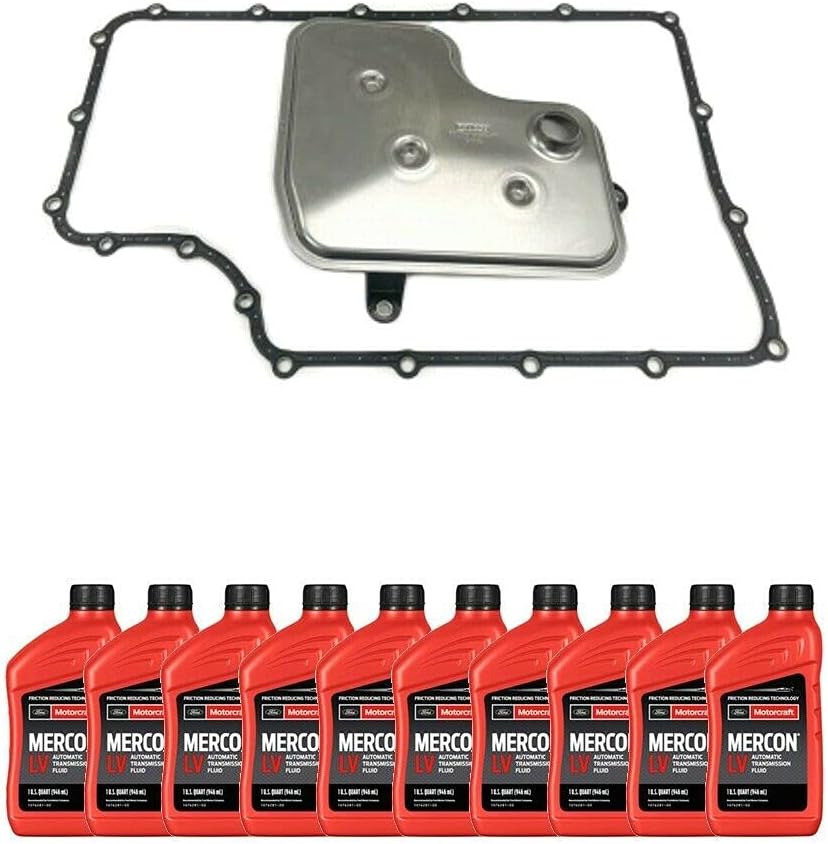
6R140 Transmission Service Kit with Filter and 10qt Fluid
Filter, pan gasket, and 10 quarts of MERCON LV in one order — enough for a pan-drop service with the correct fluid on hand before the truck is on the lift.
View the service kit →Also browse the full 6R140 parts collection.
The drain-refill-repeat procedure
A single pan drop only touches the fluid sitting in the pan and the filter circuit. The torque converter and cooler lines hold the rest, which is why one pass is a partial change, not a full one. Here is how to get most of a flush's turnover without a machine:
- Drain the pan. Pull the drain plug or the pan bolts, let it fully drain, and inspect the pan for metal. Expect roughly 8 quarts to come out on a stock pan.
- Replace the filter and the neck seal, not just the filter. The seal on the filter's intake neck is what keeps the pump primed. Transmission Digest's January 2025 case from Wayne Colonna documents exactly what happens when it's wrong: an undersized O-ring on a replacement filter neck caused cavitation, the line pressure gauge read 0 psi even with the case connector disconnected, and the truck set false codes for output shaft speed sensor no signal and invalid body-control-module data — codes that cleared the moment the correct seal went in. Confirm the new seal has real resistance seating into the pump intake before the pan goes back on.
- Refill to the spec for the service performed (8.2 / 10.2 / 16.2 quarts above), using MERCON LV only.
- Drive it to full operating temperature, then drain the pan a second time. This pulls in fluid that mixed back from the converter and cooler circuit during the drive, so the second drain is carrying a meaningful share of what the first pass couldn't reach.
- Refill again and repeat a third time if the fluid coming out on pass two still looks dark. Two to three cycles gets you most of the turnover a machine exchange would deliver in one visit, without ever running the transmission with an unmanaged fluid balance.
- Verify hot, not cold. Sonnax's documented procedure for this unit adds fluid in 0.5-pint increments only after extended road tests at 196–216°F, and confirms there's no slip or neutral condition on a 20 to 30 degree incline before calling the service done. That incline check exists because a borderline-low fluid level or a weak filter seal will show up there before it shows up on flat ground.
6R140 Deep Cast Aluminum Transmission Pan
More fluid capacity and more surface area to shed heat on every future service. If you're already dropping the pan for a drain-and-fill, this is the upgrade that makes the next one easier and keeps the fluid running cooler in between.
Shop 6R140 pans →Quick reference: flush vs drain-and-fill
| Machine flush (fluid exchange) | Drain-and-fill (repeated) | |
|---|---|---|
| Fluid turnover | Near-complete in one visit, including converter and cooler | Partial per pass; 2-3 passes with drive cycles between gets most of it |
| Main risk | Transmission runs with an actively unbalanced fluid level if drain/fill rates mismatch | Low, but a rushed filter/seal reinstall between passes carries real risk |
| Tooling needed | Dedicated exchange machine and cooler line adapters | Pan tools, a torque wrench, and time for warm-up drives between passes |
| Best fit | Simpler hydraulically-shifted transmissions without solenoid strategy sensitivity | Electronically controlled units like the 6R140, and any truck where the service history is unknown |
FAQ
Is a transmission fluid flush safe on a 6R140?
A machine fluid exchange works by pulling old fluid out through the cooler line while pumping new fluid in at roughly the same rate, and that balance is the whole risk. If the old fluid leaves faster than the new fluid arrives, the transmission can run dry while the engine is turning the pump, which is the documented failure mode behind these machines going back to their original patents. On a 6R140 the better-documented path is the drain-and-fill procedure Ford's own service literature and ATSG follow, not a machine exchange.
How much fluid does a 6R140 take for a drain-and-fill?
Sonnax's documented 6R140 fill figures are 8.2 quarts (7.8 L) after a simple pan drop, 10.2 quarts (9.7 L) if the valve body was removed, and 16.2 quarts (15.3 L) after a full disassembly. A pan-only drain and fill only replaces the fluid in the pan and filter circuit, which is why a single drain-and-fill is a partial fluid change, not a full one.
What fluid goes in a 6R140, and can I substitute?
MERCON LV only, sold as Motorcraft XT-10-QLVC. Motorcraft's own product listing says not to use it anywhere that calls for MERCON ULV, MERCON V, CVT fluid, Premium ATF, FNR5, or Type F. MERCON ULV is the fluid for the 10R140 ten-speed, not the 6R140, so do not cross the two even though both trucks say TorqShift on the case.
Does a repeated drain-and-fill get close to a full fluid exchange?
Not in one pass, but the turnover compounds. A pan-only drain removes roughly half the fluid in the system because the torque converter and cooler circuit hold the rest. Draining and refilling two or three times, with a full warm-up drive between each drain so the retained fluid mixes back into the pan, replaces most of the old fluid over the course of the service without the dry-run risk a machine exchange carries.
How do I know a 6R140 fluid service was done right?
Verify hot, not cold. Sonnax's documented fill procedure brings the transmission to 196-216°F, adds fluid in 0.5-pint increments, and confirms no neutral or slip condition on a 20 to 30 degree incline before calling the job finished. A Transmission Digest case from January 2025 also shows what happens when the filter neck seal is reinstalled wrong during a service: a cold no-engagement complaint with false codes that cleared only when the seal was corrected, so check that the filter has real resistance seated in the pump intake before you drop the pan back on.
Related 6R140 guides
Doing a 6R140 fluid service?
Filter and pan gasket kits, full service kits with fluid included, deep pans, and the correct MERCON LV — shipped fast from the USA.
Shop 6R140 parts →Sources
- Ford Customer Service Division (FCSD) — Motorcraft MERCON LV Automatic Transmission Fluid product page. Backs the fluid identity (XT-10-QLVC), the base oil and performance properties, and the explicit list of fluids MERCON LV must not replace, including MERCON ULV, MERCON V, CVT chain-type fluid, Premium ATF, FNR5, and Type F, plus power take-off units. fcsdchemicalsandlubricants.com
- Transmission Digest — "Similar but Different: A Look at Ford's 6R140W," Pete Luban, ATSG. Backs the seven pulse-width-modulated regulating solenoids with no on/off type, the normally-high/normally-low solenoid definitions, the MERCON LV fluid, the 16.2 quart (diesel) / 17.2 quart (gas) dry capacity, and the 90 psi idle / 230-240 psi WOT line pressure spread. transmissiondigest.com
- Transmission Digest — "Ford 6R140: Repairing the Elusive Intermittent Neutral Condition," Jim Mobley, Sonnax TASC Force (also published by Sonnax). Backs the 90-260 psi line pressure spec, the documented fill quantities by service level (8.2 / 10.2 / 16.2 quarts), and the 0.5-pint fill increments with 196-216°F / 20-30° incline verification procedure. sonnax.com
- Transmission Digest — "Hot and Cold: Why a Ford 6R140W No-Engagement Shows Up Only When Cold," Wayne Colonna. Backs the undersized filter-neck O-ring case: 0 psi line pressure reading from cavitation, and false codes P0722 and U0422 that cleared once the correct seal was installed. transmissiondigest.com
- US Patent 5,853,068 — "Apparatus for exchange of automotive fluids." Backs the core dry-run risk mechanism in fluid exchange machines: the transmission can be damaged or destroyed if old fluid drains faster than new fluid replaces it while the engine runs, and manual exchange methods require two attendants to manage that balance safely. patents.google.com
Shop 6R140 filter and pan gasket kits, full service kits with MERCON LV included, and deep pans — shipped fast from the USA.
Shop 6R140 parts →Shop the 6R140 filter & pan gasket kit →