A 6R140 that slips is almost never a mystery once you know which clutch is letting go. The trouble is that "slipping" is the word the customer uses for four different things: an rpm flare between gears, a gear that holds and then lets go under load, a converter that will not stay locked, and a truck that goes to neutral on a hill. Each one points to a different circuit, and each has a cheap cause you have to rule out before the expensive one.
This is the order I work a slipping TorqShift in, gas or diesel, with the specs that matter.


Know the unit before you chase the slip
Per Ford Component Sales' own 6R140 specification sheet, this is a Lepelletier powerflow: one simple planetary in front of a Ravigneaux gearset, with five clutch packs — three rotating clutches and two brake clutches. It is rated for 935 ft-lbs of engine torque, uses Mercon LV, holds roughly 4 gallons total, and Ford lists 250°F as the continuous operating temperature. Converter K-factor is 125K on gas applications and 97K on diesel. Diesel trucks run a separate TCM; gas trucks are controlled by the PCM.
The ratios are what you use to identify a slip on the scan tool:
| Range | Ratio | Clutches holding (by circuit name) |
|---|---|---|
| 1st | 3.974 | Forward (1-2-3-4) + one-way clutch, low/reverse in manual low |
| 2nd | 2.318 | Forward (1-2-3-4) + intermediate (2-6) |
| 3rd | 1.516 | Forward (1-2-3-4) + direct (3-5-R) |
| 4th | 1.149 | Forward (1-2-3-4) + overdrive (4-5-6) |
| 5th | 0.858 | Direct (3-5-R) + overdrive (4-5-6) |
| 6th | 0.674 | Intermediate (2-6) + overdrive (4-5-6) |
| Reverse | 3.128 | Direct (3-5-R) + low/reverse |
The clutch names tell you where they work, and that table is the whole diagnostic trick. Divide turbine speed by output shaft speed in each gear and compare it to the ratio. If the calculated ratio drifts only in 3rd, 5th and reverse, the common element is the direct 3-5-R clutch. If it drifts in 1st through 4th but 5th and 6th are clean, look at the forward clutch. Slip in 2nd and 6th only puts you on the intermediate 2-6. Slip in 4th, 5th and 6th is the overdrive 4-5-6.
Flare versus slip versus converter slip
A flare is an rpm rise during the shift that settles once the oncoming clutch catches — that is timing or apply-pressure, usually solenoid or valve body. A slip is the ratio going wrong in a steady gear under load — that is a clutch that cannot hold, from worn friction, a leaking piston or seal ring, or a regulator bleeding off apply oil. Converter slip shows as engine rpm running above turbine speed with the TCC commanded on, and it throws converter clutch slip codes rather than gear ratio codes. Log engine rpm, turbine speed, output speed and commanded TCC together.
Step 1: Fluid level, and the filter seal that fakes it
Check level correctly before anything else. Sonnax's fill procedure for this unit calls for checking with the scan tool reading 91–102°C (196–216°F), only after two or three extended road tests at operating temperature, and topping off in 0.24 L (0.5 pint) increments. A drain-and-fill takes 7.8 L (8.2 qt); with the valve body removed, 9.7 L (10.2 qt); a full teardown, 15.3 L (16.2 qt). Do not overfill — aerated fluid slips clutches too.
Then look at the filter neck seal. Sonnax's Jim Mobley documented a 2016 F-550 that went intermittently neutral in forward and reverse 9,000 miles after a rebuild. Level was right, line pressure was right in the bay, and a gauge on a road test showed line pressure falling to 0 psi going up an inclined driveway. The filter dropped out of the case with no resistance from its snout seal; the pump was pulling air whenever fluid sloshed away from the pickup. A better seal fixed it, and the same shop found it on multiple trucks. Any 6R140 that "slips" on grades, on hard stops or in turns gets a new filter and seal first. After service, Sonnax's verification step is to drive it nose-first up a 20–30 degree incline and confirm it holds gear.
6R140 Filter and Pan Gasket Kit (FT187), 2011–2019
New filter with a fresh neck seal and pan gasket — the first part on any 6R140 that loses drive on a grade or after a hard stop. Cheap insurance before you condemn clutches.
View the filter kit →Also browse the full 6R140 parts collection.
Step 2: Line pressure on a real gauge
The published 6R140 line pressure range is 90–260 psi (619–1790 kPa). Tee a mechanical gauge in and watch it through the complaint, not just at idle. If commanded pressure climbs with load and actual pressure does not follow, every clutch in the box is being asked to hold with less oil than the module thinks it has, and the slip shows up first in whichever gear carries the most torque.
Low pressure across the board sends you to the pump and the line pressure control valve. Sonnax's vacuum test guide lists poor shift quality, erratic line pressure, burnt clutches and overheating for a worn line pressure control valve (oversized kit 126740-08K), and flare, harsh and soft shifts, pressure loss and burnt clutches for leaking end plugs (126740-09K external, 126740-05K internal). Those end plugs are o-ringed in the repair kits for a reason: the OE plugs leak as the bores wear.
Step 3: Match the slipping gears to a regulator valve
On this unit each clutch has its own regulator valve fed by its own solenoid, and a worn bore on one regulator produces slip on exactly the gears that clutch serves. Sonnax's 6R140 vacuum test guide gives the map:
- Direct 3-5-R clutch regulator — delayed reverse, 2-3 flare, 4-5 flare, 3rd slip, 5th slip, reverse slip, bind-up, burnt direct clutch. Repair is the oversized kit 126740-11K, which needs a reamer and fixture.
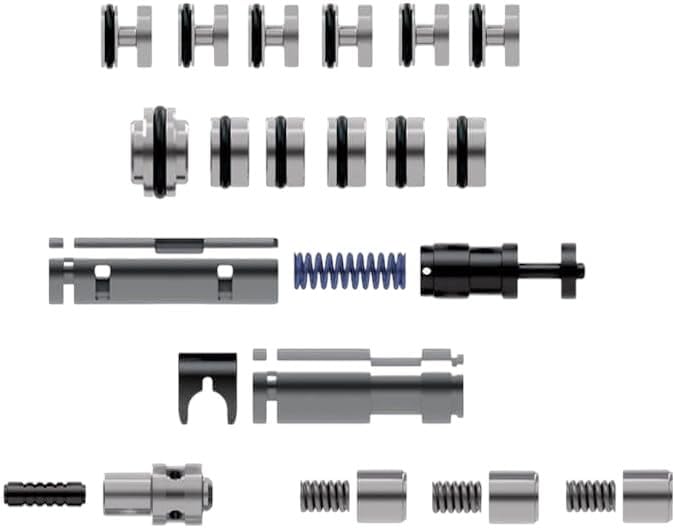
- Forward clutch latch valve — delayed engagement, gear ratio and solenoid codes, harsh shifts, burnt forward clutch (oversized kit 126740-06K).
- Low/reverse regulator — burnt low/reverse clutch and delayed reverse (oversized kit 126740-27K).
- Converter limit valve — converter shudder and TCC slip, overheated converter (126740-25K).
Notice how often "burnt clutch" appears on that list. A regulator that bleeds apply oil lets the clutch run partially applied, and under diesel torque that pack is burnt quickly. One pack burnt and the rest clean? Suspect that pack's regulator first.
Vacuum test every bore when the valve body is on the bench. Air checking tells you a circuit is open; a vacuum reading tells you how much a bore leaks, and you can compare it to the next one.
Step 4: The 2-3 flare, and why it is usually solenoids
The most common "slipping" complaint on a 6R140 is actually a 2-3 flare. On the 2-3 shift the direct 3-5-R clutch applies while the intermediate 2-6 clutch releases. Per Sonnax technical specialist Jim Dial, the 3-5-R clutch is controlled by the "B" solenoid, which is normally high, and the 2-6 clutch by the "C" solenoid, which is normally low. When the handoff is inconsistent — flare one time, bind-up the next — both solenoids are suspect, and the fault is usually mechanical inside the solenoid rather than electrical. Resistance checks pass. The solenoid still flows wrong.
Ford recognized this early. TSB 11-7-10 covered 2011 F-Super Duty trucks with the 6.7L and 6R140 built on or before 11/19/2010 that showed a 2-3 flare, a MIL with P0733 (gear 3 incorrect ratio) and/or delayed reverse engagement, often worse after an extended soak. The fix was to replace the three normally high solenoids, which can be done without removing the main control, using the service solenoid that matches the band number stamped on the original.
Solenoid banding and reused solenoids
That band number matters. Dial's write-up on 6R80 and 6R140 timing-related shift complaints explains that these variable bleed solenoids are calibrated into bands 1 through 5, and the strategy and solenoid body ID codes on the valve body and the case tag have to be loaded into the module so it knows how each solenoid flows. A solenoid that has drifted out of its band gives the module bad data, and adaptive learning cannot converge. With correct data, relearn can complete in three to five shift cycles. With drifted solenoids, the truck keeps flaring. Reusing old solenoids on a rebuild is the most common cause of a post-overhaul 6R140 that "slips" between gears.
Rules that hold up: record each solenoid's position, band and normally-high or normally-low type before it comes off; replace like-for-like on band unless you are reprogramming the ID codes; and after any valve body or solenoid work, reset adaptives and drive a full relearn cycle — roughly 20 to 25 stops and starts through all six gears. Expect firm shifts for a few days while the module learns.
Step 5: Converter slip is its own diagnosis
If engine rpm sits above turbine speed with TCC commanded applied, you are looking at the converter circuit, not a clutch pack. Transmission Digest's Tony Bonnano lists the usual causes on this unit: bore wear in any of the three valve body valves tied to converter clutch apply and release, low line pressure, and a design weakness inside the converter itself. The 6R140 converter uses a captive clutch — the piston applies the friction plate against a backing plate, not the cover — and the friction plate sits between two steels with leaf springs pop-riveted to their outer tangs. Those springs snap off or the rivets pull out, and the debris chews up the friction plate and the rest of the converter.
So a converter slip code on a high-mile truck gets the valve body TCC circuits checked (Sonnax lists the TCC apply regulator, TCC apply boost valve, TCC charge limit valve and converter limit valve), line pressure verified, and the converter opened by a builder who knows the leaf-spring failure. Sonnax's Smart-Tech clutch kit FD-CP-20K is the repair Bonnano describes for the rebuild.
When it is the clutches
If pressure is good, the valve body vacuum tests clean, solenoids are new and banded correctly, and the ratio still drifts in the gears one clutch serves, that clutch pack has failed and the unit comes out. On teardown, air check every circuit, inspect the seal rings and their drum and shaft journals, and check the pistons for cracked or delaminated bonded seals. Burnt frictions are the result; find the leak that caused them.
Rebuild with a complete overhaul kit with new bonded pistons, all new frictions and steels for the burnt packs, a new filter, and new solenoids. Put the Zip Kit or the specific oversized valve kit into the valve body while it is apart; the worn regulator that burnt the first clutch will burn the second.
Keeping it from slipping again
- Mercon LV only, filled and checked at 196–216°F the way Ford calibrates it.
- Watch temperature when towing. Ford's continuous rating is 250°F. Fleet and hot-shot trucks that live above that need shorter fluid intervals and a working cooler bypass.
- New filter seal every service. It is the cheapest part in the pan and the one most likely to cause an intermittent loss of drive.
- Never reuse solenoids on a rebuild, and always enter the correct ID codes.
FAQ
Why does my 6R140 slip only in 3rd, 5th and reverse?
Those three ranges share the direct 3-5-R clutch, so slip in all three points at that clutch or its regulator valve. Sonnax lists 3rd slip, 5th slip, reverse slip, 2-3 and 4-5 flare and a burnt direct clutch for a worn direct clutch regulator bore, repaired with oversized kit 126740-11K. Check line pressure and the B solenoid before pulling the unit.
Can a clogged or bad filter make a 6R140 slip?
Yes. A degraded seal on the filter snout lets the pump draw air when fluid moves away from the pickup, and Sonnax documented a 6R140 whose line pressure fell to 0 psi on an incline because of it. The symptom is a loss of drive or slip on grades, hard stops or turns. Replace the filter and its seal before diagnosing anything else.
What does P0733 mean on a 6R140?
P0733 is gear 3 incorrect ratio: the module calculated a 3rd gear ratio that does not match 1.516. On early 2011 Super Duty trucks built on or before 11/19/2010, Ford TSB 11-7-10 tied P0733, 2-3 flare and delayed reverse to the three normally high solenoids. On other trucks, check line pressure, the B and C solenoids and the direct clutch regulator.
What fluid and line pressure does the 6R140 use?
The 6R140 uses Mercon LV only, about 4 gallons total, checked at 196-216 degrees F on the scan tool. Published line pressure is 90-260 psi (619-1790 kPa) across the operating range. Verify it with a mechanical gauge during the complaint, not only at idle.
Will new solenoids fix a slipping 6R140?
They fix flares caused by solenoids that have drifted out of their calibration band, which is common on high-mile units and after rebuilds that reused old solenoids. They will not fix a clutch pack that is already burnt or a regulator bore that leaks. Enter the correct solenoid ID codes and run a full relearn after replacement.
Fixing a slipping 6R140 this week?
Overhaul kits with pistons, Sonnax Zip Kits, solenoid sets, valve bodies, filter kits, Mercon LV service kits and the air-check tooling to prove your repair — shipped from the USA.
Shop 6R140 parts →Sources
- Ford Component Sales, LLC — “Ford 6R140: 6-Speed Automatic Transmission Technical Specifications” (OEM spec sheet). Backs the Lepelletier powerflow, one simple planetary plus one Ravigneaux gearset, five clutch packs (three rotating, two brake), 935 ft-lbs maximum engine torque, Mercon LV, 4-gallon capacity, 250°F continuous rating, 125K gas / 97K diesel converter K-factor, PCM (gas) versus TCM (diesel) control, and the 3.974 / 2.318 / 1.516 / 1.149 / 0.858 / 0.674 / 3.128 reverse ratios. fordcomponentsalesllc.com
- Sonnax — “Ford 6R140 Vacuum Test Guide.” Backs the regulator-to-symptom map: direct clutch regulator 126740-11K (delayed reverse, 2-3 and 4-5 flare, 3rd, 5th and reverse slip, burnt direct clutch, bind-up), forward clutch latch valve 126740-06K, low/reverse regulator 126740-27K, line pressure control valve 126740-08K, converter limit valve 126740-25K, TCC circuit valves, and o-ringed end plug kits 126740-09K / -05K. sonnax.com
- Sonnax — “Troubleshooting Ford 6R80 & 6R140 2-3 Shift Quality Issues,” Jim Dial, September 16, 2022. Backs the 2-3 shift as 3-5-R clutch apply and 2-6 clutch release, the B solenoid (normally high) controlling 3-5-R and the C solenoid (normally low) controlling 2-6, both solenoids being suspect on inconsistent 2-3 shifts, and the fault being mechanical inside the solenoid. sonnax.com
- Sonnax — “Troubleshooting Ford 6R80 & 6R140 Timing-Related Shift Issues,” Jim Dial, August 15, 2022. Backs solenoid banding (bands 1–5), strategy and solenoid body ID codes on the valve body and case tag, drifted reused solenoids preventing adaptive learning, relearn completing in three to five shift cycles with correct data, and the relearn drive procedure. sonnax.com
- Sonnax — “Ford 6R140: Repairing Elusive Intermittent Neutral Condition,” Jim Mobley, June 6, 2022. Backs the 2016 F-550 case, line pressure falling to 0 psi on an incline from a failed filter snout seal, the 90–260 psi (619–1790 kPa) line pressure range, the 7.8 / 9.7 / 15.3 L fill quantities, the 91–102°C check temperature, 0.24 L top-off increments, the 20–30 degree incline verification, and the overfill warning. sonnax.com
- Transmission Digest — “The 6R140 torque converter: Common fault codes and how to rebuild,” Tony Bonnano, July 13, 2023. Backs the converter clutch slip causes (bore wear in the three TCC-related valve body valves, low line pressure), the captive clutch design with the piston applying against the backing plate, the leaf springs pop-riveted to the steel plates that break or pull loose, and the Sonnax FD-CP-20K Smart-Tech clutch kit. transmissiondigest.com
Shop 6R140 overhaul kits, Zip Kits, solenoid sets, valve bodies, filter kits and Mercon LV service kits — shipped fast from the USA.
Shop 6R140 parts →Shop the 6R140 filter kit →