The customer says it feels like the truck is driving over rumble strips. It happens around 35 mph, light on the throttle, usually right after it drops a gear and they ease back into it. Cold in the morning it is fine; twenty minutes into the drive it is back. That is the textbook 6R80 converter lockup shudder, and it is one of the few transmission complaints where the cheapest fix is also frequently the right one.
It is also one of the complaints most likely to get a converter or a whole unit thrown at it when the real cause is a calibration, tired fluid, a driveshaft, or a misfire. So this is the order I work it in: reproduce, split, then fix from cheapest to most expensive.
The short version: Shudder is the converter clutch grabbing and releasing unevenly while it is applying or holding a small amount of slip. Confirm it warm at a steady light throttle, watch TC slip desired against TC slip actual, then command lockup off. If the shake goes away, it is in the converter clutch circuit. From there: check for the TSB 10-25-13 calibration on early 2010 F-150s, do a real MERCON LV exchange set hot, verify WK release pressure drops cleanly, and only then condemn the converter.

What Shudder Actually Is on a 6R80
The 6R80 is Ford's build of the ZF 6HP26, and it uses ZF's two-path converter. Pressure in the release circuit, which ZF calls WK, holds the clutch off the cover. To lock up, the TCC solenoid vents WK toward zero and charge pressure on the other side pushes the clutch into the cover. Sonnax's Bob Warnke describes the strategy on this family plainly: to gain fuel economy it applies the converter clutch full-on and as early as possible, often right after the 2-3 shift and sometimes right after the 1-2.
That is the setup for shudder. Early, aggressive lockup puts the clutch on at low engine speed and relatively high torque. Every apply is a short slip event, and the TCM also holds a sliver of deliberate slip at times for noise control — Sonnax gives 1.5 to 2 psi of WK as the normal "slight slip" reading, against 0 psi for full lock. If the friction surface and the fluid cannot hold a smooth slip, the clutch sticks and lets go many times a second. That stick-slip is the vibration the driver feels.
Warnke puts the hydraulic side in one line in his converter clutch control article: low pressure causes TCC shudder and slip. He also notes two-path converters are the ones prone to shudder and friction failure under high-torque, low-speed apply conditions. Which is exactly how a 6R80 is programmed to drive.
Three things decide whether a given apply is smooth: the calibration that decides when and how hard to apply, the fluid's friction characteristics, and whether the valve body can actually deliver the pressure being commanded. The converter's lining is the fourth, and it is the one people jump to first.
Step One: Reproduce It and Read the Right PIDs
Drive it with the fluid fully warm. The factory-documented window on these trucks is 25 to 45 mph at light throttle, and ATRA's bulletin on the early F-150 notes the shudder may also be felt on a downshift followed by a light throttle tip-in. Pick a smooth road so you are not feeling pavement.
On the scan tool, Ford's own field guidance names the PIDs to log. In SSM 47456, which covers a 6R80 take-off shudder, Ford tells technicians to monitor accelerator pedal position, RPM, vehicle speed, torque converter slip desired and torque converter slip actual in the TCM. Log those together. What you are looking for:
- Slip actual oscillating around slip desired during the event, instead of settling. That is the stick-slip, visible in numbers.
- Steady pedal, steady load, steady speed. GEARS Magazine's Aaron Golas makes this point in his shudder diagnosis piece: verify VSS, throttle and engine load are stable while the shudder is happening, or you are chasing a driver input.
- Locked slip under about 60 rpm. Golas gives that as the ceiling for most lockup clutches once engaged. A 6R80 at full lock should read close to zero.
Step Two: Split Converter From Everything Else
This is the most valuable five minutes in the whole job. With a bidirectional tool, repeat the same drive with the converter clutch commanded off.
| Result with lockup commanded off | Where to look |
|---|---|
| Vibration disappears | Converter clutch circuit: calibration, fluid, WK pressure and valve body, converter lining |
| Vibration stays, tracks road speed | Driveshaft angles, U-joints, slip yoke splines, wheel and tire |
| Vibration stays, tracks engine load | Misfire, mounts, engine-side controls |
Do not skip the driveline side because it "feels like the converter." Ford's SSM 47456 is a good reminder: for a slight shudder on take-off on a 6R80 4WD, Ford's first instruction is to measure both driveshaft angles per the workshop manual, Section 205-01, because excessive angles produce the same complaint. Lifted and leveled trucks deserve extra suspicion here.
On the engine side, Golas recommends using Mode 6 to read per-cylinder misfire counts, since a light-load misfire that the PCM has not flagged yet will feel like converter shudder at exactly the same speeds. Swap coils or plugs to see if the count follows the part before you go further.
Step Three: Check the Calibration First
If the truck is a 2010 F-150 with the 4.6L, check its build date. ATRA bulletin 2013-108 and the TCRA converter bulletin TCB27 both document shudder between 25 and 45 mph on light throttle on trucks built on or before 12/1/2009, and both point to Ford TSB 10-25-13, which corrects it with a new PCM calibration. No parts.
The broader lesson applies to every 6R80: when and how hard the converter applies is software. Before replacing hardware on any year, confirm the PCM has the latest calibration Ford offers for it. And if the valve body or solenoids have been replaced, make sure the solenoid strategy and body ID codes were programmed afterward — a TCC solenoid running on the wrong characterization will apply badly no matter what else you do.
Step Four: Fluid, Done Properly
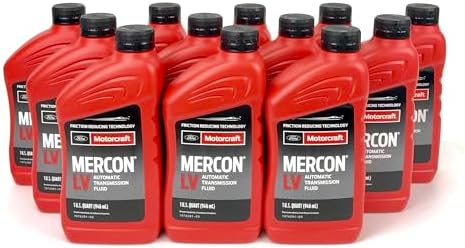
Worn ATF is the most common real cause of converter shudder I see, because the friction modifiers that give the fluid a smooth slip curve are what wear out first. The fix is new fluid of the correct spec, and only the correct spec: MERCON LV, Ford specification WSS-M2C938-A, per Ford's own automatic transmission fluid application chart.
Two details decide whether the fluid change works:
- One pan drop is not a fluid change. The converter and cooler circuit do not drain with the pan, so a single drain-and-fill only replaces a portion of the fill. Old fluid dilutes the new. Either do repeated drain-and-fills with drives in between or a full exchange. Our 6R80 fluid type and capacity guide has the factory capacities.
- Set the level hot. Sonnax points out the 6R80 has a thermal element that sends converter oil back to the bushings instead of to the cooler below about 125°F. Service it cold and the cooler fills later, leaving the unit low after one drive. Low or aerated fluid causes exactly the slip you are trying to fix.
A word on bottled shudder additives. A concentrated friction modifier can quiet a shudder, and that result tells you something: the lining is probably still usable and the fluid was the problem. But it is a diagnostic, not a repair. The durable fix is fresh fluid that meets the spec, and if it only stays quiet with a bottle in it, keep diagnosing.
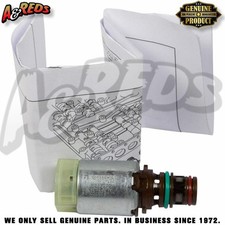
6R80 7-Piece Transmission Solenoid Kit (2007-2014), OEM AL3P-7G276-AF
If the WK test below shows the TCC circuit is not venting cleanly and the bores vacuum-test good, a worn or contaminated solenoid is the next suspect. These age together, so replace the set. Available at Core Transmission Parts, our sister store.
Shop the part for this fix →Browse all transmission solenoids at CoreTransmissionParts.com
Step Five: Verify WK Pressure
If fresh fluid and a current calibration have not cured it, prove the hydraulics before you blame the converter. The 6R80 case has one pressure tap, the WK port on the driver side of the bell housing above the cooler lines. It uses a 10 x 1.00 mm thread and never exceeds about 80 psi, so use a 100 psi gauge. Sonnax's published ranges:
| Condition | WK pressure |
|---|---|
| Running, cold, clutch released | 70 to 75 psi |
| Operating temperature, released | 65 to 68 psi |
| Clutch applied | 0 to 2 psi (1.5 to 2 psi = deliberate slight slip) |
For a shudder, the telling reading is WK that wanders during the event, or hangs at a few psi above where it should settle, instead of dropping cleanly. That points to a leaking bore in the converter circuit or a sticky TCC solenoid, not the converter. The valves involved and the Sonnax repair kits are covered in our 6R80 P0741 guide, and vacuum testing the valve body is in our 6R80 valve body testing guide.
Step Six: When It Really Is the Converter
Sonnax's diagnostic rule is the one to follow: if WK is normal and the solenoid command is low, consider the converter. In other words, when the hydraulics are doing exactly what they are told and the clutch still will not hold smoothly, the lining is glazed, burned or unevenly worn, and no fluid or calibration will bring it back.
At that point the converter gets replaced or rebuilt with a quality friction lining, the cooler and lines get flushed, the fluid is new MERCON LV, and the adaptive tables are reset so the TCM relearns apply on the new clutch. Expect firm or odd lockup for a few drive cycles while it learns. Gearbox Insider does not sell torque converters, so source the converter from your usual supplier; everything else on the job, from filter to fluid to valve body, is on our 6R80 page.
If the fluid came out dark with clutch material in it, look past the converter. Debris from a failing clutch pack will score valve bores and contaminate the new converter within a few thousand miles. That truck needs a proper inspection, not just a converter swap.
Keeping It From Coming Back
Ford markets this fluid as long-life, but shudder is almost always a fluid-life story. On a truck that tows, idles a lot, or sees short trips, change the MERCON LV well before the scheduled interval, set the level hot every time, and keep the calibration current. If you are building the unit, vacuum test the valve body instead of trusting a clean-looking casting, and never put a used converter behind a fresh rebuild.
MERCON LV, filter and pan gasket kits, TCC and full solenoid sets, and valve bodies — matched to your 6R80 and shipped fast from the USA.
Shop 6R80 parts →FAQ
What does 6R80 torque converter shudder feel like?
Most drivers describe it as driving over rumble strips or a washboard road at a steady, light throttle, usually somewhere between 25 and 45 mph. It tends to show up right after a downshift followed by a light tip-in, and it gets worse once the fluid is fully hot. If the vibration changes with road speed regardless of throttle, or is there with the converter clutch commanded off, it is not converter shudder.
Will a fluid change fix 6R80 converter shudder?
Often, if the converter clutch lining is still intact and the problem is worn-out fluid. A single pan drop only replaces part of the fill, so a real fix means repeated drain-and-fills or a full exchange with MERCON LV, Ford specification WSS-M2C938-A, with the level set hot so the thermal element has opened and the cooler is full. If shudder comes back within a few thousand miles, the lining or the valve body is the problem, not the fluid.
Is there a Ford TSB for 6R80 torque converter shudder?
Yes. Ford TSB 10-25-13 covers some 2010 F-150s with the 4.6L and 6R80 built on or before December 1, 2009 that shudder between 25 and 45 mph on light throttle. The fix is a new PCM calibration, not hardware, so check the calibration level before you touch the transmission on one of those trucks.
How do I know it is the converter and not a driveshaft or misfire?
Reproduce the vibration, then repeat it with the converter clutch commanded off on a bidirectional scan tool. If the vibration disappears with lockup off, it lives in the converter clutch circuit. If it stays, look at driveshaft angles, mounts and misfire counts; Ford's own SSM 47456 sends technicians to driveshaft angle measurement first on a 6R80 take-off shudder complaint.
Sources
- ATRA — Technical bulletin 2013-108, "Ford 6R80 Torque Converter Shudder Between 25-45 mph." Backs the 2010 F-150 4.6L / 6R80 built on or before 12/1/2009 application, the 25-45 mph light-throttle shudder, the shudder felt on a downshift followed by light throttle tip-in, and Ford TSB 10-25-13 as a calibration fix. atracom.blob.core.windows.net (PDF)
- Ford Motor Company via NHTSA — Special Service Message 47456. Backs the 6R80 4WD take-off shudder/vibration caused by excessive driveshaft angles, the instruction to measure both driveshaft angles per WSM Section 205-01, and the TCM PIDs to monitor: accelerator pedal position, RPM, vehicle speed, torque converter slip desired and torque converter slip actual. static.nhtsa.gov/odi/tsbs/2018/MC-10144936-9999.pdf
- Sonnax — "Six Ways from Sunday: Diagnosing ZF6 & Ford 6R60/80 TC-Related Drivability Concerns," Bob Warnke. Backs the full-on, early lockup strategy after the 1-2 or 2-3 shift, the single WK case tap location and thread, the 80 psi ceiling, the cold, hot and applied WK pressure ranges including 1.5-2 psi slight slip, the 125 degree F thermal element fill warning, and the rule that normal WK with a low solenoid command points to the converter. sonnax.com/tech_resources/325
- Sonnax — "Hydraulics Fundamentals Part IV: Converter Clutch Control," Bob Warnke, May 3, 2019. Backs the statement that low pressure causes TCC shudder and slip, and that two-path converters can develop shudder or friction failure under high-torque, low-speed apply conditions. sonnax.com/tech_resources/713
- GEARS Magazine (ATRA) — "Shudder Diagnosis," Aaron Golas, April 4, 2023. Backs monitoring TCC commanded and actual slip, confirming VSS, throttle and engine load are stable during the event, the roughly 60 rpm ceiling for an engaged lockup clutch, and using Mode 6 misfire counts and component swaps to rule out misfire. gearsmagazine.com/magazine/shudder-diagnosis
- Ford Customer Service Division, Chemicals & Lubricants — Automatic Transmission Fluid Application Chart. Backs MERCON LV, Ford specification WSS-M2C938-A, as the specified fluid for the 6R80. fcsdchemicalsandlubricants.com/quickref/atf2US.pdf