P0741 on a 6T40 is the opposite of the P0742 stall complaint. Here the TCM asked the torque converter clutch to lock and it would not hold. The usual customer story is a shudder at steady cruise somewhere between 35 and 55 mph, a tach needle that floats 100 to 200 RPM higher than it used to on the highway, or a fuel mileage drop nobody can explain. Plenty of them come in with no drivability complaint at all, just a lamp and P0741 in memory.
The generic description is "Torque Converter Clutch Circuit Performance or Stuck Off." GM's OBD documentation for the 6T40 calls it TCC System Stuck OFF [1]. Like P0742, it is a performance code. The TCM is not measuring a circuit. It is comparing engine speed to turbine speed while it commands lockup, and it sees more slip than it will accept. That makes the code a symptom with four possible sources: the TCC pressure control solenoid, the TCC valves, the converter itself, or a fluid and pressure problem feeding all of them. This guide covers the 6T40 and 6T45 in the Cruze, Sonic, Malibu, Equinox, Terrain, Encore, Trax and the rest of the family.
What GM's monitor actually checks
GM's 2011 OBD tables include a section just for the 6T40, and the P0741 test is spelled out there [1]. In shop terms:
| Item | 6T40 value (GM 2011 OBD tables) |
|---|---|
| Precondition | Commanded TCC pressure 500 kPa (about 73 psi) or more for 2 seconds before the test runs |
| Fail condition (A) | TCC slip error in TCC On mode at or above a calibrated table value for 5 seconds |
| Fail condition (B) | TCC slip in Lock On mode of 130 RPM or more for 5 seconds |
| Fail count to set | 6 fail counts |
| MIL | Two trips |
| Gears tested | 2nd through 6th (ratio windows for each, e.g. 6th 0.6975 to 0.8025) |
| Engine torque / throttle | 50 Nm or more, throttle 8 percent or more |
| Fluid temperature | -7 to 130 C |
| Other | Ignition 9 to 31.99 V, engine 400 to 7500 RPM, TCC commanded Lock On or On, PTO not active |
Three things in that table shape the diagnosis.
It is a two-trip code with a 6-count fail counter. The converter has to slip repeatedly, across two drive cycles, before the lamp comes on. A P0741 is not a one-time glitch. By the time the customer sees the light, the clutch has been slipping for a while, and that matters when you look at the fluid.
It runs in every gear from 2nd to 6th. Unlike the stuck-on test, which only runs in 2nd, the stuck-off test runs wherever the TCM commands lockup. Note which gear the freeze frame shows. A failure that only shows up in 5th and 6th under light load points one way. A failure under heavier throttle in 3rd and 4th, when the converter is asked to hold more torque, points another.
The 500 kPa precondition is commanded, not measured. There is no TCC pressure sensor. The TCM assumes the pressure it commands is the pressure the clutch sees. Anything that bleeds off apply oil between the solenoid and the converter, from a worn valve bore to a leaking pump bushing or converter hub seal, shows up as slip.
GM also blocks the stuck-on and stuck-off tests while speed sensor codes (P0716, P0717, P0722, P0723) or TCC solenoid electrical codes (P2763, P2764) are present [1]. Slip is engine speed minus turbine speed, so a bad input speed signal can make a good converter look like it is slipping. Fix those codes first.
How the TCC circuit works on the 6T40
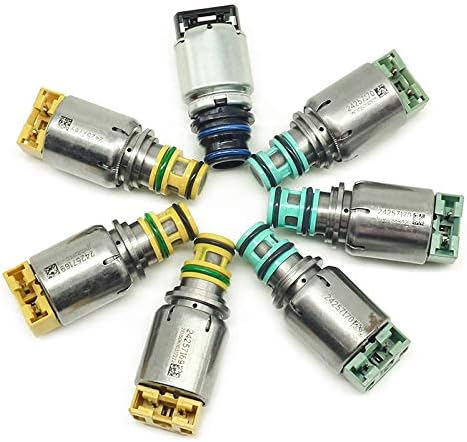
The TCC pressure control solenoid is one of the solenoids built into the TEHCM, the combined TCM and solenoid body bolted to the valve body. Gears magazine lists it as normally low: no current, no apply. The TCM raises current to raise TCC apply pressure, and the solenoid output strokes the TCC regulator apply valve and the TCC control valve [2]. Gears gives 3 to 5 ohms for the pressure control solenoids, measured off the TEHCM [2]. A normally low solenoid that sticks, or a screen that plugs, fails toward no apply. That is a P0741, not a P0742.
Sonnax's 6T40 Gen 2 and Gen 3 vacuum test guide puts the rest of the circuit in two places [4]:
- TCC regulator apply valve (control valve body). Sonnax tags this bore with "Code P0741, 742," no lockup, TCC slip, loss of fuel economy, low TCC apply pressure and overheated fluid and lining [4]. The kit page puts it simply: a valve stuck in release means no apply or slip [5].
- TCC control valve (pump body). This valve sees constant movement and wears its bore. Sonnax lists excess TCC slip, low cooler flow, overheating, low converter and lube flow, TCC codes and TCC lining failure [4].
- Lube-on-Demand valve (Gen 3 pump body only). Sonnax lists "no converter apply," low cooler flow and an overheated converter for this one [4]. It is easy to miss if you are used to the Gen 1 and Gen 2 pump.
After those comes the converter: worn lining, a glazed clutch surface, or a damaged hub seal that lets apply oil leak away.
Diagnosis, in the order I run it
1. Clear the blocking codes and check for updates
Pull TCM and ECM codes and save the freeze frame, including the gear and fluid temperature at the time of the fail. Fix speed sensor, TCC solenoid electrical and engine airflow or misfire codes first [1]. Then check the VIN for TSBs and calibration updates. Gears magazine describes a 6T40 that was pulled and rebuilt when a reflash would have fixed it [3]. That is an expensive lesson to repeat on a TCC code.
2. Check the fluid level properly, then look at the fluid
Low fluid is the cheapest P0741 fix there is, and on a 6T40 it is easy to get wrong. There is no dipstick. Check with the engine running, in Park, through the check plug, with the fluid at 85 to 95 C (185 to 205 F) per Gears [3]. Correct the level with DEXRON VI and find any leak. Then drop the pan or pull a sample. A slipping converter clutch makes a burnt smell and a fine dark lining paste in the pan. Heavy clutch material or metal means the converter is not the only thing that has been hurt.
3. Road test with the right data
On a scan tool, watch TCC commanded state or mode, TCC slip speed, TCC pressure control solenoid commanded pressure or current, current gear, transmission fluid temperature and engine torque. Names vary by tool. On a healthy unit in full lock, slip settles near zero within a second or two of the command. A P0741 unit shows the command go to full and slip stay up, often climbing as you add throttle. GM's hard number for full lock is 130 RPM held for 5 seconds [1].
Watch how the slip behaves. Slip that comes down partway and stops points at low apply pressure: solenoid, regulator valve, control valve or a leak. Slip that falls to zero cold but returns hot points at a worn valve bore or a pump problem that gets worse as the oil thins. Slip that rises steadily with throttle at full command, on a unit that tests good hydraulically, points at the converter clutch itself.
4. Run the solenoid cleaning routine
Gears recommends running the scan tool's solenoid cleaning routine with the system pressurized before you go further [3]. A normally low TCC solenoid with debris on the screen or spool can fail to reach full output. If the code stays away after the routine and a fluid service, keep the old filter and look at what it caught.
5. Air test the TCC solenoid
GM's method, as Gears describes it, uses the Kent-Moore DT-47825 kit. Remove the control solenoid assembly, mount it on the DT 48616 test plate at 5 Nm (44 lb-in), feed it 90 to 100 psi of regulated air, and cycle each solenoid through the DT48616-10 cable while you watch the gauge [3]. For a P0741, you want to see the TCC solenoid's output climb as the command climbs. Output that stays low, or rises slowly and stops short, is a failed solenoid.
Without the GM fixture, Gears gives a bench check with the solenoids off the TEHCM at 45 psi, unenergized. Do not put 12 volts on a pressure control solenoid; only the on/off shift solenoid takes direct 12 V [2]. Check the resistance at the same time. A TCC solenoid outside 3 to 5 ohms is done [2].
6. Vacuum test the valves
If the solenoid is good, pull the valve body and the pump. Vacuum test the TCC regulator apply valve bore in the control valve body, and the TCC control valve bore in the pump body, at the locations in the Sonnax guide [4]. On a Gen 3 unit, test the Lube-on-Demand valve too. A bore that will not hold vacuum leaks apply oil, and that leak is exactly the "slip at full command" the TCM sees.
7. Then the converter
If the solenoid passes, the valves hold vacuum and there is no external leak, the converter clutch is the remaining suspect. Check the converter hub and the pump bushing for wear while the unit is apart, since a sloppy bushing leaks converter oil just like a worn valve does.
The fix
- Low fluid or a leak: fix the leak, refill with DEXRON VI, and check the level hot. GM's 2026 TechLink capacity chart lists the current 6T40 at 4.0 to 6.0 liters (4.2 to 6.3 quarts) depending on application [6].
- TCC solenoid weak or sticking: GM services the TEHCM as an assembly, which then needs programming. Rebuilders often replace the solenoid set instead. Match the generation first. Gears says the eighth character of the TEHCM part number tells you: 1, 2 or 3 is Gen 1, and B, C or D is Gen 2, and the two do not interchange [2].
- Worn TCC regulator apply valve bore: Sonnax kit 144740-38K for moderate wear, or 144740-16K oversized with the F-144740-TL16 tooling and VB-FIX fixture [4][5].
- Worn TCC control valve bore (pump body, Gen 2): Sonnax 144510-05K, which needs F-144510-TL5C and VB-FIX [4]. On Gen 3, check the Lube-on-Demand valve as well (Sonnax 144510-19K) [4].
- Converter clutch worn or glazed: replace the converter, then flush or replace the cooler and lines. A slipping clutch sheds lining into the cooler, and that material comes straight back into the new parts if you skip this.
- After any repair: clear codes, reset the transmission adapts, and road test long enough to see full lockup in several gears. Because P0741 is a two-trip code, confirm on the scan tool that the stuck-off test ran and passed, not just that the lamp stayed off for one drive.
TCC solenoid failed the air test?
Core Transmission Parts carries a 6T40 solenoid valve kit for 2008-up units. It covers the solenoid set when the TCC solenoid is weak or sticking and the TEHCM housing and TCM are good. Check your TEHCM generation before you order.
View the 6T40 solenoid kit →FAQ
What does P0741 mean on a 6T40?
It means the TCM commanded the torque converter clutch on and the converter kept slipping. GM's 6T40 monitor first needs at least 500 kPa of commanded TCC pressure for 2 seconds, then flags a fault if slip stays above the calibrated limit, or above 130 RPM in full lock mode, for 5 seconds. Six failed checks set the code, and the lamp needs two trips.
What are the symptoms of P0741 on a Cruze or Equinox?
Most drivers notice a shudder or a light vibration at steady cruise between about 35 and 55 mph, RPM that wanders or reads higher than normal on the highway, and worse fuel mileage. Some cars show no symptom at all and only have the check engine light. Overheated fluid is common, because a slipping converter clutch turns engine power into heat.
Is P0741 the TCC solenoid or the torque converter?
It can be either, plus the valves in between. The TCC pressure control solenoid lives in the TEHCM, the TCC regulator apply valve is in the control valve body, and the TCC control valve is in the pump body. Sonnax lists P0741 and no lockup for a worn regulator apply valve. Air test the solenoid and vacuum test the valves before you condemn the converter.
Can low fluid cause P0741 on a 6T40?
Yes. Low fluid starves the TCC circuit and the converter clutch cannot hold full apply pressure. The 6T40 has no dipstick, so check the level at the check plug with the engine running and the fluid at 85 to 95 C. Fix any leak and correct the level before you chase parts.
Can I keep driving with P0741?
You can drive it gently for a short time, but do not ignore it. A slipping converter clutch makes heat and sheds lining material into the fluid and cooler. The longer it slips, the more likely a solenoid or valve repair turns into a converter, cooler flush and overhaul.
Shop the 6T40 solenoid kit →
Need parts for this job?
6T40 solenoid sets, valve bodies, pumps, overhaul kits and rebuild kits, with secure checkout.
Shop 6T40 parts →Sources
- General Motors — 2011 OBD monitor tables, "11OBDG08 TRANS Diagnostics," 6T40 Unique Section. Backs the "TCC System Stuck OFF" descriptor, the 500 kPa / 2 s precondition, the slip-error and 130 RPM / 5 s fail conditions, the 6-count two-trip logic, the 2nd-6th gear ratio windows, the 50 Nm, 8 percent throttle and -7 to 130 C enables, and the speed sensor and TCC solenoid code disables. gsi.ext.gm.com PDF
- GEARS Magazine (ATRA) — "Understanding GM 6T40 Solenoids." Backs the normally low TCC pressure control solenoid, the 3-5 ohm spec, the 45 psi unenergized air check and no-12-volt warning, and the eighth-character TEHCM generation ID. gearsmagazine.com
- GEARS Magazine (ATRA) — "6T40/45 Diagnosis & Fixes." Backs the TSB and reflash check, the 85-95 C hot level check, the solenoid cleaning routine, and the DT-47825 / DT 48616 air test at 5 Nm and 90-100 psi. gearsmagazine.com
- Sonnax — GM 6T30/40/45/50 (Gen 2) and Gen 3 6T40 Vacuum Test Guide (PDF). Backs the TCC regulator apply valve and its "Code P0741, 742" symptom list, the pump body TCC control valve, the Gen 3 Lube-on-Demand valve, and kits 144740-38K, 144740-16K, 144510-05K and 144510-19K. sonnax vacuum test guide PDF
- Sonnax — TCC Regulator Valve Kit 144740-38K. Backs the stuck-in-release (no apply or slip) and stuck-in-apply behavior and Gen 1/2/3 fitment. sonnax.com
- GM TechLink — 2026 Transmission Fluid Capacities chart. Backs DEXRON VI and the 4.0-6.0 L (4.2-6.3 qt) capacity for the current 6T40 (RPO MNH). gm-techlink.com PDF