P0961 gets read the wrong way on a 6T40 more often than almost any other pressure code. On a lot of transmissions the generic description, "Pressure Control Solenoid A Control Circuit Range/Performance," pushes people straight to a pressure gauge and a valve body. On the GM 6T40 and 6T45, that is usually the wrong first move. GM's own monitor for this code on the 6T40 is an electrical check on the line pressure solenoid driver, not a hydraulic one.
This is how I work P0961 on the 6T40 and 6T45 (Cruze, Sonic, Malibu, Equinox, Terrain, Regal, LaCrosse, Verano, Encore, Trax, Envista and the rest of the transverse six-speeds). It starts with what the TCM is actually testing, then the circuit and the solenoid, and only then the hydraulics. GM's OBD tables, GM bulletins, GEARS and Sonnax are listed at the bottom.
What GM's monitor actually checks
GM's 2011 OBD monitor documentation has a section written just for the 6T40, and P0961 is in it under the heading "Pressure Control (PC) Solenoid A Control Circuit Rationality Test," with "Line Pressure VBS" in parentheses [1]. VBS is variable bleed solenoid. Solenoid A on this unit is the line pressure solenoid. In shop terms:
| Code | What the TCM sees (GM 2011 6T40 table) | Time | MIL |
|---|---|---|---|
| P0961 Rationality | The hardware input/output (HWIO) reports an invalid voltage (out of range) error flag on the line pressure VBS circuit | 4.4 s of a 5 s sample | Two trips |
| P0962 Low voltage | HWIO reports a low voltage (ground short) error flag | 1.5 s of a 1.875 s sample | One trip |
| P0963 High voltage | HWIO reports a high voltage (open or power short) error flag | 4.4 s of a 5 s sample | Two trips |
All three run with ignition voltage between 9 and 31.99 volts and engine speed between 400 and 7500 RPM, held for at least 5 seconds [1].
Read that table twice, because it changes the whole diagnosis. On the 6T40 the TCM is not comparing commanded line pressure to some measured pressure and setting P0961 when they disagree. There is no line pressure sensor to compare against. What it does is watch its own solenoid driver. When the driver circuit reports a voltage that does not make sense for what it is commanding, and that holds for 4.4 seconds out of 5, a fail is logged. Two trips like that and the lamp comes on.
The siblings tell you the same thing. P0962 is a short to ground, P0963 is an open or a short to power, and P0961 is the "something is electrically wrong but it is not a clean open or short" code. Think resistance creeping out of range, an intermittent connection at the solenoid, a solenoid coil breaking down when it gets hot, or a driver problem inside the module. One more note: these values come from GM's 2011 calibration. Later model years can carry different thresholds, so check the SI for the year in front of you, but the logic of the monitor is the place to start.
What the line pressure solenoid does on a 6T40
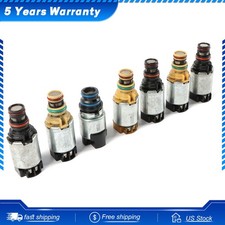
On the 6T40 the solenoids live on the TEHCM, the combined transmission control module and solenoid body that bolts to the valve body inside the side cover. Per GEARS, the line pressure control solenoid is a normally high solenoid: with low current applied it makes high pressure, and it sends its signal oil to the pressure regulator valve to set line pressure [2]. The other two normally high solenoids on Gen 1 units are PCS2 and PCS3; the TCC solenoid and several others are normally low [2]. GM's own 2026 bulletin PIP6095 labels the line solenoid the same way in its legend: "Line (NH)" [4].
Normally high matters for the symptom. If current to the line solenoid drops out, the solenoid goes to its default and line pressure goes up, not down. That is the fail-safe direction, and it is why a 6T40 with a line pressure circuit problem usually complains of firm or banging engagements and shifts rather than slipping. GEARS also notes that when the computer sees a problem that could hurt the transmission it will usually raise mainline pressure on purpose to protect it [3]. Either way the driver feels the same thing: everything is harsh.
GEARS lists the bench values too. All of the pressure control solenoids should measure 3 to 5 ohms, and the on/off shift solenoid 16 to 20 ohms [2]. Measure them with the solenoid removed from the TEHCM, not through it, to avoid damaging the module [2].
Know which generation you have
There are two generations of the 6T40 TEHCM and they do not interchange. GEARS says to read the eighth digit on the TEHCM: a 1, 2 or 3 means Generation 1, which also has pressure switches; Generation 2 has no pressure switches in the TEHCM and moves PCS2 and PCS5 [2]. GM's 2012 parts bulletin PIP4624M shows the split by vehicle: 2012 Sonic, Cruze 1.8L, Captiva and Orlando used the Gen 1 TEHCM (24256524 at the time), while 2012 Malibu, Equinox, Terrain, LaCrosse, Regal, Verano and Cruze 1.4L used the Gen 2 TEHCM (24265367) [5]. Those numbers have been superseded over the years, so use them to understand the split and look up the current number by VIN.
Symptoms that come with P0961
- Check engine light with P0961 current or history. Because it is a two-trip code, a fault that only shows up hot may sit as a pending code for a while first.
- Harsh garage shifts into Drive and Reverse and firm upshifts, from line pressure going to its normally high default.
- Shift quality that does not adapt. With the line control in question, the TCM cannot trim pressure the way it normally would.
- P0962 or P0963 in history. If either one is stored alongside P0961, the problem is almost certainly in the circuit or the solenoid coil, and it is getting worse.
How I diagnose it, in order
- Pull every code and the freeze frame. Note ignition voltage, fluid temperature and engine speed at the time of the fail. A code that only sets hot points at a coil or terminal that opens with heat. Low ignition voltage in the freeze frame points you at the battery and charging system, not the transmission.
- Prove power, ground and communication to the TEHCM. GEARS is clear that because everything connects internally to the TEHCM, there is not much external testing possible: confirm power and ground to the module, a brake light and Park/Neutral signal, and serial data in both directions [3]. Their 2010 Cruze 1.4L example has battery on pin 1, ground on pin 2 and ignition on pin 12 of the case connector, but pin use varies by year and model, so verify against factory information [3]. Voltage-drop the ground under load. A weak ground or supply is exactly the kind of thing that makes a solenoid driver report a voltage that does not add up.
- Check for software. GEARS reports shops pulling 6T40s to find nothing wrong inside, then finding out the fix was a software update [3]. Check for calibrations before you take anything apart.
- Run the solenoid cleaning routine. A capable scan tool can command the TEHCM to cycle the solenoids while the system is pressurized to flush debris, with no disassembly. GEARS says to always do this before diagnosing further [3]. On P0961 this is more about clearing a sticky valve than an electrical fault, but it costs little and it is the step GM-trained techs expect to see done.
- Check the fluid hot and correctly. There is no dipstick. Check at the plug near the axle seal, engine running, in Park, at 85 to 95 C (185 to 205 F) [3]. GEARS warns these units are often overfilled because the synthetic fluid's expansion rate is very sensitive to temperature, which gives false level readings [3].
- Pull the TEHCM and test the line solenoid on the bench. Off the module, the line pressure solenoid should read 3 to 5 ohms [2]. Then test it functionally. GEARS describes two ways. One is a static air test: apply about 45 psi of air with the solenoid not energized, cover the entry port with a plastic plate and watch the exhaust; all of these variable bleed solenoids leak a little, but a normally high one passes more air [2]. Never put 12 volts on a pressure control solenoid; only the on/off shift solenoid tolerates that [2]. The other is GM's DT 48616 fixture: torque it to the control solenoid assembly at 5 Nm (44 lb-in), feed it 90 to 100 psi of regulated shop air, connect the scan tool through cable DT48616-10 and command the solenoid on and off; the gauge should rise and exhaust as you cycle it, and if it does not change, replace the control solenoid assembly [3].
- Look at the screens. On 2025-2026 Buick Envista and Chevrolet Trax with the 6T40 (RPO MNH or MNK) built from May 1, 2025, GM bulletin PIP6095 says the normally high solenoids can over-travel and contact or rupture the solenoid screen, causing harsh garage shifts into Drive or Reverse [4]. The line solenoid is one of the normally high ones in that bulletin's legend [4]. If you find a valve touching or pushed through the screen, GM's repair is the TEHCM (24052399) plus the control valve body (24265971), the filter plate (24263196) and the seal and gasket kit (24053920) [4]. The bulletin also says to root-cause any stored DTCs per SI first, so it is a confirmation step, not a shortcut [4]. GM revised it in February 2026 as PIP6095C, which lists builds from June 1, 2025 in its header, retitles it a harsh shift into Drive, and allows 3.0 hours for the TEHCM and valve body job [4].
The fix, by cause
| What you found | Fix |
|---|---|
| Low ignition voltage or bad ground in freeze frame or on a voltage-drop test | Repair the battery, charging system, ground or supply circuit; clear and road test before touching the transmission |
| Calibration update available | Program the TEHCM, clear codes, run the adaptive learn |
| Line solenoid out of the 3-5 ohm range or fails the air test | Replace the line pressure solenoid, or the TEHCM if the solenoids are not serviced separately in your situation |
| Solenoid tests good, code returns with a good supply | Suspect the driver in the TEHCM; replace and program the TEHCM |
| 2025-26 Envista or Trax with a solenoid through the screen | TEHCM, control valve body, filter plate and gasket kit per PIP6095 |
A note on replacing solenoids instead of the whole TEHCM. GEARS points out that if you can source the individual solenoid, you can swap just the bad one, and since you are keeping the same TEHCM you do not have to reprogram it [2]. That is often the cheapest real fix for a single bad line solenoid. If the TEHCM itself is replaced, it has to be programmed, and you should match the generation before you order anything [2][5].
After any repair, clear codes and run the Transmission Adaptive Values Learn. GEARS gives the conditions: drive wheels blocked, parking and service brakes applied, zero throttle, fluid at 70 to 100 C, and Park to Reverse three times to purge air from the reverse clutches, then power the TCM down and restart [3].
When the code is gone but it still shifts hard
If the electrical side checks out and the vehicle still has erratic or high line pressure, the problem has moved from the solenoid to the valve it feeds. The line solenoid signals the pressure regulator valve, which on this unit lives in the pump body. Sonnax builds oversized pressure regulator valve kits for worn bores on the 6T30/40/45/50; the Gen 2 kit, 144510-12K, requires reaming with Sonnax tool kit F-144510-TL12C and the VB-FIX fixture, and the finished bore should hold the recommended minimum 16 and 18 in-Hg on a vacuum test at the indicated ports [6]. A worn regulator bore will not set P0961 by GM's monitor logic above, but it produces the same harsh or unstable pressure the driver is complaining about, so it belongs on the list once the circuit is proven good.
How to keep it from coming back
Keep the electrical system healthy: a weak battery or corroded ground on these cars shows up as module codes first. Set the fluid level hot at the check plug, never by guesswork, and do not overfill [3]. When the TEHCM is out, handle the solenoids by the body, keep the screens clean, and do not bench-test pressure control solenoids with direct battery voltage [2]. And on late Envista and Trax units, look at the screens whenever the side cover is off [4].
FAQ
What does P0961 mean on a 6T40?
On the 6T40, GM defines P0961 as a rationality test on the line pressure control solenoid circuit. The TCM sets a fail when its own hardware reports an out-of-range voltage on that solenoid driver for 4.4 seconds out of a 5 second sample, and it takes two trips to turn on the lamp. It is an electrical check, not a comparison against measured line pressure.
Is P0961 a bad valve body on a 6T40?
Usually not. Because the 6T40 monitor watches the solenoid circuit, the common causes are the line pressure solenoid itself, its connection on the TEHCM, low supply voltage or a bad ground, or the driver inside the TEHCM. A worn pressure regulator valve can cause harsh or unstable pressure, but by GM's monitor logic it does not set P0961.
What are the symptoms of P0961 on a Cruze or Equinox?
The usual complaint is harsh engagements into Drive and Reverse and firm shifts. The line pressure solenoid is normally high, so when its control drops out line pressure goes up rather than down, and the TCM may also raise pressure on purpose to protect the clutches.
How do you test the 6T40 line pressure solenoid?
Remove the TEHCM and measure the solenoid off the module; GEARS lists 3 to 5 ohms for all the pressure control solenoids. Then test it functionally with low-pressure air or GM's DT 48616 fixture at 90 to 100 psi while commanding it with a scan tool. Never apply 12 volts directly to a pressure control solenoid.
Does the TEHCM need programming after a P0961 repair?
If you replace the TEHCM, yes, it must be programmed and you must match the generation, since Gen 1 and Gen 2 units do not interchange. If you replace only the individual solenoid and reuse your original TEHCM, no reprogramming is needed. Either way, clear codes and run the adaptive learn afterward.
Shop the 6T40 solenoid kit → All 6T40 parts →
Need parts for this job?
6T40 solenoid kits, valve bodies, rebuild kits and overhaul kits, with secure checkout.
Shop 6T40 parts →Sources
- General Motors — 2011 OBD monitor tables, "11OBDG08 TRANS Diagnostics," 6T40 Unique Section, page 63-64 of 108. Backs the P0961 "PC Solenoid A Control Circuit Rationality Test (Line Pressure VBS)" HWIO invalid-voltage criterion, 4.4 of 5 s, two trips; P0962 ground short 1.5 of 1.875 s, one trip; P0963 open or power short 4.4 of 5 s, two trips; and the 9-31.99 V and 400-7500 RPM enables. gsi.ext.gm.com PDF
- GEARS Magazine (ATRA) — "Understanding GM 6T40 Solenoids." Backs the normally high line pressure solenoid feeding the pressure regulator valve, the 3-5 ohm and 16-20 ohm values, removing solenoids from the TEHCM to measure, the eighth-digit generation ID, the 45 psi air test, the warning never to apply 12 V to pressure control solenoids, and swapping individual solenoids to avoid reprogramming. gearsmagazine.com
- GEARS Magazine (ATRA) — "6T40/45 Diagnosis & Fixes." Backs the TEHCM power, ground and serial data checks, the 2010 Cruze 1.4L connector pinout, the software-update warning, the solenoid cleaning routine, the DT 48616 test (5 Nm, 90-100 psi, cable DT48616-10), raised mainline as protection, the 85-95 C hot level check and overfill warning, and the adaptive learn conditions. gearsmagazine.com
- GM Bulletin PIP6095 (NHTSA copy, January 2026) — 6T40 Harsh Garage Shift into Drive or Reverse; revision PIP6095C (February 2026). Backs the 2025-2026 Envista and Trax (MNH/MNK, from May 1, 2025) normally high solenoid over-travel against the screen, the "Line (NH)" legend, and parts 24052399, 24265971, 24263196 and 24053920; revision C backs the June 1, 2025 header date and 3.0-hour labor time. PIP6095 PDF / PIP6095C PDF
- GM Bulletin PIP4624M (NHTSA copy) — Valve Control Solenoid (TEHCM), 6T30/6T40/6T45/6T50. Backs the 2012 Gen 1 (24256524) and Gen 2 (24265367) TEHCM split by vehicle. static.nhtsa.gov PDF
- Sonnax — 144510-12K Oversized Pressure Regulator Valve Kit instructions, GM 6T30/40/45/50 (Gen 2). Backs the pump-body pressure regulator location, the F-144510-TL12C and VB-FIX reaming requirement, and the 16 and 18 in-Hg vacuum test. Sonnax instruction sheet PDF