When a 6T40 or 6T45 in a Cruze, Malibu, Equinox, Terrain, Sonic, Regal or Trax loses a gear, the first guess at the counter is usually "shift solenoid." Sometimes that is right. But this transmission barely has a shift solenoid in the old sense. It has one on/off solenoid and six variable bleed pressure control solenoids, and each clutch has its own. That design is what makes it diagnosable: the gears you lose tell you which circuit failed.
This guide covers what each solenoid does, the missing-gear patterns GM ties to specific codes, how to tell Gen 1 from Gen 2 before you buy anything, how to bench test the solenoids, and what replacement really involves. Specs come from GM bulletins, ATRA and Sonnax, cited at the bottom.
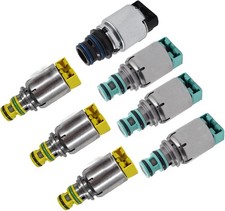
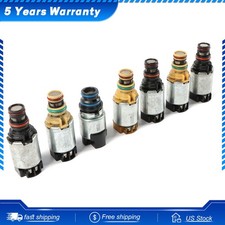
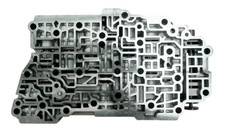
Seven Solenoids, One Module
ATRA's 6T40/6T45 introduction lists the control hardware plainly: one on/off shift solenoid, SS1, and six variable bleed solenoids, PCS1 through PCS5 plus TCC. None of them bolt to the valve body individually the way they do on a 4L60E. They live in the TEHCM, the "control solenoid valve assembly," which also carries the TCM itself, the fluid temperature sensor and, on early units, the pressure switches. The whole assembly bolts to the control valve body inside the case, behind the side cover.
The 6T40 shifts clutch to clutch. There are five clutches and one one-way clutch, and every gear is two clutches applied at once. Here is the apply pattern from the Sonnax Gen 2 apply chart:
| Gear | Clutches applied |
|---|---|
| 1st | 1-2-3-4 + one-way clutch (low/reverse clutch added in 1st braking) |
| 2nd | 1-2-3-4 + 2-6 |
| 3rd | 1-2-3-4 + 3-5-R |
| 4th | 1-2-3-4 + 4-5-6 |
| 5th | 3-5-R + 4-5-6 |
| 6th | 2-6 + 4-5-6 |
| Reverse | 3-5-R + low/reverse |
Now match each clutch to the solenoid that feeds its regulator valve. Jarad Warren's breakdown in GEARS magazine gives the functions and the "normally high" or "normally low" behavior for both generations:
| Solenoid | Feeds | Gen 1 | Gen 2 |
|---|---|---|---|
| PCS1 (line) | Pressure regulator valve | Normally high | Normally high |
| PCS2 | 3-5-R clutch regulator | Normally high | Normally low |
| PCS3 | Low/reverse and 4-5-6 clutch regulator | Normally high | Normally high |
| PCS4 | 2-6 clutch regulator | Normally low | Normally low |
| PCS5 | 1-2-3-4 clutch regulator (and boost valve) | Normally low | Normally high |
| TCC PCS | TCC control and regulator valves | Normally low | Normally low |
| SS1 (on/off) | Clutch select valve | Normally closed | Normally closed |
"Normally high" means the solenoid delivers full output with no current, and current turns it down. On a normally high clutch solenoid, low current applies the clutch and high current releases it. Normally low is the reverse. Notice that PCS2 and PCS5 flipped between generations. That one detail is why Gen 1 and Gen 2 parts do not mix, and why reading a Gen 2 wiring diagram against a Gen 1 truck will send you in circles.
SS1 is the odd one out. It controls oil to the clutch select valve, and the Sonnax chart shows it on only in Park, Reverse, Neutral and 1st braking, which are exactly the ranges where the low/reverse clutch is applied. PCS3 shares one regulator between the low/reverse and 4-5-6 clutches, and the clutch select valve decides where that oil goes. GM's own 2011 OBD monitor tables name the part the shift solenoid works on the "Mode 2 Multiplex Valve," and GM's 2026 bulletin PIP6095C labels the solenoid itself "Clutch Select (On/Off)."
The Symptom Is the Missing Gears
Put those two tables together and the failure patterns fall out on their own. If a clutch's solenoid circuit dies, every gear that uses that clutch goes with it. GM's Preliminary Information PI1131 lays out four conditions on 2011 LaCrosse, Regal, Cruze, Equinox, Malibu and Terrain built before April 1, 2011, all caused by a non-functioning pressure control solenoid inside the TEHCM:
- No reverse, 3rd or 5th, with P0776 (PCS2 performance, stuck off). All three gears use the 3-5-R clutch.
- No 4th, 5th or 6th, with P0796 (PCS3 performance, stuck off). All three use the 4-5-6 clutch.
- No 2nd or 6th, with P2714 or P0873 (PCS4 performance, or the Gen 1 pressure switch 3 circuit). Both use the 2-6 clutch.
- No 1st, with P2723 or P0878 (PCS5 performance, or the pressure switch 4 circuit). PCS5 runs the 1-2-3-4 clutch.
GM adds a line I wish more people read: only one of these conditions will show up from this cause. If a car is missing gears from two different groups, you are not looking at one bad solenoid. Look at wiring, the TEHCM connector, line pressure, or a mechanical failure.
The other symptoms are less tidy. A tired line pressure solenoid gives soft, late, flaring shifts across the board, or harsh ones if it is stuck high. A TCC solenoid problem shows up as shudder, no lockup, or a converter clutch code in the P0741-P0742 family. SS1 performance codes (P0751 stuck off, P0752 stuck on) point you at the clutch select circuit, so pay attention to how the unit engages Reverse and how 1st behaves on a coast, the two places the low/reverse clutch does its work. Per GM's 2011 OBD monitor tables for the 6T40, P0751 sets when the TCM commands 1st Lock but sees 400 RPM or more of slip with a ratio of about 1.33 to 1.53, which is 4th gear, and it takes two trips to light the MIL. P0752 runs the opposite check with 3rd commanded. The full walk-through is in our 6T40 P0751 guide.
The newest one: harsh garage shifts on 2025-2026 Trax and Envista
GM bulletin PIP6095 (January 2026) covers the 2025-2026 Chevrolet Trax and Buick Envista with the 6T40 (RPO MNH/MNK) built from May 1, 2025. The complaint is a harsh garage shift into Drive or Reverse. The cause is a normally high solenoid in the TEHCM whose valve over-travels and contacts or ruptures its own inlet screen. GM's correction is to diagnose any DTCs first, then pull the TEHCM and look at the screens on the normally high solenoids (line, C1234, and CBR1/C456). If a valve is touching or pushing through the screen, GM replaces both the TEHCM (24052399) and the control valve body (24265971), at 2.6 labor hours. The body goes too because debris from a torn screen does not stay in the solenoid.
Before You Buy Parts: Rule Out the Clutch
A P0776 on a 6T40 is as likely to be the 3-5-R piston or wave plate as the solenoid, and the code cannot tell you which. That is the point of GM's PI0670A: on Gen 1 controls the TEHCM performance test in the scan tool does not work, and GM says not to replace the TEHCM until you have visually inspected the 3-5-R clutch and piston. It also warns that air checking the 3-5-R clutch through the case feed ports frequently leads to the wrong diagnosis. The only reliable check of that piston is teardown.
On Gen 2 controls, run the TEHCM performance test. It is functional there and GM says it must be part of the diagnosis.
Two more things to rule out before condemning a solenoid:
- Fluid level. The 6T40 is fussy. It has to be checked hot at the level plug. A low unit will throw pressure and performance codes that look electrical.
- Dark fluid is not proof of damage. PI1131 notes that fluid in these 2011 units tends to turn dark because of the rust inhibitors used on internal parts during assembly. GM tells techs not to replace the transmission or the fluid on appearance alone.
Gen 1 or Gen 2? Check This First
Everything you order depends on this. GEARS gives the quick test: read the eighth digit of the TCM identifier on the TEHCM. 1, 2 or 3 is Gen 1. B, C or D is Gen 2. Sonnax adds a physical check on the valve body: Gen 2 has a 4-5-6 clutch boost valve, Gen 1 does not. The TEHCM and the control valve body must be the same generation.
GM's PI0604C explains the split. For the 2012 model year, most 6T30/6T40/6T45/6T50 applications moved to Gen 2, with a revised control solenoid valve assembly that has no fluid pressure switches. With them went the pressure switch codes: P0842/P0843, P0872/P0873, P0877/P0878 and P0989/P0990 do not apply to Gen 2. The 2012 exceptions that stayed Gen 1 were the 1.8L Cruze, the 1.8L Sonic, the 3.0L Captiva Sport and the Orlando. All 2013 vehicles in that bulletin are Gen 2.
This matters for diagnosis, not just parts. A Gen 1 unit setting P0873 or P0878 may have a pressure switch problem, not a solenoid problem. GEARS reports the Gen 1 switches had a high failure rate, with retaining rivets that work loose, and that is part of why GM dropped them.
Bench Testing the Solenoids
Resistance first. GEARS gives 3-5 ohms for every pressure control solenoid, line and TCC included, and 16-20 ohms for the on/off shift solenoid. Sonnax lists the same values at 70°F. An open or shorted winding is a clear fail. A solenoid that reads in spec can still be sticking mechanically, so resistance alone does not clear it.
Then test flow. There are two published methods:
- With the TEHCM off the unit (GEARS, Warren): fit a plastic test plate, apply 45 psi of air, and check each solenoid's output without energizing anything. Warren's warning is worth repeating: never apply voltage to the pressure control solenoids or the solenoid block. Only the on/off shift solenoid tolerates 12 volts.
- With the TEHCM in the car (GEARS, "6T40/45 Diagnosis and Fixes"): the Kent-Moore DT47825 kit bolts on at 5 Nm (44 lb-in). Feed it 90-100 psi of regulated shop air, then command the solenoid on and off with the scan tool. Pressure should show on the gauge and exhaust as you cycle it. A solenoid that will not build or will not exhaust has failed.
One more thing to rule out before you blame a solenoid: the TEHCM filter plate. Transmission Digest documented a 2011 Cruze 1.8L Gen 1 unit that flared to neutral on every 1-2 shift. PCS4 and even the whole TEHCM were on the table. The real fault was a damaged filter plate letting actuator feed pressure leak into the pressure switch 2 circuit, which is pressurized in 1st, 3rd, 4th and 5th and exhausts for 2nd. When it exhausted on the 1-2 shift, actuator feed dropped and the solenoids could not regulate. A new filter plate fixed it, and the 2-6 clutch was fine. See our 6T40 slipping guide for the other slip and flare causes.
If a solenoid passes both tests and you still have the missing-gear pattern, the problem is almost certainly downstream: a worn regulator bore in the valve body, a cut piston seal, or a broken wave plate.
If every solenoid tests good and you still have codes on more than one circuit, look upstream at the valve body. Sonnax's installation notes for its Gen 2/Gen 3 remanufactured 6T40 valve body specify the solenoids at 3-5 ohms (PCS) and 16-20 ohms (shift) at 70°F, and point out that downshift clunks, a slight 3-4 bind and a 2-3 flare are normal during relearn and usually clear within 10-15 shift cycles, so do not condemn a new solenoid on the first drive. Worn actuator feed limit and pressure regulator bores starve every solenoid at once; our 6T40 valve body symptoms and testing guide covers how to prove it.
Replacement: What the Job Really Is
GM services the solenoids as part of the TEHCM assembly. PI1131 lists the whole control solenoid valve assembly with body and TCM (24256524 for those 2011 units) as the fix once SI diagnostics point there. Aftermarket solenoid kits exist and are the cheaper route on an out-of-warranty car, but a few rules apply:
- Match the generation. Gen 1 solenoids are variable bleed units that Sonnax says cannot be swapped with Gen 2 solenoids. GEARS puts it plainly: the two generations are not interchangeable.
- Do not shuffle positions. Sonnax notes the solenoids are calibrated at the factory to their location, so do not move one to another bore to "test" it. Keep them in order when the module is apart.
- Replace screens and seals. After PIP6095, inspect every inlet screen. A torn screen means debris is already in the valve body.
- Look at the valve body while you are there. Worn regulator bores cause the same flare and slip symptoms as a weak solenoid.
- Relearn. Sonnax says to erase the adaptive values after valve body or solenoid service, then run GM's Fast Learn. Skip it and a good repair drives like a bad one. A new TEHCM from GM also has to be programmed to the vehicle before it will run the unit correctly.
For a Gen 2 car that also has a clutch complaint, weigh the rebuild. A car with P0776 and a teardown that shows a cracked 3-5-R wave plate needs the clutch work first. A new solenoid will not fix it.
6T40 parts at Core Transmission Parts
If you are ordering the rest of the job at the same time, Core Transmission Parts carries 6T40 filter kits, pistons and rebuild parts from the same group we are part of.
Browse 6T40 parts at Core Transmission Parts →6T40 and 6T45 solenoid kits, remanufactured valve bodies, master rebuild kits and bonded pistons — shipped fast from the USA.
Shop 6T40 parts →Related guides
- 6T40 Common Problems and Fixes
- GM 6T40/6T45 Wave Plate Failure
- 6T40 Fluid Change Cost
- 6T40 Slipping: Causes and Fix
- 6T70 P0776 Fix
- 6T40 Valve Body Symptoms and Testing
FAQ
What are the symptoms of a bad shift solenoid in a 6T40?
On a 6T40 a failed solenoid usually shows up as a specific set of missing gears rather than a general slip. GM's PI1131 lists no 1st with P2723, no 2nd or 6th with P2714, no 4th, 5th or 6th with P0796, and no reverse, 3rd or 5th with P0776. Harsh garage shifts, flares and limp mode are the other common complaints.
How many solenoids does a 6T40 have?
Seven. ATRA lists one on/off shift solenoid (SS1) and six variable bleed solenoids: line pressure (PCS1), PCS2 through PCS5, and the TCC solenoid. All of them live in the control solenoid valve assembly, the TEHCM, bolted to the valve body inside the case.
What is the resistance of a 6T40 pressure control solenoid?
GEARS magazine gives 3-5 ohms for every pressure control solenoid, including line and TCC, and 16-20 ohms for the on/off shift solenoid. Sonnax specifies those readings at 70 degrees F. Never put 12 volts across a pressure control solenoid to test it; only the shift solenoid tolerates that.
Can you replace just one solenoid in a 6T40?
Physically yes, but GM services the TEHCM as an assembly, and Sonnax notes the solenoids are factory calibrated to their location, so you should not swap positions. Gen 1 and Gen 2 solenoids and bodies do not interchange. Whatever you replace, clear the adaptive values and run a Fast Learn afterward.
How do I tell a Gen 1 from a Gen 2 6T40?
Read the eighth digit of the TCM identifier on the TEHCM: 1, 2 or 3 is Gen 1, and B, C or D is Gen 2. Gen 2 units have no pressure switches and add a 4-5-6 clutch boost valve in the valve body. GM switched most 2012 models to Gen 2, except the 1.8L Cruze and Sonic, 3.0L Captiva Sport and Orlando.
Sources
- ATRA / GEARS Magazine — Jarad Warren, "Understanding GM 6T40 Solenoids." Backs the function and normally high/low state of each Gen 1 and Gen 2 solenoid, the PCS2 and PCS5 changes in Gen 2, 3-5 ohm and 16-20 ohm resistance specs, the eighth-digit TEHCM generation ID, the 45 psi test-plate air check, the no-voltage warning, and that the generations do not interchange. gearsmagazine.com
- General Motors — Preliminary Information PI1131, "Various Missing Gears, DTC P0776, P0796, P0878, P0873, P2714 or P2723 Set," December 2013 (via NHTSA). Backs the four missing-gear conditions and their DTCs, the non-functioning pressure control solenoid cause, the one-condition-only note, the dark-fluid rust-inhibitor note, and TEHCM part number 24256524. static.nhtsa.gov (PDF)
- General Motors — Preliminary Information PIP6095, "6T40 Harsh Garage Shift into Drive or Reverse," January 2026 (via NHTSA). Backs the 2025-2026 Trax/Envista MNH/MNK application from May 1, 2025, the normally high solenoid valve over-travel and screen rupture, the solenoid legend, the inspection steps, parts 24052399 and 24265971, and 2.6 labor hours. static.nhtsa.gov (PDF)
- General Motors — Preliminary Information PI0604C, "Information on 6T30/6T40/6T45/6T50 Automatic Transmission Product Updates," May 2013 (via NHTSA). Backs the 2012 Gen 2 changeover and its Gen 1 exceptions, removal of the pressure switches from the control solenoid valve, and the pressure switch DTCs that do not apply to Gen 2. static.nhtsa.gov (PDF)
- Sonnax — 6T40-GEN2-ZIP Zip Kit Quick Guide. Backs the solenoid and clutch apply chart by gear, the Gen 2 solenoid locations, the 4-5-6 clutch boost valve generation check, the factory-calibrated solenoid position warning, the 3-5 and 16-20 ohm values at 70°F, and the clear-adapts and Fast Learn requirement. sonnax.com (PDF)
- ATRA / GEARS Magazine — "6T40/45 Diagnosis and Fixes." Backs the Kent-Moore DT47825 in-car solenoid test, 5 Nm (44 lb-in) installation torque and 90-100 psi test pressure, the Gen 1 pressure switch failures and loose rivets, and P2723. gearsmagazine.com
- Transmission Digest — "Shift Pointers: 6T40 Neutral Drop." Backs the 2011 Cruze 1.8L Gen 1 flare to neutral on the 1-2 shift, the damaged filter plate and pressure switch 2 circuit cause, and the gears in which that circuit is pressurized. transmissiondigest.com
- Sonnax — GM6T40-2-3 Remanufactured Valve Body, "Tech & Install Tips" (Gen 2 and Gen 3). Backs the 3-5 and 16-20 ohm values at 70°F and the relearn behavior over 10-15 shift cycles. sonnax.com (PDF)
- General Motors — 2011 OBD monitor tables, "11OBDG08 TRANS Diagnostics," 6T40 Unique Section. Backs the "Mode 2 Multiplex Valve" component name, the P0751 1st Lock test with 400 RPM slip and the 1.33-1.53 (4th gear) ratio window, the two-trip MIL, and the P0752 3rd-gear test. gsi.ext.gm.com PDF
- General Motors — Preliminary Information PIP6095C, "6T40 Harsh Shift into Drive," February 2026 (via NHTSA). Backs the solenoid legend naming the Clutch Select (On/Off) solenoid and the updated June 1, 2025 build range. static.nhtsa.gov PDF
Also referenced: GM PI0670A, "Diagnostic Tips for DTC P0776" (February 2012), for the Gen 1 TEHCM performance test limitation, the inspect-the-3-5-R-piston-first instruction and the case air check warning, static.nhtsa.gov (PDF); and ATRA's 6T40/6T45 introduction for the SS1 plus six variable bleed solenoid layout and the TEHCM description, atracom.blob.core.windows.net (PDF).